Table of Contents
Software developers would not construct a system any other way than using a distributed application architecture. However, the database has not been kept up for over a decade. Contemporary cloud applications require microservices, elasticity, and horizontal scaling in their architecture, which often clash with the design of classic relational databases. The solution to this dilemma was a distributed database, which is also gaining popularity among the general public.
You must be wondering: what a distributed database is and how it works? In this blog of All Assignment Help, we will answer all your questions, whether it is related to types of distributed databases or how distributed databases work. Read this blog and know everything about the distributed database management system.
What Is A Distributed Database?
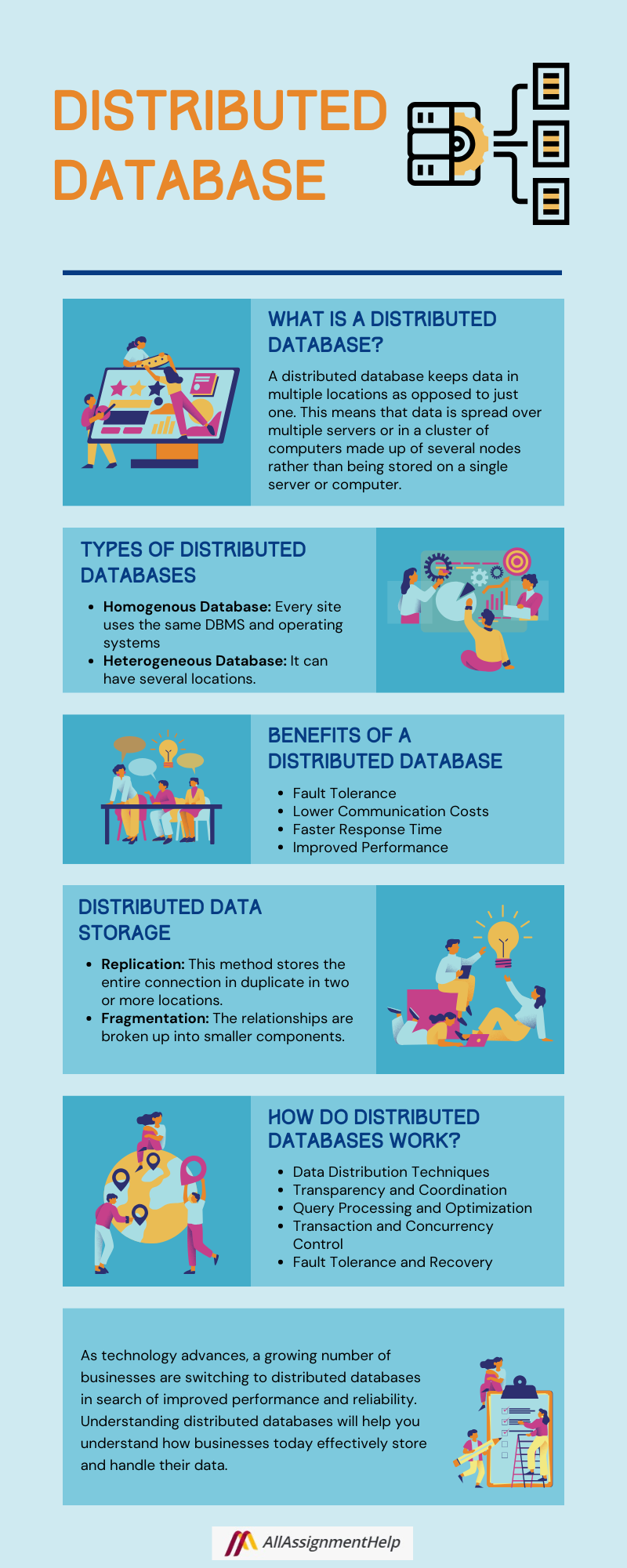
A distributed database keeps data in multiple locations as opposed to just one. This means that data is spread over multiple servers or in a cluster of computers made up of several nodes rather than being stored on a single server or computer. These nodes can often be geographically separated. It might be actual PCs or virtual workstations inside a cloud database.
Furthermore, the distributed database system is managed in a centralized manner by connecting the data logically. It helps in managing the bulk data in a manner as if it were all stored in one single place. Data in a centralized database is synchronized in such a way that updates or deletions made in one place are automatically updated in other areas of the database. This is how a distributed database makes it simple to manage large amounts of data.
It is not easy to write assignments on any topic of a distributed database management system. Students might get stuck at any writing stage. This is where online distributed database assignment help services come to assist you, where you will be matched by an expert who will write your assignment in the way you want.
Read Here: Database Management System: Introduction, Types, and Top Courses
Types of Distributed Databases
The power to develop a distributed database dates back to the 1980s. This is done based on various types of distributed database environments that are widely categorized as homogeneous and heterogeneous databases. Let’s have a look at these two types in more detail:
Homogenous Database
In a homogeneous distributed database, every site uses the same DBMS and operating systems. This type of environment works in a way in which the structures are the same in all the sites, such as operating systems, database management systems, and data structures. This environment further works under two environments: autonomous and non-autonomous.
- Autonomous: In this, each DBMS works independently by passing messages back and forth, and helps in sharing data updates.
- Non-autonomous: Here, the environment the central database management system works and coordinates database access across sites and updates other nodes.
Heterogeneous Database
A heterogeneous distributed database can have several locations, such as different data models, DBMS products, and operating systems. Several of its websites use different technologies and schemas. For example, the system can have a large number of object-oriented, hierarchical, network, or relational DBMSs. There are two subgroups of heterogeneous distributed databases: unfederated and federated.
- Federated: A federated distributed database allows several nodes, each of which can operate independently and can store distinct data, to cooperate and act as a single unit.
- Unfederated: Every node in an unfederated distributed database functions independently. Furthermore, each node’s access to every database is controlled by a central application.
You might get confused between heterogeneous and homogeneous databases. Don’t worry! Just do one thing: enroll in online classes where you get to learn all about the distributed database system easily from the subject professionals. Also, if you are afraid of taking online classes regularly, we have a solution for this, too. Many students nowadays request online class experts, take my online class for me. You can also give them a try to manage your online classes and other responsibilities.
Benefits of a Distributed Database Management System
A distributed database is capable of offering various types of advantages to the business in the maintenance of large-scale data in a simpler and systematic form. Some of the most notable benefits are listed below:
Fault Tolerance
- A distributed database prevents complete system failure during a failure event.
- The system continues to perform, albeit more slowly, until the error is fixed.
- Users can continue their work during a failure period.
Lower Communication Costs
- Data is located close to where it’s most frequently accessed.
- Reduces communication costs for administrators.
- Easier communication due to data proximity to points of use.
Faster Response Time
- Data distribution enables faster extraction of specific information.
- Data is kept close to users at particular sites.
- Users can access data promptly whenever needed.
Improved Performance
- Accomplish both intraquery and interquery parallelism.
- Divide a query into several subqueries to essentially run in parallel.
- Improves speed by running several queries at multiple locations.
The primary benefits of a distributed database are its potential to offer more reliability and availability than a centralized database system. If you are asked to write a short assignment on the benefits of a distributed database system and are unaware of how to start, you can take online assignment help from subject experts. They will help you submit a well-written assignment by meeting your professor’s guidelines.
You can even consider getting help with your online exams when you feel overwhelmed with back-to-back classes or academic tasks, such as writing assignments, while pursuing your computer science degree online. Simply get in touch with online class helpers and ask, can you take my exam for me? You’ll receive the support you need to stay on track and perform better in your academics.
Distributed Data Storage
There are two methods for storing data on different sites. These are:
Replication
This method stores the entire connection in duplicate in two or more locations. A database is considered completely redundant if it is accessible at every site. Thus, systems save copies of data during replication.
There are multiple types of database replication schemas available, such as:
- Full replication: In full replication, every site in the distributed database system receives a complete, working copy of the whole database.
- Transactional replication: Each node in transactional replication receives a complete copy of the database. When transactions are processed, data changes are updated to that copy.
- Snapshot replication: Snapshot replication creates a duplicate of the database at a certain moment in time. After that, this snapshot moves around the user base and nodes as required, but it doesn’t continuously check for data updates.
- Merge replication: It is the process of combining two databases into one. This is one of the most intricate types of database replication. However, you don’t need to worry as there are distributed database management assignment help services available to help you.
Fragmentation
According to this method, the relationships are broken up into smaller components, and each component is kept in a separate location depending on its needs. The components must be such that they can be utilized to recreate the original relationship (i.e., no data loss occurs). There are two ways of fermenting the relationships:
- Horizontal (Splitting by rows): The relation is divided into groups of tuples using horizontal fragmentation, which splits by rows and assigns each tuple to a minimum of one fragment.
- Vertical (Splitting by columns): The relation’s schema is broken up into smaller schemas. Each fragment has to have a shared candidate key to guarantee a lossless join.
How do Distributed Databases Work?
Distributed databases work by using several of key components that set them apart from conventional, centralized databases. A distributed system can grow horizontally and offer greater availability and fault tolerance since its data is spread across several nodes or servers. Let’s understand how does distributed database works in a step-by-step manner:
Data Distribution Techniques
Fragmentation and replication are the two main data distribution techniques used by distributed databases. Fragmentation is the process of breaking up a database into smaller parts, or fragments, which are then kept in various locations according to factors like access speed, location, or usage patterns. Replication increases data availability and fault tolerance by storing identical copies of the data across multiple locations. Also, some systems combine the two approaches in a hybrid manner.
Transparency and Coordination
One of the primary objectives of distributed databases is transparency; users interact with the database like it were a single unit, unaware that the data is distributed. Distributed database management systems (DDBMS) facilitate this process by controlling the placement, consistency, and changes of data across nodes. Tasks including query processing, transaction management, concurrency control, and guaranteeing data consistency across all sites are handled by the DDBMS.
Query Processing and Optimization
When a user sends a query, the DDBMS analyzes the location of the data to identify the optimal way to execute it. It might gather information from several nodes and combine the findings. However, this requires query optimization techniques to cut down on network traffic and response time. Distributed indexing and advanced algorithms are used to guarantee effective query execution.
Transaction and Concurrency Control
It is difficult to maintain ACID (Atomicity, Consistency, Isolation, Durability) properties in a distributed context. Distributed databases include timestamp ordering or distributed locking techniques to provide conflict-free concurrent access management, and protocols such as Two-Phase Commit (2PC) to guarantee that all nodes concur on a transaction’s ending.
Fault Tolerance and Recovery
Fault tolerance is a major benefit of distributed databases. Other nodes can still function and offer access to duplicated data if one fails. Once the failing node is back up, recovery mechanisms assist in restoring the system, guaranteeing minimum data loss and continuity.
Distributed databases work by combining advanced coordination protocols, smart information placement, and smooth user interaction. They serve as the foundation for modern data-driven applications, including global e-commerce platforms to cloud services. However, if you find it difficult to understand the working process of a distributed database system and need to submit an assignment the next day, you can reach out to instant assignment help services available online for immediate writing assistance.
Also Read: How to Become a Data Architect: A Career Roadmap
Conclusion
As technology advances, a growing number of businesses are switching to distributed databases in search of improved performance and reliability. Understanding distributed databases will help you understand how businesses today effectively store and handle their data. Furthermore, having expertise in this area can help you advance in professions like cloud computing, software development, and data management.
FAQs
What is the function of the distribution database?
The distribution database stores transactions for transactional replication as well as metadata and historical data for every type of replication. It is often enough to have just one distribution database.
What is distributed database query processing?
Processing a query in a distributed database system involves both local and global optimization. The client or controlled site is where the query enters the database system. In this case, the user is verified, and the query is reviewed, translated, and globally optimized.
How does a distributed database store data?
The data will be stored across multiple places in a distributed data storage system. These could be geographically remote places. It is more comparable to an assembly of several interrelated systems. Also, it is possible to manage the data at each site separately.