Table of Contents
Writing a dissertation is a process that requires a lot of effort. To write a dissertation, you have to define and explore a topic in thousands of words after conducting extensive research on it. Your job doesn’t end there. As soon as you finish writing your dissertation, you have to be ready to edit your paper to give it a proper shape, both internally and externally. However, to do that, you need to be familiar with the ways to edit a dissertation. Thus, in this blog, we will discuss the different ways you can edit your dissertation effectively.
Editing is one of the most important parts of dissertation writing. However, you may feel lost after completing your chapters and may not know where to begin. This is where AllAssignmentHelp enters the picture. To make the process less overwhelming, we will provide you with some ideas and effective ways to edit a dissertation that can help you achieve better academic results.
So, without further ado, let’s discuss some effective ways that you can follow to edit a dissertation on your own. But first, let’s discuss what a dissertation is.
Let’s get started!
What is a Dissertation?
A dissertation is a research project completed as part of a bachelor’s or master’s degree program. It typically allows students to present their findings in response to a research question or proposition of their choice.
The goal of a dissertation is to test students’ independent research skills during their time at university. The results may also contribute significantly to their final grade. Although instructors typically provide some guidance throughout the process, the dissertation is largely an independent piece of academic work. Students who need additional support with proofreading, structure, clarity, or overall presentation can also consider professional dissertation editing services to refine their work before submission.
A dissertation is one of the longest academic assignments students may have to complete, but it can also be a rewarding experience when it is well-researched, original, and authentic. Therefore, it is important to choose a topic that genuinely interests you. Working on a subject you find engaging can make the research and writing process more manageable and help you produce a stronger dissertation.
Read Here: Exceptional Ways To Format a Personal Letter
Skills Needed While Editing a Dissertation
While writing a dissertation, you should have these skills in yourself regardless of the topic and what you write.
- Defining and specifying a research topic with a specific query
- Identifying the most important issues
- Obtaining the necessary information
- Considering all sides of a discussion’s evidence
- Getting at a well-thought-out conclusion
- Organizing and presenting the results of your study in a critical, convincing, and articulate manner, while adhering to all formatting rules.
Having all these skills can help you in writing an A+ dissertation that can fetch you good grades as well. Now, we will move forward and discuss how to edit a dissertation.
How to Edit a Dissertation? Effective Ways and Techniques
Editing and proofreading are different processes. Editing goes beyond correcting grammar and spelling; it involves reviewing your dissertation’s structure, chapters, flow, and references. However, many students are unsure how to approach academic editing. This is why understanding the key steps can make the process easier.
Editing is an important stage before dissertation submission, but it can also raise several questions, such as:
- Are my thoughts stated in a clear and concise manner?
- Is it written in an ‘academic’ style?
- Is my grammatical usage correct?
- Have I followed the guidelines for writing?
- Is it possible to put all of the portions together?
- Have I done everything appropriately in terms of referencing?
These questions become much more important while editing a dissertation. Fortunately, this blog post is here to assist you. The following are recommendations that any student can use edit a dissertation.
Now, look at how to do a good job of editing a dissertation to make it prefect.
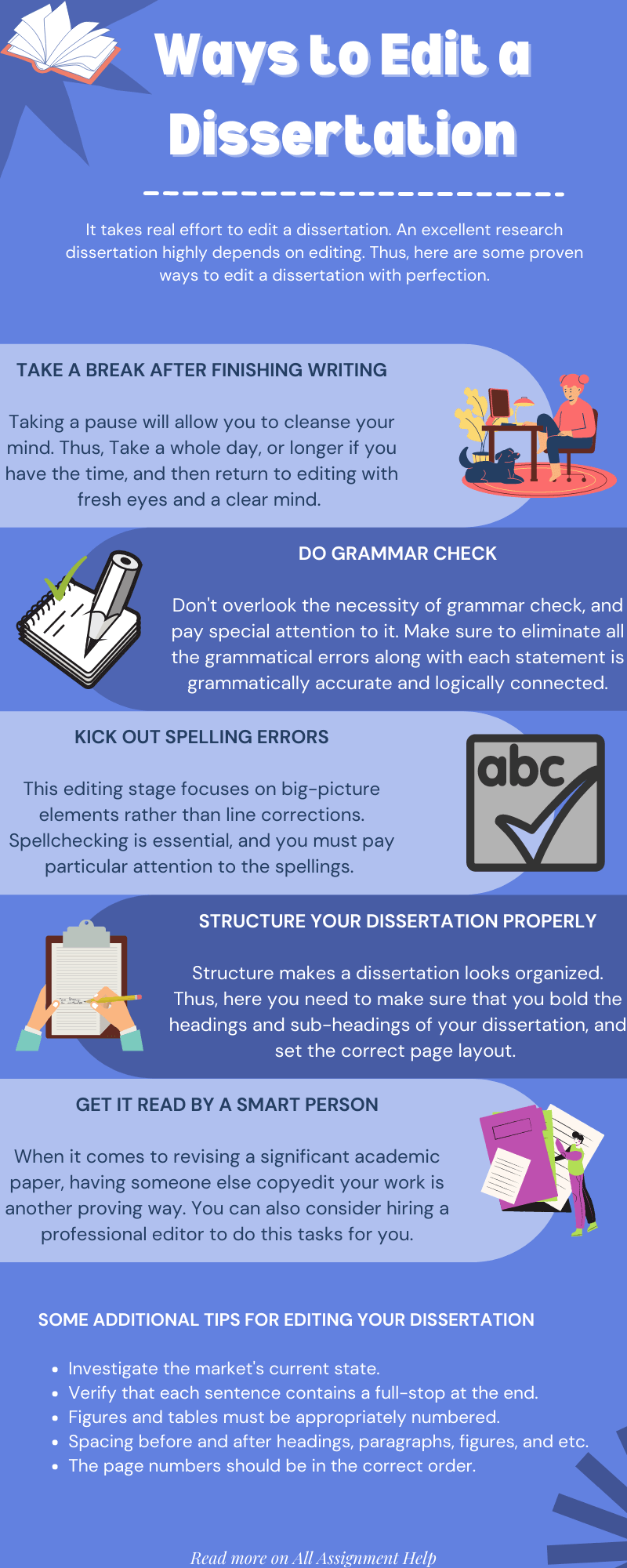
Take a Break After Finishing Writing
First, avoid editing your dissertation immediately after finishing the writing process. You may have spent days or even weeks working on thousands of words, which can make you mentally tired and less likely to notice mistakes. Taking a break gives you time to refresh your mind and return to your dissertation with a fresh perspective.
If you start editing in a hurry, you may overlook important errors. Instead, give yourself enough time to step away from your work before beginning the editing process. Depending on your deadline, even a day or two can make a difference.
When planning your editing time, consider the following:
- Take at least a full day off after completing your dissertation, if your deadline allows.
- Return to your work with a fresh and focused mind.
- Divide the dissertation into smaller sections or chapters.
- Aim to edit a manageable amount, such as 15 pages per day.
- Set aside several days, or up to a week, for a thorough review.
- Avoid rushing through the entire dissertation in a single sitting.
This approach can make the editing process more manageable and help you identify errors, unclear sentences, and structural issues that you may have missed while writing.
Read here: Key points to write a solid dissertation
Do Grammar Check
Do not overlook the importance of checking grammar when editing your dissertation. After taking a break, read your dissertation carefully from beginning to end. This can help you identify grammatical mistakes that you may have made while writing, especially if you were working under time pressure.
Pay attention to both major and minor errors, and make sure that every sentence is grammatically correct and logically connected to the next. While reviewing your dissertation, focus on:
- Correct sentence structure and grammar.
- Proper use of tenses and punctuation.
- Clear and logical connections between sentences and paragraphs.
- Consistent use of academic language.
- Grammatical errors that may have been overlooked during the writing process.
You can also use online grammar-checking tools such as Grammarly to identify common mistakes. However, avoid relying on these tools completely, as automated suggestions may not always fit the academic context. If possible, ask someone with strong grammar skills to review your dissertation and point out errors that you may have missed.
Kick out spelling errors
This editing stage focuses on big-picture elements rather than line corrections. Your professor won’t be impressed seeing you making spelling errors as a masters and Ph.D student. So, you also need to filter spelling errors from your dissertation by reading it well.
Spellchecking is essential, and you must pay particular attention to the spellings. A single spelling mistake can ruin the whole authenticity of your dissertation. Thus, do not ignore this part and check every major and minor spelling mistake while editing your dissertation.
One thing you must remember is that you should not use spelling checker software to find out these mistakes, as these software can make errors itself. Still, these online checkers can help you to some extent.
Structure your dissertation properly
Then comes the step of structuring your dissertation. Here, you need to make sure that you bold the headings and sub-headings of your dissertation and set the correct page layout. Also, in a dissertation, structural editing should first focus on the research’s core format and structure, i.e. Abstract, Introduction, Literature Review, Methodology, Discussion, Conclusion, Recommendation, and Bibliography. You can take dissertation structure help online as well in order to get your dissertation perfectly structured, leaving no points unturned.
While structuring your dissertation, you should not neglect some major things as well. These are structured body paragraphs, with spacing before and after headings, and they avoid double spacing. As you already know, structure makes a dissertation look organized. Hence, we suggest that you look more closely at this part as it is also associated with editing.
You should do all this after looking at the guidelines set by your university. If you are not clear about anything regarding structuring, then you must contact your professor.
Get it read by a smart person
It’s last but the most difficult thing you have to do as no one will be ready to read your dissertation. When it comes to revising a significant academic paper, having someone else copyedit your work is another proven way. Your friends, siblings, a,nd classmates might say “why I have to read a boring research paper? But, you have to get one of them ready to do it as they can find some mistakes in your dissertation that you might not have found and this way you might be able to save some crucial marks.
You can also consider hiring a professional editor or a dissertation writer. A professional editor can correct frequent errors, improve the clarity of your writing, and format your dissertation according to the needed citation style, allowing you to submit a flawless dissertation.
Read Also- Advantages Of Dissertation Writings In Academics
Some Additional Tips for Editing Your Dissertation
Apart from the above-stated ways, you can also consider these tips while editing your dissertation.
- Before you begin writing, plan out the framework of the paper.
- Learn the rules of the discipline, journal, or university where you’ll be submitting your study.
- Make a list of all the materials and reference books you’ll need ahead of time.
- Investigate the market’s current state.
- Verify that each sentence contains a full-stop at the end.
- Figures and tables must be appropriately numbered.
- Spacing before and after headings, paragraphs, figures, and etc.
- The page numbers should be in the correct order.
An excellent research dissertation highly depends on editing. It is critical to do the correct thing. However, if you follow all these tips appropriately, you can submit a perfect dissertation to your professor.
Final Thoughts!
Editing is an essential step in completing a dissertation. It helps you improve the clarity, structure, grammar, formatting, and overall quality of your research before submission. Taking a break after writing, checking grammar and spelling, reviewing the structure, verifying references, and getting feedback from someone else can help you identify mistakes that you may otherwise overlook.
A well-edited dissertation not only presents your research more clearly but also ensures that it follows your university’s academic and formatting requirements. Therefore, give yourself enough time to review and refine your work rather than treating editing as a final-minute task. If you need additional support with structure, clarity, proofreading, or formatting, professional dissertation editing services can also help you prepare your paper for submission.
If you still have some problem in writing or editing your dissertation, then you can try our dissertation writing service and can get it done by our professional dissertation writers.
Frequently Asked Question
What is dissertation editing?
Dissertation editing is the process of reviewing and improving a dissertation for grammar, spelling, structure, clarity, formatting, and referencing before submission.
How is editing different from proofreading?
Editing focuses on the overall structure, flow, clarity, and organization of a dissertation, while proofreading mainly focuses on correcting grammar, spelling, punctuation, and minor errors.
When should I start editing my dissertation?
It is better to take a short break after completing your dissertation before starting the editing process. This gives you a fresh perspective and makes it easier to identify mistakes.
What should I check while editing a dissertation?
You should check grammar, spelling, sentence clarity, structure, headings, formatting, references, page numbers, tables, figures, and compliance with your university’s guidelines.
Why is dissertation structure important?
A clear structure makes your research easier to understand and helps ensure that important sections such as the abstract, introduction, literature review, methodology, discussion, and conclusion are properly organized.
Can I edit my dissertation myself?
Yes, you can edit your dissertation yourself by reviewing it carefully and following a systematic editing process. Taking breaks and reviewing each chapter separately can make the process more manageable.
Should someone else read my dissertation?
Yes. Having a professor, classmate, friend, or professional editor read your dissertation can help identify errors and unclear sections that you may have missed.
Can grammar-checking tools help with dissertation editing?
Grammar-checking tools can help identify common grammatical and spelling mistakes, but they should not be relied on completely. Your dissertation should also be reviewed manually for accuracy and context.
How much time should I spend editing my dissertation?
The time required depends on the length and complexity of your dissertation. It is better to set aside several days and review the paper section by section instead of trying to edit everything at the last minute.
Can professional dissertation editing services help?
Yes. Professional dissertation editing services can help improve the clarity, structure, grammar, formatting, and referencing of a dissertation before submission.