
Table of Contents
Today, let’s talk about something every student deals with which is HOMEWORK. You might not think there’s much to say about it. But there is. It has been a part of schools everywhere for many years. It’s important for reasons we can’t just ignore. We’ve always heard that it helps us remember what we learn in class. But have you ever wondered who came up with homework? Or why? In this blog by All Assignment Help, we’ll explore some interesting homework facts you might not know. We’ll answer questions you’ve had since you were a kid. So, keep reading to find out the answers to those questions you had as a kid about who invented this and why.
What is Homework?
Homework is schoolwork that teachers assign students to complete outside the classroom, usually at home.It is meant to help you practice what you learned, improve understanding, and build discipline.
Why Homework Is Given:
- Reinforces learning: helps you remember concepts taught in class
- Builds responsibility: teaches time management and discipline
- Improves skills: especially in subjects like math, writing, and reading
- Prepares for exams: regular practice makes exams easier
Homework helps students understand the subjects taught in the classroom more effectively and supports better academic growth. It is not meant to feel forced, but rather serves as an essential practice that helps students improve their knowledge and skills over time.
What Are the Historical Facts About Homework and Its Origin?
Ever wondered who actually invented homework? The answer isn’t as simple as it sounds, but the story is quite interesting.
Let’s go back to ancient Rome, where a teacher named Pliny the Younger encouraged students to practice their lessons at home. His idea was simple: the more students practiced, the better they became. This early approach is one of the reasons homework is still seen as useful today.
Later, in 1905, another name entered the story—Roberto Nevilis. Many believe he used homework as a punishment. While this idea became popular, there is little evidence to prove he truly “invented” homework. Still, the story stuck and spread across the world.
Key Highlights:
- Ancient beginnings – Pliny the Younger promoted learning beyond the classroom
- Practice-based learning: Homework started as a way to improve skills
- Punishment myth: Roberto Nevilis is often linked, but without proof
- Global adoption: Schools began using homework as a learning tool
- Modern purpose: Now seen as essential for revision and growth
Today, homework is more than just extra work. It acts like a brain gym, helping students sharpen their thinking and problem-solving skills.
And if it ever feels overwhelming, remember, there are always reliable homework help services available to support you.
Also Read: What Is Inferiority Complex? How To Deal With It?
The Evolution of Homework & Educational Practices
Homework has a pretty interesting story, starting way back before laptops and smartphones were introduced. Back in the day, learning was pretty exclusive, and it wasn’t really a thing as we know it. There were only a few kids getting lessons was just to remember what they talked about. But, now we’re not just sitting at desks with piles of books. With all the modern technologies, it has gone digital too. And here’s the best thing when things get tough for students, they are finding smart ways to get help. Ever heard someone say, can someone take my online class? Yes, that’s happening, and it’s making learning a whole new experience for them.
Let’s explore how it has evolved till now:
Middle Ages to the Renaissance
- Education during these periods was primarily reserved for the wealthy or those in religious orders.
- Learning was often one-on-one or in small groups, with a focus on rote memorization.
- Assignments, as we know it, was not a formal concept but learners were expected to memorize texts or practice skills outside of their lessons.
The Industrial Revolution
- This period brought significant changes to society and education.
- With the rise of compulsory education laws, more children were going to school.
- The model of education shifted to prepare students for industrial work, emphasizing punctuality, following instructions, and completing assigned tasks similar to homework.
20th Century
- The concept and practice of homework have evolved over the 20th century.
- In the early 1900s, progressive education theorists like John Dewey criticized traditional homework for being too rote.
- And, also not focusing enough on the child’s interests and natural curiosity.
- This led to a fluctuation in the popularity and acceptance of homework.
The Cold War Era
- The launch of Sputnik by the Soviet Union in 1957 had a significant impact on education in the United States.
- There was a push for better science and mathematics education, which included an increase in homework to ensure that American students could compete globally.
Late 20th to Early 21st Century
- It has continued to be a topic of debate among educators, parents, and policymakers.
- Research on the effectiveness of homework has provided mixed results.
- Often showing that the quality of assignments is more important than the quantity.
Modern Views
- Today, there is a growing understanding of the need for a balanced approach to work given for home.
- Educators are encouraged to consider the purpose of assignments, their relevance to students’ learning, and the stress they may cause.
- There is also a recognition of the disparities in resources among students that can make completing assignments a challenge for some.
Facts About Homework to Motivate You!
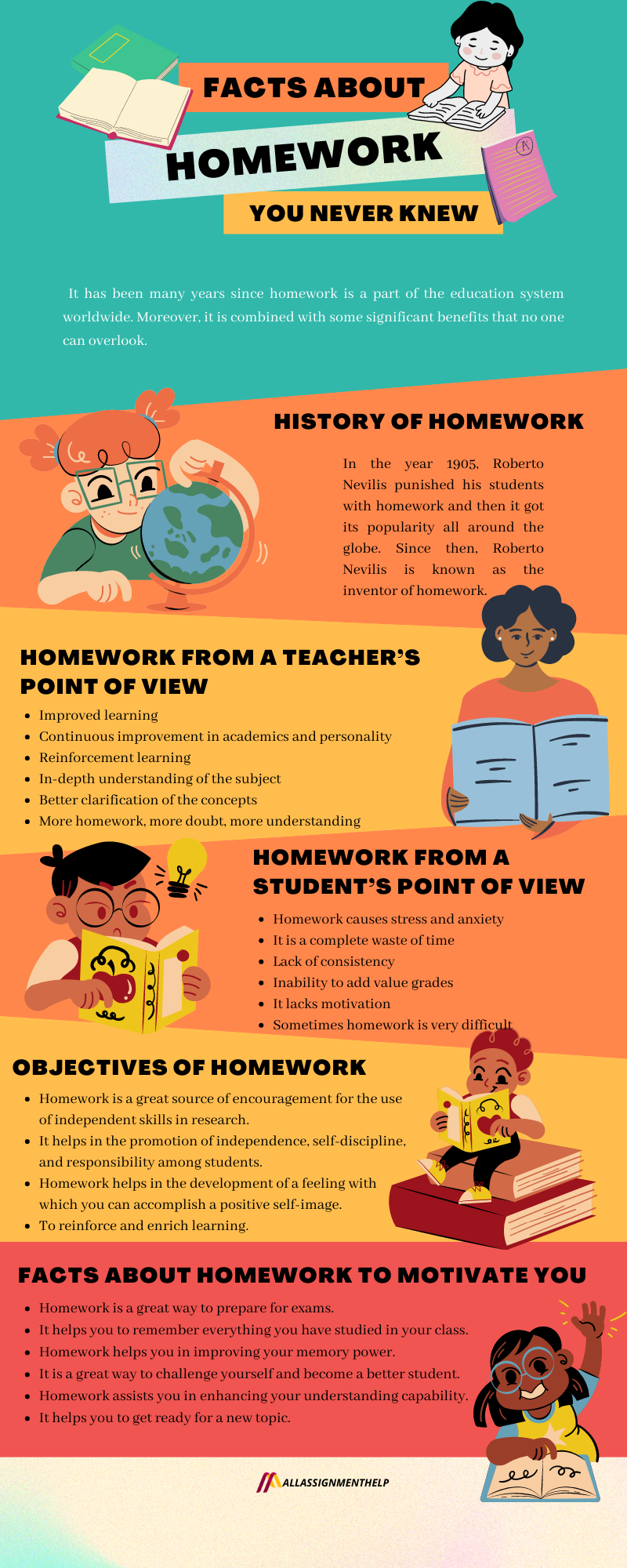
As we’ve explored, homework is an integral part of the learning experience. Moreover, it’s crucial to commit fully to achieve the best results. Understand that homework isn’t always a punishment. Instead, it’s an effective way to learn more, do meaningful work, and excel academically. With this in mind, here are some reasons why homework has always been important and why you should approach it seriously:
- Homework is an excellent way to prepare for exams.
- It helps you remember everything studied in class.
- Homework improves your memory power.
- It challenges you to become a better student.
- Homework enhances your understanding capabilities.
- It prepares you for new topics.
- Homework teaches you time management.
- It offers valuable study tips.
- Homework encourages deeper engagement with your studies.
- It allows your teacher to track your progress.
Homework Through the Eyes of Teachers
Ever wondered what teachers think about giving work for your home? Well, we asked them! Their insights tell us about the benefits of homework and its role in education.
Here’s a breakdown of what they had to say:
The Benefits of Homework According to Teachers
Teachers highlight several key advantages of regular assignments:
- Enhanced Learning: Work given for home isn’t just busy work, it’s designed to deepen students’ understanding.
- Growth Beyond Grades: It’s not all about academics; personal growth is also a big part of the picture.
- Reinforcement of Classroom Learning: Homeworks help cement what’s taught in class.
- Clarity and Comprehension: It provides a chance to clarify doubts and understand concepts on a deeper level.
- The Virtue of Questions: More assignments might mean more questions, but that leads to better understanding.
- The Habit of Revision: Regular reviews at home can significantly boost retention.
- Self-Directed Learning: Work given for home encourages students to take charge of their learning journey.
Teachers’ View on Homework’s Role
- Valuable, Not Wasteful: Contrary to some opinions, the work given for home is seen as valuable and not harmful.
- Grade-Level Appropriate: Teachers believe in tailoring homework’s quantity to be grade-appropriate to avoid overburdening students.
- Creativity Counts: The design of it should spark interest, not boredom or frustration.
- Learning Extension: It’s an opportunity to extend learning beyond the classroom walls.
- Adaptability: It should be structured so students can tackle it without unnecessary struggle.
Challenges that Students Face in Homework
Challenges do arise when students are completing their work. hence, teachers remind us that support is available and they can always ask for assistance. Whether through creative assignment experts or online resources, help is out there. You just need to ask an online homework doer for help regarding the subject you are struggling with.
Homework Philosophy of Hilary, a School Teacher
I am Hilary, a school teacher in Newcastle, UK, and here I am sharing my philosophy as an educator. I believe that homework plays a significant role in the educational process. Moreover, our textbook states that with 24 repetitions of a skill, any student can reach an 80% competency rate. Also, I believe that practising a skill is worthwhile. Moreover, I have encountered some vague comparisons regarding skills, to which I want to say that students need to practice skills so that they can build a solid foundation. In addition to this, homework helps students develop their capacity to remember, which they can then use to apply those skills in real life.
Also, I am a parent, and as a parent, I must admit that sometimes it is difficult to complete work. Furthermore, sometimes I find my children’s work too lengthy for one night. However, if needed, I never hesitate to send the teacher a note. Teachers need to understand that not every student is getting help at home. Moreover, I believe that a good teacher must be aware of their students’ home situations so that they can modify their work accordingly.
Also Read: Academic Research: Its Importance & Ways to Conduct
Homework From a Student’s Point of View
Many students have a positive attitude towards homework. According to some students, it’s necessary so they can practice certain skills at home. Moreover, it helps them remember all the important things they have read in class. Furthermore, they believe this is the major reason why schools require summer reading. This is because, if you do not practice reading during the three months of no school, your ability to read and write might regress to square one, as you are no longer actively practising those skills. However, sometimes they feel that the workload is too much. For example, solving 30 math questions with a similar format and formula makes no sense when only 10 questions can achieve the same result.
Students have their unique solutions to this. They suggest that teachers assign 10 questions and leave the rest up to the students, who can then practice or solve extra questions if they need more practice. Furthermore, this approach puts students in charge of their learning. Additionally, it is also beneficial for students who have already mastered the topic to move on to something new and learn new skills. If you are also facing something similar, then instead of wondering, How can I pay someone to do my homework. Or, How can I pay someone to take my online exam for me, You can hire experts. With their help, you can focus on learning some new skills. Moreover, the problem with homework does not end here. Sometimes students need to stay up late at night to complete it, barely getting any good sleep, which is unhealthy for the body.
Points of Criticism According to Students
Students generally despise homework. According to them, it is nothing more than an additional burden. Below are some reasons why students strongly criticize homework-
- Work given for home causes stress and anxiety.
- It’s a complete waste of time.
- There is a lack of consistency.
- It fails to add value to grades.
- It lacks motivation.
- Sometimes, work given for home is very difficult.
- It does not contribute to holistic growth.
- It causes health-related issues.
- It consumes excessive time.
With the above list, we can see that not all student thinks of it as rosy.
Objectives of Homework
As we have studied above, homework is an effective way to extend learning experiences. It begins in the classroom but continues successfully beyond it. Moreover, it is a good method to reinforce the concepts that students study in the classroom. Additionally, homework can consist of written study works that students practice independently. It also serves as a great tool for parents to engage in their children’s learning experiences. Furthermore, the education board always supports assigning homeworks to students. The objectives of it can vary across different grade levels, but the purposes generally remain the same, as mentioned below:
- Home work extends the concept of learning beyond the classroom.
- It nurtures the development of good study habits.
- Home work encourages the use of independent research skills.
- It promotes independence, self-discipline, and responsibility among students.
- Home work aids in developing a positive self-image through accomplishment.
- To reinforce and enrich learning.
- It prepares students for upcoming lessons.
- Homework provides immediate reinforcement of classroom lessons.
- It allows teachers to continually assess students’ progress.
These points highlight the primary objectives of homework for students. If you encounter any issues with your work, assignments, or essays, you can always seek assistance from an essay helper online.
Conclusion
In conclusion, homework isn’t just about assignments and deadlines; it’s a key part of learning that helps students prepare for future challenges, improve essential skills, and stay engaged with their studies. By understanding its importance and utilizing resources wisely, students can make the most out of their homework and pave the way for academic success. Remember, every bit of effort put into your homework today can pay off in your academic journey tomorrow. Keep pushing forward, stay curious, and always be ready to learn and grow.
Frequently Asked Questions
| Question. 1. If I get my homework done by experts, how would I ensure that the answer is correct? Answer. 1. You should always get your assignments done from the website where they have verified writers because they always have in-depth knowledge of the subject. Moreover, they always check the correctness of the work twice before sending it to you. |
| Question. 2. How long it generally takes a website to do my homework? Answer. 2. The time in which you will get your homework done depends on the deadline you set for the website. Only if there are certain glitches, your homework will get delayed otherwise they are always strict with the deadlines. |