Table of Contents
In recent years, schools have witnessed a noticeable rise in behavioral issues among children. Many parents and teachers are concerned about classroom discipline and student safety. Questions naturally arise about the children’s indecent behavior and whether enough is being done to teach children proper social conduct.
Before finding solutions, it is important to clearly understand what inappropriate behavior looks like, why it happens, and how it can be corrected effectively.
Well, all these questions are pretty valid and much need to be answered. But we need to find out the reasons why students show indecent behavior during their academic life and what parents and teachers can do to improve their behavior. Therefore, with the help of this blog presented by a writer of All Assignment Help, we will discover all about the indecent behavior of children.
Overwhelmed with Online Exams? 😰
Deadlines piling up? Stress affecting your grades? Get professional exam support and stay ahead without the pressure.
🚀 Get Expert Exam Help NowSecure • Confidential • On-Time Assistance
What Is a Child’s Indecent Behavior?
To begin with, what is indecent behaviour in the context of children?
It refers to actions that violate accepted social or school norms and negatively affect others. In a classroom, this may include disruptive conduct, disrespect toward teachers, bullying classmates, or refusal to follow rules.
However, behavior can sometimes be subjective. What one environment considers inappropriate may be acceptable in another. That said, schools function on shared standards designed to maintain safety, respect, and productive learning.
Some common indecent behaviour examples include:
- Constantly interrupting lessons
- Using offensive language
- Physical aggression
- Mocking or bullying peers
- Damaging school property
- Openly defying teachers
These behaviors disrupt not only the individual’s growth but also the learning experience of others.
Furthermore, it’s important to note that the problem of improper behavior is situational or a matter of perspective. This implies that it relies on your definition of what constitutes suitable behavior. As a result, what you consider inappropriate behavior for someone else may be acceptable to you.
Indecent behavior of students can also affect their academic grades. Henceforth, if they do not want to get their grades affected, they can assignment help online to get appropriate assistance.
Why Do Children Show Indecent Behavior?
Children may misbehave and become annoyed for a variety of reasons, but to put it all in perspective, let’s look at the most prevalent ones. This portion of the blog will look at the most frequent causes of children acting indecently.
To Influence Other Kids
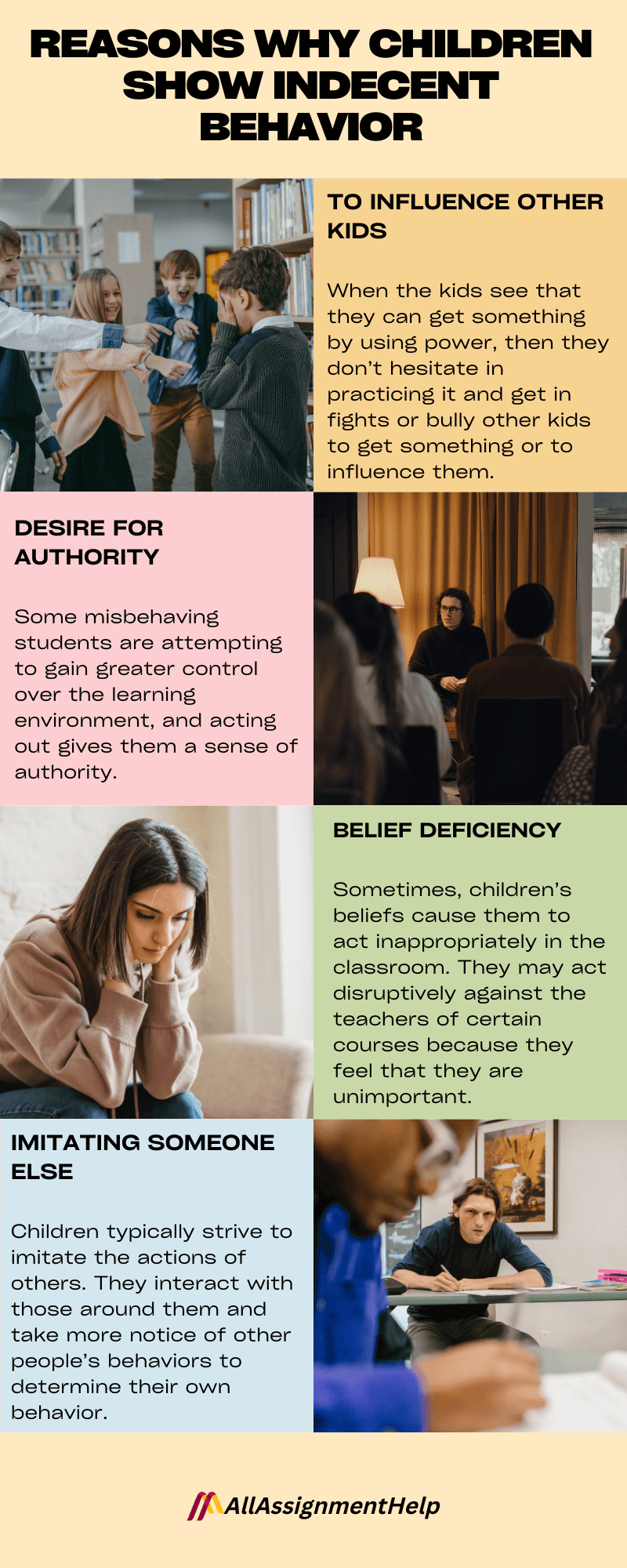
In this world where everyone is hunting for power in their own way, kids choose their own way to do the same. In simple words, when the kids see that they can get something by using power, then they don’t hesitate in practicing it and get in fights or bully other kids to get something or to influence them. So, it’s the necessity of the hour that parents and teachers give emphasis teaching some social skills to them so that the kids hunt for satisfaction rather than power.
Read Here: Know your Student’s Personality
They Want Their Back Patted by the Teachers
These are the times when competition is on the rise. Everyone needs to make huge efforts in order to get recognition from the teacher. This urge of getting famous or acknowledgment is something that starts at an early age. So, when a kid sees other kids getting their back patted by the teachers for performing well in academics, they also seek the same. But due to the lack of understanding of the fact that they can get the same thing by doing well in their studies, they get frustrated sometimes and end up fighting with their peers. However, such students can also take assignment help online rather than getting frustrated for not getting recognization from the teachers.
Money And Toys Matter
Money and many other things have been the cause of children fighting each other for a long time. So, when a child sees other children possessing more money than they do or playing with some cool toy. They feel the urge of getting their hands on the same, or they get jealous and get indulge in a fight with others to take out their frustration or to get these things. So, it’s a must for parents to teach their kids that having a friend is better than possessing money and stuff like toys.
Desire for Authority
Some misbehaving students are attempting to gain greater control over the learning environment, and acting out gives them a sense of authority. These children make it clear that they don’t want to follow the established course of events and are unwilling to do so. Furthermore, a student who is power-seeking will argue frequently and will not abide by fundamental guidelines that are intended for everyone.
They Have a Belief Deficiency
Sometimes, children’s beliefs influence them to act inappropriately in the classroom. For example, some students may behave disruptively toward teachers of certain subjects because they feel those subjects are unimportant. Such forms of indecent behavior are often linked to gaps in belief or negative perceptions. However, these viewpoints can vary depending on a student’s mindset and personal experiences. With proper guidance and by performing well academically, students can rebuild their self-belief and confidence.
They Are Imitating Someone Else
Children typically strive to imitate the actions of others. For instance, there is a good possibility that a child may raise their voice in class if they observe their teacher doing so. Additionally, they can be copying a character they saw on television or in a movie. However, it should be kept in mind that personality traits are not inherited in children. They interact with those around them and take more notice of other people’s behaviors to determine their own behavior. If you want your child to be obedient, you must model this behavior for them by respecting all.
Read Here: Classroom Management: A Necessity To Improve Students Behavior
Understanding Legal and Social Boundaries
Another serious question people sometimes ask is: what does indecent behavior with juveniles mean?
In legal and social contexts, this phrase refers to inappropriate or exploitative conduct involving minors that violates moral or legal boundaries. It is very different from ordinary classroom misbehavior. Such actions are considered serious offenses and require legal intervention.
It is crucial to clearly separate:
- Normal childhood misbehavior
- Classroom discipline issues
- Legally punishable misconduct involving minors
Understanding this distinction prevents confusion and ensures that concerns are addressed appropriately.
Several Common Behavioral Problems in Children
Other than the aforementioned reasons, some behavioral problems in students as well made them react in an indecent way. Children might be going through issues like:
ADHD
Children who struggle to stay focused are often diagnosed with ADHD (Attention-Deficit/Hyperactivity Disorder). In the United States, ADHD is one of the most commonly diagnosed developmental conditions among school-aged children. While difficulty concentrating is a core symptom, behavior challenges are also common and can be stressful for both parents and teachers.
Children with ADHD may have trouble following instructions, controlling impulses, and managing frustration. When asked to complete tasks they find difficult or uninteresting, they may respond by arguing, refusing to cooperate, having emotional outbursts, or acting rebellious.
These challenges are often more visible in online learning environments. Virtual classrooms require sustained attention, time management, and self-discipline, areas where many students with ADHD struggle. When they begin to feel overwhelmed by deadlines, assignments, and digital distractions, some may search for online academic support and even type phrases like take my online class for me out of frustration.
While this reaction reflects stress and academic pressure, the better approach is structured support, tutoring, behavioral strategies, and guided assistance. With the right help, students can strengthen their focus, build confidence, and succeed independently.
Autism
Dramatic meltdowns are a common occurrence among children with autism spectrum disorders. These children frequently have tight routines that they depend on for mental comfort, and any sudden shift might frighten them. Additionally, they might not have the language or communication abilities to express their needs or wants.
Learning Disorders
When a child misbehaves in school or when doing homework, it may be the consequence of a learning disorder. Instead of asking for help, they can tear up the paper or start a fight with another child if they are having trouble with a math issue or a writing assignment. However, they can also take assignment writing services to avoid the issues they may face during the learning process.
Problems with Sensory Processing
Children who have problems processing sensory information may exhibit excessive and confusing behavior. They might shout if their faces get dirty or have a breakdown if the environment is too loud, bright, or crowded. Furthermore, children with sensory issues may also be inflexible about schedules and become angry or oppose changes that other people might find unimportant.
The Best Ways to Handle Indecent Behavior in Children
There isn’t yet a strategy that can be used generally to control child misbehavior. However, studies do outline strategies an educator might do to avoid or lessen this issue. These approaches can be used to do this:
Find the source of the issue
Think about the potential causes of indecent behavior. Identifying the cause can support teachers in predicting student needs, maintaining control, and avoiding unintentionally encouraging undesirable behavior.
Good Communication
When people believe that communication is the key, nothing works better than one-on-one conversations. Children typically misbehave when they found no one to talk to them or listen to what they have to say. Stop this from happening and try to listen to your children.
Eliminate Zero-Tolerance Behavior
Teaching students and allowing them to actively participate and learn should be the main priorities in the classroom. When establishing rules for the classroom, be sure to consult with the students and try to stay away from overly detailed lists of what is prohibited.
Also Read: Zero Tolerance Policy Bumping the Education System!
Child Counselling
If you still feel as though you are unable to recognize the causes of your children’s misbehavior, don’t hesitate to choose child counseling sessions and seek advice and direction from knowledgeable professionals in order to evaluate your children’s mentality and put an end to their misbehavior and attitude problems.
Conclusion
Children show indecent behavior for a variety of reasons, making it difficult for parents and teachers to control them constantly. Some are straightforward, while others are considerably more complicated and difficult to understand. However, the first step in improving a child’s behavior is to understand why they misbehave in the first place. We should also consider what may be done to stop concerns about misbehavior in children and behavior problems. By doing so, we can stop children from growing a bad side.
FAQs
| Q: In what circumstances do students exhibit a lack of personal skills in the classroom? A: Students are more likely to misbehave in the classroom when they lack personal qualities including empathy, awareness of desired social behavior, self-discipline, etc. |
| Q: What are the characteristics of indecent behavior in students? A: Disruptive talking, persistently avoiding work, clowning, interfering with educational activities, bothering classmates, verbal insults, rudeness to teachers, defiance, and aggression are characteristics of student indecent behavior. |