English Confusing Words: Tricky Words That Often Cause Confusion
What this article will help you understand
English you are an uphill battle. Just when we think we understand you, you go ahead and violate a spelling rule or insist on using a variety of pronunciations for the suffix "ough." Some words sound the same, while others have the same appearance. It can be somewhat challenging to distinguish between these similar terms.
What are you trying to do with this topic?
Choose the closest task and the page will point you towards a useful next step.
Start with the central concept and the terminology used in the article.
Open the closest route ↗Connect the explanation to the question, learning outcomes and marking criteria.
Open the closest route ↗Review evidence, structure, referencing and the exact submission requirements.
Open the closest route ↗Do you have enough information to begin?
Select what you already have. Nothing is submitted from this checklist.
When these details are together, the requirement can be reviewed in context.
Assignment Help USA ↗Table of Contents
English you are an uphill battle. Just when we think we understand you, you go ahead and violate a spelling rule or insist on using a variety of pronunciations for the suffix “ough.” Some words sound the same, while others have the same appearance. It can be somewhat challenging to distinguish between these similar terms. This blog by allassignmenthelp includes definitions for some of the most frequently mispronounced word pairs, or we can say some confusing words, along with examples that illustrate them in context. This list is not all-inclusive, but it should help you identify specific distinctions and perhaps some trends among common English terms and expressions.
So, let’s get started and know the pair of English confusing words that trick you the most.
HomoPhones, Homonyms and Homographs
Words that sound alike but have very distinct meanings are often shown to us in English, a language rich in nuances. This peculiarity in language might cause misinterpretations and poor communication. We will definitely examine some of the most perplexing English words that often cause us to stumble and delve into the reasons why these words can be so confusing. But before that, let’s explore the types of English confusing words that often trip us up:
Words with similar spellings or meanings
Words become complicated when they have similar meanings. The terms “desert” and “dessert” have very distinct pronunciations and meanings. However, their spellings are sufficiently close to confuse. For example, “accept” and “except,” which have different spellings and meanings but similar pronunciations. Or “advise” and “advise,” which are different parts of speech but have similar meanings (and pronunciations).
The problem is seen here. These similarities readily cause misuse and misunderstandings.
Words from various geographical areas
Because many nations make English their first language, there are variations in spelling and pronunciation. The colour “grey” (in US English) or “grey” (in UK English) is an example.
Homophones
Words that sound the same but have distinct spellings and meanings are called homophones.
Words such as:
- there, their, they’re
- to, too, two
- hear, here
Homonyms
Words that have the same pronunciation and spelling but distinct meanings are called homonyms.
Words such as:
Bank ( financial services), Bank (edge of a river)
Homographs
Words that have the same spelling but distinct pronunciations and meanings are called homographs. For example, “bow” can refer to both a knotted ribbon and the movement of bending at the waist. Or “lead,” which can refer to either the act of directing or a particular kind of metal.
Thua you can see, English can sometimes feel like a puzzle, especially with homophones, homonyms, and homographs that make the language tricky to understand. However, with regular practice, paying attention to context, and learning through examples, one can avoid confusion and use these words effectively. Students who struggle with these concepts in their academic writing can also benefit from online assignment help, which provides guidance and clarity to ensure accuracy in communication.
List of Confusing Words And Their Meaning
Which is preferable: to accept or except an invitation? After dinner, do you have dessert or a desert? Although many words in English are difficult to understand. However, with these straightforward explanations, you can become fluent in utilising them. This list was made by us in order to assist you. Here, you will find some pairings of English words with similar sounds that frequently confuse.
Excess vs Access
Access can be used as a verb that means “to enter,” as in “access the stage from the rear,” or as a noun that refers to the capacity to enter, as in “access to the building.”
As a noun or adjective, excess usually refers to an amount that is greater than normal or required, as in “an excess of salt” and “excess baggage.”
Addition & Edition
Both edition and addition are nouns. As in “new additions to the museum’s collection” and “an addition to the house,” addition can refer to either the act of adding something or the result of adding something, as in “the addition of cream to the soup” and “math problems involving addition and subtraction.” Additionally, it appears in words like “cookies in addition to the pie and cake.”
When something is referred to as “an illustrated edition,” it’s a specific version of a book, product, newspaper, etc.; when it’s given as part of a series, it’s called “tonight’s edition of the show.”
Allude and Elude
The verb allude means “to speak of or mention something or someone in an indirect way,” as in “they alluded to difficulties at their former school.”
The most common meaning of the verb elude is “to avoid or escape someone or something by being quick, skilful, or clever,” as in “a criminal who has eluded capture.”
Allusion and Illusion
The term allusion denotes “a statement that refers to something without mentioning it directly,” as in “a colleague’s allusion to a former spouse.”
The term illusion describes something that appears or appears different from what it actually is, as in “paint that creates the illusion of metal” and “an optical illusion.” Additionally, it describes a notion that is predicated on an untrue statement, such as “they were under the illusion that the car was brand new.”
Although allusion and illusion sound somewhat similar, their meanings are very different. Understanding confusing word pairs is essential for improving both writing and communication skills. You can learn them more easily by enrolling in online coursework, where language concepts are taught effectively. At the same time, if you wish to balance learning with your academic responsibilities, seeking online class help from a reputable website can be a smart way to enhance both understanding and performance.
Bass and Base
Base is an adjective, verb, and noun. Several of the nouns’ meanings, such as “the lamp’s base,” “the base of a mountain,” “the company’s customer base,” and “base of operations,” allude to a literal or figurative foundation or bottom. Additionally, it appears in a number of expressions, such as “touch base” and “on base.” Base is a verb that implies “to have a particular place as the main place where a person works or lives or where a business operates,” such as “a company based in Iowa.” Additionally, on and upon are used with it: “an economy based on tourism.” “Base” is an adjective that indicates “not honest or good,” or “base motives.”
Bass is a term that describes a musical instrument or a low, deep voice. Bass is another word for a type of fish that rhymes with pass.
Current and Currant
The term “currant” describes a little berry or sultana.
As in “ocean currents,” the noun “current” can refer to a continuous flow of water or air in the same direction, or it can refer to a flow of electricity, as in “a strong/weak electrical current.” An adjective that means “happening or existing now,” current can also be used in phrases like “the current month” and “the magazine’s current issue.”
Distract And Detract
Both distract and detract are verbs. Detract refers to “to reduce the strength, value, or importance of something,” referring to “a minor error that does not detract from the overall quality of the report.”
Distract refers to “to cause someone to stop thinking about or paying attention to someone or something and to think about or pay attention to someone or something else instead,” such as “noises in the hallway that distracted the students.
Device And Devise
A device is a word that typically designates a machine, item, or piece of equipment that has been created with a certain function in mind, such as “electronic devices.”
As in “developing a new method for converting sunlight into electricity,” the verb devise denotes “to invent or plan something difficult or complicated.”
Its and It’s
Many of us mourn for these two. It’s the contraction of it is, and its is its possessive form, as we all know. Are you tempted to use a cunning apostrophe? First, see if you can substitute his or hers for the word. It is for you, if you can!
A lot vs. Allot
The impact that a space can have. Also, a lot can be used with both countable and uncountable nouns, such as people, seats, or cups of coffee, as well as uncountable nouns, such as water, rice, money, or hair. Consider: I have plenty of time. He has a large book collection. How much do we have? A great deal. Conversely, the ordinary verb allot means to distribute.
Lose versus Loose
Was the final lost by your team? Were your trousers loose or tight when you shed 10 kg? Does it really make a difference? Yes, that innocent appearance does make a huge impact. Suppose that both words were identical at first, but that at some point, the letter “o” was dropped. (Perhaps because a moose was out there?)
Bad and Bed
It’s not like confusion with the words arises only with the tough words. For your information, this confusion is more common with the words we use in daily life.
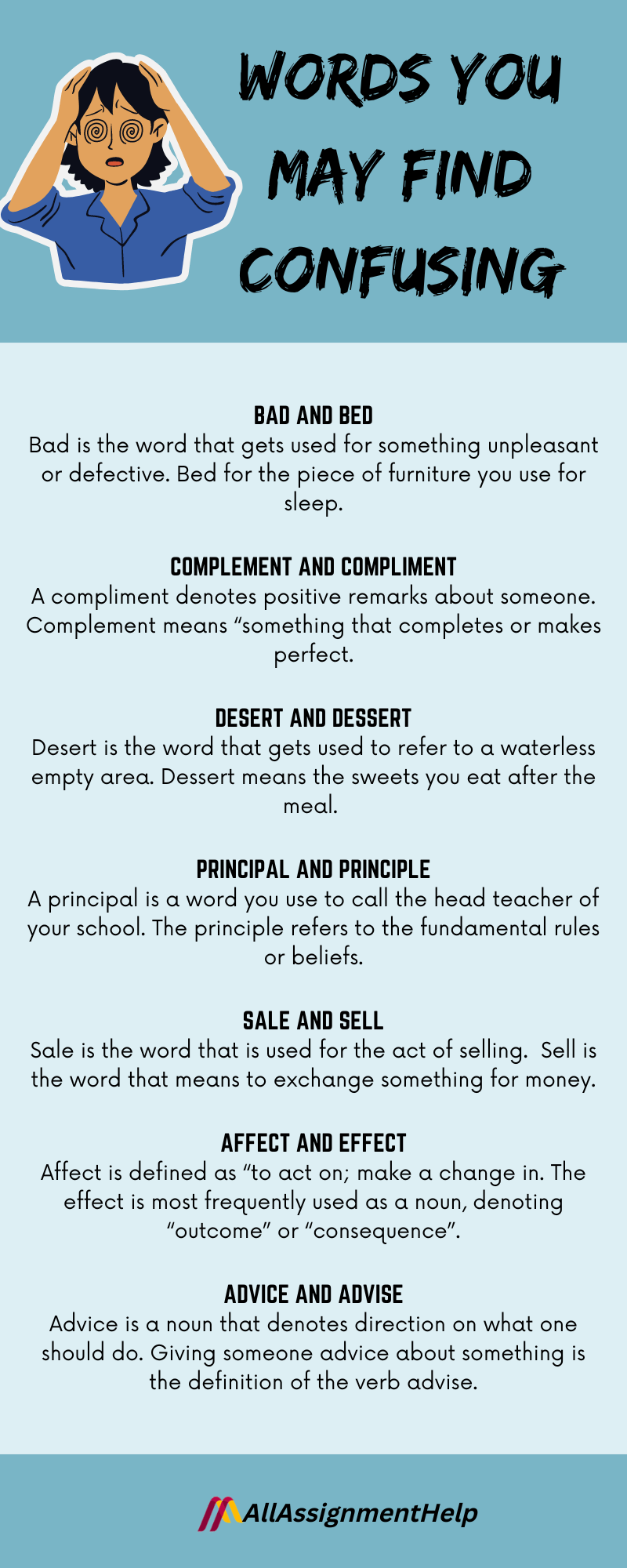
Bad and Bed is the right example of it. Bad is the word that gets used for something unpleasant or defective. And you use the word Bed for the piece of furniture you use for sleep. But, confusion between A and E could change the whole meaning, so be aware!
Read Here: Linking Words To Use In An Essay
Complement and Compliment
A compliment is a word that is also pretty common. However, many people (including me) make the mistake of spelling it. You are being complimented when someone says, “I really like your clothes.” To put it another way, they are praising you. Both as a verb and a noun, a compliment denotes positive remarks about someone.
On the other hand, when two items complement or complete one another, they work well together. This phrase is frequently used in both fashion and gastronomy to indicate complementary designs or components. For example, the wine goes well with the meat meal.
Desert and Dessert
You write one S write in the Dessert and your sweets turn into desert soil. Can’t get it? Well, Desert is the word that gets used to refer to a waterless empty area. In general, a piece of terrain with little to no vegetation or the act of abandoning something or someone is considered to be in the desert.
Whereas, dessert means the sweets you eat after the meal. However, you can go for online assignment writing services to know more about the differences between these two confusing words.
Principal and Principle
You may also get confused among these words and may not find which one of them is the word you use to call the head teacher of your school. Well, it’s the first one for your information.
Another, Principle refers to the fundamental rules or beliefs. In short, the principal refers to the leader of a school or the important object, principles are ideas, standards, or fundamental facts.
Sale and Sell
Both the words sell and sale refers to the idea of exchanging items, yet they are frequently used interchangeably.
Sale is the word that is used for the act of selling. The words “for sale” and “on-sale” both refer to items that are being exchanged at a discount. For example, you get 10% off on sweatshirts in the new year.
Sell is the word that means to exchange something for money. When used as a verb, sell denotes giving something away in exchange for cash or promoting or convincing someone to buy a specific good or service.
Although sale and sell are closely related, remembering that sale is a noun and sell is a verb will help avoid confusion. If you want to practice more and successfully distinguish between confusing English words, you can take English homework help to improve your grammar and writing skills.
Affect and Effect
Despite having somewhat different pronunciations, the primary difference between these two words is grammatical. When discussing the outcomes or repercussions of certain activities, affect and effect are typically employed as a verb and a noun, respectively.
Affect is defined as “to act on; make a change in,” as in “The cold weather affected the crops. The meaning of the verb impact is also “to stir or impress the feelings. Whereas, the effect is most frequently used as a noun, denoting “outcome” or “consequence”. For example, my doctor said it would take a few hours for the medicine to take effect.
Advice and Advise
These terms have nearly identical pronunciations, remarkably similar meanings, and pretty much identical spellings. However, there are many assignment help services available online to help you understand these two.
Advice is a noun that denotes direction on what one should do. Giving someone advice about something is the definition of the verb advise. In other words, giving someone counsel is the same as advising them. Although they are spelled quite similarly, the words advice and advise are pronounced differently. While advise rhymes with advertise, advice rhymes with ice.
Assure, Ensure and Insure
To assure someone of something implies stating that it will undoubtedly occur or be true. For example, James gave Melon his assurance that no one would engage in bingo fraud.
The verb ensures means to guarantee or make absolutely sure of something. For example, Joseph made measures to ensure no one participated in bingo fraud.
To insure is to purchase an insurance plan. For instance, Potter was relieved that the bingo hall was protected by insurance against harm from unruly bingo players.
However, students who want to sharpen their vocabulary and avoid such confusions can benefit from literature assignment help, which provides structured guidance for improving accuracy and fluency.
Also Read: Transition Words for Compare and Contrast Essay
Altogether and All together
These words are frequently used interchangeably, but as you will see, their usage in the English language is not the same.
Altogether is used as an adverb. It denotes that something is finished, includes everyone, or is comprehensive. It can be used in place of the phrases entirely, completely, or absolutely. Example:- As stated by the principal, the dress code Altogether forbids shorts.
On the other hand, as an adverb, the phrase all together is never utilized. It is merely a word that denotes a gathering of all people or things. It is utilized, when referring to something or someone at the same time or place. For example, they last spent time all together back in November.
Eminent and Imminent
Eminent refers to something notable or outstanding whereas imminent refers to something that is about to occur. Many linguists believe that both words share the same Latin root, mons, which means “mountain,”.
If you get confused between these two words while writing them in your assignment, then you can take help from Assignment helper USA to know the key differences and how to use these two in assignment writing.
Bear and Bare
As a verb, the bear can signify holding up or supporting a heavy object as well as going through tough times. Here we are not referring to large, bushy bears that dwell in forests. For your clear understanding, here is an example, don’t try to stand up on that worn-out chair; it cannot bear your weight.
In contrast, the word “bare” can be used as a verb or an adjective to denote nakedness or exposure. It doesn’t matter if you’re referring to someone’s “bare hands” or completing the “bare minimum,” the word “bare” always denotes being emptied.
Dependent and Dependant
Dependant and dependent are not alike in some ways. According to every British reference source we looked at, British English treats dependent as the adjective and dependent as the noun.
A person who is dependent on another person is referred to by the term dependent (usually financial support). In British English, this term is typically spelled, dependant. The word may also be spelled in the British style, but dependent is more frequently spelled that way in American English.
Discreet and Discrete
Other confusing words of homophones in the list are discreet and discrete. The definition of discreet is “judicious in one’s behavior or speech, especially with reference to preserving private or keeping silent regarding something of a delicate nature.” Alternatively, “wise, quiet” in a broader sense. For example, You must be extremely discreet if you want to work for the royal family.
Furthermore, discrete denotes “alone or detached from others; distinct, different, discontinuous,”. It implies that something is distinct, independent, or has a definite, self-contained shape or form. For example, Strong colors, discrete shapes, and rhythmic patterns were used in her paintings.
Also Read: Easiest Ways to Learn a Foreign Language
The Final Words!
Such English terms might be really confusing, don’t you think? Fortunately, understanding the variations makes it simpler to avoid errors. Most listeners won’t notice if you mix up these words, especially if you’re speaking English. However, you should watch out for these words and make sure you are utilizing the right ones when you are writing. Furthermore, always double-check your spelling and consider the circumstances.
That said we will sum up this writing piece here. Hope you find it useful. For such informative blogs, you can connect with us at AllAssignmentHelp.com. Moreover, if you are looking to pay someone to do assignments or homework online, you can take help from us. We are an academic assignment help providers who help students with their academic assignments, homework, projects, and other write-ups.
FAQs
Q1. What are confusing words in English?
Confusing words are pairs or groups of words that sound similar or have close meanings but are used differently in writing and speaking.
Q2. Why do people mix up confusing words?
People often confuse words because of similar spelling, pronunciation, or meaning, which leads to mistakes in grammar and usage.
Q3. How can I remember the difference between confusing words?
You can remember confusing words by learning their definitions with examples, practising in sentences, and creating simple memory tricks.
Q4. What are some examples of confusing words?
Examples include affect vs. effect, accept vs. except, then vs. than, and compliment vs. complement.
Connect the explanation to the work your course actually requires
Use this guide beside the exact brief, course material and marking criteria for Words You May Find Confusing.
- Read the complete brief.
- Identify the expected academic output.
- Follow the marking criteria and source rules.
- Check the final structure and referencing.
Dr Mark Shaffer
Mathematics
Students working on a brief connected to “English Confusing Words: Tricky Words That Often Cause Confusion” may compare the requirements with Dr Mark Shaffer’s live Mathematics profile.
Mathematics tutor with doctoral-level academic preparation. Doctorate in Mathematics, University of Sydney
View established tutor profile ↗Relevant subject areas
- Mathematics
- Advanced Mathematics
- Problem Solving
Find another explanation across the complete blog
This search uses WordPress itself, so it can reach articles beyond the 20 shown on the dashboard.
Connect Words You May Find Confusing to the task in front of you
Keep the brief, marking criteria, required evidence and submission format visible while you work.