What is Information Technology (IT) | Top Information Technology Courses
What this article will help you understand
IT is an acronym for information technology. Generally, IT is the use of computers to store, transmit and manipulate data. IT remains a central place to perform many operations in companies. Therefore, we can say this century is all about IT. People utilize computers, the internet, and other information technology tools all throughout the world.
What are you trying to do with this topic?
Choose the closest task and the page will point you towards a useful next step.
Start with the central concept and the terminology used in the article.
Open the closest route ↗Connect the explanation to the question, learning outcomes and marking criteria.
Open the closest route ↗Review evidence, structure, referencing and the exact submission requirements.
Open the closest route ↗Do you have enough information to begin?
Select what you already have. Nothing is submitted from this checklist.
When these details are together, the requirement can be reviewed in context.
Assignment Help USA ↗Table of Contents
IT is an acronym for information technology. Generally, IT is the use of computers to store, transmit and manipulate data. IT remains a central place to perform many operations in companies. Therefore, we can say this century is all about IT.
People utilize computers, the internet, and other information technology tools all throughout the world. Because of this, there is a great need for IT professionals. There are several institutions that provide IT courses. Australia, on the other hand, boasts top-notch IT institutions. Although studying IT is not a simple life. To pass the course, you need to study diligently. Along with it, you have to complete multiple assignments as well.
Furthermore, there are multiple information technology courses available in Australia. As we already know that IT is a fascinating field to study but many students are not familiar with what it is all about and where to pursue a degree in IT. Therefore, in this blog of All Assignment Help, we will explore the definition, importance, benefits, and best courses to pursue in Australia that may provide you with the knowledge and skills you need to succeed in this fast-paced industry.
So, let’s get started!
What is Information Technology?
Information technology (IT) is the use of technology, systems, and procedures to store, retrieve, transmit, and modify digital data. IT includes all aspects of its usage, development, and administration. It involves designing, putting into place, and maintaining networks and computer-based systems that make it easier to create, store, process, and share information.
Furthermore, information technology comprises a wide range of tools and techniques, including hardware, software, networking, cybersecurity, and data management. It includes all of the hardware, including computers, servers, and networks, as well as the software programs and operating systems that operate on them.
There is an association of several other industries with IT. Following are some of them.
- Computer Hardware
- Computer Software
- Electronics
- Internet
- Engineering
- Healthcare
- E-commerce
- Computer services
You may have seen a mountain of assignments being hurled at you since you are a student of IT. Although, making an assignment is a difficult process. To complete an assignment well, a lot of knowledge and effort are required. However, taking an Information technology assignment help can sugarcoat the pill for you.
Also Read: Concept of E-Banking -Information Technology
What Is the Difference Between Computer Science and Information Technology?
Computer Science (CS)
Computer Science is all about building technology from scratch. It focuses on coding, algorithms, and problem-solving.
- Coding is the foundation of CS. You learn how to write programs and design algorithms.
- It involves applying theory to develop software, apps, and systems.
- Strong mathematical and logical thinking skills are essential.
- You learn how to choose the best algorithms and build efficient programs.
- Knowledge of programming languages is important. Common ones include C++, Python, JavaScript, SQL, PHP, HTML, and CSS.
A Computer Science degree usually takes four years to complete. During this time, students gain deep knowledge of mathematics, programming, and system design.
Career options in CS:
- Software Developer
- Web Developer
- Data Scientist
- AI Engineer
Information Technology (IT)
Information Technology focuses on using technology effectively in real-world business environments.
- IT is more about managing and applying software rather than creating it.
- It includes handling systems, networks, databases, and security.
- Students learn how to use technology to solve business problems.
- Administrative and operational tasks are a big part of IT roles.
An IT degree can take 2 to 4 years depending on the course.
Career options in IT:
- Technical Support Expert
- IT Manager
- System Administrator
- Network Engineer
- Cybersecurity Specialist
Computer Science Vs Information Technology: Key Difference
| Aspect | Computer Science (CS) | Information Technology (IT) |
|---|---|---|
| Focus | Building software and algorithms | Using and managing technology |
| Core Skill | Programming and problem-solving | System management and support |
| Mathematics | High-level math required | Basic to moderate math |
| Work Type | Development and innovation | Implementation and maintenance |
| Degree Duration | Typically 4 years | 2–4 years |
| Career Roles | Developer, Engineer, Data Scientist | IT Manager, Support, Security |
| Work Environment | Tech companies, startups | Corporate and business settings |
| Salary Potential | Generally higher | Moderate but stable |
Advantages of Studying Information Technology
Australia has evolved into a center for IT. Australians are tech-savvy and have a competent labor force. Leading IT businesses with offices in Australia include Google, IBM, and Canon. These businesses conducted technology testing in Australia. Students that study in such a setting are exposed to cutting-edge technology. IT enables students to learn about cutting-edge technologies and foster their innovation. It takes a lot of work and dedication to become a pro. Making the choice to work in IT is a wise one. Here is why:
The following are some compelling benefits of pursuing information technology:
Different Careers
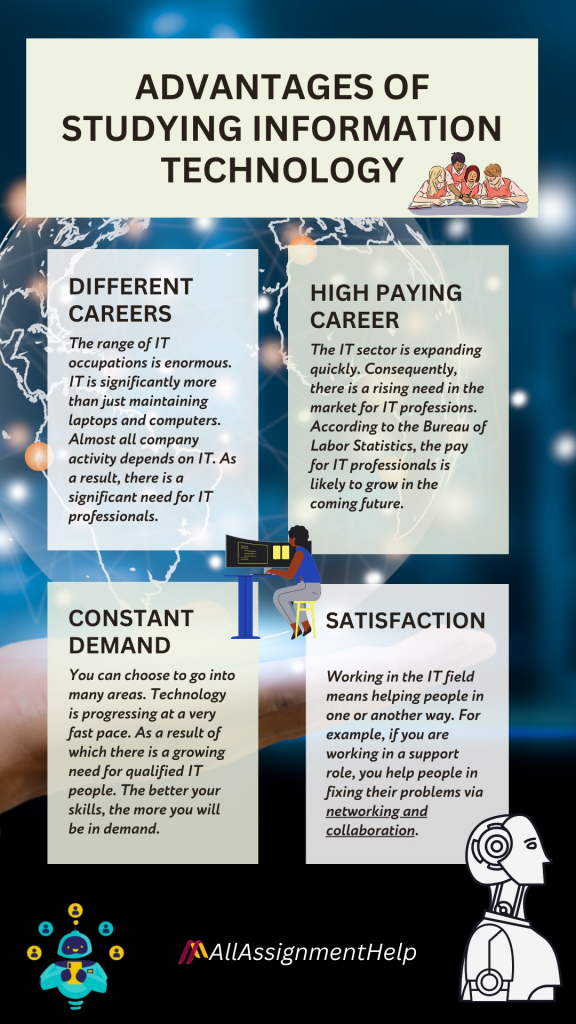
The range of IT occupations is enormous. IT is significantly more than just maintaining laptops and computers. Almost all company activity depends on IT. As a result, there is a significant need for IT professionals.
You can choose to become the following:
- Computer programmer
- Network Analyst
- Computer systems analyst
- Information security analyst
- Web developer
- ICT operations support
- ICT user support
- PC support
Seeing such diversity, one can imagine how vast the field is. Due to this, IT graduates don’t struggle much to get a job.
A career that pays well
The IT sector is expanding quickly. Consequently, there is a rising need in the market for IT professions. It is somewhat tough to become a pro in IT. Not only this, but you also need to put in a lot of effort. According to the Bureau of Labor Statistics, the pay for IT professionals is likely to grow in the coming future.
You can see what you are doing
The major of IT is the practical; you won’t just learn things but also make things. Therefore, with your IT knowledge, you can implement what you have learned. Certainly, Knowledge is essential to any field. In IT, you will get many chances to see what you are learning by doing it. There is a direct visible application of IT. No matter if you set up networks, build servers, and handle other things, you will be able to see what you are doing.
Constant demand
You can choose to go into many areas. Technology is progressing at a very fast pace. As a result of which there is a growing need for qualified IT people. The better your skills, the more you will be in demand. We all know about the scarcity of jobs in today’s world. However, this thing doesn’t apply to IT.
Satisfaction
Working in the IT field means helping people in one or another way. For example, if you are working in a support role, you help people in fixing their problems via networking and collaboration. You also give them advice on how to improve their work. On the other hand, if you’re a developer, you create solutions to all sorts of problems.
Whatever area you get into, it’s satisfying that you are part of an industry that makes people’s lives easy.
Also Read: Computer Technology: A very important topic in Information Technology
Top Online Information Technology Courses to Pursue in 2026
In 2026, IT courses are more practical, flexible, and live-interactive than ever. Most platforms now offer live classes, real-time projects, mentorship, and career support, making them highly valuable for students and working professionals.
Let’s explore the best online IT courses with live learning features.
1. Google IT Support Professional Certificate (Beginner-Friendly)
Platform: Google (via Coursera)
Why choose this course?
- Best for beginners entering IT
- Covers fundamentals like networking, troubleshooting, OS, and security
- Designed by industry experts
Live Course Details:
- Mostly self-paced with optional live mentorship sessions
- Weekly assignments and hands-on labs
- Duration: 3–6 months
- Certificate included
Career Roles: IT Support Specialist, Help Desk Technician
2. AWS Certified Cloud Practitioner (Cloud Computing)
Platform: Amazon Web Services
Why choose this course?
- Cloud computing is one of the most in-demand IT skills in 2026
- Learn cloud architecture, pricing, and deployment
Live Course Details:
- Live instructor-led training and doubt sessions (via training partners)
- Real-time cloud labs and simulations
- Duration: 1–3 months
Career Roles: Cloud Engineer, Cloud Support Associate
3. Cybersecurity Certification (CompTIA Security+)
Platform: CompTIA
Why choose this course?
- Cybersecurity jobs are rapidly growing
- Learn encryption, network security, and risk management
Live Course Details:
- Live hacking simulations and labs
- Interactive sessions with industry experts
- Duration: 2–4 months
Career Roles: Security Analyst, Ethical Hacker
4. Full Stack Web Development Course
Platforms: Udemy, Coursera
Why choose this course?
- Learn frontend, backend, and databases
- High demand in startups and IT companies
Live Course Details:
- Live coding sessions and project reviews
- Capstone projects (real websites and applications)
- Duration: 4–6 months
Career Roles: Web Developer, Software Engineer
5. Data Science and Analytics Course
Platforms: IBM, Coursera
Why choose this course?
- Data-driven decision-making is essential across industries
- Learn Python, machine learning, and data visualization
Live Course Details:
- Live project-based learning
- Real datasets and mentorship
- Duration: 4–8 months
Career Roles: Data Analyst, Data Scientist
6. Artificial Intelligence and Machine Learning Course
Platforms: DeepLearning.AI, Coursera
Why choose this course?
- AI is shaping the future of IT
- Learn machine learning, deep learning, and NLP
Live Course Details:
- Live sessions with industry projects
- Case studies and model-building exercises
- Duration: 6–12 months
Career Roles: AI Engineer, Machine Learning Engineer
7. Networking Course (CCNA)
Certification: Cisco
Why choose this course?
- Strong foundation in networking
- Covers IP connectivity, routing, and switching
Live Course Details:
- Live labs with routers and switches
- Instructor-led troubleshooting sessions
- Duration: 2–4 months
Career Roles: Network Engineer, System Administrator
Quick Comparison Table
| Course | Level | Duration | Live Features | Best For |
|---|---|---|---|---|
| Google IT Support | Beginner | 3–6 months | Mentorship and labs | Freshers |
| AWS Cloud | Beginner–Intermediate | 1–3 months | Live cloud labs | Cloud careers |
| Cybersecurity (Security+) | Intermediate | 2–4 months | Live simulations | Security roles |
| Full Stack Development | Beginner–Advanced | 4–6 months | Live coding sessions | Developers |
| Data Science | Intermediate | 4–8 months | Projects and mentorship | Analytics roles |
| AI and ML | Advanced | 6–12 months | Case studies and live sessions | Future tech roles |
| CCNA Networking | Intermediate | 2–4 months | Live networking labs | Network careers |
Also Read: Information Technology Jobs : A bright career path for Students
Final Words
Pursuing an Information Technology education is a powerful step toward building a rewarding and future-ready career. As technology continues to evolve and the demand for skilled IT professionals grows, choosing the right course can equip you with the knowledge, skills, and opportunities needed to succeed in this fast-changing industry.
Today’s education system offers a wide range of high-quality IT programs. Whether you choose a Bachelor’s degree to build a strong foundation or a Master’s program to specialize in a specific domain, you will gain practical exposure and industry-relevant expertise. These courses are designed to prepare you for real-world challenges and global career opportunities.
Take the leap, explore your options, and begin a journey that can open doors to exciting job prospects and endless innovation in the field of Information Technology.
However, if you ever find yourself struggling with IT assignments or coursework, professional assignment help services are always available to guide you and help you stay on track.
FAQs
1. What is Information Technology (IT)?
Information Technology (IT) refers to the use of computers, software, networks, and systems to store, process, and manage data. It plays a key role in businesses, education, healthcare, and almost every industry today.
2. What are the top Information Technology courses to pursue?
Some of the top IT courses include Cloud Computing, Cybersecurity, Data Science, Artificial Intelligence, Full Stack Development, and Networking certifications like CCNA. These courses are highly in demand and offer strong career opportunities.
3. Which IT course is best for beginners?
Beginner-friendly IT courses include IT Support, basic programming, and networking fundamentals. Courses like Google IT Support or introductory coding programs are ideal for those starting with no prior experience.
4. What are the career options after studying Information Technology?
After completing an IT course, you can work as a Software Developer, Network Engineer, Data Analyst, Cybersecurity Specialist, IT Support Expert, or Cloud Engineer, depending on your specialization.
5. Are online IT courses worth it in 2026?
Yes, online IT courses are highly valuable in 2026. Many platforms offer live classes, hands-on projects, certifications, and industry-relevant skills that help learners gain practical experience and improve job prospects.
Connect the explanation to the work your course actually requires
Use this guide beside the exact brief, course material and marking criteria for What Is Information Technology It Top Information Technology Courses.
- Read the complete brief.
- Identify the expected academic output.
- Follow the marking criteria and source rules.
- Check the final structure and referencing.
Raul Hegidges
Psychology · 4.8/5
For a topic such as “What is Information Technology (IT) | Top Information Technology Courses”, a tutor with a published background in Psychology offers a useful subject-matching option.
Raul’s published profile combines psychology writing experience with cognitive science, quantitative research and clinical reasoning. Master’s in Psychology, University of Queensland
View established tutor profile ↗Relevant subject areas
- Psychology and Cognitive Science
- Numeracy and Quantitative Research
- Clinical Reasoning
- Experiential Learning
Find another explanation across the complete blog
This search uses WordPress itself, so it can reach articles beyond the 20 shown on the dashboard.
Connect What Is Information Technology It Top Information Technology Courses to the task in front of you
Keep the brief, marking criteria, required evidence and submission format visible while you work.