Table of Contents
The 20th century opened with both excitement and uncertainty, ushering in a transformative era for humankind. During this time, literary modernism (spanning from the late 19th to the mid-20th century) emerged as a groundbreaking movement that redefined writing and reshaped the course of literature.
Modernist writers challenged conventional norms by experimenting with non-linear plots and stream-of-consciousness techniques to explore inner emotions and personal experiences. This artistic shift brought a more reflective and psychological depth to literature. Prominent figures of this movement include W.B. Yeats, Joseph Conrad, Samuel Beckett, D.H. Lawrence, Virginia Woolf, T.S. Eliot, and William Carlos Williams.
This blog by AllAssignmentHelp explores key aspects of modernism, helping you understand its influence on literature. Read on to clear any doubts and gain insights into this fascinating literary period!
Struggling with English classes?
Let experts handle your assignments, discussions, and exams—stress-free.
✍️ Take My Online English ClassIntroduction to the Modern Period
The Modern Period in English literature, spanning from the early 20th century to 1965, marked one of the most transformative phases in literary history. It represented a decisive break from centuries of tradition, as writers sought to reinterpret reality through experimentation, individualism, and bold new perspectives on the human experience.
Break from Tradition
Earlier literary movements valued order, harmony, and adherence to form, but modernism disrupted these conventions. Writers began exploring fragmented structures, non-linear storytelling, and stream-of-consciousness narratives to mirror the complexities of modern life. This artistic rebellion emphasized subjectivity, inner consciousness, and the ambiguity of truth, paving the way for more authentic expressions of thought and emotion.
Cultural Upheavals and Influences
The rise of modernism was not merely a stylistic evolution, it was deeply rooted in the profound cultural and intellectual transformations of the era. Key influences included:
- The decline of religious and moral absolutes, leading writers to question meaning and purpose in a seemingly indifferent world.
- Rapid industrialization and urbanization, which altered social structures and fueled feelings of isolation amid progress.
- Advancements in psychology and existential philosophy, particularly the works of Freud and Nietzsche, which encouraged exploration of the subconscious mind and human existence.
These forces created a pervasive sense of alienation and disillusionment, reflected vividly in modernist texts. The modern writer was no longer a detached observer but an active participant, wrestling with chaos, uncertainty, and the fragmented nature of reality itself.
Impact of the World Wars
One of the most defining aspects of the Modern Period was the devastation caused by the two World Wars:
- World War I (1914–1919): Shattered the optimism of the 19th century, leaving societies in a state of disillusionment.
- World War II (1939–1945): Deepened global trauma, reinforcing themes of chaos, destruction, and existential despair in literature.
The aftermath of these wars influenced modernist writers to explore themes of loss, fragmentation, and the instability of human existence.
Key Literary Characteristics
Modernist literature introduced several defining features, including:
Experimentation: Abandoning traditional plot structures in favor of non-linear narratives.
Subjectivity: Emphasizing individual perception and psychological depth.
Symbolism & Imagery: Using abstract symbols to convey deeper meanings.
Alienation & Disillusionment: Reflecting the isolation and uncertainty of the modern world.
Prominent modernist writers include T.S. Eliot, Virginia Woolf, James Joyce, and Ezra Pound, whose works challenged literary norms and reshaped the landscape of English literature.
Five Traits of Modernist Literature
Here are a few elements that modernist literature has in common.
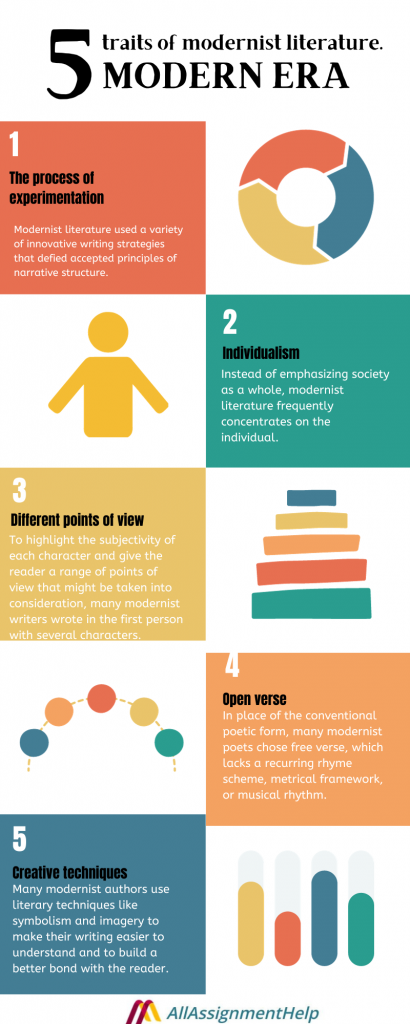
1. The process of experimentation: Modernist literature used a variety of innovative writing strategies that defied accepted principles of narrative structure. The use of mixed images and themes, absurdity, nonlinear tales, and stream of consciousness, a free-flowing internal monologue, are a few of these strategies.
2. Individualism: Instead of emphasizing society as a whole, modernist literature frequently concentrates on the individual. Stories follow characters as they adjust to a changing environment, usually coping with challenging situations and issues.
3. Different points of view: To highlight the subjectivity of each character and give the reader a range of points of view that might be taken into consideration, many modernist writers wrote in the first person with several characters.
4. Open verse: In place of the conventional poetic form, many modernist poets chose free verse, which lacks a recurring rhyme scheme, metrical framework, or musical rhythm.
5. Creative techniques: Many modernist authors use literary techniques like symbolism and imagery to make their writing easier to understand and to build a better bond with the reader.
Key Points to Remember About the Modern Period
English literature of the Modern Age emerged at the beginning of the 20th century, bringing a revolutionary shift in literary themes and styles. Unlike the structured morality of the Victorian era, modernist literature embraced experimentation, individualism, and psychological depth. Writers such as T.S. Eliot, Virginia Woolf, and James Joyce introduced fragmented narratives, stream-of-consciousness techniques, and existential themes, making modernist literature a fascinating yet complex subject to study.
Rebellion Against Victorian Hypocrisy
The Victorian Age was often regarded as hypocritical and restrictive, with ideals that appeared superficial and outdated. Many modernist writers developed a rebellious attitude toward Victorian values. What was once considered beautiful and honorable in the Victorian era was now viewed as artificial and oppressive by modernist thinkers. One key difference was the lack of critical thinking among Victorians, people rarely questioned authority, whether it was the government, the church, or social norms.
The Rise of Critical Thinking and Questioning Authority
During the Victorian period, people generally accepted laws and moral standards without questioning them. They adhered to the voices of those in power, including religious institutions, without resistance. However, the generation that followed embraced critical thinking, challenging established beliefs and questioning authority. Writers of the Modern Age strongly opposed the rigid ideologies of their predecessors, sparking a literary revolution.
George Bernard Shaw: A Pioneer of Intellectual Rebellion
The Modern Age replaced the Victorians’ simple belief systems with a modern man’s desire to question and explore. George Bernard Shaw was a leading figure in this intellectual rebellion. He attacked both religious superstitions and blind faith in science, advocating for a more interrogative mindset. Shaw openly challenged political leaders and religious authorities, urging people to question morality, religion, and social norms instead of blindly accepting them. His works encouraged society to rethink old values and embrace a more rational and questioning approach to life.
If you want to dive deep into the intricacies of the Modern Period but find your online class schedule overwhelming, keeping up with readings, discussions, and assignments can be challenging. In such cases, you can hire someone to take your online class and help you navigate complex literary concepts. Professional assistance ensures that you don’t miss key insights while managing your workload effectively.
The Transition From the Victorian Period to the Modern Period
It is nearly a fact to state that no other transitional period in English literature has been as rich in its diversity and complexity, in the confluence of advancement and regression at the same time. Writing is always a reflection of life and also a product of the times, and modernist writing has been more influenced by its social environment than literature from other eras. In the first decades of the century, new technologies and ideas were quickly changing the globe, and social life in all of its diverse physical, intellectual, political, economic, and moral facets had essentially begun afresh.
Changes in the literature
There were various changes took place in the field of literature also during the modern period. The imaginative writing, verses, and structure of the verses of the Victorian period became obsolete. Writers’ work started losing the magic they used to have in the previous age. Victorian writers were becoming rancid and their works were failing to evoke the spirit of the readers. Art has to be renewed in order to revitalize the readers. However Victorian artworks lacked the surprising elements and freshness in the content.
Declination of sentiments and values
In the modern world, people value independence and prefer not to be bound by parental authority. In contrast, Victorians prioritized family life and saw themselves as devoted family members.
Additionally, the concept of love changed significantly. While Victorians viewed love as deeply romantic and emotional, modern times reduced it to mere physical attraction and self-interest. This shift reflects a decline in traditional values, emotions, and deep feelings.
Literature of the Modern Period mirrors this transformation. If writers continued to focus on Victorian themes, their work would no longer feel relevant or impactful. As a result, modern literature tends to show less enthusiasm for love, natural beauty, and deep sentiment. Instead, modern writers introduce fresh perspectives that resonate with contemporary audiences
Age of machinery
There is no doubt that machinery has taken over modern life, earning this era the title “The Age of Machinery.” While technological advancements have made life more comfortable and increased production efficiency, they have also led to growing materialism among people.
Although machines have simplified daily tasks and boosted productivity, they have also turned human life into a rigid, mechanical routine, much like a clock, where people follow schedules rather than their own will. This structured and demanding lifestyle has created a sense of distress, leaving many feeling trapped in a system that prioritizes efficiency over individuality.
If you’re a student studying English literature and having trouble comprehending particular concepts or finishing assignments related to those concepts, you should consider seeking English homework help. The major benefit of hiring professionals is that you may get good grades, understand your English concepts better, and develop your knowledge.
Literature of the Modern period
Everything in Victorian culture suffered greatly from a large deal of contempt during this all-encompassing and thorough transition process. New spheres of experience were included, outdated literary expression theories were abandoned, and new ones emerged. All branches of the period’s literature, including poetry, the novel, and drama, reflect this.
Literary trends
The trend of modernism emerged after the end of the First World War. They include:
- Stream of consciousness
- Surrealism
- Cubism
- Dadaism
- Futurism
- Expressionism
- Imagism
- Symbolism
a) Modern English poetry
Modern English poetry is a sort of revolution against the traditional thoughts and types of Victorian-era poetry. The Red Wheelbarrow, The Embankment, Darkness, and Image are a few of the masterpieces of modern English poetry. There is no doubt that these poems are the best in their way, but the major problem arises when it comes to understanding their meaning. Students studying English literature often experience issues comprehending the serious compression of information in these lyrics.
If you find yourself struggling to understand English poetry and literature, constantly thinking, How can I find someone to take my online English class for me? Then you’re not alone. The good news is that you can turn this into reality by hiring professionals from a reliable assignment help service provider.
With expert assistance, you no longer have to worry about grammar fundamentals, academic vocabulary, or language proficiency assessments. These professionals ensure that you grasp complex literary concepts while reducing your academic stress.
b) Modern English novels
They rein the literature in the initial three decades of the twentieth century, these years are known as the golden period of modernist novels.
c) The development of 20th-century English drama
George Bernard Shaw and Oscar Wilde were the most known, praised and celebrated drama writers of the nineteenth century. They were highly popular in the last decade of the century. One can say that they marked the beginning of the modern drama. However, these two eminent writers never brought many variations or innovations in the writing techniques and types.
2. Modern period: Artistic features
Rapid advancements in technology and industry have inspired artists to portray the world in fresh and creative ways. The end result was art that experimented with minimalism and incorporated new colours and other forms.
Read More: British Literature and Its Division Into Various Periods
a) Modernism
Modernism is a quite unique and complex movement in almost all the creative areas. It began at the end of the 19th century. During this period literature was the inception of the greatest renaissance of the 20th century. When the First World War ended, a number of literary trends of the modern period such as Dadaism, stream of consciousness, futurism, cubism, expressionism and imagism emerged.
b) Basic characteristics of modernism:
The foundation of modernism lies in the theory of psychoanalysis and irrational philosophy. One of the main characteristics of the modern period is “the dehumanization of art”. Some other crucial themes of modernism involve alienated, ill and distorted relations between man and man, man and his own self, man and society and most importantly between man and nature.
The pillars of modernism
- David Herbert Lawrence (1885-1930) – Sons and Lovers
- James Joyce (1882- 1941) Ulysses
- Thomas Stearns Eliot (1888- 1965) Murder in the Cathedral
- George Bernard Shaw (1856- 1950) Mrs. Warrant’s Profession
- William Butler Yeats (1865- 1939) The Land of Heart’s Desire
- John Galsworthy (1867- 1933) The Man of Property
These authors are regarded as major figures in modernist literature. Reading their literary works can help you become familiar with the main modernist concepts. If you need some guidance with any literary device, technique, or work, you can rely on an online assignment service for assistance. The talented English experts at these websites have extensive knowledge of everything and can assist you with everything you need.
Let’s know more about the lives, thoughts and works of some major representatives of this age:
D. H. Lawrence
David Herber Lawrence was born in 1885 in a mining village which lies in Nottinghamshire. He was reared by parents who belonged to different classes and saw a silent conflict of views. His father was a man who acquired little education and led his life as a coal miner. On the other hand, his mother was educated and had experience working as a teacher. She used to think that she her marriage was beneath her and had a strong desire to provide education to her sons so they could stay away from the tough life of the coal miners.
His personal life had a great impact on this literary work. It can be read in his masterpiece “Sons and Lovers” as well. In that, he has portrayed the consistent conflict between a strong strong-willed, up-climbing mother and a coarse, energetic, earthy but often drunken father. “Sons and Lovers” is considered an autobiographical novel.
His masterpieces include:
- Lady Chatterley’s Lover
- The Rainbow
- Woman in Love
The theme in the novels of Lawrence
In his opinion, the bourgeois industrialization or civilization, which made its realization at the cost of ravishing the land, started the catastrophic uprooting of man from nature and caused the distortion of personality, the corruption of the will, and the dominance of sterile intellect over the authentic inward passions of man.
- D.H. Lawrence strongly opposed the mechanical civilization of his time in his writings.
- He believed that materialistic civilization and industrialization led to a detachment between humans and nature.
- He argued that these factors were responsible for destroying lives and land.
Lawrence saw materialism as the root cause of:
- Corruption of human will
- Dominance of sterile intellect
- Suppression of true inward passion
- Distortion of personality
He viewed mechanization as a force that turned humans into mere animated matter. His writings were deeply influenced by his agonized perspective on the dehumanizing effects of industrialization on human sensitivity.
Read More: A Complete Guide on Reflection Paper
Brief Analysis of Lawrence’s Masterpiece
Sons and Lovers – Introduction
Sons and Lovers is known as one of the best writings of Lawrence. It is more or less an autobiographical piece which is written in vivid episodes and a straightforward narrative. The novel follows a chronological sequence, where the story begins with the marriage of Mr. and Mrs. Morel, parents of Paul. Mrs. Morel belongs to a well-settled middle-class family who is highly ambitious. Lawrence presents her as “a woman of character and refinement”. She is an intelligent, strong-willed woman and falls in love with an energetic and sensuous coal miner named Walter Morel. In the course of her love, she marries beneath her own class and enters into a chaotic life full of everyday struggles.
Sons and Lovers – Theme
D. H. Lawrence is remembered as one of the first writers who brought the theme of psychology into literature. Through his works, he presented a number of psychological themes in a precise manner. Lawrence had an opinion that the life impulse or sexual impulse is the safest way to the psychological development of human beings. For him, human sexuality had some different notions; he considered it a symbol of the force of life. He showcases the subtle and deep psychological experience of individuals and relationships. Through Sons and Lovers, he began a new territory of novels.
Analysis of the two main characters of Sons and Lovers
Mrs. Gertrude Morel
She is the first major character and protagonist in the story. She marries beneath her class in her fascination with energetic Walter Morel, a coal miner. With the passage of time, she comes one after another, struggling with both financial and emotional aspects of her marriage. Her unhappiness with her marriage creates detachment with her husband, and she devotes her life to their 4 kids.
Paul Morel
After Gertrude Morel, her son Paul Morel takes over the role of main protagonist from the second half of the novel. He emerges as a main character after his elder brother William dies. William Morel was the first child of Mrs Morel and her favourite among all children. When he dies, it is Paul who becomes her favourite. Throughout the novel, he struggles to bring a balance between his love for Mrs. Morel and other relationships with women.
James Joyce
James Joyce was born in Dublin in 1882. He belonged to a Catholic family and got his education from Catholic schools. During his studies he went through a phase of religious zest, however, he rejected the Catholic Church. He was influenced was Ibsen and inspired by his views, Joyce took literary mission as a career. He was sternly against the bigotry of Philistines in Dublin.
His most remarkable works include:
- A Portrait of the Artist as a Young Man
- Dubliners
- The theme in the works of Joyce
- Ulysses
Joyce brought a number of changes in the conventional forms of fiction by generating a unique medium of art. He portrayed the crisis and chaos of consciousness in his contemporary world. He brought light to the stream of consciousness as a genre in modern period literature.
Brief analysis of Joyce’s writing
Ulysses
It gives insight into a man’s life on a day (16 June 1904). The main characters of Ulysses are An Irish Jew, his wife, Leopold Bloom, Stephen Dedalus and Marion Tweedy Bloom. The novel’s division is into eighteen chapters, resembling 18 hours of the day.
Conclusion
All the institutions that once rebelled against now adhere to modernism as the new tradition. The grand story of modernism was broken down by postmodern artists with the goal of studying cultural norms, politics, and social ideology in their specific environment, pushing the boundaries of modernism to new heights. The use of new media and technology, such as video, techniques of bricolage and collage, the collision of art, and the appropriation of older styles within a contemporary context are characteristics of postmodern art.
To conclude everything, in short, I would say there are many more things you should know about the modern period and the literary development of this era. The more you study the works of this modernist literature, the more you will admire them. We all know that English literature can be both interesting and difficult at the same time.
FAQs
1. What is the Modern Period in English Literature?
The Modern Period refers to the era in English literature from the early 20th century to around 1965. It was marked by a break from traditional forms of writing and the rise of modernism, a movement that emphasized experimentation, individualism, and new ways of representing reality.
2. What are the main characteristics of modern literature?
Modern literature is known for:
- Experimentation in style and structure
- Stream-of-consciousness narration
- Psychological depth and focus on inner experiences
- Fragmentation and non-linear storytelling
- Themes of alienation, loss, and uncertainty
3. What caused the rise of the Modern Period?
The Modern Period emerged as a response to massive cultural and social changes, including:
- The World Wars
- Industrialization and urbanization
- Decline of religion and traditional values
- Influence of psychology and existentialism
4. Who are some famous modernist writers?
Prominent modernist authors include T.S. Eliot, Virginia Woolf, James Joyce, W.B. Yeats, D.H. Lawrence, Joseph Conrad, Ezra Pound, and Samuel Beckett.
5. What is meant by ‘stream of consciousness’ in modern literature?
‘Stream of consciousness’ is a narrative technique that presents the continuous flow of a character’s thoughts and feelings, often in a fragmented or unstructured way. It reflects how the human mind actually works. Virginia Woolf and James Joyce are well-known for this style.
6. How did World War I influence modern literature?
World War I caused widespread disillusionment and trauma, leading writers to question traditional beliefs about progress, heroism, and morality. This resulted in darker, more introspective, and experimental writing styles.
7. What are the central themes of modernist literature?
Key themes include:
- Alienation and isolation
- Disillusionment and fragmentation
- Search for meaning in a chaotic world
- Psychological exploration
- Rejection of absolute truths
8. How does modernism differ from Victorian literature?
Victorian literature emphasized morality, realism, and social order, while modernism broke these conventions. Modernist writers used symbolism, irony, and ambiguity to capture the complexity and uncertainty of modern life.
9. What literary techniques define the Modern Period?
Modern writers used techniques such as:
- Free verse poetry
- Stream-of-consciousness narration
- Fragmented plots
- Multiple perspectives
- Symbolism and mythic references
10. What is the significance of the Modern Period in literary history?
The Modern Period reshaped how literature represented reality. It expanded the boundaries of language, form, and thought, influencing nearly all subsequent literary movements, including postmodernism and contemporary fiction.