Table of Contents
Atychiphobia is the fear of failing. It’s a strong and overwhelming feeling that can make people scared to take on tasks or chase their goals. People with this fear often believe they will fail, even when there’s no real reason for that belief. This fear can affect the way they think, feel, and act.
A little fear of failure is normal. It can help us stay focused and prepare better. But when the fear becomes too strong, it can hold you back and make you feel alone.
At some point in life, you will have to face the fear of failure. You can either confront it and rise above it, or let it push you aside. The choice is always yours.
If you are one of those students who are familiar with this situation, then this blog by AllAssignmentHelp.com would be quite helpful for you to overcome your fear of failure.
What Makes People Fear Failure?
The fear of failing, known as atychiphobia, is not just the worry of doing something wrong. It goes deeper. It is the fear of not being “good enough” and the belief that any failure will disappoint others or yourself. This fear becomes a general feeling that you will not measure up, no matter how hard you try.
What this fear often looks like
- Constant worry about making mistakes
- Feeling judged, even when no one is judging
- Believing you won’t succeed before you even begin
- Avoiding challenges or opportunities
- Procrastinating or delaying important tasks
- Feeling stuck or unmotivated
How does the fear affect you
- Emotional impact: self-doubt, sadness, stress
- Mental impact: overthinking, negative thoughts, comparing yourself to others
- Behavioural impact: hesitation, avoidance, quitting early
When fear can be helpful
A mild fear of failure isn’t always bad. Sometimes it can:
- Increase focus
- Give you a healthy push
- Motivate you to prepare better
- Encourage you to stay disciplined
When fear becomes harmful
But when the fear grows too strong, it can:
- Block your growth
- Stop you from trying new things
- Affect your confidence
- Make you feel isolated
- Limit your achievements
Why does this fear develop
People may develop atychiphobia due to:
- Past failures
- High expectations from family or society
- Perfectionism
- Fear of judgement
- Low self-esteem
Let’s understand this with a simple example. Students who enrol in online courses often feel relaxed and enjoy the flexibility of learning at their own pace. But when it’s time to participate in online exams, which are necessary to complete the course, they start feeling stressed and uncertain. Because of this fear, many students end up reaching out to professional writing experts at online class help sites and ask, Can you do my online exam for me?
This clearly shows how the fear of failure affects their mind. Instead of trusting their abilities, the anxiety of not performing well pushes them to look for shortcuts or external help. It reflects how deeply fear can influence decisions, confidence, and behaviour.
The real challenge
At some point, everyone must face the fear of failing.
You have two choices:
- Face it and rise, or
- Avoid it and let it control your path
The direction you choose shapes your confidence, your progress, and your future.
7 Signs you’re being hampered by Fear of Failure
Procrastination, worry, despair, and even physical symptoms like fatigue or headaches are all indications of fear of failure. A little bit of concern over a project’s outcome or what others may think is completely acceptable, but it becomes an issue when it prevents you from making progress toward a goal.
Here are seven indicators that you have a severe fear of failing:
- A lack of optimism for the future
- Persistent worry
- Fears of what other people will think of you if you fail or perform poorly
- Frequently putting things off
- High propensity to get sidetracked by unimportant or irrelevant things
- Avoiding activities or people connected to a project or broad objective
- Physical sign
What Leads to Fear of Failure?
Everyone avoids risky or uncomfortable situations because of the fear of failure. But this fear also stops us from reaching our true potential. When fear takes over, it keeps us from trying new things, makes us doubt ourselves, slows our personal growth, and can even push us to compromise our values just to avoid “failing.”
Main Causes of the Fear of Failure
1. Early Childhood Environment
Your early environment shapes how you see success and failure.
If you grew up in a home where failure was treated harshly, you may have learned to fear it.
Possible effects include:
- Low self-esteem
- Constant anxiety
- Panic attacks
- Depression
- Deep feelings of shame
- Fear-based thinking
Common childhood triggers:
- Caregivers who punished mistakes
- Unrealistic expectations
- Rules based on fear
- Being compared with others
- Little emotional support
These experiences teach a child that failure is dangerous, embarrassing, or unacceptable, and that belief often carries into adulthood.
2. Perfectionist Tendencies
Perfectionists see failure as unbearable.
The thought of doing something imperfectly feels worse than not doing it at all.
Signs of perfectionism:
- Fear of leaving your comfort zone
- Avoiding tasks unless success is guaranteed
- Feeling embarrassed by small mistakes
- Setting impossible standards
Perfectionism often begins in childhood when:
- Anything less than perfect was treated as a failure
- Praise was given only for flawless work
- High expectations became the norm
At its core, perfectionism is driven by ego, the need to be accepted, admired, or seen as capable.
3. Over-Personalisation
Over-personalisation means you attach your identity to your failures.
Instead of seeing failure as a single event, you see it as a reflection of your worth.
This can lead to:
- Believing people will judge you harshly
- Thinking one failure defines your whole character
- Feeling ashamed to try again
- Avoiding opportunities to protect your image
When your ego gets too involved, even small mistakes can feel like a deep personal attack.
Also Read: Ten Things to Do During the Spring Holidays 2023
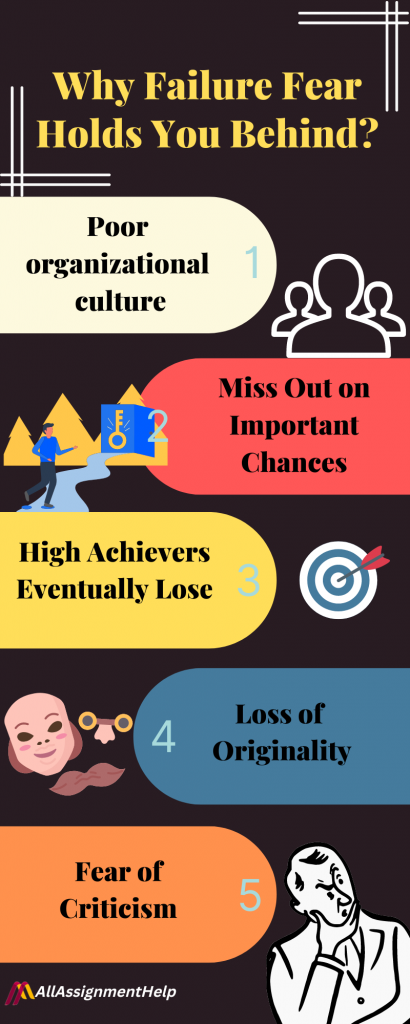
Why Failure Fear Holds You Behind?
Everyone frequently hears advice to be optimistic. Perhaps every person also needs to understand that the challenging aspects of their lives and experiences are just as crucial to the ability to succeed at work, in academics, and in professional life.
If you are a student and struggling to cope up with your daily academic tasks of writing due to which you are spending restless nights, in that situation, availing online assignment help service would be quite helpful for you as well as it can cater to all your worries of writing and help you to have stress-free academics without the fear of failure.
Poor organizational culture
Today, too many businesses have “cultures of perfection,” according to which any failure is unacceptable. Imagine the anxiety and fear within such a company. the fabrication of information, falsification of data, and hiding of issues up until they reach crises that can no longer be ignored.
Miss Out on Important Chances
Many people fail as a result of their ego-driven dedication to what has previously worked. People who are further along in their careers frequently exhibit this, particularly those who produced their names by ushering in a significant change years ago. They are hesitant to innovate further because they are worried about failing. Furthermore, they believe that the success of something new may even show that their earlier accomplishments weren’t all that great after all.
The same applies to academic students as they need to deal with multiple assignments on a tight schedule. Due to this, often they are unable to finish their assessments prior to the deadline and eventually end up losing their precious marks. This deeply roots the fear of failure in students’ minds and this affects their performance in the long run.
However, there are several methods that students can utilize to avoid such last-minute hustle related to the assignment submission. They can simply seek online class help and resolve all their worries of writing.
High Achievers Eventually Lose
Successful people enjoy winning and setting high goals. A positive characteristic, like achievement, is on the verge of becoming a significant barrier when it dominates a person’s life to an excessive degree. For many successful people, achievement is a strong value. In every endeavour they pursue, in school, college, sports, the arts, hobbies, and employment, they succeed. Each new accomplishment strengthens the significance of their lives.
Loss of Originality
Everyone enjoys success. The issue arises when fear of failure rules, when you are unable to accept that mistakes are inevitable or understand how crucial trial and error is to come up with the most original solution. You will make more mistakes the more creative you are.
Everyone enjoys success. The issue arises when fear of failure rules, when you are unable to accept that mistakes are inevitable or understand how crucial trial and error is to come up with the most original solution. You will make more mistakes the more creative you are.
Also Read: Why Teachers Should Encourage Students To Write Assignments?
How to Get Rid of Failure Fear?
Don’t escape; face it head-on and without fear
You will inevitably experience ups and downs in this life and might occasionally succeed at something, but the next day it might not go as planned. You should therefore be prepared to accept both success and failure in this life. The best course of action would be for you to confront your fear rather than run from it. You should tell yourself that if you put in the necessary effort, you can overcome your fears and experience success.
Try to determine what caused your fear
You can easily comprehend that there may be a reason why you are afraid. It would be better for you to discover the cause of the fear if you are trying to overcome it. Give yourself plenty of time to figure it out. Try to determine how the fear entered your mind and what gave it the opportunity to grow. It is strongly advised because improvement in anything requires assessment.
Find the most effective coping strategy for the fear
In an effort to conquer your fear, you look into its origins. Finding the most effective ways to deal with the fear is the next step you must take after analysing your issue. You shouldn’t be overly rigid in your approach to overcoming the fear; instead, focus on maintaining good self-control. Additionally, you should be proactive and think positively rather than dwelling on the issue.
Rephrase Your Goal-Related Beliefs
Sometimes having an all-or-nothing mindset leaves you with nothing. Have a clear idea of what you want to achieve, but make acquiring new knowledge a part of it. You are much less likely to fail if you develop a growth mindset where you strive for learning and development. Failure is a part of that mind frame, but as long as they succeed in telling great stories, all of the obstacles are just growth potential.
Imagine every outcome that might occur
You might hesitate to accept a new job out of fear of the unknown. Consider the advantages and disadvantages, as well as possible outcomes, before making such a significant choice. Understanding potential outcomes might assist you in breaking out of a rut.
View the Worst-Case Situation
Sometimes, the worst-case scenario could be utterly disastrous. When bad things happen, they frequently don’t spell the end of the world. It’s critical to consider how bad the worst-case scenario would be in the context of your entire life. They occasionally give situations more authority than they merit. A failure is usually not irreparable.
How to reduce fear of failure
Workplace pressure can feel particularly intense depending on your career. Here are some suggestions to help you overcome your fear at work.
Recognize the advantages of prior failures
Even if you don’t immediately notice them, many negative experiences have hidden advantages. Examine your past transgressions and how they affected you. Perhaps a humiliating error or a missed deadline improved your attention to detail or efficiency. Even though these situations may have been painful, you persisted.
If you are a student and you surely have experienced these words. Also may have faced similar situations. To reduce such errors, availing proofreading and editing services can be a quite smart idea for you.
Acceptance is crucial
Nobody enjoys making mistakes. They are at best embarrassing. At worst, they influence your loved ones or members of your team. But they can’t be avoided. No matter how hard you try, you will err; it’s part of being human. You stop evolving in your life and career when you stop making mistakes.
Identify the issue
According to psychologists, there are three coping mechanisms used by individuals. These are problem-focused, sentimental, and untrusting. Take the example of being concerned about snakes in your garden. You could make the decision to never go outside again, persuade yourself that having snakes in your backyard isn’t all that bad, or go outside and get rid of the snakes.
Recover from your errors
A psychologist in America conducted research on how first-graders felt about an upcoming test forty years ago. Some saw it as a chance to gauge their level of learning, while others saw it as a chance to measure up against their peers. They are referred to as task-oriented when they are learning-focused. To increase motivation, confidence, self-control, academic performance, and reduce anxiety, a task-oriented environment should be created.
Accept the ambiguity
In both sport and education, the outcome can occasionally be used to hide flaws. Young people may believe that everything is fine because they received a good grade or won their most recent competition. On the other hand, a bad grade or a loss makes everything seem bleak. Black-and-white thinking of this nature can cause stress, anxiety, and brittle self-esteem. Better indicators and those that are probably more likely to lead to the high marks and victories that they so desperately want are your mindset, dedication, and what you’ve understood.
No-shame rule
The fear of humiliation and shame is the most prevalent fear of failure among young people. This is evident in sportspeople who play it too safe because they don’t want to be the ones who mess up or in students who refuse to answer a question in class for fear of looking bad in front of their teammates. These people believe that trying is not cool. Attempting and failing is uncool, without a doubt.
Conclusion
To sum up, failure itself is not dangerous. It merely serves as an indicator of your level at the moment. People fear the unfavorable outcomes they believe will occur as a result. The fear of shame and embarrassment is the most prevalent of these. Young people can overcome their fear of failure using a variety of techniques and strategies, which will encourage them to keep going and reach their full potential. You might frequently find writing academic assignments to be difficult. In such circumstances, you shouldn’t be afraid and should instead choose online assignment help. Authors provide you with excellent assistance in completing your assignment, and you can anticipate receiving high grades in the classroom.
FAQ
1. What is the fear of failure?
The fear of failure is the intense worry that you might not succeed. It often comes with self-doubt, overthinking, and avoiding tasks because you assume the outcome will be negative.
2. What causes the fear of failure?
Common causes include childhood pressure, perfectionism, past negative experiences, high expectations, and the habit of linking your self-worth to your achievements.
3. How can I recognize if I have a fear of failure?
You may notice signs like:
- Avoiding new challenges
- Procrastinating
- Feeling anxious before starting tasks
- Overthinking every decision
- Believing you must be perfect
4. What are some effective ways to overcome the fear of failure?
Helpful strategies include:
- Setting small, achievable goals
- Changing negative thoughts into positive ones
- Accepting mistakes as part of learning
- Practicing self-compassion
- Celebrating small wins
- Gradually facing your fears instead of running from them
5. Can fear of failure be completely removed?
It may not disappear entirely, but it can be managed. With practice, self-awareness, and healthy habits, you can reduce its impact and build confidence to face challenges without fear holding you back.