Top English Strategies to Improve Text Analysis Skills
What this article will help you understand
"He is wrapped up in bureaucracy." Can you identify the English technique used in this sentence? It's a metaphor. Well, it is only one component that adds thrills to a sentence. However, there are many different types of other English learning techniques used to tell a story to improve its quality. English writing techniques are
What are you trying to do with this topic?
Choose the closest task and the page will point you towards a useful next step.
Start with the central concept and the terminology used in the article.
Open the closest route ↗Connect the explanation to the question, learning outcomes and marking criteria.
Open the closest route ↗Review evidence, structure, referencing and the exact submission requirements.
Open the closest route ↗Do you have enough information to begin?
Select what you already have. Nothing is submitted from this checklist.
When these details are together, the requirement can be reviewed in context.
Assignment Help USA ↗Table of Contents
“He is wrapped up in bureaucracy.” Can you identify the English technique used in this sentence? It’s a metaphor. Well, it is only one component that adds thrills to a sentence. However, there are many different types of other English learning techniques used to tell a story to improve its quality.
English writing techniques are necessary for improving your writing. You can make your work memorable by utilizing any of the techniques. However, you must excel at both understanding and executing the elements. But wait, there’s more! While understanding them is important, applying them practically is a whole different ball game.
Don’t worry! We will give you a deeper look if you wish to understand the English language and its particularities better. Keep reading this blog of All Assignment Help to understand different English techniques to understand written text and incorporate them into your work to impress the professor.
📚 Falling Behind in Your Online English Class?
Struggling with assignments, grammar, or deadlines? Don’t let stress affect your grades. Get expert support and stay ahead in your English class without the pressure.
Take My Online English Class for Me →✔ Expert English Tutors ✔ Timely Submissions ✔ 100% Confidential Support
What Are English Techniques?
English techniques, also known as literary or rhetorical techniques, are methods used by writers and speakers to express ideas clearly, create emotional impact, and engage their audience. These techniques improve the overall effectiveness of communication and make any piece of writing or speech more powerful.
By using English literary techniques, you can shape how readers think and feel. They can be applied to all types of content, such as articles, assignments, essays, and novels. These techniques help you inform, persuade, inspire, or simply connect better with your audience.
At times, students may fail to use these techniques in their assignments due to a lack of understanding. If you struggle with applying literary techniques, you can seek support from reliable online assignment help services. An experienced English assignment writer can guide you in understanding these techniques and show you how to use them effectively in your work.
Read Here: The Ten Most Confusing Words in the English Language
Why Use English Techniques?
Before we discuss some English language techniques, let’s explore why it matters so much for writers, authors, and students to use these strategies in the text:
- Increased Descriptive Capability: Writers can create a more vivid image in the reader’s imagination by using literary methods. For example, descriptions can become more interesting and relevant by utilizing metaphors, similes, or images.
- Participation and Emotional Effects: Writers can add additional energy and emotional resonance to their work by using techniques like personification, hyperbole, or onomatopoeia. These techniques enable the writer to invoke particular feelings in the reader by creating a feeling of environment and mood.
- Communication and Persuasion: Literary techniques in English can be used to highlight important concepts, strengthen arguments, and influence the reader’s viewpoint. For example, you can convince the reader by using emotional appeals or rhetorical questions.
- Improved Interpretation and Analysis: Readers who understand literary devices are better able to analyze texts by identifying the techniques implemented and how they affect the text’s tone and meaning. Additionally, readers could be better able to figure out the writer’s goals and message.
English techniques are common and important in English literature homework for students. They are purposefully used to evoke more profound meanings and set a tone for the environment. Hence, students need to understand the different types of English techniques and how to use them to analyze the text better to write an impactful homework.
How to Use English Techniques to Analyse Any Written Text?
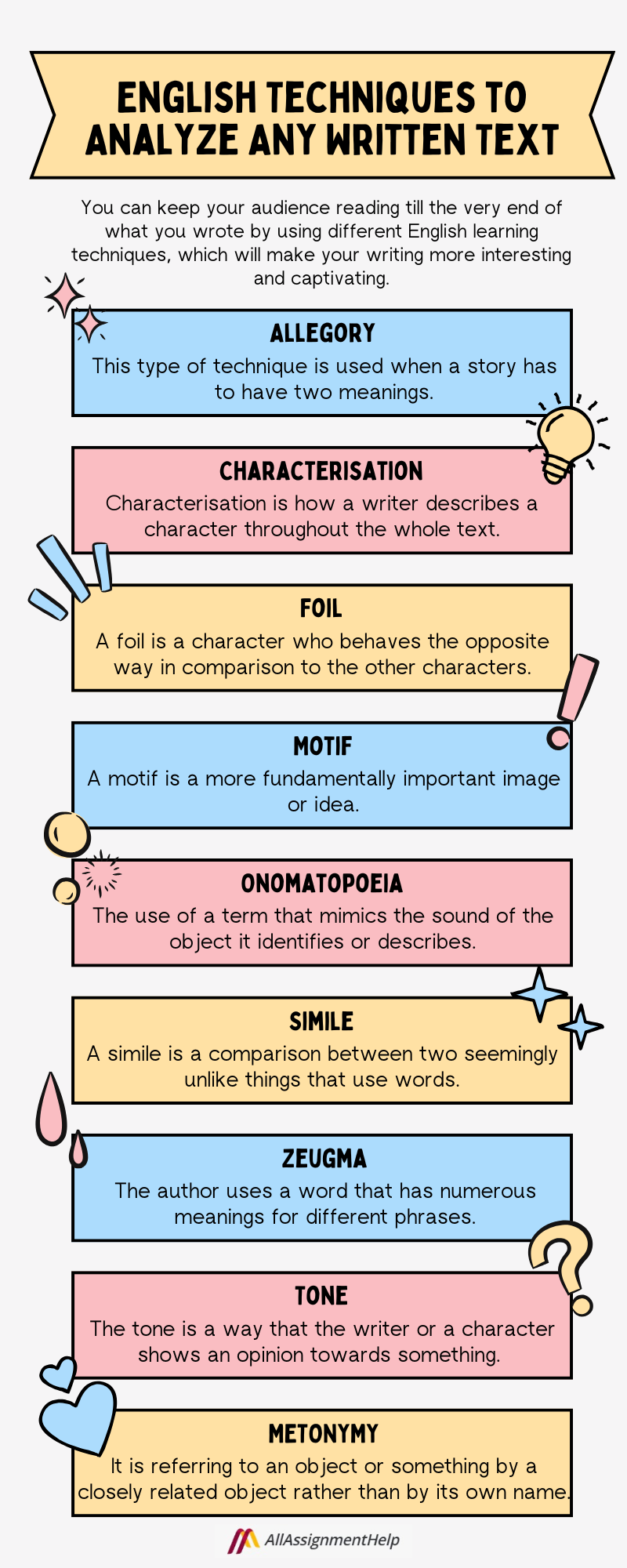
You can keep your audience reading till the very end of what you wrote by using different English learning techniques, which will make your writing more interesting and captivating. The following list includes some of the most commonly used English techniques to understand written text that you could try the next time you want to write something different.
Allegory
This type of technique is used when a story has to have two meanings. It is a long metaphor in which the story connects with the things, people, and activities.
For example, young Goodman Brown, written by Nathaniel Hawthorne, is an example of allegory as it uses the Devil’s staff to defy God and eat the forbidden fruit.
Tip: Have a thought. Are you able to analyse the deeper meaning of the whole story? If yes, then it may be an allegory.
Allusion
It is a figure of speech in which something is referred to without being stated directly. To put it simply, it’s an indirect reference. Usually, the writers make references to other literary works, politics, history, and culture.
For example, when the volcano erupted, the forest was swallowed up in ash and dust like Jonah.” In the Bible, Jonah was swallowed by a whale.
Tip: Do you recognise a reference as being familiar? Congratulations, you caught an allusion!
Assonance
Assonance is the repetition of vowel sounds within a sentence. Along with consonance, it is a common technique used primarily in poetry.
For example, Rhea thought she had lost her father’s ring, Joseph.
Tip: You can identify assonance, where the vowel sounds rhyme but the endings do not.
Characterisation
Characterisation is how a writer describes a character throughout the whole text. This can be done directly, in which the writer simply says that a certain character has a particular trait, or indirectly, in which the writer conveys what a character does, and you draw your conclusions.
For example, Rebecca is a soft-spoken girl. She has issues talking to boys, and never talks too much in class. The writer has characterised her as being shy.
Tip: Are you learning some other things about a character’s personality? If yes, then the character is being characterised.
Foil
A foil is a character who behaves the opposite way in comparison to the other characters in a text. Such a character usually foils the protagonist. However, it is necessary to understand that this does not imply that the foil is the antagonist.
For example, Fredrick is wild and straightforward. His best friend, Edward, is simple and boring. You’ll notice Fredrick’s reckless behaviour even more because the difference between him and Edward is so huge.
Tip: Does this character highlight some other character’s traits because both of them act differently? If yes, then he or she is a foil.
Genre
The genre of a story is the basic category that it falls into. Common genres include science fiction, fantasy, romance, historical fiction, and non-fiction. The genre is influenced by narrative methods and aspects such as tone, style, topic, and mood.
For example, Many of Edgar Allan Poe’s works are horror stories. This is because they carry suspense and have a dark set-up. Also, they deal with things like madness and death.
Tip: Every story around us has a genre. It’s up to you how to figure out which one it is. Focus on the subject matter, the things, and other relevant literary devices to find some clues.
Motif
A motif is a more fundamentally important image or idea. Its widespread application in the context makes it slightly more grounded than a symbol.
For example, Jack goes on a journey through a forest, and he continues to see owls as he travels. Every time he sees one, he reminds his mother, who told him that owls are a sign of wisdom and good fortune.
Tip: If you keep finding the same object throughout the text and it seems to be important, it’s probably a motif.
Onomatopoeia
The use of a term that mimics the sound of the object it identifies or describes is known as onomatopoeia. This figurative language technique is often used in poetry and literature to highlight points, give a work a more realistic feel, or evoke a sensory experience for the reader, generally via the use of vivid imagery.
For example, Words like splash, babble, boom, buzz, crash, sizzle, warble, gurgle, hiss, mumble, and zap.
Tip: If the noise’s name sounds like the noise itself, it’s onomatopoeia.
Parody
A parody is a text that copies the style of another text but humorously changes certain details to draw attention to how absurd they are. The main purpose of parody is to mock a perceived weakness. Also, it can be used to offer a fresh perspective on a concept, generally in a humorous way.
For example, Pride and Prejudice and Zombies is a book that incorporates zombies into Jane Austen’s world.
Tip: Does the text make you laugh because it’s an exaggerated imitation of something else? It’s probably a parody.
Satire
Satire is the comedic ridicule of someone’s flaws or shortcomings to draw attention to a specific issue. It is used by writers to use humor, irony, exaggeration, or mockery to highlight and critique the folly and corruption of a person or a society.
For example, Saturday Night Live is full of skits that satirise political figures. The cast of the show dresses up as people such as Barack Obama and Hillary Clinton and then mocks their speech patterns and mannerisms in a way that is lightly critical.
Tip: If it makes you laugh, but also makes you question what exactly is being made fun of and why it’s satire.
Pathetic Fallacy
Pathetic fallacy is the attribution of human traits to non-humans, especially the weather or other elements within nature. It is a type of personification.
For example: The dark, heavy clouds looked pregnant with rain.
Tip: Is it a natural phenomenon being described in a human way? The author is probably using a pathetic fallacy. Also, keep in mind that “pathetic” here does not mean sad and pitiful.
Simile
A simile is a comparison between two seemingly unlike things that use words such as “like,” “as,” or “then.” By comparing two concepts, you can paint a clear picture and enhance the descriptive interest of your writing.
For example, She was as welcome as a fart in an elevator.
Tip: If you see two different things being compared and the words “like” or “as” between them, it’s probably a simile.
Metaphor
A metaphor is a comparison between two seemingly different things. You are encouraged to notice the resemblance between these objects because one word or phrase is replaced by another word or phrase.
For example, the child was a monkey, climbing all over the table and chairs and screaming at the top of his lungs.
Tip: If what’s being described is not literally happening but instead makes a judgment on the similarity between the two things, that’s a metaphor.
Verse
Verse is a form of writing in which the structure of the text is just as important as the text itself. Those who write verse will pay attention to things like rhyme scheme and meter, while those who write in prose will not.
For example, I think that it could be worse, but these lines are a nice little clue of what a verse should look like to you!
Tip: It’s probably versed if it’s written in anything besides paragraphs.
Truncated Sentence
A truncated sentence is purposefully left off, generally the verb, subject, or both, but still makes sense in its context. It is used by writers for dramatic effect, impact, or intensity.
For example, If you say, “I like dogs more than Jane,” you’re most likely meaning that you adore dogs more than Jane likes cats. Not that you don’t like Jane.
Tip: Look for a sentence that seems to be missing a subject or verb but still makes sense, or that is abruptly interrupted.
Zeugma
Zeugma is when the author uses a word that has numerous meanings for different phrases in the same sentence. Understanding the use of Zeugma while writing a text is important, as many students do it wrong. Hence, it is suggested to take online English homework help from experts so that you can better write or analyze the text while incorporating this literary technique in your writing.
For example, Jennet lost her purse and her mind. “Lost her purse” literally means that she misplaced it. However, “lost her mind” means she went crazy and is a figure of speech.
Tip: Did you pause for a while to be sure that you read it right, because the phrases didn’t quite flow? The writer might have used zeugma.
Tone
The tone is a way that the writer or a character shows an opinion towards something. Tone can be both negative or positive, but it can also be other things such as satirical, light-‐hearted, nostalgic, or reverent.
For example, the tone in a news article should be natural and neutral, both because a journalist doesn’t intend to sway the readers’ opinions.
Tip: The language that is utilised will give you a clue about the way a writer or speaker feels.
Symbol
A symbol is an object in a text that has a deeper meaning beyond what it actually is. The English techniques of using symbols can be seen in some classic symbols like certain flowers, colours, foods, and the weather, but writers often make symbols that are particular to individual stories.
For example, Water is often linked to things like purity, cleansing, and rebirth.
Tip: Most of the stories have different symbolic items throughout. Though, don’t be too eager to try too hard to find out what they are. At times, a red curtain is red just because the writer felt like it. Most often, symbolism is fairly obvious in most of the texts.
Sarcasm
Sarcasm is the use of words that mean the opposite of how someone feels, usually either to show disdain or to achieve a comedic effect.
For example, I just love getting stuck in the crowd. It is the best feeling ever!
Tip: It can be tough to catch sarcasm in written form, so don’t worry too much, but if it appears that a character is mocking another person, it is probably sarcasm.
Metonymy
Metonymy is the act of referring to an object or something by a closely related object rather than by its own name.
For example, saying that “We will swear loyalty to the crown” doesn’t mean that people are going to be ruled by a crown and consider an object as their leader. It means the people are addressing a royal person.
Tip: Do not confuse yourself if the literal meaning sounds slightly off; it’s metonymy. Synecdoches are exceptions, so work on identifying the difference between the two.
Juxtaposition
Juxtaposition is when two different objects or concepts are placed near each other. This is usually done to highlight the differences between them, much like how a foil works. Juxtaposition can appear as an element of the story or part of the writing itself.
For example, A wealthy person is having a lavish party that displays tons and tons of wastefulness, and across the street, there is a poor family who is struggling to survive.
Tip: If you can see the differences between two things more clearly after they have been thrown together, it’s because they were juxtaposed.
Foreshadowing
Foreshadowing is when the author drops hints about something that will be more meaningful later in the story. It creates a sense of suspense and gets the reader ready for what comes next.
For example, Fred mentions offhand that he’s allergic to peanuts in chapter two. In chapter nineteen, he is accidentally served something with peanuts in it and almost dies.
Tip: You might not necessarily notice that something is foreshadowing when you first read through a text, but once you know the ending, it should be pretty clear.
Imagery
Imagery is when authors use language to evoke one or more of the five senses in a strong, descriptive way.
For example, He was so distracted by the warm, sweet smell of baking cookies that he tripped and fell down the rough stone staircase.
Tip: Can you almost see, smell, touch, taste, or hear what’s happening? If so, the author used very vivid imagery.
Pun
A pun is a type of wordplay in which words with several meanings or similar sounds are used to produce a rhetorical or funny effect. It can be found in plays, poetry, comedy, and advertisements.
For example: Did you hear about the psychic dwarf who escaped from prison? They say that there’s a small medium at large.
Tip: If it makes you laugh and groan at the same time, it’s a pun.
These English literary works are also taught in online English classes and can help students achieve high marks in writing exams when applied effectively. A strong command of linguistic skills not only enhances your analysis but also enables you to score higher grades in online exams with ease.
However, there are times when managing online English classes, tight deadlines, multiple assignments, and other responsibilities can feel overwhelming. In such situations, seeking additional support can be a practical solution. Whether you need help with concept clarity, exam preparation, or completing coursework, there are reliable online class help platforms available. You can seek expert guidance, clear your doubts, or even request assistance from these sites by simply asking, Can you take my class for me? When you are under pressure.
Also Read: All You Need to Know About Professional Writing
Conclusion
As you can see, a variety of English language strategies can enhance the overall experience of writing, reading, and studying. Trying out these techniques can significantly improve both your understanding and expression. Since English is one of the most widely used languages in the world, it requires a structured and thoughtful approach. These techniques not only strengthen your writing but also elevate the overall quality of your language skills.
If you find it challenging to apply these strategies effectively, seeking expert support can be a smart choice. Professional guidance can help you refine your work, improve clarity, and achieve better results. In addition to English, assistance is also available across various subjects. Whether you need help with mathematics, science, history, or any other discipline, expert support can make your academic journey smoother whenever you feel stuck.
FAQs
What makes learning English language techniques important?
Learning English language techniques enhances communication, writing, and critical thinking skills. It aids effective expression, enables nuanced interpretation, and fosters cultural understanding, vital in academia, careers, and daily life.
Where can I find language strategies?
A linguistic strategy can be found anywhere in a story, novel, poem, or essay. Assonance, idioms, personification, imagery, proverbs, onomatopoeia, imperative, and other linguistic devices are crucial in English.
How can one identify Literary techniques in English?
To spot a literary technique in English, a reader must first study the material and search for words and phrases that could be used as language techniques.
What effect do English techniques have on the reader?
Readers are left with a lasting impression by the way language is used. These techniques help the readers understand a piece of writing better. This is why writers often use these techniques.
Are English techniques only used in fiction?
No. They are also used in non-fiction, speeches, advertising, journalism, and everyday communication to persuade or entertain.
Connect the explanation to the work your course actually requires
Use this guide beside the exact brief, course material and marking criteria for English Techniques.
- Identify the exact question or text.
- Use relevant evidence or quotations.
- Explain rather than only describe.
- Connect each paragraph to the central argument.
Sarah Mitchell
English · 4.9/5
English literature tutor whose established profile covers critical analysis, composition, creative writing, grammar and language arts. Master’s degree in English Literature
View established tutor profile ↗What students highlighted
The reviewer described receiving help when English literature homework became difficult and valued the academic and literary treatment.
Profile feedback · September 27, 2023 · 4.7/5The reviewer described a positive first English assignment experience and later returning to the service.
Profile feedback · August 17, 2023 · 4.8/5Find another explanation across the complete blog
This search uses WordPress itself, so it can reach articles beyond the 20 shown on the dashboard.
Connect English Techniques to the task in front of you
Keep the brief, marking criteria, required evidence and submission format visible while you work.