
Table of Contents
According to educationists, critical thinking has been defined in many ways. One widely accepted definition describes it as a deliberate, structured, and logical way of thinking about a specific topic. It is an essential skill for students, especially when working on assignments. At the same time, it also gives them a strong advantage in their professional lives.
Critical thinking can be applied to any subject, problem, or piece of information. It helps students understand theoretical concepts and apply them effectively in real situations. One of its biggest benefits is that it improves the overall quality of thinking. It is built on key intellectual standards such as accuracy, consistency, depth, clarity, and fairness.
This process involves careful understanding, detailed analysis, combining ideas, and, most importantly, evaluating the information gathered. In this blog by All Assignment Help, we will explore critical thinking in detail. Give it a quick read.
What is Critical Thinking?
Critical thinking is the ability to think clearly, logically, and independently about a topic, idea, or problem. It involves analyzing information, questioning assumptions, and evaluating evidence before forming a judgment. Instead of accepting things at face value, a critical thinker asks questions like “Why is this true?” or “Is there another perspective?”
This skill includes several important processes such as observation, analysis, interpretation, and reasoning. A person uses facts, logic, and evidence to reach a fair and well-informed conclusion. It also requires open-mindedness, as one must consider different viewpoints and be willing to change their opinion if better evidence is presented.
Key features of critical thinking include:
- Asking relevant and thoughtful questions
- Analyzing facts instead of relying on opinions
- Evaluating different perspectives
- Making logical and evidence-based decisions
- Identifying biases and assumptions
Critical thinking is especially important for students because it helps them write better assignments, solve problems effectively, and make strong arguments. In real life, it helps individuals make smarter decisions, avoid misinformation, and handle complex situations with confidence.
Overall, critical thinking is not just about thinking more, but thinking better. It enables individuals to understand situations deeply, make rational decisions, and respond thoughtfully rather than reacting quickly. This skill is essential for academic success, professional growth, and everyday life.
What is the Purpose of Critical Thinking?
We can say that being authentic is the main objective of critical thinking. It helps you determine your values and standards of judgment, so you can make better decisions in life. By using critical thinking, you carefully analyze important choices instead of acting without thought. According to experts, the main purpose of critical thinking is to help people think clearly and logically about what to do or what to believe.
Key purposes of critical thinking include:
- Thinking clearly and logically before making decisions
- Determining personal values and standards of judgment
- Analyzing important life choices carefully
- Building strong and evidence-based arguments
- Identifying weak or misleading information
This skill is especially important in education, where students must build strong arguments. For example, while writing an essay, you need a clear thesis supported by relevant evidence. Simply stating opinions is not enough; you must justify your claims with facts. However, if you lack these skills, you can seek assignment writing help, where experts provide quality work and give you time to improve your thinking abilities.
Additionally, critical thinking helps in understanding how ideas are logically connected, allowing you to create well-structured arguments. It is an essential part of all academic work, from school essays to Ph.D. research. Moreover, it enables you to identify weak or misleading arguments, especially online.
What are the Principles of Critical Thinking
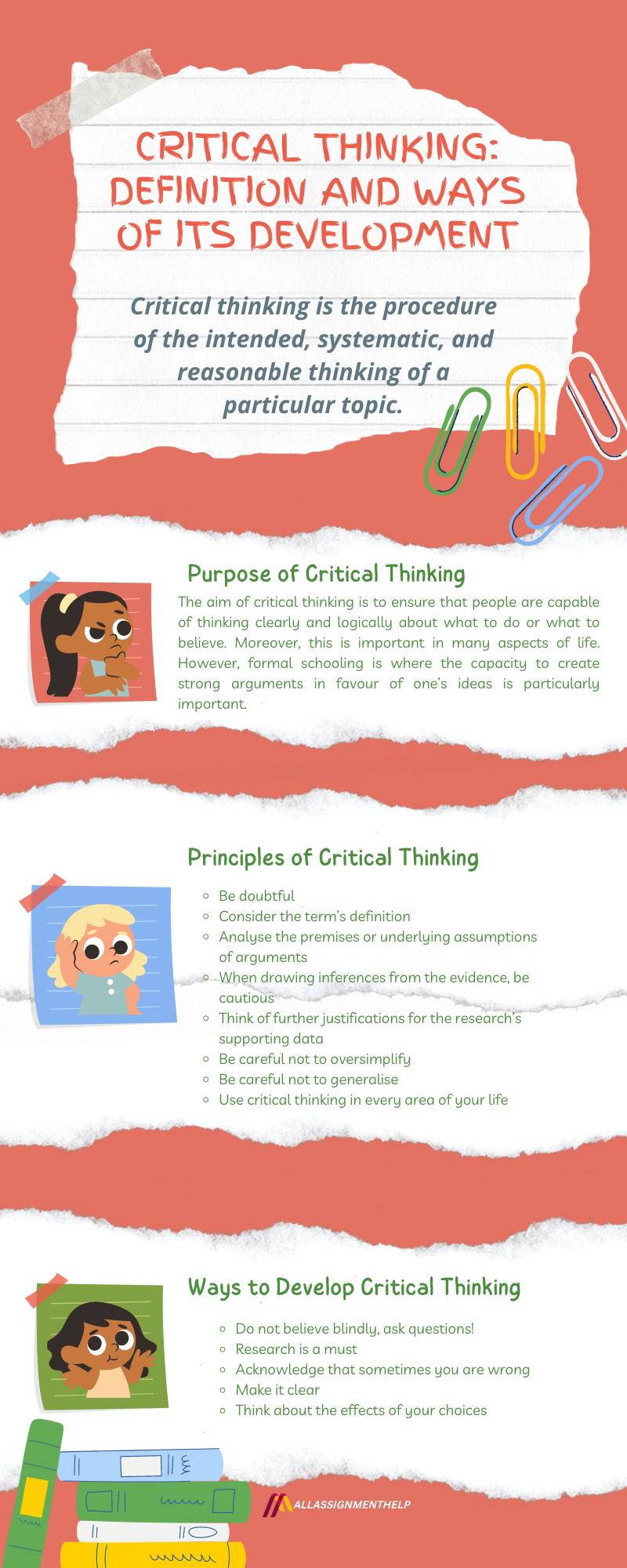
Critical thinking helps you make better decisions by analyzing facts, questioning assumptions, and avoiding bias. It allows you to look beyond surface-level information and understand situations more clearly. By following a few key principles, you can improve your reasoning skills and apply them effectively in both academics and daily life.
- Avoid ignorance
Do not confuse lack of knowledge with perspective. Always gather complete and relevant information before making decisions. - Be skeptical
Do not trust anything without proof. Question what others say instead of accepting it blindly. - Define terms clearly
A clear definition changes meaning. Always understand and stick to the exact meaning of key terms. - Analyze assumptions
Look at hidden assumptions behind arguments. Question what is being taken for granted. - Be cautious with conclusions
Avoid drawing conclusions from limited evidence. There may be multiple reasons behind a situation. - Consider alternative explanations
Research findings can have different interpretations. Do not treat one opinion as final. - Avoid oversimplification
Complex issues need detailed understanding. Simple yes/no answers are often misleading. - Do not overgeneralize
Broad statements are rarely fully accurate. Always consider exceptions. - Apply critical thinking everywhere
Stay open-minded and demand evidence in all areas of life. For academic pressure, you can also pay someone to do assignments or use assignment help for students to manage your workload effectively.
A person with critical thinking knows how to act in critical moments and overcome situations. Let’s understand this with a simple example: students in online learning courses, when overwhelmed with academic responsibilities, often turn to online class help sites for expert support. This shows that they recognize when seeking external help will help them overcome the situation, rather than just worrying. Otherwise, they might keep wondering, how can I hire someone to take my online class for me, and end up losing grades.
Also read: Easy Tips to Keep Your Brain Healthy and Sharp
What are the Ways to Develop Critical Thinking?
Every day, we make choices that have an impact on our lives. Moreover, it cannot be overstated how important and valuable making wise decisions is, whether in a personal or professional setting. Furthermore, critical thinking assists us in identifying any flaws in our decision-making process so that we can correct them and proceed to make better decisions in the future. Simply said, you need to be able to make decisions swiftly and critically no matter what you are doing. And to do this, you must possess decision-making skills. However, if you are still unsure of your ability to engage in critical thought or are wondering how to do so, take into account the following steps.
Do not believe blindly, ask questions!
The first thing you need to do to get better at critical thinking is that you give a thought to anything you hear, read, or decide to do and not believe anything blindly. For example, to answer an assignment question in a better way. You should try to find out, what the question is about. What could be the best answer? Are there any counter-arguments to the answer you are going to give in the assignment? However, using the best assignment writing service in such circumstances is a wise decision.
Research is a must
After asking yourself many questions, you should spend time researching the assignment. Moreover, you should use your library books, the internet and newspapers or magazines, etc. With that, you can also discuss your assignment topic with an expert or your professor. Hence, in this way, you will be able to gain quality information and could write a compelling answer to the question.
In the real world, critical thinking occasionally requires letting go of your convictions in order to confront problems. Reluctance to study, learn, or absorb new ideas will only hold you back and unquestionably impair your capacity for critical thought. Moreover, you will learn that if you put in the work and focus on learning, over time you’ll change and adapt to meet new problems and hone your critical thinking skills.
Acknowledge that sometimes you are wrong
It can be more difficult than it appears. Moreover, no matter who we are or what we do, we all make mistakes. The fact that most individuals want to disregard this reality, however, prevents us from exercising critical thinking. Furthermore, you should quit for your own benefit if you realize what you are doing is wrong but continue to do it nonetheless because you already believe you can do no wrong. In addition to this, always double-check your work, keep an open mind, and see mistakes as a chance to grow.
Make it clear
Being able to see the big picture is great, but being able to break things down into smaller, more manageable pieces is even better. Therefore, smaller pieces are easier to deal with and process intellectually. Besides, it is easier to work on many small tasks at once rather than the larger, potentially daunting, picture.
Also read: Positive Thinkers Spreading Optimism
Think about the effects of your choices
Every decision we make has an impact on the individual involved as well as occasionally other parties. Moreover, you must consider the potential outcomes of each of your alternatives. Furthermore, select the one that would benefit you the most while having the fewest negative effects on other people. Besides, making a list of benefits and drawbacks is a useful technique to do. Also, you can make a decision that is much more well-informed if you ask yourself to consider both all potential positive outcomes and all potential bad consequences.
What is the Importance of Critical Thinking in Academics?
Critical thinking plays a key role in academic success. It helps students move beyond memorization and truly understand what they are learning. Instead of just accepting information, students learn to question, analyze, and apply knowledge in meaningful ways.
Here’s why critical thinking is important in academics:
1. Improves Understanding of Concepts
Critical thinking helps students understand topics deeply. They don’t just learn “what” but also “why” and “how,” which makes learning more effective and long-lasting.
2. Enhances Problem-Solving Skills
Students often face complex questions in exams and assignments. With critical thinking, they can break problems into parts, analyze them, and find logical solutions.
3. Strengthens Academic Writing
Good assignments require analysis, not just information. Critical thinking allows students to present arguments, support them with evidence, and write more impactful answers.
4. Encourages Independent Learning
Students become less dependent on teachers or notes. They start exploring ideas on their own, asking questions, and forming their own opinions.
5. Helps in Better Decision-Making
Whether choosing sources for research or solving case studies, critical thinking helps students make informed and logical decisions.
6. Prepares for Real-World Challenges
Academic life is not just about exams. Critical thinking prepares students for real-life situations where they need to evaluate information and make smart choices.
7. Boosts Confidence
When students can analyze and justify their answers, they feel more confident in discussions, presentations, and exams.
A student in an online course feels overwhelmed with multiple assignments. Instead of panicking, they analyze their workload, prioritize tasks, and may even choose to seek guidance from academic support services. This shows they are using critical thinking to handle the situation effectively.
Conclusion
In conclusion, having the ability to think critically will be useful to you both inside and outside of the classroom. Moreover, we hope reading this post has encouraged you to reflect more deeply on your own life. Furthermore, remind yourself that learning critical thinking is a lifelong endeavor and that there is always more to learn.
Frequently Asked Questions
| Question: 1 How might one best hone their critical thinking abilities? Answer: 1 You can develop your critical thinking capabilities in the following ways: • Clearly define your goals • Face your prejudices • Think about the effects of your choices • Make research • Recognize that you do not always have it right • Take it apart • Do not make things too complicated |
| Question: 2 What are the five methods of critical thinking? Answer: 2 There are five aspects of critical thinking. Moreover, these are open-mindedness, respecting logic and facts, having the mental flexibility to consider many views and points of view, not being confined to one place, skepticism, and precision and clarity. |