Table of Contents
Psychology is a wide field that focuses on understanding human behavior at different ages and in different situations. It studies how the human mind works and how people behave. This field includes many branches, and child psychology is one of the most important ones. It mainly focuses on newborns and young children. Over time, it has expanded to include development during adulthood, aging, and overall life stages.
Talking to children and understanding what they think or feel can be challenging. This is why child psychology focuses on studying social behaviors that shape a child’s emotional and mental growth. There is a lot to learn about this branch of psychology. In this blog, subject experts at All Assignment Help explain everything you need to know about child psychology and the different aspects of child behavior.
What is Child Psychology?
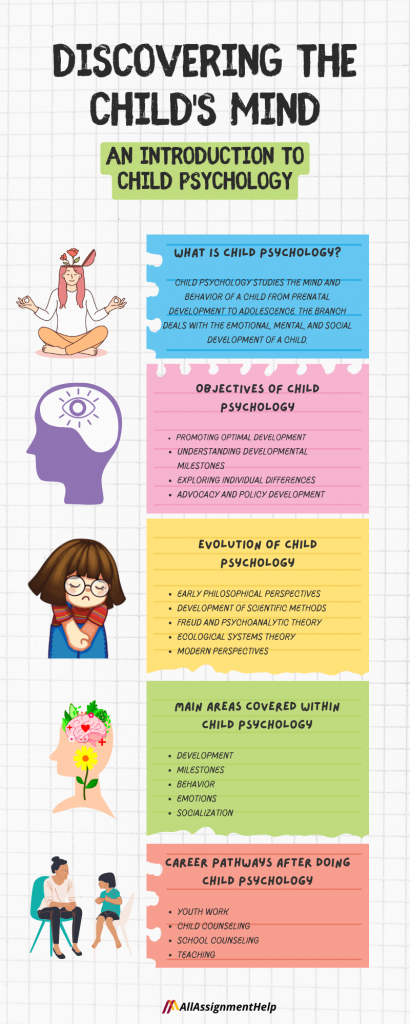
Child psychology is the branch of psychology that studies the mental, emotional, and social development of children. It focuses on how children think, feel, learn, and behave from birth through adolescence.
This field helps understand how factors like family, school, friends, and environment influence a child’s growth. Child psychologists study behaviors such as learning patterns, emotional responses, social skills, and problem-solving abilities. The goal is to support healthy development and identify any challenges early, so children can grow into confident and emotionally balanced adults.
Read Here: Different Psychology Courses to Look Out For
The Objectives of Child Psychology
Child psychology focuses on understanding how children grow, think, feel, and behave. Its main objectives include the following:
- To identify the social and environmental factors that create a healthy and supportive environment for a child’s development.
- To explain how genetics and surroundings work together to shape a child’s personality and behavior.
- To show evidence that some personality traits may be inherited through genes.
- To understand learning processes, including how a natural response to a stimulus can be changed through conditioning, along with real-life examples.
- To explain how operant conditioning can be used to encourage positive behavior and help children develop social skills.
- To study how infants recognize emotions like happiness and fear through perceptual and cognitive development.
- To compare and evaluate different theories of mother–child attachment, including the views of Freud, Harlow, and Bowlby.
- To explain reflection and impulsivity and why these traits are important for a child’s cognitive development.
- To examine the strengths and limitations of social learning theory in explaining how children acquire language.
- To explore whether intelligence is fully influenced by genetics or shaped by learning and environment.
Understanding child psychology is especially valuable for careers in psychology, counseling, teaching, and education. However, professionals from many other fields also benefit from knowing how child personality develops. Those who find the subject challenging can always seek child psychology assignment help from online experts to gain better clarity and academic support.
Evolution of Child Psychology
Children have always been treated like little versions of adults, to the point that they have had to work alongside adults in mainstream jobs and have historically been clothed like adults. Within this context, the psychology of the children was a foreign concept.
- Many people consider Jean Piaget to be the father of contemporary child psychology. His research, starting in the 1920s, provided credibility to the notion that children and adults had distinct ways of thinking.
- However, one of his most significant achievements was the realization that children go through many phases of emotional and mental development during their childhood.
- Additionally, he suggested that the emotional, social, and physical development of an individual is intimately related to their intellectual growth.
- Piaget developed the concept of through interaction and firsthand observation. Furthermore, he listed the several phases of childhood learning development and discussed how children perceived the world and themselves at each one.
Nowadays, child psychologists are strongly dedicated to supporting children’s healthy growth and development. Their interests span areas such as parenting, education, social pressures, and self-esteem. To stay updated with current trends, many professionals enroll in advanced child psychology courses online.
However, balancing online coursework with professional and personal responsibilities can be challenging. In such cases, some students may turn to online class help sites, asking, Can I pay someone to take my online psychology class for me. Luckily, there are many reliable online class help services available to reduce academic stress and ensure steady progress without compromising learning goals.
Importance of Child Psychology
You may be wondering why psychology is necessary since children are always playing and don’t experience stress. Parents sometimes mistakenly believe that their children’s strange behavior or carelessness with their schoolwork are just acts of mischief. Children have difficulties when learning. Oftentimes, parents misunderstand their children. Therefore, parents must comprehend their children and their problems. Here is where the psychology of the war child enters. This is why it is significant to know the importance of child psychology which are:
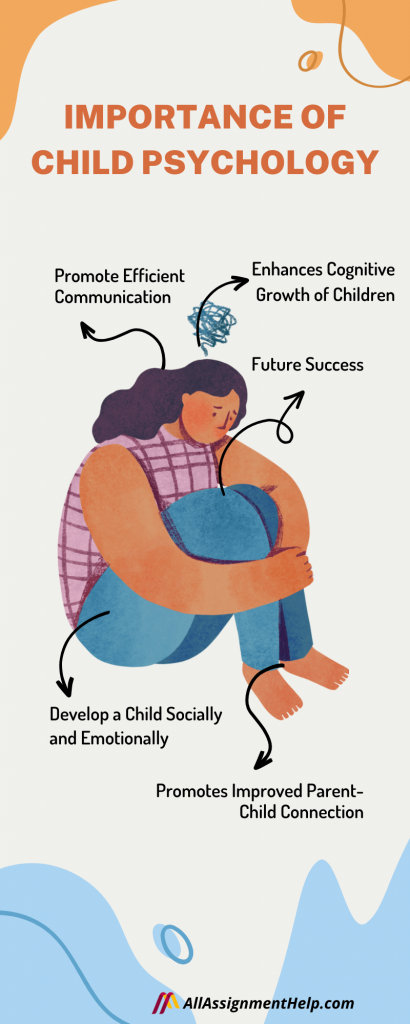
To Promote Efficient Communication
Creating a good communication channel between a child and their parents or teachers is one of the responsibilities of child psychology and childhood psychologists. A child spends the majority of their interactions with these initial few persons. Thus, knowing the requirements of a child through child psychology facilitates improved communication.
Develop a Child Socially and Emotionally
The development of children’s social and emotional skills is another reason why child psychology is crucial. They pick up on the thoughts and feelings of a youngster, including trust, fear, pride, confidence, friendship, and so forth. These are the types of skills that fall within the social and emotional development area.
Enhances Cognitive Growth of Children
Cognitive development is the area of development that deals with logic, reasoning, language, mental processes, problem-solving abilities, and the ability to make decisions. Child psychology helps in the development of these skills. It monitors how well children are growing in all areas and how well they can interpret simple information.
Promotes Improved Parent-Child Connection
While children are under a lot of strain and can become disoriented in their jobs, parents often believe that their children have little to do. For example, the mother has said no when the grandmother requests to eat. As a child and a grandchild, they become confused. Thus, child psychology helps in improving parent-child relationships by helping parents comprehend the pressures placed on their children.
Understanding the requirements of a child is much easier with the help of child psychology. Rather than making quick judgments when you don’t understand the conduct of your child, think it through and make an effort to understand them. Just being thoughtful, interested, and adaptable makes a big difference, even if you don’t understand the motivations behind their actions.
5 Main Areas Covered Within Child Psychology
Child psychology is divided into five fundamental sections, which are discussed below:
Development
Child development is divided into three broad categories: Physical, cognitive, and socio-emotional.
- Physical development: It is a stable process and a predictable one, too. It refers to body changes and acquiring certain skills. For example, gross motor and fine motor coordination.
- Cognitive development: It is a process of gaining knowledge in children. It includes language, thought, reasoning, and imagination.
- Socio-emotional development: Emotional development includes feelings and the expression of feelings, whereas social development is the study of interpersonal relationships.
For ease of study and understanding, they may be divided into different categories. However, development in one area has a strong influence on the other two.
Milestones
Milestones are the parameters used to a child’s development, to know what an average child can do at a specific age.
Child psychologists usually judge a child’s ability on four main milestones.
- Physical milestones: Related to gross and fine motor skills.
- Cognitive milestones: Related to a child’s aptitude for learning and problem-solving
- Socio-emotional milestones: Child’s ability to show emotions and response to social interaction.
- Communication and language milestones: This involves the development of a child’s verbal and non-verbal communication skills.
Behavior
Children can be naughty and impulsive at times. Conflicts between parents and children are also very common. These behavior changes are normal and are a part of a child’s growing process.
However, some children show extreme or unusual behavior. In such cases, these actions may be linked to behavioral disorders. Taking help from a child educational psychology assignment expert can help students understand the reasons behind these abnormal behaviors.
Sometimes, behavior issues are temporary and happen due to stress or a difficult situation. But if these extreme behaviors continue for a long time, it can be a serious concern. This may indicate disorders such as OCD, ADHD, or ODD. These conditions share common symptoms and can worsen if not addressed properly.
Emotions
Development of emotions involves the understanding of feelings and emotions, why feelings occur to a particular stimulus, recognition of one’s feelings and feelings of others and ways to manage them. These things come under emotional development. However, the development of emotions begins during infancy and continues into adulthood. The first emotions of babies are joy, anger, first cry, and fear. Then, they develop emotions like shyness, surprise shame, etc., late in life. Children learn emotional coping methods and adopt different strategies to manage them.
Emotion regulation is different for different children. Some easily learn to regulate emotions and others face difficulties. Some react to emotions simply whereas some react to any emotion aggressively. Child psychologists must manage those children and help them to overcome the problem of erratic emotions.
Socialization
Socialization involves acquiring the skills and knowledge to interact in a social atmosphere. This helps in a positive contribution to family, school, and community. The initial period of childhood is a period when social development takes place. The child’s primary relationship is with parents. This relationship affects his/her other relationships later in life.
When a child goes into a peer relationship, he/she learns to interact more in social conditions. However, those children who fail to develop socially face some serious problems later in life. They tend to become aggressive or impulsive. They engage in socially destructive actions. Psychologists try to curb this hostile, aggressive action of these children and make them grow constructively.
Child psychology is one of the main branches of psychology. If you have a good knowledge of child psychology, you can easily understand children’s behavior.
Also Read: Clinical Psychology – Definition, Career, How to Become A Clinical Psychologist
Career Pathways After Doing Child Psychology
Knowledge of child psychology is most relevant to careers in psychology, counseling, and teaching. However, professionals in many other fields benefit from a deeper understanding of childhood development.
The Child Psychology course is for those who are working in, or willing to work in the following fields:
- Youth work
- Child counseling
- School counseling
- Teaching
- Child psychology
- Social work
- Childcare
Online child psychology courses can serve as a strong foundation for further studies, professional qualifications, or personal development. Enrolling in an online course can give you a valuable head start, build confidence, and motivate you to move forward with your academic and career goals.
At the same time, balancing coursework with work, family, or personal responsibilities can become overwhelming for many students. When time and academic pressure increase, students naturally begin searching online for support, often asking, can someone do my online class for me? In such situations, hiring professional online class help provides structured assistance with deadlines, helps improve grades, and allows students to earn better course credits without unnecessary stress.
FAQs
What is child psychology?
Child psychology is the study of children’s mental, emotional, and social development from infancy through adolescence.
Why is child psychology important?
Child psychology helps in understanding children’s behavior, emotions, and learning patterns, allowing parents and educators to support healthy development.
How has child psychology evolved over time?
Child psychology has evolved from basic observations of behavior to scientific research that focuses on cognitive, emotional, and social development.
What are the main areas of child psychology?
The main areas include cognitive development, emotional development, social behavior, personality growth, and behavioral disorders.
What factors influence a child’s psychological development?
Family environment, education, social interactions, culture, and life experiences play a major role in shaping a child’s psychology.
How does child psychology help in education?
It helps teachers understand learning difficulties, improve teaching methods, and create supportive classroom environments.
When should parents or teachers seek help from a child psychologist?
They should seek help when a child shows long-term behavioral changes, learning difficulties, emotional distress, or social withdrawal.