What Are Open Educational Resources (OER)? Top 5 Benefits
What this article will help you understand
"OER is not just about saving money on textbooks; it's about enhancing the quality of education by providing diverse, adaptable, and up-to-date resources." - David Wiley Open Educational Resources are changing the face of education by offering free learning resources available under certain copyright licenses. These resources include textbooks, curricula, lecture notes, assignments, and other
What are you trying to do with this topic?
Choose the closest task and the page will point you towards a useful next step.
Start with the central concept and the terminology used in the article.
Open the closest route ↗Connect the explanation to the question, learning outcomes and marking criteria.
Open the closest route ↗Review evidence, structure, referencing and the exact submission requirements.
Open the closest route ↗Do you have enough information to begin?
Select what you already have. Nothing is submitted from this checklist.
When these details are together, the requirement can be reviewed in context.
Assignment Help USA ↗Table of Contents
“OER is not just about saving money on textbooks; it’s about enhancing the quality of education by providing diverse, adaptable, and up-to-date resources.” – David Wiley
Open Educational Resources are changing the face of education by offering free learning resources available under certain copyright licenses. These resources include textbooks, curricula, lecture notes, assignments, and other forms of educational content. The adoption of OER is growing rapidly, and for good reason. Now students can learn through these resources and upskill themselves. This blog by All Assignment Help explores all the benefits of open educational resources and how students can benefit from them.
If you are interested in learning more about these educational resources and how you can leverage them for your studies, we recommend reading the complete blog post for a better understanding.
Let’s open the door to our topic.
What are Open Educational Resources?
OER or Open Educational Resources are resources utilized for learning, teaching, and research purposes available to anyone via the Internet at no cost. These can be used, modified and shared without any restrictions in various forms such as textbooks, lecture notes, assignments, tests, projects, audio, video and any other medium.
Key characteristics of OER include:
- Accessibility: This is an important characteristic of OER because anyone with an internet connection can access these resources.
- Adaptability: These resources are flexible to accommodate changes, modifications, and additions as per the users’ requirements.
- Open Licensing: OER are usually released under open licenses (CC) that enable the subsequent uses and modifications by users.
Online education resources expand the reach of education and empower students to learn and gain subjective understanding effectively. Whether you need high-quality assignment writing, thesis, or dissertation writing assistance, these free OERs have the potential to address your queries and enhance your learning experience.
Also Read: The Benefits of Online Classes for Working Professionals
Examples of OER
Textbooks: OpenStax offers free textbooks and openly licensed content for uses
Courses: MIT OpenCourseWare is a project that makes learning materials of MIT courses freely accessible to everyone.
Repositories: Some of the available websites include OER Commons, and the Open Education Consortium are known for offering various learning resources.
OER promotes an equitable educational landscape that means everyone has the right to learn and such initiatives are quite helpful for students who want to add new skills beyond their regular classroom learning. Also, these open-source learning opportunities work as a remedy for students who may find themselves asking, Can I pay someone to take my online classes for me? Whenever they are unable to deal with their online learning programmes or perform well. Instead of resorting to this, OER helps students overcome academic challenges, gain a deeper understanding of their subjects, and address any questions that were not resolved during classroom sessions.
Benefits of Open Educational Resources for Learners
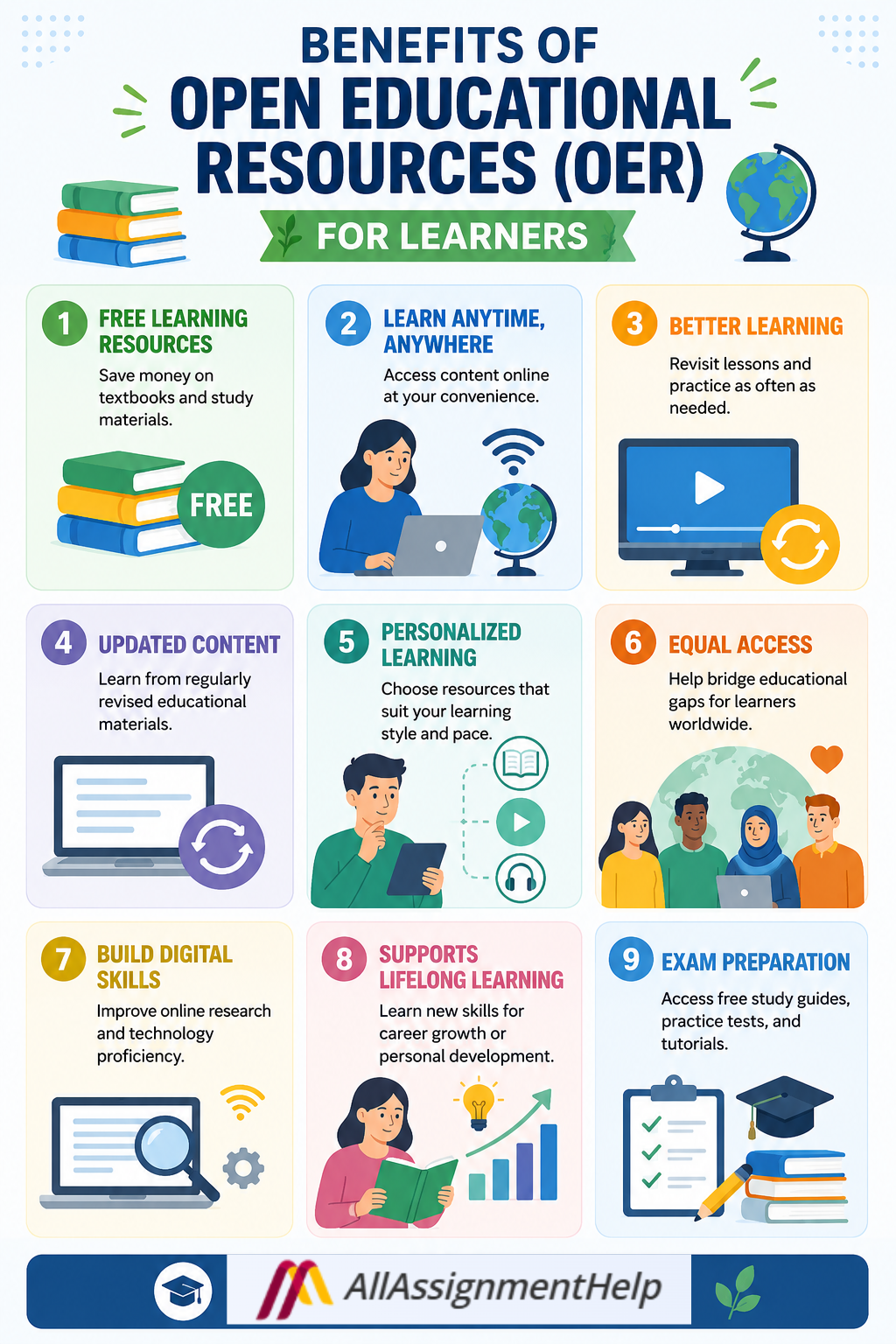
Open Educational Resources (OER) are free educational materials that anyone can access, use, adapt, and share. They include textbooks, lecture notes, videos, quizzes, research papers, and complete online courses. OER has transformed education by making high-quality learning resources available to students worldwide, regardless of their financial background.
Here are the key benefits of Open Educational Resources for learners.
1. Free Access to Quality Learning Materials
One of the biggest advantages of OER is that learners can access educational content without paying expensive subscription or textbook fees. This makes education more affordable and reduces financial barriers.
Benefits:
- Saves money on textbooks and study materials.
- Provides access to high-quality academic resources.
- Reduces educational inequality.
2. Learn Anytime, Anywhere
Most OER materials are available online, allowing students to study whenever and wherever they want. Whether you’re learning from home, traveling, or balancing work and studies, OER offers unmatched flexibility.
Benefits:
- Supports self-paced learning.
- Accessible on computers, tablets, and smartphones.
- Ideal for remote and distance education.
3. Improves Learning Outcomes
Students can revisit lessons, replay videos, download notes, and practice with quizzes as many times as needed. This helps reinforce concepts and improves understanding.
Benefits:
- Better concept retention.
- Opportunity for repeated practice.
- Encourages independent learning.
4. Up-to-Date Educational Content
Unlike traditional textbooks that may take years to update, many OER resources are revised regularly to reflect the latest research, technologies, and industry trends.
Benefits:
- Access to current information.
- Learn modern skills and practices.
- Stay aligned with changing academic standards.
5. Personalized Learning Experience
Many OER resources allow educators and learners to adapt content to meet specific learning needs. Students can choose materials that match their skill level, language, or learning style.
Benefits:
- Customized study plans.
- Multiple formats such as videos, PDFs, and interactive modules.
- Better engagement with learning.
6. Encourages Self-Directed Learning
OER empowers learners to take control of their education. Students can explore subjects beyond their classroom curriculum and learn at their own pace.
Benefits:
- Develops critical thinking.
- Builds research skills.
- Promotes lifelong learning habits.
7. Supports Different Learning Styles
Not every student learns the same way. OER provides content in various formats, making it easier for visual, auditory, and reading-based learners to understand complex topics.
Examples:
- Video lectures
- Interactive simulations
- Podcasts
- E-books
- Infographics
8. Promotes Equal Educational Opportunities
Students from developing countries or low-income families often struggle to afford expensive educational resources. OER helps bridge this gap by providing free access to quality education.
Benefits:
- Greater educational inclusion.
- Increased access for underserved communities.
- Supports global learning initiatives.
9. Enhances Digital Literacy
Using online educational resources helps learners become familiar with digital platforms, online collaboration, and modern learning technologies.
Skills Developed:
- Online research
- Digital communication
- Information evaluation
- Technology proficiency
10. Encourages Collaboration and Knowledge Sharing
Many OER platforms encourage learners to share ideas, contribute improvements, and collaborate with peers across the world.
Benefits:
- Builds global learning communities.
- Encourages peer-to-peer learning.
- Promotes teamwork and communication skills.
11. Ideal for Lifelong Learning
Learning doesn’t end after graduation. Professionals, job seekers, and lifelong learners can use OER to gain new skills, prepare for certifications, or explore personal interests without additional costs.
Popular Uses:
- Career advancement
- Professional development
- Skill enhancement
- Hobby learning
12. Supports Exam Preparation
Many students use OER for competitive exams, university entrance tests, and certification programs because they provide free practice questions, study guides, and video tutorials.
Benefits:
- Flexible preparation schedules.
- Comprehensive revision materials.
- Practice assessments.
Also Read: Importance of Creating an Effective Learning Space for Digital Learners
Conclusion
Open Educational Resources are revolutionising education by making learning more accessible, affordable, and flexible. The term OER has several advantages for students such as reduced education cost, remote accessibility, scope for creativity and lifelong learning opportunities. As more educators and institutions adapt these resources, the positive impact on education will continue to grow, creating a more inclusive, equitable, and dynamic learning environment for all.
Frequently Asked Questions
What is meant by Open Educational Resources (OER)?
OER is defined as materials that are used to support teaching, learning and research, which are available for anyone to use, modify and share. They are textbooks, readings, simulations, games, quizzes, etc., which are often released under Creative Commons licenses.
In what ways OER can help students and educators?
OER reduces costs for students and increases the access to education. Teachers can modify the content to suit their requirements, increase resource dissemination, and facilitate cooperative education.
How can I get OER for my courses?
OER can be found on platforms like OER Commons, OpenStax, MERLOT, and MIT OpenCourseWare.
What can I do to support OER?
By publishing your educational resources under an open license, modifying your existing OER, promoting the use of OER, and participating in OER activities and programs.
Connect the explanation to the work your course actually requires
Use this guide beside the exact brief, course material and marking criteria for What Are Open Educational Resources Oer Top 5 Benefits.
- Read the complete brief.
- Identify the expected academic output.
- Follow the marking criteria and source rules.
- Check the final structure and referencing.
Marquez
Computer Science · 4.8/5
This guide concerns “What Are Open Educational Resources (OER)? Top 5 Benefits”. Marquez is one of the available tutors whose live profile lists experience in Computer Science.
Marquez’s live tutor listing centres on computer networking and computer-science assignments.
View established tutor profile ↗Relevant subject areas
- Computer Networking
- Computer Science
- IT Assignments
Find another explanation across the complete blog
This search uses WordPress itself, so it can reach articles beyond the 20 shown on the dashboard.
Connect What Are Open Educational Resources Oer Top 5 Benefits to the task in front of you
Keep the brief, marking criteria, required evidence and submission format visible while you work.