The Best Online Study Tools for Students

What this article will help you understand
This article helps you understand how the new age tools help you study better. Google Notebook, OpenAI, Grammarly and many other AI based tools, their usage and prompts to do better with your online classes and other academic requirements in 2026-2027.
- Choose a study tool for a specific academic task instead of collecting multiple applications with overlapping features.
- Use active recall and source-based revision rather than depending only on repeated reading.
- Verify AI responses, citations and imported research information against the original course materials and sources.
- Follow your institution’s privacy, AI-disclosure and academic-integrity requirements.
What are you trying to do with this topic?
Choose the closest task and the page will point you towards a useful next step.
Start with the central concept and the terminology used in the article.
Open the closest route ↗Connect the explanation to the question, learning outcomes and marking criteria.
Open the closest route ↗Review evidence, structure, referencing and the exact submission requirements.
Open the closest route ↗Do you have enough information to begin?
Select what you already have. Nothing is submitted from this checklist.
When these details are together, the requirement can be reviewed in context.
Assignment Help USA ↗Table of Contents
Quick answer
The best study tool depends on the task in front of you
Writing, revision, group work, research and class organization create different problems. Grammarly can support a writing review, Google Docs helps with shared documents, Quizlet is built around recall, Google Workspace for Education keeps course activity connected, and Zotero organizes research sources and citations. A smaller combination chosen for a specific task is usually more useful than collecting tools you rarely open.
- For writing: use a language-review tool after developing your own ideas.
- For group projects: choose a shared document with comments and version access.
- For exams: use active recall instead of rereading notes repeatedly.
- For online classes: connect the tool to your calendar, course portal and weekly goals.
Students of all ages are increasingly turning to internet resources to help themselves stay organized, on track, and successful as technology is experiencing exceptional advancement. There is a plethora of sophisticated, user-friendly technologies available in 2026 that make it simpler than ever for students to get the most out of their education.
These top online tools for students in 2026 gathered by AllAssignmentHelp specialists will help you remain ahead of the curve in everything starting from making assignments, excelling in online classes, preparing for tests, and managing time to discovering resources and interacting with classmates. These flexible resources can make your academic life easier whether you are a college student, a high school student, or even an elementary school student.
Continue reading this blog to learn more about these top online tools for students in 2026 and how they can help you succeed.
Also Read: An Essential Guide to the Responsibilities of the Students
Compare online study tools by the job they need to do
No single platform covers every part of student life equally well. This quick comparison helps narrow the choice before the detailed descriptions below.
| Study need | Tool from this guide | Most useful for | Important limitation |
|---|---|---|---|
| Writing review | Grammarly | Grammar, punctuation and sentence-level suggestions | Suggestions still need human judgment |
| Shared coursework | Google Docs | Drafting, comments and group collaboration | Some features depend on internet access |
| Recall practice | Quizlet | Flashcards, practice questions and terminology | Some functions require a paid plan |
| Class organization | Google Workspace for Education | Course materials, schedules and collaboration | Availability can depend on the institution |
| Research and citations | Zotero | Collecting, organizing, annotating and citing sources | Imported metadata should be checked against the original source |
| Step-by-step explanation | ChatGPT Study Mode or Gemini Guided Learning | Guiding questions, explanations and checks for understanding | Responses must be verified against course material |
| Source-based revision | Gemini Notebook | Studying uploaded readings, notes and lecture material with citations | Its usefulness depends on the quality and completeness of the supplied sources |
Pricing, plan names and product features change. Check the provider’s current plan and your institution’s available access before subscribing.
Which online study tools help with writing, revision and class organization?
Staying on top of your studies has never been easier and for that, we need to thank the internet! In reality, there is a plethora of excellent study resources available to help you build new abilities, prepare for forthcoming assignments and examinations, and discover effective study strategies. Moreover, it is only possible because of the internet and technology that you can seek a helping hand to combat your queries like, is it possible to ask someone to do my online course for me when I surely cannot? And the answer is yes! However, let’s move back to our topic and read about some of the greatest tools for students to try in 2026.
Grammarly for grammar, clarity and writing review
Grammarly is a strong online tool that may help you write confidently.
For example, if a student is writing an essay for class, Grammarly may assist them with identifying grammatical, spelling, and punctuation issues, as well as recommending better word selections and sentence structure. The premium version aids in the detection of text plagiarism.
Grammarly looks for punctuation problems such as misplaced modifiers, looping participles, and inappropriate comma use, among other things.
- Grammarly Pro includes plagiarism detection and citation support, which can help students identify passages that require attribution.
- It proposes better word choices for your writing, allowing you to ensure that it is clear and succinct.
- It proposes improved sentence constructions to help you better explain your thoughts.
Pros:
- Free to use
- Simple interface
- Accurate and dependable
- Available in both extension and integration mode
Cons:
- Advanced rewriting, plagiarism detection and expanded AI features require Grammarly Pro.
- Suggestions still need human judgment because a grammatically correct change may alter the intended meaning.
Access:Price:
- A free version is available for core writing assistance.
- Grammarly Pro adds advanced rewriting, plagiarism detection and expanded AI assistance. Check the current plan before subscribing.
Google Docs for collaborative writing and cloud access
Google Docs is a platform for creating, editing, and storing documents all in the cloud. It is part of the Google Drive application suite and provides a variety of capabilities to assist users in creating, collaborating, and storing documents online. Students may use Google Docs to work on projects and communicate with many individuals in real time from any device with an internet connection.
For example, if a group of students is working on the same project, they may quickly create and share a Google Docs page that everyone can work on and edit.
Google Docs has the following features:
- Documents can be readily shared with other users with a few clicks.
- Using pre-made templates makes it simple to produce papers.
- All documents are securely saved online in the cloud, making them accessible from any device.
- Users may simply offer comments and ideas on papers that are visible to other users.
Pros:
- It is simple to use and navigate;
- It offers safe online document storage.
- Documents are accessible from any device.
- Support a wide range of writing and editing templates.
Cons:
- Offline access must be enabled before it is needed.
- Some advanced layout and formatting work is easier in a full desktop word processor.
Access:Price:
- Google Docs is available without charge for personal Google accounts.
- Institutions and organizations may provide additional Workspace features through their own plans.
Quizlet for flashcards, recall and exam revision
Quizlet.com is a fun and engaging online learning platform that helps students learn better.
It is an application for students to test their knowledge through flashcards, Learn and Write activities, practice questions and tests. Practice Tests can turn uploaded notes or flashcard sets into a longer timed revision activity, which makes the tool useful before an examination when the underlying material has been checked.
Quizlet also provides several ways to revisit the same study material instead of relying on repeated reading.
- It offers a Learn mode that asks pupils multiple-choice questions to help them review and recall material.
- It also includes a Test mode, which allows students to take a timed multiple-choice or fill-in-the-blank exam to assess their understanding of the topic.
- There is also a math practice option.
Pros:
- Interactive activities make studying more enjoyable and engaging;
- a number of tools and features to assist students in learning;
- the ability to construct quizzes and study sets; and
- the ability to establish courses with other students.
Cons:
- Certain features are only accessible in the premium edition.
Access:Price:
- A free account provides flashcards and selected study activities.
- Paid plans add further customization, offline study and additional study modes. Check the current plan for feature availability.
Google Workspace for Education for connected class organization
Google Workspace for Education can connect course communication, documents, storage, scheduling and class activity through services such as Classroom, Drive, Calendar and Docs. Availability and individual features depend on the edition selected by a student’s school or university.
Google for Education also has certain tools that might help students and teachers, such as:
- Google Classroom: A virtual learning environment where students and teachers can connect, exchange information, and work on projects together.
- Google Drive: A cloud-based storage service that allows students and instructors to save, view, and share documents, photos, and other items.
- Google Calendar: A cloud-based calendar that lets students and instructors quickly manage their calendars and make reminders.
- Google Docs: A web-based word-processing program that allows students and instructors to create and collaborate on projects.
Pros:
- It is simple to use;
- It has a wide range of features.
- Collaboration between students and teachers;
- Assistance in organizing study materials and timetables.
Cons:
- Internet access is always required.
Access:Price:
- Access is normally provided through the educational institution.
- Some advanced AI and administrative capabilities depend on the institution’s edition or add-ons.
Zotero for research, source organization and citations
Zotero is a free research tool that helps students collect, organize, annotate, cite and share sources. It is particularly useful when an assignment draws on journal articles, books, reports and webpages that would otherwise become difficult to track.
For example, a student preparing a literature review can save source details into a course collection, attach or annotate available files, add notes and generate citations or a bibliography. Zotero can recognize records from many library catalogues, research databases and publisher websites, although imported metadata should still be checked against the original source.
Zotero includes features such as:
- Browser-assisted collection of source records and available files
- Collections and tags for organizing material by course, topic or assignment
- PDF reading, annotation and note organization
- Citation and bibliography generation for supported styles
- Group libraries for shared research
Pros:
- Free and developed specifically for research work
- Available across major desktop and mobile platforms
- Useful for both short assignments and longer dissertation research
Cons:
- Imported titles, author names, dates and identifiers still require checking
- Students need to learn how their required citation style handles unusual sources
Access:
- The core Zotero application is free.
- Optional paid storage is available for users who need additional synced file space.
Ergo, these are some of the greatest study tools that everyone should be aware of and use in their studies. There are several free and commercial study tools accessible both offline and online that can help students learn more effectively.
AI-assisted studying
Which AI study tools are useful for understanding course material?
AI tools are most useful when they make you explain, retrieve and question information rather than simply hand over a finished response. The three options below serve different study situations, and none removes the need to check your syllabus, readings and instructor guidance.
ChatGPT Study Mode for guided questions and step-by-step explanations
ChatGPT Study Mode is designed to guide learning through questions, staged explanations and checks for understanding instead of providing only a final answer. A student can use it to unpack a difficult idea, practise explaining a concept in their own words or work through a problem one stage at a time.
Useful prompt: “Help me understand this concept by asking one question at a time. Do not give me the final answer until I explain my reasoning.”
Check before relying on it: compare important definitions, calculations and references with the material supplied by your course.
Gemini Guided Learning for interactive concept practice
Gemini Guided Learning is intended to build understanding through step-by-step support and guiding questions. It can be useful when a lecture moves too quickly, when you need another explanation of a concept or when you want practice questions adjusted to your current level.
Useful prompt: “Teach this topic at undergraduate level, pause after each stage and check whether I can apply it before continuing.”
Check before relying on it: use the terminology, methods and conventions required in your own class rather than assuming a general explanation matches the professor’s approach.
Gemini Notebook for source-grounded revision
Gemini Notebook works from material supplied to a notebook, such as PDFs, websites, documents, slides and other supported sources. Students can use it to question their readings, create study guides, review connections between sources and trace answers through inline citations. Audio, video, quiz and mind-map features can also provide different ways to revisit the same material.
Useful prompt: “Using only the uploaded sources, identify the three arguments I should understand, show where each appears and quiz me on the differences.”
Check before relying on it: make sure every required reading has been added, open the cited passage and confirm that the summary preserves its context.
A simple rule for using AI without replacing the learning
Use AI to question, explain, organize and practise. Do not treat an unverified response as a source, invent citations, submit generated wording that your course prohibits or upload restricted class material without checking the institution’s privacy rules. When AI contributes to assessed work, follow the disclosure and citation policy stated by your instructor or university.
- Begin with your course material and a precise learning goal.
- Ask the tool to show its reasoning process as questions or stages you can examine.
- Verify factual claims, quotations, formulas and citations independently.
- Rewrite your notes from your own understanding rather than copying the response.
- Finish with retrieval practice without the AI window open.
How should a student choose an online study tool?
Start with the academic task rather than the popularity of the application. A useful tool should remove a specific obstacle without replacing the thinking, reading or practice the course expects from you.
- Name the task: decide whether you need to draft, revise, memorize, collaborate, organize or digitize information.
- Check the course rules: confirm that the platform is permitted and that no private class material will be exposed.
- Test it on low-risk work: learn the controls before using it for a graded submission or timed assessment.
- Check the output: compare writing suggestions, OCR text or generated practice material with the original source.
- Keep the smallest useful set: one reliable tool for each recurring task is easier to manage than several overlapping apps.
How can students make online study tools work during a real class?
When it is all about utilizing online tools for better studying, students must know how to maximize themselves to do it successfully.
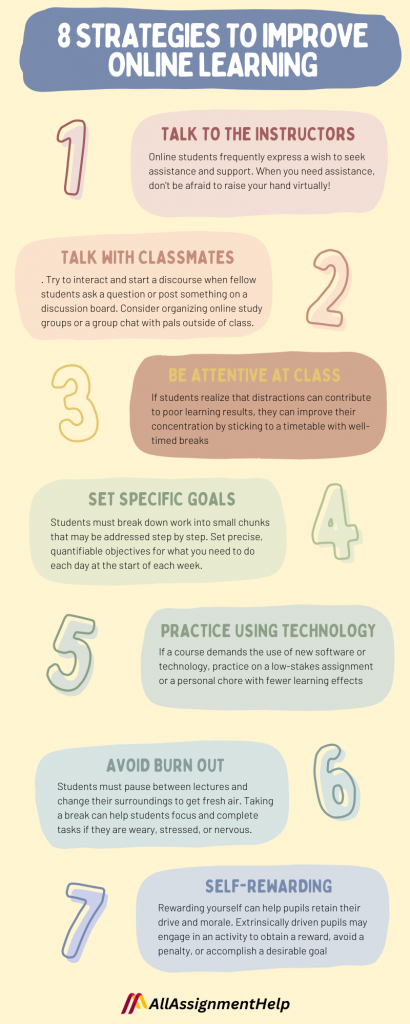
Students can improve their online learning by focusing on the following strategies:
Use study tools to communicate clearly with instructors
When students develop a relationship with their teacher or instructor, they have the chance to ask for assistance and offer valuable feedback. Online students frequently express a wish to seek assistance and support. When you need assistance, do not be afraid to raise your hand virtually regarding any lesson plan assignment or complex concept.
Keep peer discussion active in an online classroom
Instead of sitting next to classmates, stare into a camera or at a Zoom screen. Peer-to-peer involvement, on the other hand, is still vital in online classrooms. Try to interact and start a discourse when fellow students ask a question or post something on a discussion board. Working by yourself might result in social isolation. It is critical to check in with classmates and spend time exchanging personal news. Consider organizing online study groups or a group chat with pals outside of class.
Reduce distractions while attending an online class
People may feel more distracted and less engaged in learning during this period of undesired transition. When the mind wanders, students miss important information. If students realize that distractions can contribute to poor learning results, they can improve their concentration by sticking to a timetable with well-timed breaks. Students can think about using extension browsers to filter distracting information or leaving their phones in another room.
Set specific study goals before opening another tool
Online learning can be overwhelming for students. Setting specific goals is essential for staying motivated. Students must break down work into small chunks that may be addressed step by step. Set precise, quantifiable objectives for what you need to do each day at the start of each week.
Practice unfamiliar course technology before graded work
Learners of all ages may struggle the first time they utilize a new tool or software. If a course demands the use of new software or technology, practice on a low-stakes assignment or a personal chore with fewer learning effects. Remember that asking for assistance is completely okay!
Plan breaks before online study becomes exhausting
Taking a break can help students focus and complete tasks if they are weary, stressed, or nervous.8 Students should try to arrange pauses between lectures and change their surroundings to obtain some fresh air, sunlight, or a sip of water.
Use small rewards to maintain study momentum
Rewarding yourself can help pupils retain their drive and morale. Extrinsically driven pupils may engage in an activity to obtain a reward, avoid a penalty, or accomplish a desirable goal.
When maintaining the above-mentioned pointers, students are supposed to see the improvement themselves. In case, they still find it difficult to manage their online assignment or online class, they can seek genuine assignment writing help services at any time.
Also Read: Get Acquainted with the Pros and Cons of Studying in THE US!
What study tools can and cannot do for an online class
A study tool can organize documents, support revision and make course information easier to handle. It cannot decide what your professor means, guarantee that a source is accurate or take responsibility for the rules in your syllabus. Keep your course portal, rubric and instructor guidance as the primary reference.
If the difficulty is no longer about choosing an app and has become a matter of missed modules, overlapping deadlines or unfamiliar course requirements, review the available online class support route in the context of the exact subject and schedule.
Build a smaller study system you can use consistently
Being a college student already has enough problems. Fortunately, these applications can help you obtain that A while also freeing up some time in your calendar for other activities. So, give these apps a shot and make the most of your study time!
Also Read: Do Not Misunderstand the Students with Learning Disabilities
Questions students ask before choosing an online study tool
Will online tools help me learn better?
Obviously! If you use the right tools, you will surely benefit from them as these can help increase your productivity as a student.
What is the best way to find the most effective online tools for studying?
Begin with the task you need to complete, then compare current guidance from the tool provider, your institution and credible education sources. Recommendations from classmates can help, but test a tool on low-risk work before depending on it for an assignment or examination.
Which study tool is best for exam revision?
A recall-based tool is generally more useful than a writing or storage application when you are preparing for an exam. Flashcards and practice questions can help you retrieve information, but they should be checked against your course notes and required readings.
Can one application manage an entire online class?
Usually not. Students may use one platform for course access, another for documents and a separate method for revision or scheduling. The aim is to create a simple workflow rather than force every task into one application.
Should students rely on grammar and OCR tools without checking the result?
No. Grammar suggestions may change the intended meaning, while OCR can misread symbols, quotations and formatting. Compare the result with the original material before using it in coursework.
Are free study tools enough for college work?
Free versions can be enough for basic writing, storage and revision. A paid plan is worthwhile only when a required feature solves a recurring academic need and the institution does not already provide access.
What is the safest way to use an AI study tool?
Give the tool a specific learning task, keep private or restricted course information out of the prompt, and verify the response against lectures, readings and credible sources. Use AI to test your understanding rather than to disguise work you did not complete.
What this article covers
This guide compares practical online study tools for writing, research, revision, citation management, collaboration and guided learning. It explains where each tool may fit in a student’s workflow and highlights checks to make before relying on AI-generated material. It does not replace course readings, instructor guidance, independent research, professional academic advice or a university’s academic-integrity policy. Tool features, availability and pricing may change. Students should confirm important facts and citations using original sources and check whether AI-assisted work must be disclosed.
Terms used in this guide
- AI study tool
- Citation manager
- Collaborative document
- Flashcard
- Generative AI
- Guided learning
- Metadata
- Source grounding
- Study mode
Sources consulted for this guide
- Introducing study mode in ChatGPTOpenAI · July 29, 2025
- Using study mode in ChatGPTOpenAI · Accessed October 16, 2026
- Use learning tools in Gemini AppsGoogle · Accessed October 16, 2026
- Learn about Gemini NotebookGoogle · Accessed October 16, 2026
- Work on Google Docs, Sheets, and Slides offlineGoogle · Accessed October 16, 2026
- How does Grammarly work?Grammarly · Accessed October 16, 2026
- Studying with FlashcardsQuizlet · Accessed October 16, 2026
- Studying with Study GuidesQuizlet · Accessed October 16, 2026
- Creating BibliographiesZotero · Accessed October 16, 2026
- Word Processor PluginsZotero · Accessed October 16, 2026

AllAssignmentHelp
- Edited by
- AllAssignmentHelp
- Fact-checked by
- AllAssignmentHelp
- Fact-checked
- October 16, 2026
What changed: Human Written Summary, AI tools verified with prompts, Image relevance has been verified and content relevance to the year 2026 and 2027 has been established.
Connect the explanation to the work your course actually requires
Use this guide beside the exact brief, course material and marking criteria for The Best Online Study Tools for Students.
- Read the complete brief.
- Identify the expected academic output.
- Follow the marking criteria and source rules.
- Check the final structure and referencing.
Connor Hamilton
Data Science
Data science tutor with eight years of industry experience across analytics, large-scale data systems and machine learning. MSc in Data Science
View established tutor profile ↗Relevant subject areas
- Data Mining and Warehousing
- Hadoop and Spark
- Data Visualisation and Analytics
- Machine Learning Integration
- Cloud Big Data
- Python, R and Scala
Find another explanation across the complete blog
This search uses WordPress itself, so it can reach articles beyond the 20 shown on the dashboard.
Connect The Best Online Study Tools for Students to the task in front of you
Keep the brief, marking criteria, required evidence and submission format visible while you work.