Cost Benefit Analysis: Your Path Towards Success
What this article will help you understand
Cost Benefit Analysis (abbreviated as CBA) is used by businesses as part of a systematic process to choose which possibilities to pursue and which to reject. Before subtracting the total costs associated with a situation or course of action, the cost-benefit analyst adds up the potential benefits predicted from that situation or course of action.
What are you trying to do with this topic?
Choose the closest task and the page will point you towards a useful next step.
Start with the central concept and the terminology used in the article.
Open the closest route ↗Connect the explanation to the question, learning outcomes and marking criteria.
Open the closest route ↗Review evidence, structure, referencing and the exact submission requirements.
Open the closest route ↗Do you have enough information to begin?
Select what you already have. Nothing is submitted from this checklist.
When these details are together, the requirement can be reviewed in context.
Assignment Help USA ↗Table of Contents
Cost Benefit Analysis (abbreviated as CBA) is used by businesses as part of a systematic process to choose which possibilities to pursue and which to reject. Before subtracting the total costs associated with a situation or course of action, the cost-benefit analyst adds up the potential benefits predicted from that situation or course of action. Furthermore, some consultants or analysts develop models to assign a monetary value to immaterial items like the benefits and drawbacks of moving to a particular region.
Often, this subject turns out to be quite tough to deal with. You being a student pursuing a course in it, may indeed have faced many issues. Reading this blog written by experts at allassignmenthelp.com can help you big time in clearing doubts and coming back with much higher confidence to deal with this subject and its associated assignments successfully.
What is Cost-Benefit Analysis?
Cost-Benefit Analysis (CBA) is a method used to compare the costs and benefits of a project or decision to determine if it is worthwhile.
Formula:
Net Benefit = Total Benefits − Total Costs
- If benefits exceed costs, the decision is worthwhile.
- If costs exceed benefits, the decision may not be worthwhile.
Example:
A project costs $10,000 and generates $15,000 in benefits.
Net Benefit = $15,000 − $10,000 = $5,000, so the project is beneficial.
Also Read: Qualitative Analysis- Your overall Guide with Informative Facts
What are the Main Purposes of Cost Benefit Analysis
Cost-benefit analysis is used to evaluate whether a decision or project is worth the investment. By comparing all expected costs with the anticipated benefits, it helps businesses, governments, and individuals make informed and financially sound decisions.
- Support decision-making: Helps determine whether a project, investment, or business decision is financially worthwhile.
- Compare different options: Evaluates multiple alternatives to identify the option that provides the greatest overall value.
- Improve resource allocation: Ensures that available money, time, and resources are invested in the most beneficial projects.
- Reduce financial risk: Identifies potential costs, risks, and expected returns before implementation, reducing the chance of financial losses.
- Measure profitability: Determines whether the expected benefits exceed the total costs, ensuring the project generates a positive return on investment.
By using cost-benefit analysis, decision-makers can choose solutions that maximize benefits while minimizing costs, leading to more effective planning and better financial outcomes.
Why is CBA Beneficial for Decision-Makers?
There are a handful of points that make cost-benefit analysis very crucial as well as beneficial for decision-makers around the world.
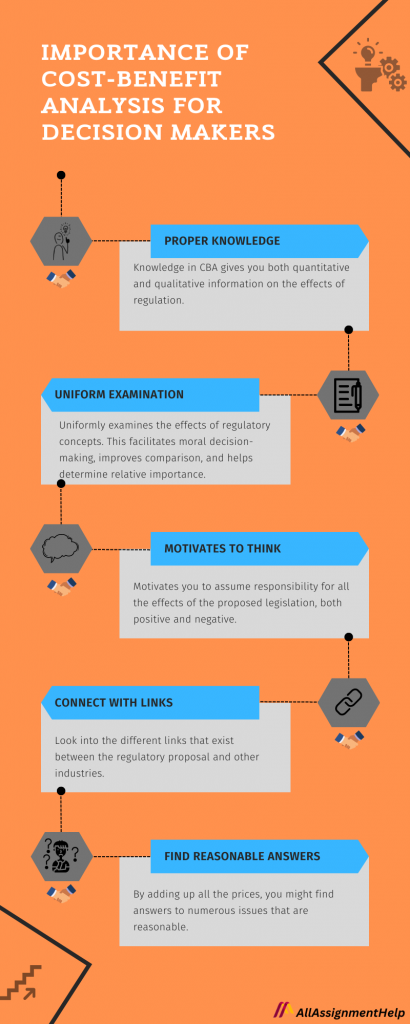
You being a student who wants to achieve a decision-making position in life must know the following to effectively pursue this profession-oriented course:
- Knowledge in CBA gives you both quantitative and qualitative information on the effects of regulation.
- Uniformly examines the effects of regulatory concepts. This facilitates moral decision-making, improves comparison, and helps determine relative importance.
- Motivates you to assume responsibility for all the effects of the proposed legislation, both positive and negative. You are also discouraged by making decisions exclusively focused on how they will impact a particular community group.
- Look into the different links that exist between the regulatory proposal and other industries. It also gives you the chance to maximize net social benefits.
- By adding up all the prices, you might find answers to numerous issues that are reasonable.
A clear understanding of the above-mentioned pointers will help you go much higher in your academic as well as professional life. However, if you think you need urgent assistance with your cost-benefit analysis assignment, contacting a genuine online assignment help can be a very good idea. This way, you will be able to give more concentration on your studies and get closer to success.
Cost-Benefit Analysis Performing Method
A straightforward method for comparing a project’s costs and benefits is cost-benefit analysis. To decide whether to move further with a specific project or not.
CBA can be used in a variety of circumstances, including:
- When adding a new department, which necessitates recruiting new personnel
- To examine whether a capital purchase is feasible.
- Consider a recent endeavor or a significant shift.
The CBA performance method is detrimental and causes great success for the company or organization. On the other hand, a faulty performance of CBA may result in a lot of damage. Having a clear idea of CBA performance is a must-have for young professionals like you who are pursuing this course.
Step-wise Cost-Benefit Analysis’ Processes
The complete idea of the step-wise CBA process makes you a true leader and a professional who can find out the true success formula for any company.
If you have issues understanding this part, this part can be very helpful by getting a complete idea of the CBA through the below-mentioned systematic stages:
1: Analyze Costs and Benefits
- The first step is to examine all of the expenses related to your project. Make a list of all of your expenses.
- Examine all of the profits associated with your project next.
- It is possible that there will be some unanticipated benefits or costs that you did not initially anticipate. When you sit down to analyze the costs and benefits, take into account the duration of those expenses and benefits.
2: Give the Expenses a Financial Impact
- Costs include the cost of the labor used throughout each stage of a project as well as the cost of the necessary materials.
- Make an effort to think of as many charges as you can. For example, running a rug business requires you to purchase carpets, hire personnel, pay them for their time spent there, and incur numerous other present and future costs.
- Pay attention to all expenses. Work in accordance with how long you anticipate your project taking. You should therefore plan ahead just in terms of costs.
3: Put a Price on the Advantages
- As a result, it becomes a little more difficult to determine the value of the benefits your organization might receive.
- Because predictions are subject to change in response to impending events, the advantages you calculate are soft benefits. What impact, for instance, does it have on the environment? What are the financial impacts of issues like employee happiness or health and safety concerns?
4: Assess the Costs and Benefits for You
- This is the final step. Compare the values of your costs and benefits, and then decide what actions are necessary.
- Establish the individual costs and benefits qualities before deciding if the worth of the advantages outweighs the significance of the costs.
- The simplest approach is to divide the total cost value by the total benefit value. The length of time or the duration of the repayment period will subsequently be known to you.
Knowing all these stages can help you come up with an opinion to help your organization overcome all the challenges and eventually make you a great leader.
Also Read: Language Analysis: Get Blown Away By Useful Clues
Cost Benefit Analysis Assessment
CBA aims to quantify both a project’s beneficial and unfavorable effects. This is indeed one of the major parts that need to be done very carefully and tactically.
The process may include the following:
- Repercussions on those who are actually affected by it
- Implications for those who are not necessarily touched by it
- Influences from outside sources
- Alternative value or additional societal advantages
- There could be a wide range of benefits and expenses. Financial costs are quickly represented through cost-benefit analyses. Because of more comprehensive market data.
- Among the net benefits may be the public’s willingness to pay compensation or accept it, cost savings, or both. The welfare of the public is the goal of the policy changes.
- Before adding the positive or negative value, the basic rule that will help you, in this case, is to establish a list of all the groups of people who are touched by the external mean.
- It is typical practice to use surveys or market behavior to ascertain the compensation related to a policy. They then demonstrate how much emphasis they place on various environmental factors.
- How much human life should be valued is a contentious issue.
- When identifying measures for traffic or life safety, for instance. Cost-utility analysis, however, can occasionally assist in avoiding this situation.
- Another is the argument over how to value the environment, which in the modern day also refers to how to value ecosystem services. The air and water quality as well as pollution are mentioned.
- A company’s reputation, market share, and other evolving effects may also have a monetary value.
When students are able to do it effectively, it can be considered that they are well-versed in the ideas related to the subject and/or topic. However, many fail in doing so, as this part is possibly one of the most challenging ones in an entire paper. Taking help from trustworthy CBA assignment makers can turn out to be a smart idea when one wants to score really well academically.
History of CBA in the USA
Some intellectual and institutional objections to CBA began to surface in the 1980s.
The following were the primary three criticisms:
- CBA might be applied to political ends. The benefits of cost and benefit can be discussed by putting aside political or philosophical objectives, rules, and regulations.
- CBA is not a neutral analysis technique because it is anti-regulatory.
- The time required to complete CBA may result in some delays that impede the implementation of policy rules.
These criticisms persisted into the 1990s. They slowly diminished after that. The primary defense made was that CBA shouldn’t participate in the regulatory process. However, the use of CBA persisted even after that. It was because there was a disagreement regarding its usefulness and objective values. Though some analysts continue to be opposed to CBA’s use in policymaking, the majority of analysts support it.
Constraints of Cost-Benefit Analysis
There are many pros of CBA. However, there are a handful of reasons that puts CBA at the back. Students must know these drawbacks as well.
The following are setbacks:
- CBA will be adequate to make a thorough choice for projects with low to medium levels of capital and limited time.
- CBA fails to consider significant financial issues for a project that is quite huge and will take a long time to complete.
- The current worth of money, inflation, different cash flows, and interest rates are all included.
Even if there are constraints, the analysis process is still one of the most effective ones considered by the majority of organizations around the world. You need to learn the subject very well to be able to make the most of it to achieve success in your future life.
Summary of Findings
Cost-benefit analysis (CBA) helps determine whether a project or decision is financially worthwhile by comparing its expected costs and benefits. A well-prepared CBA enables students to make logical conclusions and support their recommendations with evidence. If you’re overwhelmed with multiple assignments and searching for take my online class for me services, getting academic assistance can help you manage your coursework while meeting deadlines.
The key findings of a cost-benefit analysis include:
- Cost-benefit analysis is an effective tool for evaluating the feasibility of a project or investment.
- All direct and indirect costs should be identified before making a decision.
- Expected benefits should be compared with the initial investment to determine overall value.
- Costs and benefits should be measured consistently to ensure accurate analysis.
- The final findings help recommend whether a project should be accepted, modified, or rejected.
Frequently Asked Questions
1. What is a cost-benefit analysis?
A cost-benefit analysis (CBA) is a decision-making method that compares the total expected costs of a project with its expected benefits. It helps determine whether a project or investment is financially worthwhile.
2. What are the main steps in conducting a cost-benefit analysis?
The basic steps include identifying all costs and benefits, assigning monetary values, comparing the totals, calculating the net benefit, and making a recommendation based on the results.
3. What is the formula for cost-benefit analysis?
The most common formula is:
Net Benefit = Total Benefits − Total Costs
If the result is positive, the project is generally considered beneficial. Some organizations also use the Benefit-Cost Ratio (BCR) by dividing total benefits by total costs.
4. Why is cost-benefit analysis important for students?
Cost-benefit analysis is widely used in business, economics, finance, engineering, and project management courses. It helps students evaluate real-world decisions, justify recommendations, and improve analytical thinking. If you’re finding such assignments challenging, many students look for take my online class for me services to manage coursework and meet deadlines without compromising on quality.
5. What are the limitations of cost-benefit analysis?
Cost-benefit analysis relies on accurate estimates, and some benefits, such as customer satisfaction or environmental impact, can be difficult to measure in monetary terms. As a result, the findings should be considered alongside qualitative factors before making a final decision.
Connect the explanation to the work your course actually requires
Use this guide beside the exact brief, course material and marking criteria for Cost Benefit Analysis.
- Read the complete brief.
- Identify the expected academic output.
- Follow the marking criteria and source rules.
- Check the final structure and referencing.
Lina
Finance · 4.9/5
For a topic such as “Cost Benefit Analysis: Your Path Towards Success”, a tutor with a published background in Finance offers a useful subject-matching option.
Finance tutor with related experience in economics, accounting and business information systems.
View established tutor profile ↗Relevant subject areas
- Finance
- Economics
- Business Information Systems
- Microeconomics
- Accounting
Find another explanation across the complete blog
This search uses WordPress itself, so it can reach articles beyond the 20 shown on the dashboard.
Connect Cost Benefit Analysis to the task in front of you
Keep the brief, marking criteria, required evidence and submission format visible while you work.