How to Become a Successful Business Analyst in 2026

What this article will help you understand
There are many rewarding career options in today’s world, such as financial analysts, psychiatrists, software developers, petroleum engineers, and information security analysts. Among these highly respected professions, becoming a business analyst is also considered one of the best career choices. The role offers excellent job satisfaction, attractive salary opportunities, and a healthy work-life balance. And
What are you trying to do with this topic?
Choose the closest task and the page will point you towards a useful next step.
Start with the central concept and the terminology used in the article.
Open the closest route ↗Connect the explanation to the question, learning outcomes and marking criteria.
Open the closest route ↗Review evidence, structure, referencing and the exact submission requirements.
Open the closest route ↗Do you have enough information to begin?
Select what you already have. Nothing is submitted from this checklist.
When these details are together, the requirement can be reviewed in context.
Assignment Help USA ↗Table of Contents
There are many rewarding career options in today’s world, such as financial analysts, psychiatrists, software developers, petroleum engineers, and information security analysts. Among these highly respected professions, becoming a business analyst is also considered one of the best career choices. The role offers excellent job satisfaction, attractive salary opportunities, and a healthy work-life balance. And honestly, these are the qualities most professionals look for when choosing a career path.
So, are you thinking about becoming a business analyst too? If yes, then this blog by AllAssignmentHelp.com can help you understand the field better and guide you toward making smart career decisions at the right time.
Who is a Business Analyst?

A business analyst is a professional who helps organizations identify problems, improve processes, and make better business decisions using data, research, and strategic planning. They act as a bridge between business teams and technical teams to ensure that business goals are achieved effectively.
In simple words, a business analyst studies how a company works, understands its challenges, and suggests practical solutions to improve performance, productivity, and profits. They gather information, analyze business needs, and help companies implement better systems or strategies.
For example, if a company is losing customers because its website is slow and difficult to use, a business analyst will identify the issue, collect user feedback, and work with developers and managers to improve the website experience.
Some common responsibilities of a business analyst include:
- Analyzing business processes and identifying problems
- Collecting and interpreting data
- Understanding client or company requirements
- Preparing reports and documentation
- Communicating with stakeholders and technical teams
- Suggesting solutions to improve efficiency and growth
- Helping companies adopt new technologies or systems
Business analysts are needed in many industries, including healthcare, finance, IT, retail, education, and marketing. Because companies rely heavily on data and smart decision-making today, the demand for skilled business analysts continues to grow worldwide.
What Steps Do You Need to Follow to Become a Business Analyst?
There are three steps that you need to follow if you want to become a successful analyst in the business domain. Let’s go through them one by one.
Master Business Analysis Fundamentals
The first thing you should keep in mind before stepping into any career is understanding your dream role clearly. Find answers to questions like what the position involves, what responsibilities you will handle, and what challenges you may face in the profession.
A business analyst identifies and analyzes business-related problems to find effective solutions that support company growth and improve overall performance. They help organizations make better decisions by studying data, understanding business needs, and suggesting practical strategies.
For better clarity about this career path, you can also explore business analyst courses, tips, and industry insights to strengthen your understanding and make informed career decisions.
Well, there is a list of jobs for them, like:
- Systems Analyst
- Process Analyst
- Business Architect
- Management Consultant
- Requirements Engineer
- Product Manager
- Quality Assurance
- Data Scientist
The most logical thing is to take up a degree that gives them exposure to the theory of business analysis, and that must be your first step. You should go for a degree in the following domains:
- Business administration
- Finance
- Accounting
- Statistics
- Computer science
- Programming
- Economics
Root for the Best Data Analytics Course
As I told you before, the main task of a business analyst is to focus on data, which ultimately helps them analyze problems and give solutions. So, this is the perfect course, as you can grow laser-focused skills that will be beneficial for you. The following are a few of the best Business analyst degrees:
- B.S. in Business Administration
- B.S. in Financial Management
- B.S. in Statistics
- Master’s in Business Analytics
- Master of Business Administration (MBA)
- Master’s in Marketing and Communication
- Master of Science in Data Analytics
Succeeding in a business analyst course can be challenging for beginners. However, with the right guidance from experts, students can focus better on their studies and improve their understanding of the subject. If you are unable to find proper guidance and need support with your business analysis courses, seeking online academic assistance can be a helpful option.
Many business analyst students search online using phrases like “take my online classes for me” to connect with reliable online class help services. These services often help students strengthen their subject knowledge, manage academic pressure, and achieve better grades. You can also seek professional assistance to overcome learning difficulties and stay confident throughout your course journey.
Get Experience Related to Your Field
Enrolling in a business analyst degree program is the first step toward building a successful career. However, completing a degree alone is not enough. To become a skilled business analyst, you also need practical experience and real-world exposure.
Instead of directly applying for full-time jobs after graduation, try gaining experience through internships. Internships help you move beyond textbooks and understand how businesses actually work. They improve your problem-solving, communication, and analytical skills while preparing you for the professional world.
Many students avoid internships because of academic pressure, assignments, and deadlines. Managing studies and practical learning together can feel overwhelming. That is why some students seek online assignment help to balance their workload more effectively. With proper guidance and time management, you can focus on both your studies and career growth without unnecessary stress.
Apply For Jobs related to Business Analysts!

The one thing you need to do when it’s time to apply for a job is conduct good research. Check the priorities of the company and see whether they can lend a hand toward your goals and aspirations. Let me name some of the most well-known roles:
- Data Analyst
- Functional Analyst
- Quantitative Analyst
- Research Analyst
- Systems Analyst
- Enterprise Architect
- Process Architect
- Business Solution Architect
- IT Project Coordinator
- IT Lead
- Process Coordinator
- Management Consultant
- Product Manager
- Project Manager
- Compliance Manager
- Chief Information Officer
The average annual salary for a business analyst is $78,285 per year, which is better than many other high-profile jobs. So what are you still thinking of? Business analysts are an in-demand career in which you may have the best job satisfaction.
Also Read: Best Business Research Topics For Your Academic Paper
What are the Responsibilities of a Business Analyst?
A business analyst plays an important role in helping companies improve their performance, solve business problems, and achieve their goals more effectively. They work closely with different teams to understand business needs and suggest practical solutions.
Some major responsibilities of a business analyst include:
- Identifying business problems and finding effective solutions
- Analyzing data and business processes to improve efficiency
- Gathering and documenting business requirements
- Communicating with clients, stakeholders, and technical teams
- Preparing reports, presentations, and project documentation
- Helping companies implement new systems or technologies
- Monitoring project progress and ensuring business goals are achieved
- Conducting market and competitor research for better decision-making
- Improving workflow, productivity, and overall business performance
Business analysts act as a bridge between management and technical teams, ensuring that projects align with business objectives and deliver successful results.
Also Read: See Yourself Growing with Business Management Courses
What Skills Are Required to Become a Successful Business Analyst?
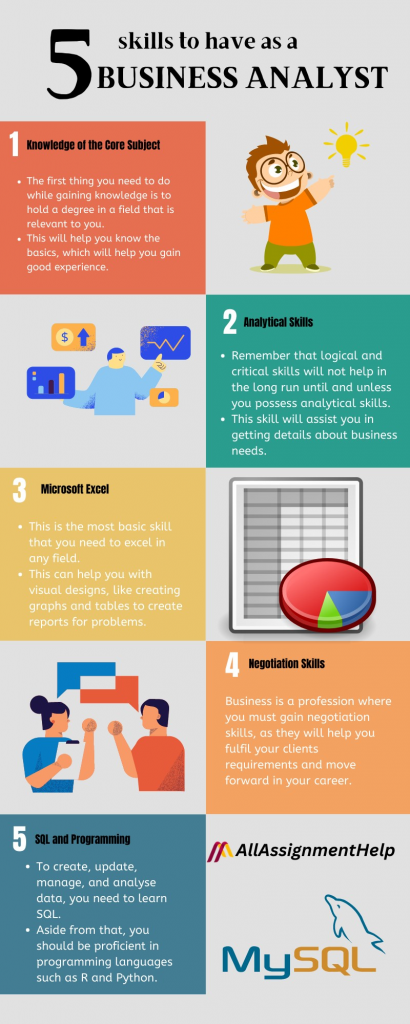
To become a successful business analyst, you need a combination of technical knowledge, analytical thinking, and communication skills. Since business analysts work with both business and technical teams, they must be able to understand problems, analyze data, and communicate solutions clearly.
Here are some important skills every business analyst should develop:
Knowledge of the Core Subject
- The first thing you need to do while gaining knowledge is to hold a degree in a field that is relevant to you.
- This will help you know the basics, which will help you gain good experience.
- If you find any difficulty understanding the subject, you can always hire a professional who can provide guidance.
Analytical Skills
- Remember that logical and critical skills will not help in the long run until and unless you possess analytical skills.
- This skill will assist you in getting details about business needs.
- You can also find the best solutions for the issues when you possess analytical skills.
Microsoft Excel
- This is the most basic skill that you need to excel in any field.
- This can help you with visual designs, like creating graphs and tables to create reports for problems.
- Isn’t it something that you might have learned during your schooling, but have you by any chance missed learning this or were inattentive? You can always rely on experts for that.
Negotiation Skills
- Business is a profession where you must gain negotiation skills.
- As an analyst, you would be dealing with clients, and you must keep them happy.
- And how can you do that without excelling in negotiation skills?
SQL and Programming
- To create, update, manage, and analyze data, you need to learn SQL. Many students initially find databases and coding concepts difficult, which is why they often seek guidance from experts or look for programming assignment help to strengthen their understanding.
- It is important to learn Microsoft SQL Server, MySQL databases, Oracle DB, and SQLite if you want to become a successful business analyst. These tools help professionals manage and analyze large amounts of business data efficiently.
- Apart from database knowledge, you should also develop proficiency in programming languages such as R and Python. These languages are widely used for data analysis, visualization, automation, and business forecasting, making them highly valuable skills for aspiring business analysts.
Conclusion
Becoming a business analyst can be a smart career choice for students who enjoy problem-solving, data analysis, communication, and strategic thinking. From understanding business needs to helping companies improve their performance, business analysts play a major role in the success of modern organizations. The career also offers excellent job opportunities, attractive salaries, and strong professional growth.
However, succeeding in this field requires the right mix of education, practical experience, and technical skills. By choosing the right degree, developing analytical abilities, gaining internship experience, and continuously improving your knowledge, you can build a successful future as a business analyst.
If you stay dedicated, keep learning, and focus on skill development, this career path can open doors to exciting opportunities across different industries worldwide.
Frequently Asked Questions
1. What qualifications do I need to become a business analyst in 2026?
To become a business analyst, you should preferably have a degree in business administration, finance, accounting, statistics, computer science, or a related field. Certifications and practical skills can also improve your career opportunities.
2. Is business analyst a good career option in 2026?
Yes, business analysis continues to be one of the most in-demand and rewarding career options in 2026 because companies rely heavily on data-driven decision-making and business strategies.
3. What skills are required to become a successful business analyst?
Some important skills include analytical thinking, communication, problem-solving, data analysis, SQL, Microsoft Excel, programming basics, and project management skills.
4. Can I become a business analyst without technical knowledge?
Yes, but having basic technical knowledge can give you an advantage. Many business analysts start with non-technical backgrounds and gradually learn tools like SQL, Excel, and data visualization software.
5. How important are internships for aspiring business analysts?
Internships are extremely important because they provide practical experience, improve professional skills, and help students understand real-world business environments before applying for full-time jobs.
6. What is the average salary of a business analyst?
The salary of a business analyst depends on experience, skills, and location. However, business analysts generally earn competitive salaries with strong career growth opportunities worldwide.
Connect the explanation to the work your course actually requires
Use this guide beside the exact brief, course material and marking criteria for Business Analyst.
- Select the relevant framework.
- Apply it to the case or organisation.
- Use evidence for analysis.
- Make realistic, supported recommendations.
Anita Sahay
Management
Management tutor with a finance management background and professional financial advisory experience. Master’s in Finance Management, University of Manchester (2017)
View established tutor profile ↗Relevant subject areas
- Finance Management
- Management
- Financial Advisory
Find another explanation across the complete blog
This search uses WordPress itself, so it can reach articles beyond the 20 shown on the dashboard.
Connect Business Analyst to the task in front of you
Keep the brief, marking criteria, required evidence and submission format visible while you work.