A Detailed Guide on How to Write a Reflection Paper

What this article will help you understand
Reflection papers are a part of the academic career. University and college students are often assigned various types of reflection papers to assess their critical thinking and self-assessment skills. It is a great way to apply everything you have learned. This academic paper bridges the gap between objective knowledge and personal insight. Writing a reflection
What are you trying to do with this topic?
Choose the closest task and the page will point you towards a useful next step.
Start with the central concept and the terminology used in the article.
Open the closest route ↗Connect the explanation to the question, learning outcomes and marking criteria.
Open the closest route ↗Review evidence, structure, referencing and the exact submission requirements.
Open the closest route ↗Do you have enough information to begin?
Select what you already have. Nothing is submitted from this checklist.
When these details are together, the requirement can be reviewed in context.
Assignment Help USA ↗Table of Contents
Reflection papers are a part of the academic career. University and college students are often assigned various types of reflection papers to assess their critical thinking and self-assessment skills. It is a great way to apply everything you have learned. This academic paper bridges the gap between objective knowledge and personal insight. Writing a reflection paper can truly be an engaging experience for students. However, not all students are aware of the writing method and often wonder how to write a reflection paper.
Before discussing anything else, you must know one thing: that reflection papers are different from typical essay writing. This academic writing can be both a liberating and challenging experience. To know more about how to approach this writing, refer to this blog post from All Assignment Help. Learn and acquire knowledge about how to write a reflection paper on your own.
What is a Reflection Paper
Reflection writing is the type of writing where you are free to express your own thoughts. Students writing a reflection paper are free to express their personal thoughts, feelings, and insights. A reflection paper can be on a movie, article, or book.
It is the writer’s responsibility to explain an analytical practice in which the writer compares a real or imagined scene, interaction, passing thought, event, or memory to an incident, thought, feeling, emotion, or situation in their own life while also reflecting on their perceptions and thoughts.
Reflective writing can shape everything about your thoughts. It is an opportunity to briefly describe a summary or concept. To start with, before asking any other person, ask yourself the way you want to start. Ask yourself how to write a reflection of your thoughts. Jot down your perspectives, and then you will surely be able to start in the right manner. There is no right or wrong in it; it all depends on your opinions and emotional response. However, it does not mean that you can write anything you want.
Whether you are writing a reflection paper or your chemistry assignment, planning is very important. Without planning, you won’t be able to develop your ideas and present them effectively. On the other hand, with proper planning and knowledge about the format, you can easily crack any part of academic writing. Moreover, if you need any help with chemistry assignment or a reflection paper, get assistance from online writers. They can timely assist with a top-grade guarantee.
Basic Reflection Paper Format
A reflection paper is incomplete without following the correct reflection paper format. Students attempting to write this paper must have a clear understanding of the format. For a better understanding of terms, you may refer to the information given below. We have provided a detailed explanation of the reflection paper format. Moreover, you may also refer to the reflection paper example online to understand things better.
Introduction – First Step in the Reflection Paper Outline
An introduction is the first in the reflection paper outline. The opening of a reflection paper introduces the reader to the reflection paper, much like any other sort of academic writing. It introduces the reader to the thoughts and perspectives of the author.
- The main purpose of the introduction is to reflect on the paper. Let the reader know what the reflection paper is all about.
- Make sure you provide enough context to the readers and avoid unnecessary content.
- Try all ways to set the tone for the rest of the content.
The introduction follows the thesis statement. This can be found in the final sentence of the introduction. It serves as the reflection paper’s main focus. It introduces the reader to the central themes of the paper.
Also Read: Outstanding Ethics Topics for Academic Papers and Research Writing
How to Write an Introduction for a Reflection Paper
The introduction is a crucial part of an academic paper. Whether you are writing a reflection paper, research paper, or essay, you must start your work with an introduction. When writing assignments in subjects like history, the introduction plays an important role. It introduces the main purpose of your assignment to the reader. Unfortunately, not all students are pros at writing introductions and end up struggling with poor assignments. Some of them even seek history homework help to get their work done. Here are some tips to help all those students write the best introduction.
- Start with a hook statement to grab readers’ attention.
- Include a question mark or striking observation related to the topic of your reflection.
- Give a brief overview of the subject or experience in the introduction.
- Discuss the central theme you will reflect on.
- State the purpose clearly and let the reader know what to expect.
- Always end your introduction with a thesis statement. Your reflection paper introduction is incomplete without it.
Body Paragraphs – Second Step in the Reflection Paper Outline
Body paragraphs are where you will use personal experiences to support your thesis statement. This is the main part of the reflection paper and is typically three to four paragraphs. As it is about your reflection, you are free to adjust the length and analysis as per your preference.
We hope you now know how to write a reflection paper main body. Four things you should include in the main body of the reflection paper are
- Description
- Reaction
- Analysis and connection
- Evidence or examples
Also Read: Thesis vs. Dissertation vs. Research Paper – Understanding The Difference
Tips to Write a Reflection Paper Main Body
- You are free to describe what you feel and say in the body paragraph. But make sure you always keep things organized.
- Remember to at least cover three key topics in the reflection paper that will help to support your argument.
- Whenever you begin a paragraph, always include the topic sentence.
- The topic sentence, which appears in the first line of the paragraph, will be explained in more detail in the following sentences.
- When writing topic sentences or viewpoint statements, never write without supporting your claims with proof.
- Evidence must be presented logically and supported by facts and statistics.
Conclusion – Third Step in the Reflection Paper Outline
The conclusion comes at the end of the reflection paper. It sums up everything you have written in the paper. It is always advised for students not to go for paraphrasing. The conclusion is an opportunity to tell the readers how the particular experience changed your life. How did it influence your overall reflection?
You should carefully summarize the key insights in this step. This can be a time-consuming part for beginners, but make sure you do not skip anything. If this takes up your other exam preparation time, you may hire online exam helpers for it. Just say, can someone take my online exam for me? They will help in completing all your online exams with top grades. While they do their work, you can focus on making your reflection paper the best among all.
How to Write a Conclusion for a Reflection Paper
- While writing the conclusion, restate the thesis statement. Just explain your thesis statement in a few lines along with your points of discussion.
- End your conclusion with an open-ended question or a strong statement.
- Restate the entire thing you have discussed in the introduction and main body.
- Do not repeat word-for-word; just summarize the key points.
- Writing a reflection paper is all about showing growth. Therefore, in the conclusion, reflect on how the particular experience changed your thinking or behavior. Moreover, if you need any assistance in writing your conclusion, hire an assignment helper. They will thoroughly guide you.
References – Last Step in the Reflection Paper Outline
The reference section is not necessarily added in the reflection paper. However, when adding quotes in the paper, you should always cite them. When referencing, always follow the reference style instructed by your teacher.
- Add a reference only when mentioning or quoting any external sources.
- Make sure the citation style you use is as per your academic field.
- References should always be placed at the end of the reflection paper.
Tips to Write a Reflection Paper
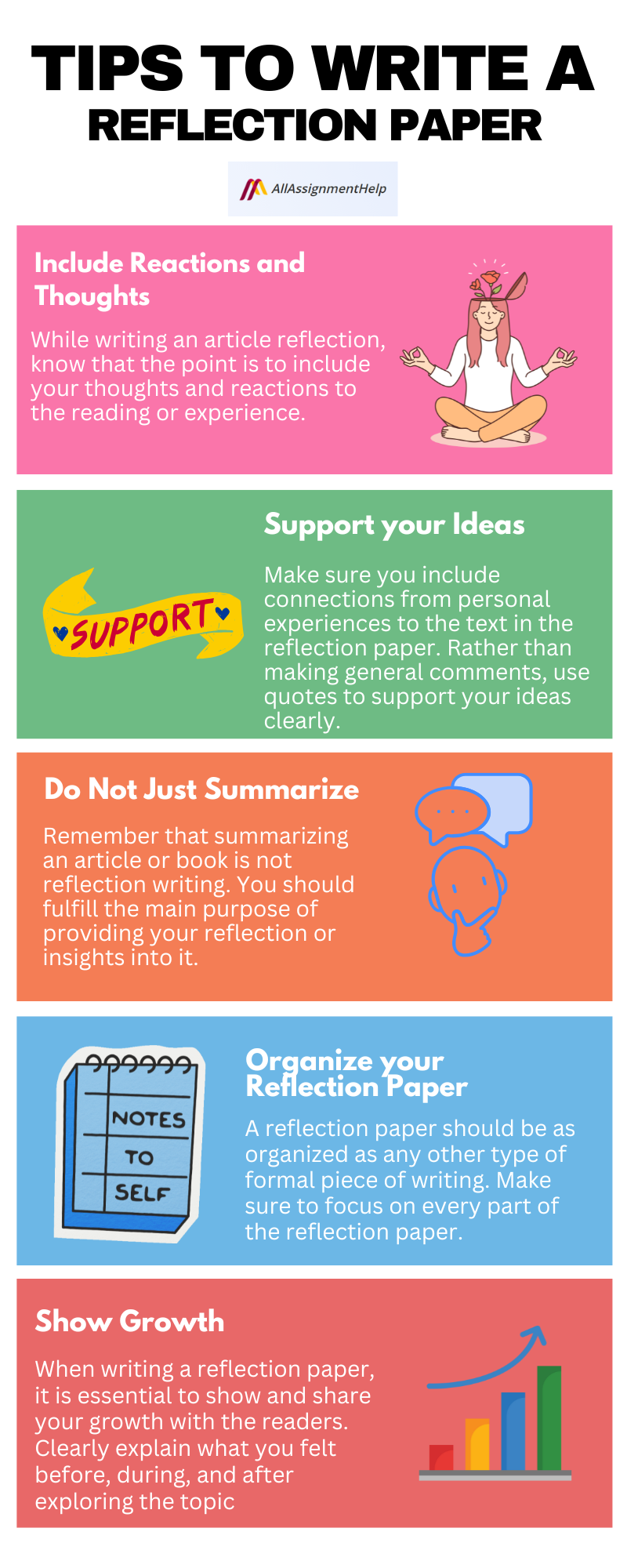
Are you one of those students who are not good at writing assignments, participating in quizzes, or writing a reflection paper? Do you often want to pay someone to do your online class to increase your academic scores? Well, to become an expert in academic writing, you just need to start by understanding the basic structure of academic tasks. It is not difficult to score good grades on assignments. You just need to be consistent and dedicated. Likewise, it is not difficult to write a reflection paper. Some tips to help you in the process of writing are
Include Reactions and Thoughts
While writing an article reflection, know that the point is to include your thoughts and reactions to the reading or experience.
Support Your Ideas
As a student, you might be well-versed in providing evidence to support evidence. Use this skill when writing a reflection paper as well. Make sure you include connections from personal experiences to the text in the reflection paper. Rather than making general comments, use quotes to support your ideas clearly.
Do Not Just Summarize
Remember that summarizing an article or book is not reflection writing. You should fulfill the main purpose of providing your reflection or insights into it. Reflection is about sharing personal experiences, but it does not mean you can write casually. You should follow a formal academic tone to answer the main question.
Also Read: A Complete Guide on Reflection Paper
Make Sure to Organize Your Thoughts
A reflection paper should be as organized as any other type of formal piece of writing. Make sure to focus on every part of the reflection paper. Organize the introduction, body, and conclusion perfectly. Make sure to keep the reflection paper format appropriate. If you prepare your reflection by keeping these three points, you will surely write a perfect one.
Show Growth
When writing a reflection paper, it is essential to show and share your growth with the readers. Clearly explain what you felt before, during, and after exploring the topic. Whether it is personal or intellectual growth, it includes every detail carefully.
Conclusion
A reflection paper is an important part of academics. Writing down a reflection paper is far from narrating the story to your audience. You are not supposed to narrate the story to them. It should have paragraphs, without which your ideas will be disorganized. It would be of no use to have a perfect storyline, yet your ideas are jumbled up.
Do remember that your reflection paper is about you. It is a chance for you to express your thoughts on a movie you have seen (and enjoyed, hopefully). If you need to know how to write a reflection paper thoroughly, refer to this blog post. We have briefly answered how to start a reflection paper.
Frequently Asked Questions
Question 1: How to write a reflection paper on a book?
Writing a reflection paper on a book is different from other. It should reflect your experience and indicate the specific knowledge that you gained after reading the book.
Question 2: How to write a reflection paper on a movie?
When writing this research paper, you must make sure to summarize the plot for the readers. From characters to key scenes to emotional responses, tell how you feel about the movie through your writing.
Question 3: How to write a reflection paper on an article?
A reflection on an article can be written on an assigned piece of a speech or an experience. The paper will record your reactions and feelings. Plus, the analysis of an experience in a personal way. You can say this in a less formal research/analytical essay.
Question 4: How to write a self-reflection paper?
This reflection paper writing is a personal and thoughtful process. You should clearly explain your thoughts, feelings, and experiences to the reader.
Connect the explanation to the work your course actually requires
Use this guide beside the exact brief, course material and marking criteria for An Art of How to Write a Reflection Paper.
- Read the complete brief.
- Identify the expected academic output.
- Follow the marking criteria and source rules.
- Check the final structure and referencing.
Sarah Johnson
Mathematics
This guide concerns “A Detailed Guide on How to Write a Reflection Paper”. Sarah Johnson is one of the available tutors whose live profile lists experience in Mathematics.
Mathematics tutor with eight years of experience across core college and school mathematics topics. Master’s degree in Mathematics
View established tutor profile ↗Relevant subject areas
- Algebra
- Calculus
- Geometry
- Statistics
- Trigonometry
Find another explanation across the complete blog
This search uses WordPress itself, so it can reach articles beyond the 20 shown on the dashboard.
Connect An Art of How to Write a Reflection Paper to the task in front of you
Keep the brief, marking criteria, required evidence and submission format visible while you work.