How Important are Micro-Credentials in Higher Education?
What this article will help you understand
Do you know how important it is to get students ready for the demands of the workplace? When students believe they are more inclined to enrol in a degree program that offers industry micro-credentials, it is important to integrate them into the curriculum. Leaving a lasting impression in a competitive job market requires more than
What are you trying to do with this topic?
Choose the closest task and the page will point you towards a useful next step.
Start with the central concept and the terminology used in the article.
Open the closest route ↗Connect the explanation to the question, learning outcomes and marking criteria.
Open the closest route ↗Review evidence, structure, referencing and the exact submission requirements.
Open the closest route ↗Do you have enough information to begin?
Select what you already have. Nothing is submitted from this checklist.
When these details are together, the requirement can be reviewed in context.
Assignment Help USA ↗Table of Contents
Do you know how important it is to get students ready for the demands of the workplace? When students believe they are more inclined to enrol in a degree program that offers industry micro-credentials, it is important to integrate them into the curriculum. Leaving a lasting impression in a competitive job market requires more than just the traditional degrees currently offered in the evolving fields of education and employment. This blog by allassignmenthelp explores the potential benefits of micro-credentials for college students and new graduates, providing insight into the growing importance of these little credentials.
We also examine a number of benefits, such as enhancing employability and skill sets, and how micro-credentials offer a flexible and efficient way to close the knowledge gap between industry standards and academic standards. So, stay tuned with us…
Read More: How Positive Thinking Can Strengthen Academic Performance
What are Micro-Credentials?
Micro-credentials are short, specialised certificates that attest to your expertise in a particular ability or field of study. In contrast to conventional degrees, which span several years and cover a wide range of academic subjects, micro-credentials are designed to focus on employable abilities that may be used right away.
Consider them to be small educational components that can be joined to create a more comprehensive skill set. Furthermore, several micro-credentials are sometimes combined to form a diploma or degree because they are interchangeable.
While pursuing micro-credentials, students often juggle work, studies, and personal commitments. This is where online assignment help becomes valuable. It allows learners to manage their coursework effectively, meet deadlines, and focus on gaining practical skills without feeling overwhelmed.
Why Micro-Credentials are Important Nowadays?
Institutions of higher learning must actively participate in making sure that students have the abilities and competencies needed to find employment. There is a gap between what students learn in school and what they need to have to get employment. To close this gap, micro-credentials are becoming an innovative force that enables students to gain the competencies and abilities needed in job markets. Their availability, flexibility, and advantages are making them the new standard in higher education. As hiring practices change, it’s essential to recognise that skills are becoming more valued than degrees and that micro-credentials are becoming more widely accepted.
Below are some main benefits:
- Micro-credentials are incredibly flexible and reasonably priced for learners, especially those who were unable to attend university. It can increase the significance of higher education by giving students the opportunity to acquire and prepare for the workforce.
- They offer a secure option for pursuing interests prior to enrolling in a full-time program for students. Also, while they are studying, they can accumulate a portfolio of certificates that will help them stand out in the job market.
- With the help of micro-credentials, employees can change careers or upskill without quitting their current positions. They are especially useful in industries that are changing quickly, like business, healthcare, and technology.
- Candidates with proven abilities who are ready to contribute right away are advantageous to employers. By enabling businesses to provide staff with specialised training, micro-credentials can aid in internal workforce development.
- Higher education providers make these programs more useful and aligned with national and subject-specific standards by dividing degree programs into smaller parts and working with stakeholders.
- With it, education becomes more individualised; students can choose the program that interests them and learn at their own pace and at their own convenience.
Students benefit a lot from micro-credentials. Since most programs don’t have strict entry requirements, many students can easily enrol. This helps even well-established institutions reach a wider audience and build their reputation by connecting with students worldwide.
At the same time, students often balance work, studies, and personal life while pursuing these programs. In such cases, you can visit the online class help sites and ask the expert to take your online class for you, who can provide valuable support, helping students stay on track with deadlines and coursework while focusing on building employable skills through micro-credentials.
Read More: Frantically Trying to Complete a Plagiarism-Free Assignment
How Micro-Credentials Are Changing Education?
The adoption of micro-credentials by institutions is causing a major change in higher education. Micro-credential stacking towards more extensive credentials is now permitted by several institutions. More flexibility and personalisation are available to students at various phases of life with this modular approach. This modification reflects a more learner-centred approach that prioritises lifelong learning and useful results. Today, higher education is a variety of learning experiences catered to the objectives of each individual rather than a single, lengthy, linear path.
Below are the other reasons why micro-credentials impact education:
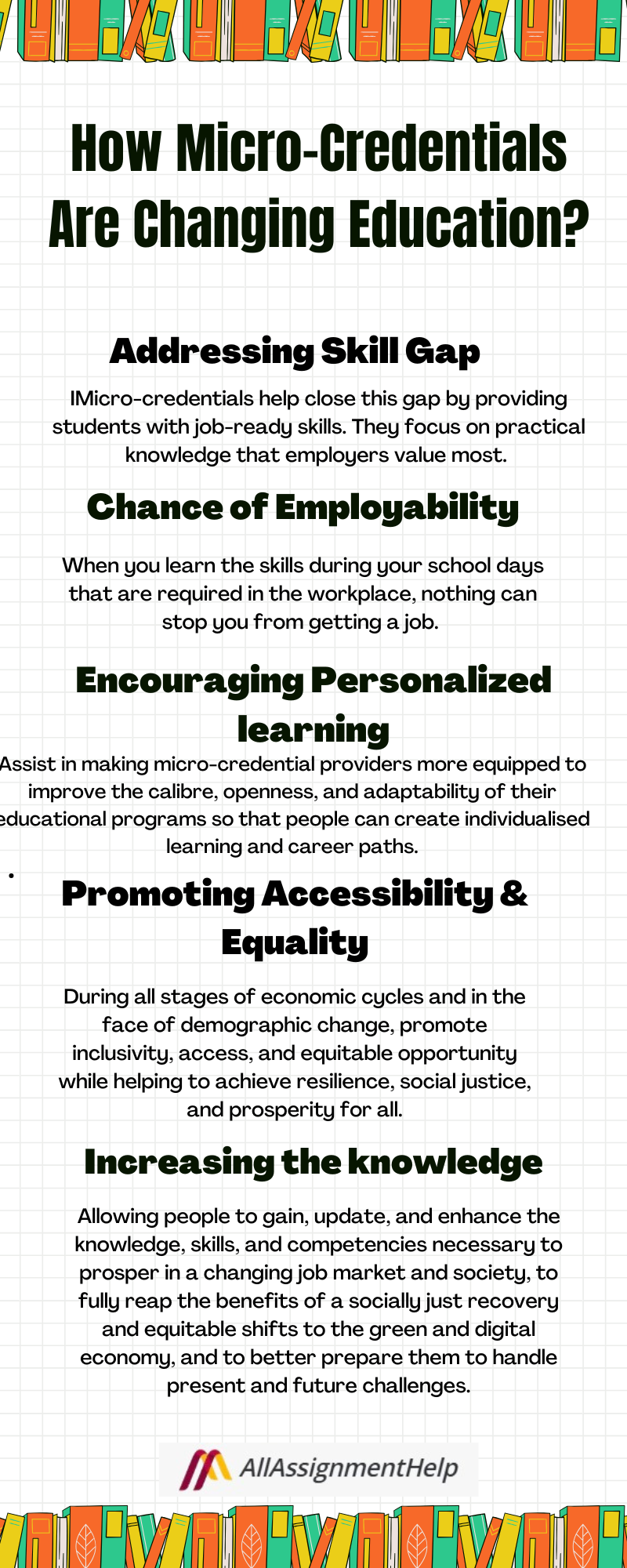
Addressing Skill Gap
So far, we can see that education is often very different from the skills required for a job. This is why students face many obstacles when searching for employment. Micro-credentials help close this gap by providing students with job-ready skills. They focus on practical knowledge that employers value most. As a result, students become more confident, adaptable, and better prepared to succeed in the competitive job market.
Don’t let anything become a hurdle on your way to getting your dream job. Whether it’s an assignment or a course you’re pursuing, every step counts toward your success. When assignments pile up, they can take away your focus from more important things, like learning new skills through micro-credential programs. That’s where professional assignment help can make a real difference.
For instance, if you’re struggling with statistics homework, it’s easy to feel stuck and lose valuable time. Instead of letting this stress affect your studies, you can rely on statistics assignment help from industry experts. They’ll take care of your assignments while you can focus on learning. Not with statistics, you can get help with any subject, such as English assignment help, economics assignment help, math help and so on.
Encouraging Life-long Learning
Micro-credential is something which encourages you to learn new things every day. And the competitive environment where we currently live demands such expertise and skills from the students. Micro-credentials allow individuals to learn specific, in-demand skills in short courses that can be completed alongside work or studies.
This continuous learning ensures that professionals can adapt to new tools, methods, and economic shifts without having to go back to school for years
Increasing the Chance of Employability
When you learn the skills during your school days that are required in the workplace, nothing can stop you from getting a job. Since micro-credentials focus on targeted and specific skills rather than covering a wide range of subjects, they play a key role in increasing employability.
Encouraging Personalized learning
Assist in making micro-credential providers more equipped to improve the calibre, openness, and adaptability of their educational programs so that people can create individualised learning and career paths.
Promoting Accessibility & Equality
During all stages of economic cycles and in the face of demographic change, promote inclusivity, access, and equitable opportunity while helping to achieve resilience, social justice, and prosperity for all.
Increasing the knowledge
Allowing people to gain, update, and enhance the knowledge, skills, and competencies necessary to prosper in a changing job market and society, to fully reap the benefits of a socially just recovery and equitable shifts to the green and digital economy, and to better prepare them to handle present and future challenges.
It is evident that micro-credentials are more than a trend; they are a crucial part of developing a workforce that is competent and competency-based as the educational system adjusts to these changes. A constructive move towards a more inclusive and skill-focused educational system is indicated by the emphasis on practical skills, alignment with industry objectives, and the validation of these credentials through multiple frameworks.
Micro-credentials give students job-ready skills by focusing on practical knowledge and industry needs. They are designed to bridge the gap between education and employment, making learners more confident and prepared for real-world challenges. To make learning easier, you can also get online coursework help from trusted sites. This way, you can manage studies and assignments effectively while boosting your career success.
Challenges of Micro-Credentials
The following are a few of the primary obstacles:
Commercialisation Risks: The emergence of micro-credentials raises concerns that education may become more like a business, with an emphasis on profit rather than high-quality instruction. This could lead to certificates that are less about learning and more about marketing.
Problems with Quality and Standards: The worth of micro-credentials might differ greatly in the absence of uniform quality standards. Employers and students find it more difficult to distinguish between genuinely valuable certifications and those that are not.
Combining Modern and Conventional Learning Methods: Micro-credentials can be challenging to integrate into conventional educational institutions, despite their flexibility. Recognising and appreciating micro-credentials in formal education can be difficult because of the frequent disparity between their brief, skills-focused character and the more comprehensive education offered by degree programs.
So, these are some challenges which come with micro-credentials, but it is not possible to overcome these issues. With the right strategy, it might be easy to incorporate micro-credentials in our learning.
Micro-Credentials And the Future of Learning
Since the global job market rapidly changes, micro-credentials are increasingly competing with traditional higher education programs.
As applicants look for more adaptable and specialised credentials, these brief certifications that concentrate on certain knowledge and abilities are becoming more popular. The trend towards micro-credentials is still growing. We can anticipate the following in the upcoming years:
- More colleges are incorporating microcredentials into their curricula.
- Worldwide acceptance that enables cross-border certifications.
- An increase in lifelong learning ecosystems that involve cooperation between online platforms, employers, and universities.
Microcredentials are intended to supplement degrees rather than to replace them. In a world that is constantly changing, they enable students to grow, specialise, and adapt. Employers and educational institutions must work together to shape a future where traditional degrees and micro-credentials complement one another, resulting in a more varied and flexible educational landscape, as this trend continues to gain traction.
Conclusion
Technological developments like blockchain for credential verification and digital badges have improved the legitimacy and usefulness of micro-credentials and micro-courses. These developments guarantee that the credentials are safe, easily shared, and verifiable.
Offering online micro-courses or modules has made it possible for students from a variety of geographic regions to receive top-notch instruction and training, which has helped them succeed globally.
The industry has highly regarded micro-courses and modular learning, although they may pose some difficulties for both students and institutions, including the necessity for ongoing evaluation, standardisation, and the possibility of fragmented learning.
Micro-courses are predicted to be a worldwide success because they cater to the changing needs of companies and students, providing flexible and focused professional development and educational opportunities that are becoming increasingly acknowledged and respected across various industries.
Read More: Top Science Courses to Pursue in USA 2025
FAQs
Q1. What are micro-credentials in higher education?
Micro-credentials are short, skill-based certifications that focus on specific, job-ready abilities.
Q2. How do micro-credentials help students?
They provide practical skills, boost employability, and prepare learners for industry demands.
Q3. Can I pursue micro-credentials with other studies?
Yes, micro-credentials are flexible and can be taken alongside degree programs.
Q4. How does online coursework help support students?
It helps students manage assignments, save time, and focus on learning practical skills.