Everything You Need to Know About Online Journalism Degrees
What this article will help you understand
There are hundreds of students enrolled in online degree programs either entirely or partially. This has increased significantly over the last couple of years. Nowadays, the majority of prestigious colleges and universities provide at least some of their on-campus programs and courses online, including journalism. A lot of prospective students are pursuing online journalism degrees
What are you trying to do with this topic?
Choose the closest task and the page will point you towards a useful next step.
Start with the central concept and the terminology used in the article.
Open the closest route ↗Connect the explanation to the question, learning outcomes and marking criteria.
Open the closest route ↗Review evidence, structure, referencing and the exact submission requirements.
Open the closest route ↗Do you have enough information to begin?
Select what you already have. Nothing is submitted from this checklist.
When these details are together, the requirement can be reviewed in context.
Assignment Help USA ↗Table of Contents
There are hundreds of students enrolled in online degree programs either entirely or partially. This has increased significantly over the last couple of years. Nowadays, the majority of prestigious colleges and universities provide at least some of their on-campus programs and courses online, including journalism. A lot of prospective students are pursuing online journalism degrees to get the necessary expertise and qualifications. Still, many question, “Is an online journalism degree worth it?” There are many different types of accredited online journalism programs available. However, it’s important to know what you are signing up for.
Read this blog of All Assignment Help to know everything about online journalism degrees, including top programs, course details, career options, and more.
What Are Online Journalism Degrees?
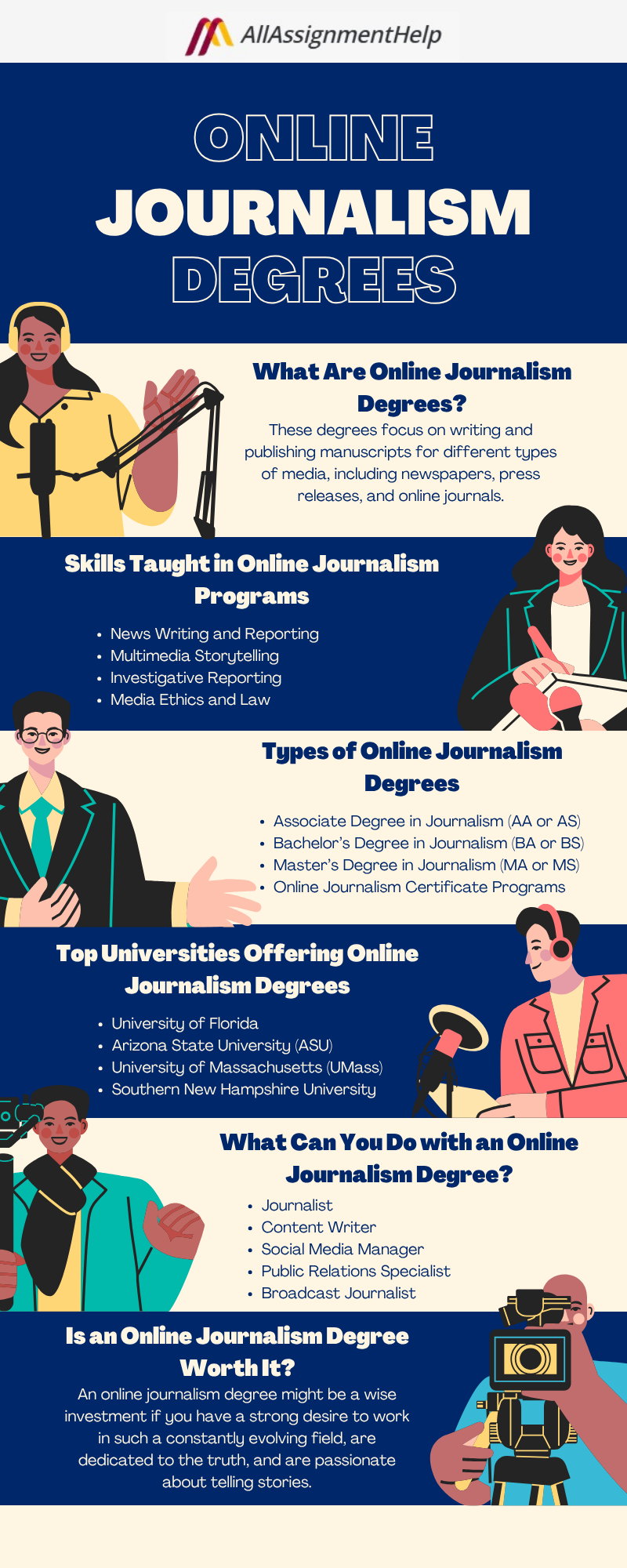
An online journalism degree usually lasts three years and covers topics including advertising types, mass communication methods, and the fundamentals of writing news and magazines. These degrees focus on writing and publishing manuscripts for different types of media, including newspapers, press releases, and online journals.
Getting a journalism degree online can be helpful since it provides a flexible and reasonably priced option for students to begin.
Additionally, these courses might be helpful for aspiring journalists who are unaware of how to develop online journalism expertise.
Besides, it might be intimidating for students to deal with their online journalism classes. In this case, hiring an online class helper can prove beneficial as they will provide you with the necessary assistance to deal with the problems you are facing. You can ask them, will you take my online class for me? And they will instantly take charge of your online class problems.
Read Here: Effects of Electronic Technology on Social Life
Key Skills Taught in Online Journalism Degree Programs
Students who complete online journalism degrees learn multiple skills that are important for success in the modern digital media environment. The skills taught in accredited online journalism programs are:
- News Writing and Reporting: Students learn skills in conducting interviews, verifying facts, writing concise, readable, and engaging news, and reporting on different topics.
- Multimedia Storytelling: They acquire the capacity to produce material for several platforms (print, web, audio, and video) through the integration of diverse types of media.
- Investigative Reporting: Students get the skill to perform in-depth research, analyze data, and uncover hidden stories.
- Media Ethics and Law: They acquire knowledge of the laws that control the media, the fundamentals of ethical reporting, and the duties of journalists.
- Interviewing: This involves having the capacity to interact with sources, ask perceptive questions, and conduct productive interviews.
- Social Media Reporting: It is important to use social media sites like Facebook, LinkedIn, and Twitter for audience interaction and news delivery.
- Data Journalism: It involves using tools for data analysis and visualization to improve reporting and storytelling.
Online journalism degrees often incorporate modern technology to make studying easier. You will interact with multimedia content, take part in online forums, and get prompt feedback on your assignments. Furthermore, you will also have to take multiple online exams that assess your skills and knowledge you learned during your online degree program. Taking an online exam can be hectic as it involves a lot of preparation. You can take help from an online exam help service provider by asking them, can you take my online exam for me? This will ease your stress, and you can earn better grades in your coursework.
Types of Online Journalism Degrees
There are many types of online journalism degrees, each suited to a certain educational level and professional goal. However, you might be wondering, “How long does it take to get a journalism degree online?” Whether you are a working professional looking to improve your skills or a recent high school graduate starting over, there are journalism degrees online available to meet your needs. Below is an overview of different types of journalism degrees you can take online:
Associate Degree in Journalism (AA or AS)
Duration: 2 years
Best for: Those just starting who want to learn the basics or who intend to transfer to a bachelor’s degree.
An associate’s degree in journalism is the best option for those who wish to have a strong foundation in media studies and reporting. This degree includes fundamental media ethics, communication theory, and writing. Moreover, it is a fantastic first step for anyone who wants to seek entry-level positions in content writing and local media or transfer into a bachelor’s program later.
Bachelor’s Degree in Journalism (BA or BS)
Duration: 3–4 years
Best for: Students looking to work in media-related fields or as entry-level journalists.
A bachelor’s degree is the most popular and well-known journalism degree. Under this degree program, students get an understanding of fundamental subjects such as broadcast journalism, media law, digital storytelling, and news writing. Moreover, several online journalism schools provide practical training, internships, or capstone projects to prepare students for real-world and digital media professions. Hence, taking a digital media assignment help could assist them in overcoming the problems they came across during their course of study.
Master’s Degree in Journalism (MA or MS)
Duration: 1–2 years
Best for: Professionals who want to change careers or switch from another industry to journalism.
This degree program is intended for professionals or recent graduates who want to learn more. It goes further into subjects including international reporting, data journalism, and investigative journalism. Furthermore, it is also helpful for those who want to work in academia, in senior positions in the media, or who want to switch from another profession to journalism.
Online Journalism Certificate Programs
Duration: 3–12 months
Best for: Students or working professionals who want to build up particular skills without committing to a full degree program.
Certificate programs provide an economical and flexible choice if you’re pressed for time or want to develop particular skills. These can be finished in as little as three months and focus on specialized fields such as multimedia creation, podcasting, SEO writing, and photography. However, earning a certificate might help you advance your job or add new skills to your résumé.
You can choose an online journalism degree program that suits best to your needs and requirements. There are universities that offer accredited online journalism programs at various academic levels.
Top Universities Offering Online Journalism Degrees
The following is a list of trustworthy universities with accredited online journalism programs, which are also trusted by employers and media professionals alike:
| University | Program | Duration | Accreditation |
| University of Florida | BS in Journalism (Online) | ~4 years | SACSCOC |
| Arizona State University (ASU) | BA in Mass Communication & Media Studies | ~4 years | Higher Learning Commission (HLC) |
| University of Massachusetts (UMass) | BA in Journalism (UMass Global) | ~4 years | NECHE |
| Southern New Hampshire University | BA in Communication – Journalism Concentration | ~4 years | NECHE |
| University of Nebraska – Lincoln | MA in Journalism & Mass Communication (Online) | ~2 years | HLC |
| Harvard Extension School | Journalism Graduate Certificate | ~1 year | NECHE |
| UCLA Extension | Journalism Certificate Program | 6–12 months | WASC |
Always check whether your chosen program is accredited by a regional or national accrediting body recognized by the U.S. Department of Education or equivalent in your country.
What Can You Do with an Online Journalism Degree?
You can pursue any of the following careers with an online degree in journalism:
Journalist
Journalists do research and write news articles for magazines, television, and online publications, besides other media channels. Working in this field often involves meeting deadlines, conducting source interviews, and verifying information.
Content Writer
Content writers present written content for marketing materials, blogs, and websites. Nowadays, e-content writers are in great demand due to the growth of digital marketing, which makes this a desirable career choice.
Social Media Manager
As social media has grown in popularity as a news delivery tool, many media businesses are hiring social media managers. They connect with the public, produce and choose social media material, and then assess the effectiveness of the posts.
Public Relations Specialist
Public relations specialists assist organizations in efficiently communicating with the public and media. They design communication plans, handle media relations, and write press releases.
Broadcast Journalist
Broadcast journalists use radio or television to deliver news stories. This role involves speaking in front of an audience and covering events as they happen. Additionally, you might need to have production and editing experience.
Digital Media Producer
Digital media producers are in charge of creating multimedia content for online platforms, such as podcasts and videos. This position requires both technical proficiency and imaginative storytelling skills.
There are plenty of job possibilities after completing a journalism degree online. A combination of creativity, curiosity, and digital skills can help you succeed in any field of journalism.
Also Read: Exploring Future Opportunities And Career in Mass Communication
Is an Online Journalism Degree Worth It?
An online journalism degree might be a wise investment if you have a strong desire to work in such a constantly evolving field, are dedicated to the truth, and are passionate about telling stories. Furthermore, it is particularly worthwhile if you:
- Need a flexible learning schedule
- Plan to build a strong online portfolio
- Are comfortable with digital tools and remote collaboration
Just make sure that you thoroughly research programs, give priority to hands-on learning opportunities, and stay updated with media trends. Also, take online assignment help whenever you feel the need for professional assistance to overcome the challenges coming in your way.
FAQs
What are the basic principles of online journalism?
Fairness, balance, truth, and verification are the fundamental principles of online journalism. Sticking to these principles online will help journalists stand out from other online communicators.
What qualifications are needed to enroll in an online journalism program?
A high school or undergraduate degree, transcripts, a statement of purpose, and sometimes writing samples or admission examinations are among the requirements.
What is the cost of an online journalism degree?
Tuition varies widely but is often more affordable than traditional on-campus programs. Costs depend on the institution and level of study.
Connect the explanation to the work your course actually requires
Use this guide beside the exact brief, course material and marking criteria for Online Journalism Degrees.
- Read the complete brief.
- Identify the expected academic output.
- Follow the marking criteria and source rules.
- Check the final structure and referencing.
Bertin Smith
Law
If your own brief is related to “Everything You Need to Know About Online Journalism Degrees”, you can review Bertin Smith’s established Law profile before requesting a match.
Law tutor with more than ten years of experience and subject coverage in constitutional and corporate law.
View established tutor profile ↗Relevant subject areas
- Constitutional Law
- Corporate Law
- Legal Studies
Find another explanation across the complete blog
This search uses WordPress itself, so it can reach articles beyond the 20 shown on the dashboard.
Connect Online Journalism Degrees to the task in front of you
Keep the brief, marking criteria, required evidence and submission format visible while you work.