
Table of Contents
STEM education is defined as the combined teaching of science, technology, engineering, and mathematics. It prepares students to face the difficulties of modern times by promoting creativity, critical thinking, and problem-solving. In today’s technologically advanced, fast-paced world, STEM (Science, Technology, Engineering, and Mathematics) education has become crucial for developing future innovators and problem solvers. However, STEM learning isn’t solely found in the classroom; extracurricular activities like STEM clubs provide students with the chance to experiment, create, and polish critical skills in an enjoyable setting.
Here is a thorough analysis of the Benefits of joining STEM clubs for kids and teens, provided by All Assignment Help for those who are unsure if STEM activities are worthwhile or not.
What Are STEM Clubs?
A STEM Club is a group of young people who regularly attend and use extracurricular activities to explore STEM subjects. These clubs focus on any or all STEM subjects along with other subjects like art, theatre, geography, and so forth.
STEM clubs are an outstanding way that support the curriculum while giving students a chance to be creative, have fun, and learn more about the subjects and their significance in the world.
However, STEM education involves subjects like science, technology, engineering, and mathematics. It is not easy for every student to deal with these subjects with equal efficiency. Hence, there are assignment help services available online where they can get science assignment, mathematics assignment help, and so forth to get additional assistance while working on STEM projects or assignments.
Read Here: What to Know Before Applying for a STEM Internship
Role of STEM Clubs in Shaping Young Scientists
STEM education teaches the moral principles and habits required for reasoned behavior and scientific research. Here is why STEM clubs help young scientists in building their future:
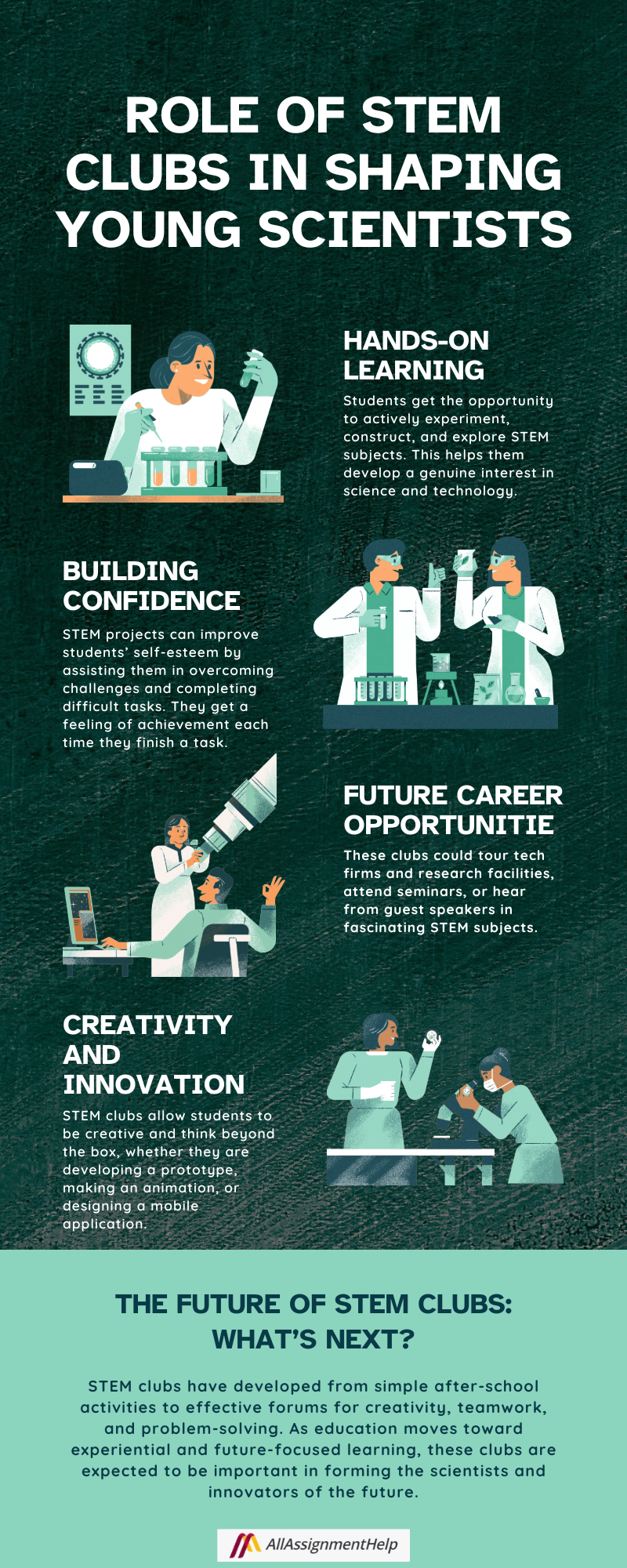
Hands-On Learning
STEM clubs transform the lessons we learn in the classroom. Students get the opportunity to actively experiment, construct, and explore STEM subjects. This could involve collaborating to create a video game or using basic materials to make a structurally sound bridge. Furthermore, students who actively participate in STEM activities enhance their memory retention and develop a genuine interest in science and technology. For example, Newton’s principles of motion are fascinating to read about, but testing them out by constructing and competing miniature automobiles is far more thrilling!
Building Confidence
STEM projects can improve students’ self-esteem by assisting them in overcoming challenges and completing difficult tasks. They get a feeling of achievement each time they finish a coding task, build a functional model, or resolve a difficult equation. Moreover, this self-confidence is shown in leadership skills, public speaking, and academic achievement, among other facets of life. Resilience is a vital skill for success in the future. However, it is taught when failures are accepted as a necessary part of the process.
Future Career Opportunities
STEM clubs introduce students to several job possibilities in science, technology, engineering, and mathematics. These clubs could tour tech firms and research facilities, attend seminars, or hear from guest speakers in fascinating STEM subjects. In this way, students get an understanding of a number of possible STEM-based careers through these sorts of activities. However, reaching your desired career in STEM can not be done alone. There are multiple writing tasks you need to complete during your academics. Hence, online assignment help services could prove beneficial in helping you reach your career goals.
Creativity and Innovation
Unlike what many people think, STEM isn’t only about computation and formulae; it’s also about creativity! STEM clubs allow students to be creative and think beyond the box, whether they are developing a prototype, making an animation, or designing a mobile application. From biomedical engineers to software developers, many scientists and engineers depend on creativity to come up with new solutions to tricky problems. As a result, STEM activities taught in clubs allow students to think creatively and explore ideas.
Teamwork and Communication
A lot of STEM projects ask for teamwork. Hence, students need to develop a knack for collaboration, share thoughts, and communicate clearly. On top of that, teamwork is important whether they’re debugging a science experiment or working on a group coding project. Moreover, teamwork and communication skills are necessary in every industry, not only in STEM fields. Teamwork is frequently ranked by employers as one of the most important soft skills in the workplace.
Nowadays, STEM clubs are not limited to offline classes where students can go and learn through STEM activities. They can join online STEM clubs as well, where they can work on the same activities taught in offline classes. However, online STEM classes demand full attention while working on projects and activities. Students who are new to these learning trends might think, can I pay someone to take my online class for me in case I am unable to attend? Yes! Such students can visit online and hire an online class taker to attend the STEM classes on their behalf.
STEM Clubs: Challenges
The foundation is laid by classrooms, but STEM clubs give students a place to explore, work together, and think creatively outside of the classroom. These clubs, like every other project, have challenges that influence their impact and effectiveness.
- Limited Resources: It is challenging for students to fully explore STEM since many schools and universities lack the funds and access to advanced tools like robotics kits, lab equipment, or software.
- Lack of Awareness: There are low participation rates in STEM clubs at certain schools because parents and students are not aware of their advantages.
- Mentorship Gaps: STEM clubs flourish when given the right direction, but learning results might be limited in the absence of knowledgeable mentors or academic assistance.
- Time Management: Sometimes, students struggle to balance their duties to clubs with their studies, particularly during test seasons or when their calendars are hectic.
- Gender Gap: There is still an absence of women in STEM sectors, and clubs often reflect this gap, necessitating more inclusive procedures.
STEM clubs provide platforms for creativity, innovation, and future preparation in addition to being extracurricular activities. Even while there are still challenges, the advantages they offer far exceed the drawbacks.
The Future of STEM Clubs: What’s Next?
STEM clubs have developed from simple after-school activities to effective forums for creativity, teamwork, and problem-solving. As education moves toward experiential and future-focused learning, these clubs are expected to be important in forming the scientists and innovators of the future. Here is what the future of STEM clubs will look like:
Integrating Emerging Technologies
Future STEM clubs will do much more than just conduct experiments. Students will have access to the same techniques that are revolutionizing businesses across the world. This includes biotechnology, robotics, artificial intelligence, and 3D printing. Furthermore, virtual and augmented reality will transform club operations. This will allow students to safely perform chemical reactions in virtual labs, model space flights, and mimic experiments.
Global Collaboration Via Online Platforms
Digital learning is enabling the globalization of STEM clubs. Students from different countries will be able to work together on common problems, come up with solutions, and even participate in worldwide hackathons. For example, a student in India may collaborate with classmates in the United States to create a prototype for sustainable energy. Besides, they will also have access to online exam help services where they can hire someone just by asking, please take my online exam for me, if they are enrolled in online STEM courses.
Focus on Sustainability and Practical Problems
Future STEM clubs will put more of their focus on using knowledge to solve practical problems. The focus will be on projects related to waste management, renewable energy, climate change, and innovative healthcare. By tackling these problems, students will develop their technical proficiency while simultaneously learning the importance of social responsibility and how science can impact significant community change.
Equal Access and Inclusivity
Inclusivity must be a key component of STEM clubs in the future. Students would have the opportunity to learn about science if these clubs were extended to rural and underprivileged schools. Additionally, the talent pool will be diversified by promoting involvement from girls and marginalized groups. It will improve equity in STEM and provide new views on innovation.
Incubators for Young Innovators
In the long run, STEM clubs have the potential to develop into hubs for upcoming innovators. They will encourage young people to start businesses, develop new sectors, and contribute to scientific advancements. Also, it will educate them to change occupations. In this way, STEM clubs will create scientists and global citizens who are capable of solving the biggest problems facing the globe.
The field of STEM education has a promising and exciting future. As the classroom is shaped by developing technology, STEM curricula will change to provide students with the skills they need for tomorrow’s workplace.
How to Join a STEM Club?
Here are some ways to get started if you want to join a STEM club:
- Contact your school: A lot of schools include STEM clubs, which are centered around science, engineering, robotics, or coding.
- Look for community initiatives: STEM seminars often take place at community centers, local libraries, and museums.
- Join STEM communities online: Many online STEM programs include fun STEM activities and contests.
- Create your own club: Think about creating a STEM club if one doesn’t already exist! Student-led projects are often backed up by communities and schools.
A STEM club could help students develop unique skills, meet new people, and get ready for their future jobs. It’s an exciting and fulfilling experience. Furthermore, STEM clubs offer an enjoyable and fascinating learning experience, whether students are creating machines, conducting chemical experiments, or designing an app.
Also Read: Practical Learning Vs Theoretical Learning: Which is the Best in 2025
Conclusion
STEM clubs are the cornerstone of the future, not merely a passing trend. As we have seen, including STEM topics in the curriculum is important for ensuring that students are ready for success in the rapidly changing fields of science, technology, and innovation. However, if anyone has taken STEM subjects in their academics and needs help with assignment writing can get in touch with us. We have experts to provide you with science assignment help, technology assignment help, engineering assignment help, and mathematics assignment help to help you excel in your STEM studies.
FAQs
What makes STEM clubs important?
Students can research and interact with science, technology, engineering, and math outside of the classroom through STEM clubs. They are not to be confused with catch-up groups or homework. The entire school, instructors, and students could all profit from STEM clubs.
Which STEM profession is the most challenging to enter?
Chemical engineering is one of the most challenging degrees in STEM and one of the most challenging engineering majors because it blends fundamental engineering ideas with topics from chemistry, physics, and biology.
What is the main objective of STEM education?
The development of critical thinking and problem-solving skills is one of the main objectives of STEM education. STEM education develops their ability to assess problems, come up with creative solutions, and apply scientific and mathematical concepts to real-world situations by involving students in real-world tasks and challenges.