Table of Contents
Reflective essays give you a chance to explore your experiences and understand how they have shaped your personal growth. They go beyond simply narrating events. The real purpose is to dive into your thoughts, emotions, and reactions to uncover deeper insights about yourself. Much like a journal entry, reflective essays help build critical thinking and self-awareness.
When writing a reflective essay, students are expected to revisit meaningful life experiences, especially those that have had a strong impact on them. This process involves not just describing what happened, but also analyzing why it mattered. It may include discussing your feelings, evaluating the importance of the experience, and identifying the lessons you learned from it.
In this blog, curated by experts at All Assignment Help, we will explore the key aspects of reflective essay writing and how you can master it effectively.
What is Reflective Writing?
Reflective writing is a type of writing in which you analyze your personal experiences and explain what you learned from them. It goes beyond simply describing events and focuses on your thoughts, feelings, and the lessons gained. This form of writing helps you understand your actions and improve future decisions.
Key Points of Reflective Writing
- Focuses on personal experiences
- Written in first person (I, me, my)
- Includes thoughts, emotions, and reactions
- Emphasizes learning and self-improvement
- Connects past experiences with future actions
For example, instead of just saying you gave a presentation, reflective writing explains what went well, what challenges you faced, and what you would do differently next time.
Reflective writing is widely used in academics, especially in essays, journals, and professional training. It helps develop critical thinking and self-awareness, making it easier to learn from both successes and mistakes. In simple terms, reflective writing is about thinking deeply, learning from experiences, and growing as a person.
Why is reflective writing important?
Reflective writing is important because it helps you understand your experiences and turn them into meaningful learning. Instead of just completing a task, it encourages you to think about what you did, why you did it, and how you can improve in the future.
Why Reflective Writing Matters
- Builds self-awareness: Helps you understand your strengths, weaknesses, and behavior.
- Improves critical thinking: Encourages you to analyze situations rather than just describe them.
- Enhances learning from experience: Turns both success and failure into valuable lessons.
- Boosts academic performance: Helps you write better essays and understand subjects more deeply.
- Encourages personal growth: Makes you more confident and thoughtful in decision-making.
- Strengthens problem-solving skills: Allows you to evaluate past mistakes and avoid repeating them.
In simple words, reflective writing is important because it helps you learn, grow, and improve continuously by thinking deeply about your own experiences. If you need more clarity on reflective essays, you can seek online assignment help to better understand the structure, format, and key elements, making it easier to write effectively and confidently.
Also read: Tips and Tricks for Writing a Good Reflective Essay
Types of Reflective Writing
Reflective writing can take different forms depending on the purpose, audience, and context. Each type focuses on analyzing experiences while highlighting learning and personal growth.
Types of Reflective Writing
- Descriptive Reflection: Focuses on describing an experience and briefly explaining what you learned from it. It is simple and does not go very deep into analysis.
- Analytical Reflection: Goes beyond description by examining why something happened and how it impacted you. It connects experiences with theories or concepts.
- Critical Reflection: Involves deep thinking and evaluation. You question your assumptions, consider different perspectives, and analyze both positive and negative outcomes.
- Personal Reflection: Centers on your own thoughts, feelings, and personal growth. It is often used in journals or diaries.
- Professional Reflection: Used in work or academic settings, such as internships or training. It focuses on skills, performance, and professional development.
In simple terms, all types of reflective writing help you understand your experiences better and learn from them, but they differ in how deeply they analyze and evaluate those experiences.
Mastering reflective essay writing requires a clear understanding of its different types. Students enrolled in online classes often find it difficult to manage reflective essay tasks due to time constraints. Working on these topics can leave them with little time for their regular classes, and they may start wondering, “How can I pay someone to take my online class for me?” If you are having similar thoughts, you are not alone.
To handle this pressure, students often seek expert assistance through online class help sites. This helps them manage their workload more effectively and focus on learning reflective essay writing with better clarity and confidence.
How to Write an Excellent Reflective Essay: Easy Steps
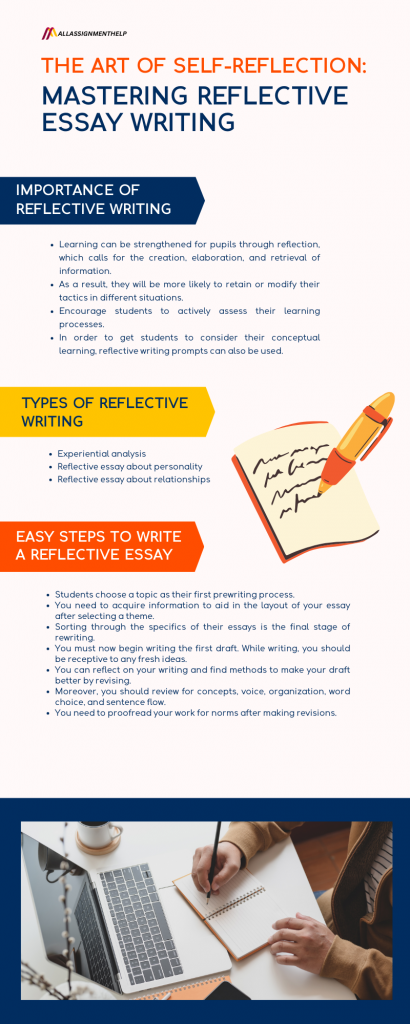
There are some simple steps that you must follow to attain excellently written reflective essays.
- Select a topic
- Collect useful and relevant information
- Organize details
- The first draft is significant
- Improve your draft
- Edit and publish
Select a topic
Students choose a topic as their first prewriting process. You have a plethora of options to select from, such as occasions or individuals who changed the course of their lives or made a significant impression on them. Examining how they have changed and the causes behind those changes is another method that students might choose their subjects.
Collect useful and relevant information
Once you select a topic, the next step is to gather relevant information to structure your reflective essay effectively. This includes recalling your experiences, organizing your thoughts, and identifying key lessons.
Moreover, if you are studying abroad, especially in countries like the US, you may have to manage multiple responsibilities beyond academics. In such situations, collecting and organizing information for your essay can feel overwhelming. If this process becomes challenging, you can refer to reflective essay examples to craft a well-structured, high-quality reflective essay.
Organize details
Sorting through the specifics of their essays is the final stage of prewriting. Moreover, you must select aspects from your reflective narrative that show life prior to, throughout, and following the transformation, as it may span a long period.
The first draft is significant
You must now begin writing the first draft. While writing, you should be receptive to any fresh ideas. A beginning, middle, and end should be included in the reflective essay. In order to develop the story and bring about the transformation, the opening, or introduction paragraph, gives background information and events.
An example that exemplifies the change should be included in the middle, or body, paragraphs. Remember to use conversation and illustrate events for your audience. Lastly, the conclusion paragraph should consider what happened following the modification.
Improve your draft
You can reflect on your writing and find methods to make your draft better by revising. Moreover, you should review for concepts, voice, organization, word choice, and sentence flow.
Edit and publish
You need to proofread your work for norms after making revisions. For the purpose of evaluating one other’s work, you might even trade writings. You will have a final copy to review after editing to make sure there are any small mistakes that you or the other student may have overlooked. Additionally, if you face issues related to writing, you can always seek an online coursework service where experts will assist you with top-quality work.
Also Read: How to Write an Outstanding 900-Word Essay
Topics for a Good Reflective Essay Paper
A strong reflective essay starts with the right topic. It should be something meaningful, personal, and capable of showing your growth and learning. Below are 50 engaging and relatable topics you can choose from:
Top 50 Reflective Essay Topics
- A moment that changed your perspective on life
- Your biggest academic challenge and what you learned
- A time you failed and how you handled it
- Your first day at college or school
- An experience that boosted your confidence
- A difficult decision you had to make
- A person who influenced your life the most
- A mistake that taught you an important lesson
- Your experience with online learning
- A time you stepped out of your comfort zone
- Your proudest achievement
- A conflict you resolved and what it taught you
- Your first job or internship experience
- A time you helped someone
- An experience that improved your communication skills
- A situation where you showed leadership
- A moment when you felt truly happy
- A time you had to adapt to change
- A challenging group project experience
- A time you received constructive criticism
- Your experience of learning a new skill
- A situation that tested your patience
- A time you overcame fear
- An experience that changed your goals
- A memorable trip and what you learned from it
- A time you faced peer pressure
- A situation where you had to manage time effectively
- Your experience of working under pressure
- A time you learned from someone younger than you
- A moment that taught you responsibility
- A situation where you had to take initiative
- A time you handled failure positively
- Your experience of moving to a new place
- A lesson learned from a teacher or mentor
- A time when your plans did not work out
- An experience that improved your problem-solving skills
- A situation where you had to stay motivated
- A time you learned the value of teamwork
- A moment when you felt proud of yourself
- A time you had to balance multiple responsibilities
- An experience that improved your decision-making skills
- A time you had to deal with stress
- A situation where you learned self-discipline
- A moment that made you more independent
- A time you had to accept change
- A lesson learned from a failure in exams
- A situation that improved your emotional intelligence
- A time you realized the importance of hard work
- A personal habit you changed and why
- A life experience that shaped who you are today
These topics will help you write a reflective essay that is engaging, meaningful, and easy to connect with, while also showcasing your personal growth and understanding.
Conclusion
It may initially appear challenging to write reflectively. If you know how to do it, though, it’s not that difficult. Not merely telling the tale or reading a book again is the main goal. Analysis, impact explanation, and conclusion-making should be within your grasp. Remember to edit, check for plagiarism, and stick to the traditional essay format of five paragraphs.
Frequently Asked Questions
| Question: How can a reflective essay be introduced? Answer: Brainstorming is a great way to get your reflective essay started. Moreover, consider carefully the type of experience in life that you feel is most appropriate. Remember that you and your audience should find this experience engaging as well. |
| Question: How can we write a reflective essay? Answer: A compelling life experience is necessary to produce a well-reflective essay. Selecting a topic to discuss with your teacher is a terrific way to find a solution. |