Tips and Tricks for Writing a Good Reflective Essay
What this article will help you understand
Have you ever taken a moment to sit quietly and reflect on your life experiences? For most college students, the answer is probably no—and that's completely understandable. Between attending classes, completing assignments, preparing for exams, and managing personal responsibilities, finding time for self-reflection can be challenging. However, what happens when your professor asks you to
What are you trying to do with this topic?
Choose the closest task and the page will point you towards a useful next step.
Start with the central concept and the terminology used in the article.
Open the closest route ↗Connect the explanation to the question, learning outcomes and marking criteria.
Open the closest route ↗Review evidence, structure, referencing and the exact submission requirements.
Open the closest route ↗Do you have enough information to begin?
Select what you already have. Nothing is submitted from this checklist.
When these details are together, the requirement can be reviewed in context.
Assignment Help USA ↗Table of Contents
Have you ever taken a moment to sit quietly and reflect on your life experiences? For most college students, the answer is probably no—and that’s completely understandable. Between attending classes, completing assignments, preparing for exams, and managing personal responsibilities, finding time for self-reflection can be challenging.
However, what happens when your professor asks you to write a reflective essay? Unlike other academic papers, a reflective essay requires you to look back on your personal experiences, analyze them, and connect them to the purpose of your assignment. If you’re wondering how to write a reflective essay effectively, you’ve come to the right place.
In this comprehensive guide by AllAssignmentHelp.com, we’ll explain everything you need to know about reflective essay writing. From understanding its purpose to learning the correct structure and avoiding common mistakes, this guide will help you write a well-organized and meaningful reflective essay.
Here’s what you’ll learn in this blog:
- What is a reflective essay?
- The format and structure of a reflective essay
- How to write a reflective essay step by step
- Common mistakes to avoid while writing a reflective essay
Keep reading to discover expert tips, practical examples, and proven strategies that will help you craft an impressive reflective essay with confidence.
What is a Reflective Essay?
A reflective essay is a personal piece of writing that explores your experiences, thoughts, and feelings. It explains what happened, what you learned from the experience, and how it influenced your personal or academic growth. Unlike a descriptive essay, it focuses on self-analysis and the lessons gained rather than simply describing events.
Also Read: Key Asset of Compare And Contrast Essay
What is the Main Purpose of Writing a Reflective Essay
The main purpose of writing a reflective essay is to encourage self-reflection and help you learn from your experiences. It goes beyond describing an event by asking you to evaluate what happened, why it happened, how you felt, and what you learned from it. This process helps you better understand your actions, decisions, strengths, weaknesses, and personal values.
A reflective essay also allows you to connect real-life experiences with academic concepts or professional skills. Whether you are reflecting on a classroom project, internship, volunteer work, or a personal challenge, the goal is to explain how the experience contributed to your growth and influenced your future decisions. Many students also choose reflective essay assignment help to understand the correct structure, improve their analysis, and submit a well-written paper.
The key purposes of a reflective essay include:
- Develop self-awareness by examining your thoughts, emotions, and actions.
- Identify valuable lessons learned from successes, failures, or challenges.
- Improve critical thinking by analyzing experiences from different perspectives.
- Connect theory with practice by linking academic knowledge to real-life situations.
- Recognize strengths and weaknesses to support personal and professional growth.
- Enhance problem-solving skills by reflecting on past decisions and outcomes.
- Promote continuous learning by applying lessons to future experiences.
Writing a reflective essay requires more than simply describing an experience. It involves critical thinking, self-analysis, and connecting your experiences with academic concepts. For students pursuing an online degree, finding enough time to complete such assignments can be challenging. Balancing classes, work, family responsibilities, and deadlines often leaves little room for thoughtful reflection. If you’re trying to manage everything on your own and find yourself wondering, “Can someone do my online class for me?”, you’re not alone. Many students seek professional help to reduce their academic workload. With experts handling your online coursework, you can dedicate more time to writing a thoughtful reflective essay while staying on track with your studies, work, and personal commitments.
What Are the Different Kinds of Reflective Essays?
There are many experiences and situations you can write about in a reflective essay. It could be a personal event, a movie, a book, a college course, or any experience that taught you a valuable lesson. The focus is not on describing what happened but on explaining what you learned from the experience and how it influenced your thoughts, feelings, or actions. Below are some of the most common types of reflective essays:
Event
Life is full of events, both positive and negative. While the event itself may be the same for everyone, each person reacts to it differently. A reflective essay allows you to explore your emotions, thoughts, and lessons learned from a particular event. For example, you can reflect on how hearing about a tragic airplane crash changed your perspective on life, safety, or the importance of family.
Movie or Book
Movies and books often leave a lasting impression on us. Some inspire us to become better people, while others challenge our beliefs or introduce us to new ideas. In a reflective essay, you can discuss how a particular movie or book affected your thinking, emotions, or personal growth and explain the lessons you gained from it.
College Course
A college course can provide valuable academic and personal experiences worth reflecting on. You can write about the knowledge and skills you gained, the challenges you faced, and how the course helped you grow. You may also evaluate your performance, identify areas for improvement, and discuss how the experience will benefit you in the future.
What is The Correct Format of a Reflective Essay?
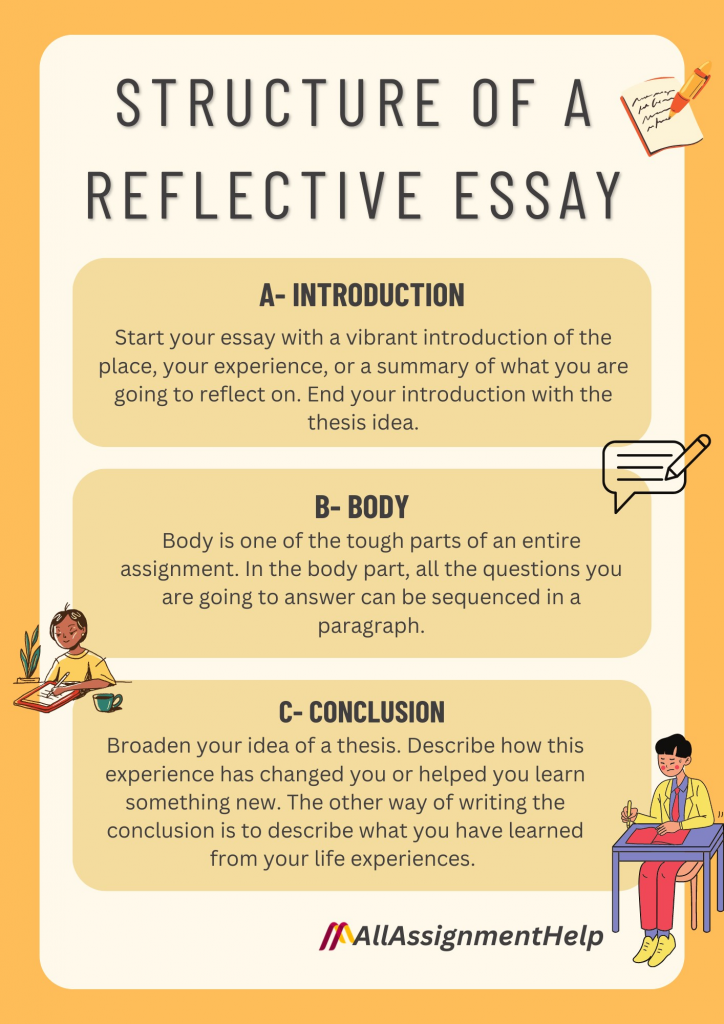
A reflective essay follows a clear structure that allows you to describe an experience, analyze its impact, and explain what you learned from it. Although there is no single mandatory format, most reflective essays follow the introduction, body, and conclusion structure.
1. Introduction
The introduction sets the stage for your essay. Briefly introduce the experience, event, book, course, or situation you are reflecting on. End this section with a clear thesis statement that explains the main lesson or insight you gained.
Include:
- A brief description of the topic or experience
- Background information
- A thesis statement highlighting your reflection
2. Body Paragraphs
The body is the heart of your reflective essay. Describe the experience in detail, explain your thoughts and emotions, analyze why it was significant, and discuss what you learned from it. Support your reflection with specific examples whenever possible.
Include:
- Description of the experience
- Your thoughts, feelings, and reactions
- Analysis of the experience
- Lessons learned and personal growth
3. Conclusion
Summarize your key reflections without repeating the entire essay. Reinforce the main lesson and explain how the experience has influenced your perspective or future actions.
Include:
- Summary of key points
- Restatement of the main lesson
- Future application or personal development
Writing a reflective essay requires careful self-analysis, critical thinking, and the ability to connect personal experiences with meaningful insights. However, many students find it difficult to dedicate enough time to research, organize their thoughts, and meet strict submission deadlines while managing other academic and personal responsibilities. In such situations, seeking essay assignment help can be a practical solution. Expert guidance can help you better understand the structure, improve the quality of your writing, and submit a well-crafted reflective essay without unnecessary stress.
Also Read: Learn the Craft of Essay Writing by Experts
How to Perfectly Write a Reflective Essay
Writing a reflective essay is more than simply describing an experience. It requires you to analyze your thoughts, emotions, and actions while explaining what you learned from the experience. A well-written reflective essay is personal, organized, and insightful. Follow these steps to write one effectively.
1. Choose a Meaningful Topic
Select an experience that had a significant impact on your personal, academic, or professional life. It could be an event, a book, a movie, a college course, or even a conversation that changed your perspective.
2. Understand the Purpose
Before you start writing, identify why you are reflecting on the experience. Ask yourself:
- What happened?
- How did it affect me?
- What did I learn?
- How will this experience influence my future?
3. Create an Outline
Organize your ideas before writing. A simple outline helps maintain a logical flow.
- Introduction: Introduce the experience and present your main reflection.
- Body Paragraphs: Describe the experience, explain your feelings, analyze its significance, and discuss what you learned.
- Conclusion: Summarize your reflection and explain how it has shaped your personal growth.
4. Describe the Experience Clearly
Provide enough context so readers understand what happened, but avoid turning the essay into a simple narrative. Focus only on details that support your reflection.
5. Reflect and Analyze
The analysis is the most important part of a reflective essay. Explain your emotions, decisions, challenges, and the lessons you learned. Show how the experience changed your thinking or behavior.
6. Support Your Reflection
If required, connect your experience with classroom concepts, theories, or academic materials. This demonstrates critical thinking and strengthens your reflection.
7. Use a Personal Yet Professional Tone
Write in the first person (“I,” “me,” “my”) while maintaining a clear, formal writing style. Be honest about your experiences and avoid exaggeration.
8. Revise and Proofread
Review your essay for grammar, spelling, clarity, and organization. Ensure every paragraph contributes to your overall reflection and supports your main idea.
Tips for Writing a Great Reflective Essay
- Choose an experience that offers valuable lessons.
- Focus on reflection rather than storytelling.
- Be honest and specific.
- Maintain a logical structure.
- Support your ideas with examples.
- Proofread carefully before submitting.
This is how you should structure your essay. If you ever get stuck in your writing and feel the need for help, rely on a professional essay writing service. There are also expert writers on these websites who can help you prepare a perfect assignment. Below, we have briefly listed everything that contributes to perfect reflective essay writing.
Also Read: Useful Descriptive Essay Topics for Students in 2023
How to Choose the Right Topic for Your Assignment
Do you want your assignment to be enticing? Do you want to engage the target audience with your essay? Then read some previously written essays by your friend or ones you find on the internet to meet your goal. If you are too lazy to do that, you may find some of the best reflective essay topics in this blog post. Here we are sharing with you some useful topics and some personal topics from which you can choose to write your reflective essay.
Some good topics for reflective essays are:
- What motivates you?
- Special qualities you hold
- How can you reach your goals?
- Which experience will you never forget in life?
- What melts your heart?
- A reflective essay on your learning experiences
Personal Topic for Reflective Essays:
- What are your dreams?
- Your biggest strength
- Your biggest fear
- A failure which you get in life
- What kind of future do you like to prefer?
- How you calm yourself?
Things to Avoid While Writing a Reflective Essay
A perfect reflective essay follows a good structure and includes engaging information. Along with this, there are also certain things that need to be avoided while writing the reflection essay. Have a look at the points listed below to learn more about them.
- Poor idea: Remember that the target audience wants to read something interesting and controversial. They are not interested in reading boring things. So make sure your idea of a topic is good.
- Improper plotting: Having a good idea in your mind is not enough; you must also make sure to have good plotting in your essay. Make a specific goal and try to accomplish it by the end of the essay. Everything must be in a loop and interconnected with each other.
- Avoid adding multiple items of information: Too many details in the essay may confuse readers. So, try to avoid adding too many details, names, or unnecessary subtleties, as this will create confusion and readers will dislike it. Keep things crisp yet informative and engaging.
- Don’t make any grammatical errors: Grammar is one of the principal things that needs to be perfect in your whole essay. Make sure that you don’t make any grammatical mistakes. To avoid this, proofread your essay 1-2 times to ensure that it is error-free.
- Provide the message properly: You know, right? With your reflective essay, you are going to deliver a message! So, ensure whatever message you are delivering does not lack personality. Do not include any false information that might give false hope or a false message to readers.
Some Final Words to Remember
So far in this blog post, we have discussed everything that will assist you in writing your college reflective essays. In addition to this, and to simplify things, we are also sharing some additional and important information about these essays.
- The key to writing a reflective essay is to represent the things you gained from experience and how much change it has made in your life.
- The process of reflection usually starts with you, as you are required to make deliberate efforts to recognize and examine your thoughts in light of the specific experience.
- Do not hesitate to discover any known expertise or skill on the topic, which can help you check why you have some ideas on it.
- Do not forget that reflective essay writing is the analysis of your thoughts, assumptions, attitudes, and values. So be open about how you feel.
- Reflective essay writing is highly beneficial and helps in examining your strengths. Also, it is helpful to improve your critical skills and enables you to take the thoughtful posture of checking your skills and learning from them.
Frequently Asked Questions
| Question 1: What is a reflective essay? Answer 1: Reflective essays are also known as reflection essays.” They are a type of essay that explores your thoughts, feelings, and views on a particular experience and how it affects you. |
| Question 2: What things to avoid when writing a reflective essay? Answer 2: Poor plotting, poor structure, adding too many details, and making grammatical errors are four main things that you must avoid in your essays. |
Connect the explanation to the work your course actually requires
Use this guide beside the exact brief, course material and marking criteria for How to Write a Reflective Essay.
- Identify the exact question or text.
- Use relevant evidence or quotations.
- Explain rather than only describe.
- Connect each paragraph to the central argument.
Sarah Mitchell
English · 4.9/5
English literature tutor whose established profile covers critical analysis, composition, creative writing, grammar and language arts. Master’s degree in English Literature
View established tutor profile ↗What students highlighted
The reviewer described receiving help when English literature homework became difficult and valued the academic and literary treatment.
Profile feedback · September 27, 2023 · 4.7/5The reviewer described a positive first English assignment experience and later returning to the service.
Profile feedback · August 17, 2023 · 4.8/5Find another explanation across the complete blog
This search uses WordPress itself, so it can reach articles beyond the 20 shown on the dashboard.
Connect How to Write a Reflective Essay to the task in front of you
Keep the brief, marking criteria, required evidence and submission format visible while you work.