Top Emergency Nursing Dissertation Topic Ideas for Students 2026
What this article will help you understand
Nursing plays a vital role in healthcare and focuses on improving and saving lives. Within this field, professionals take on different roles based on their experience, skills, and level of expertise. Unlike many other healthcare professionals, nurses follow a unique approach to patient care. They often stay closest to patients, manage treatments, and respond quickly
What are you trying to do with this topic?
Choose the closest task and the page will point you towards a useful next step.
Start with the central concept and the terminology used in the article.
Open the closest route ↗Connect the explanation to the question, learning outcomes and marking criteria.
Open the closest route ↗Review evidence, structure, referencing and the exact submission requirements.
Open the closest route ↗Do you have enough information to begin?
Select what you already have. Nothing is submitted from this checklist.
When these details are together, the requirement can be reviewed in context.
Nursing Assignment Help ↗Table of Contents
Nursing plays a vital role in healthcare and focuses on improving and saving lives. Within this field, professionals take on different roles based on their experience, skills, and level of expertise. Unlike many other healthcare professionals, nurses follow a unique approach to patient care. They often stay closest to patients, manage treatments, and respond quickly to changing health conditions.
Today, the demand for nurses exists across almost every area of the healthcare industry. This widespread need has also contributed to a growing shortage of skilled professionals. As a result, nursing has become a popular field of study, with thousands of students enrolling each year.
One of the most important parts of a nursing program is the emergency nursing dissertation. It helps students understand how to handle critical situations, make quick decisions, and provide care during emergencies.
However, choosing a topic and writing a dissertation in this field can feel challenging. Still, it is a mandatory part of completing your degree and cannot be avoided. If you are searching for strong and relevant ideas, you’re in the right place. In this blog, AllAssignmentHelp has gathered some of the most trending emergency nursing dissertation topics to help you get started and deepen your understanding of this subject.
What Is Emergency Nursing Care?
Emergency nursing is a specialized field where nurses learn how to provide immediate care to patients in critical situations. They are trained to respond quickly, use advanced techniques, and deliver timely treatment to save lives.
It is considered one of the most demanding areas of study in healthcare. Theoretical knowledge and practical training are both intensive and, in many ways, comparable to programs like a Bachelor of Medicine or Bachelor of Science. Students develop the skills needed to work efficiently in high-pressure, fast-paced environments. To manage this workload, some students also seek online class help to strengthen their understanding and keep up with their studies.
Emergency nurses are often the first to treat patients facing serious conditions such as heart attacks, accidents, or trauma. They provide immediate care and stabilize patients before further medical intervention. These professionals typically work in hospital emergency departments and must remain alert and ready at all times, even when a doctor is not immediately present.
Their role is not limited to hospitals. Emergency nurses may also work in outdoor settings, responding to accidents, disasters, and natural calamities, where quick action and critical thinking are essential.
Also Read: Bachelor of Nursing- Chaperone to Help Students
How Emergency Nursing Came Into Existence?
Emergency nursing did not develop overnight. It evolved as healthcare systems recognized the need for professionals who could respond quickly in life-threatening situations.
Early Foundations of Emergency Nursing
The roots of emergency nursing can be traced back to the 19th century, especially during the Crimean War. During this time, Florence Nightingale transformed patient care by introducing organized treatment methods for injured soldiers.
Key developments during this period:
- Immediate care became a priority for saving lives
- Nurses began working in high-pressure environments
- Structured patient care practices started to emerge
- Hygiene and sanitation were emphasized
Emergence of Emergency Departments
In the early 20th century, rapid urbanization and industrial growth led to an increase in accidents and medical emergencies. Hospitals began creating dedicated emergency rooms to manage urgent cases more effectively.
What changed during this phase:
- Hospitals established separate emergency departments
- Patients received faster and more organized care
- Nurses took on critical roles in patient assessment
- Initial treatment and stabilization became standard practice
Recognition as a Specialized Field
By the mid-20th century, emergency nursing gained recognition as a distinct specialty. Formal education and training programs were introduced to equip nurses with advanced skills.
Organizations like the Emergency Nurses Association played an important role in setting standards and supporting professional growth.
Key advancements included:
- Training in triage and trauma care
- Development of rapid response techniques
- Standardized emergency care protocols
- Increased focus on critical decision-making
Modern Emergency Nursing
Today, emergency nursing is an essential part of healthcare systems worldwide. Nurses in this field are trained to act quickly and efficiently in unpredictable situations.
Current roles of emergency nurses:
- Provide immediate care in critical situations
- Work in hospitals, ambulances, and disaster zones
- Handle trauma, accidents, and life-threatening conditions
- Support emergency response teams
Emergency nursing came into existence to meet the growing need for immediate and effective medical care. Over time, it has evolved into a highly specialized and vital field where quick thinking and skilled action can make the difference between life and death.
Also Read: Is Nursing is an Ideal Profession for you? Should you choose nursing, find out
Dissertation Topics for Emergency Nursing
Are you looking for a strong topic for your emergency nursing dissertation? Are you having trouble deciding on a topic for your dissertation? You are in the proper place; there’s no need for you to go anywhere. We have prepared a list of the finest emergency nursing dissertation subject suggestions in this blog post. Depending on your inclinations, you can select the ideal one.
Simple dissertation themes for nursing
- How to stay motivated as a nurse while waiting in the emergency room?
- What negative effects does the nurse practitioner experience at the emergency department?
- Methods for treating miscarriage sufferers delicately and compassionately.
- How does the functioning of the emergency department work during peak times?
- Do the medical professionals and nurses in the emergency nursing ward receive any special treatment?
- How do you determine whether the patient requires urgent care or standard care?
- The benefits and drawbacks of having relatives in the emergency unit.
- Is it necessary for the off-duty nurses to attend to the emergency ward patients?
- Geriatric emergency room treatment.
- As a certified emergency nursing practitioner, what emergency stroke care should you be familiar with?
Relevant topics for nursing dissertations
- The updates required in the emergency nursing department.
- The leading causes of patients’ discharges .from emergency departments in the United Kingdom.
- What age group and what is the most frequent reason for a visit to the emergency room?
- Training in an emergency cerebrovascular accident for the nursing physician.
- How many people visit the emergency room in the United States of America each year?
- Which emergency department hospital is preferred by the government hospital or the private hospital?
- Nursing approaches to assisting people suffering from depression or other mental stress.
- How to improve the patient’s behavior in the emergency care center?
- What is pediatric trauma and how does the nurse-physician deal with it?
- What kind of treatments are required for a patient with pediatric trauma and parent behavior?
Interesting subjects for a dissertation in nursing
- The number of heart attacks among patients has suddenly increased among those between the ages of 20 and 40. How can the nurses working in the emergency room get ready for this deteriorating situation?
- How do the nursing care needs of elderly patients differ from those of younger patients?
- Is the burden for emergency nursing care similar to that of other nurses in medical departments?
- Recent advancements in the accident and emergency department (A&E) in the United States of America.
- How do the nurses in the emergency room collaborate with the emergency nursing doctors?
- There is a lot of pressure on the nurse practitioner. Is there a way to handle it that won’t put one’s health in danger?
- What kind of initial treatment is required for the patient with a minor or major heart stroke?
- The best ways to save drowning victims.
- How to manage the therapy process for rape victims with patience and confidence?
- Things a new nurse should be aware of while working in the casualty department.
Emergency dissertation topics for nursing students
- Is an emergency nursing care center appropriate for the month’s baby, or do they require specialized child care?
- A critical assessment of the treatment of PTSD (post-traumatic stress disorder)
- In a hospital emergency, which type of patient is given priority: an accident victim, a burn victim, or a patient suffering from a heart attack?
- A case study highlighting the various therapeutic techniques used to provide proper care to patients in the emergency department.
- How do you deal with a scared patient or child aged 0–5 years old?
- The different emergency nursing strategies adopted in Canada to save its citizens from unexpected problems.
- Is it possible to save lives if emergency room treatment is delayed or incorrect?
- Which approach is more useful for treating spinal injury patients?
Also Read: Advantages of Dissertation Writing in the Academics
How to Write a Dissertation in Emergency Nursing?
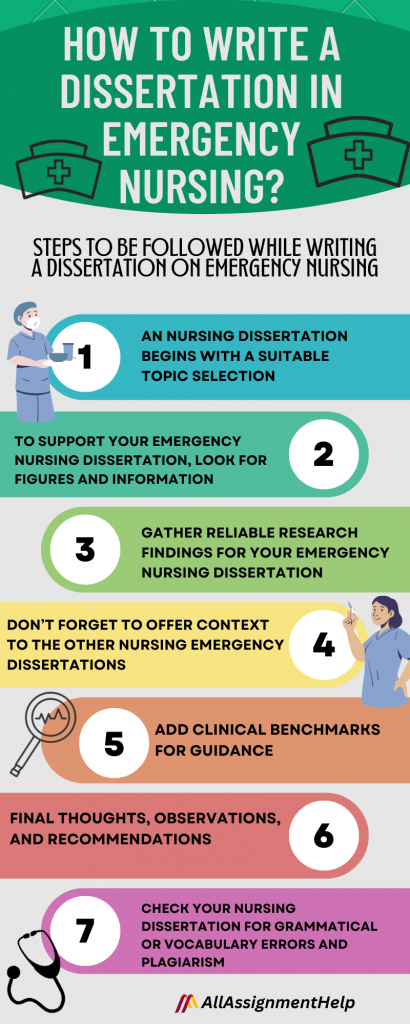
The above was the best emergency nursing dissertation topic. The ideas were covered based on the situation, which will help the nurse actively work in their profession without any errors. But do you know how to write an emergency nursing dissertation? If not, you can have a look at the information given below and learn how to craft a perfect dissertation and score good grades. You can also opt for nursing dissertation help and get a high-quality dissertation at an affordable price.
Step-1: An nursing dissertation begins with topic selection
The first step in writing a dissertation is similar to the first step in writing an essay. Here, you need to select a suitable topic for you. There are a lot of topics to choose from. You can also refer to a few of the topics above. The emergency nursing topic is the main plot, which will decide the future of your writing, so choose it wisely. You might find a few topics interesting at first, but finding suitable information would not be as easy as that. Before deciding on an emergency nursing topic, consider whether it is of interest to you, whether you will find acts on it, and, most importantly, whether it is within your scope. Selecting a popular topic would be best, as you can easily find information about it on the internet or in journals.
Step-2: To support your emergency nursing dissertation, look for figures and information
Nursing is a field of study where every piece of information is related to the human body. Nothing is written just like that, as it will affect the lives of the people. So while writing an emergency nursing dissertation, make sure that you include information from credible resources. You can refer to peer-reviewed journals like “Applied Nursing Research,” “Critical Care Nurse,” “Advances in Neonatal Nursing,” “Journal of Emergency Nursing,” and “Emergency Nurse.”
If you have any doubts or need assistance, you can contact your teachers or get assignment help for further assistance.
Step-3: Gather reliable research findings for your emergency nursing dissertation
Research evidence plays an important role in the emergency nursing dissertation. Research evidence refers to collecting the research findings and the histories of your selected patients. It is a complex task to perform, but it will help you complete your dissertation successfully. You can use different types of evidence of nursing in your dissertation, like a randomized controlled trial, a case-controlled study, and a professional expert’s review or opinion.
Step-4: Don’t forget to offer context to the other nursing emergency dissertations
Nursing dissertations are incomplete without references from other dissertations. For example, if you are writing an emergency nursing dissertation, you can link it to other dissertations written by scholars. Make sure to never connect your dissertation without verifying it, as it will backfire. The main goal of adding references is to increase your grade, but if you add false or irrelevant considerations, you will lose the points you have already earned.
Also Read: Thesis vs. Dissertation vs. Research paper – Understand the difference
Step-5: Add clinical benchmarks for guidance
Nursing dissertation clinical research aids in the development of nurses’ knowledge. Your emergency nursing dissertation ought to be as concise as you can, and you should never add any content without first thoroughly checking it. Your prepared dissertation will help you while practically treating the patients.
Step-6: Final thoughts, observations, and recommendations
Writing the conclusion is the end of the emergency nursing dissertation. The conclusion should be productive and let the readers know what the main topic of the dissertation was. After your conclusion, you include recommendations that you would like to give on the chosen topic. This suggestion would be useful to the other people reading your dissertation projects. In the end, include a summary of the findings of the emergency nursing dissertation for your professors to know the materials used.
Step-7: Check your nursing dissertation for grammatical or vocabulary errors and plagiarism
The nursing dissertation’s final step is the same as that of the other tasks: it consists solely of proofreading for flaws. Proofread your dissertation and fix any errors right away. Things can go wrong when they are delayed. The students might also ask for assistance from a reliable dissertation data analysis service. The experts at these services will carefully review your dissertation and help you earn good scores.
The main advantage of writing a dissertation is that it allows students to gain practical knowledge of the subject. So whenever your professor assigns you dissertation writing, do not panic and use this opportunity to learn things. You can also opt for professional dissertation writing help and score good marks.
Frequently Asked Questions
1. What are the best emergency nursing dissertation topics for 2026?
The best emergency nursing dissertation topics for 2026 focus on real-world challenges such as trauma care advancements, patient triage systems, mental health emergencies, disaster response strategies, and the role of AI in emergency departments. Choosing a current and practical topic improves both relevance and research value.
2. How do I choose a strong emergency nursing dissertation topic?
To choose a strong topic, focus on areas that interest you and have enough research material available. Make sure the topic is specific, relevant to modern healthcare trends, and allows you to present clear arguments or findings. Consulting mentors and reviewing recent case studies can also help.
3. Why is emergency nursing considered a challenging field of study?
Emergency nursing is challenging because it requires quick decision-making, strong clinical knowledge, and the ability to handle high-pressure situations. Students must learn both theoretical concepts and practical skills to manage critical patient conditions effectively.
4. Can I focus on mental health in emergency nursing dissertations?
Yes, mental health is an increasingly important area in emergency nursing. Topics like managing psychiatric emergencies, suicide prevention, and handling patients with anxiety or trauma in ER settings are highly relevant and widely researched.
5. How can dissertation topics in emergency nursing improve career opportunities?
A well-researched dissertation can demonstrate your expertise in a specialized area of emergency care. It can help you stand out to employers, open opportunities in advanced clinical roles, and even support further studies or research positions in healthcare.
Connect the explanation to the work your course actually requires
Use this guide beside the exact brief, course material and marking criteria for On Demand Emergency Nursing Dissertation Topic Ideas for Students.
- Use the named clinical or academic framework.
- Distinguish evidence from personal observation.
- Follow the required care, case or research format.
- Check current sources and referencing.
Finley Davies
Medical · 4.9/5
For a topic such as “Top Emergency Nursing Dissertation Topic Ideas for Students 2026”, a tutor with a published background in Medical offers a useful subject-matching option.
Finley’s profile presents clinical experience alongside tutoring across pre-clinical, para-clinical and clinical study.
View established tutor profile ↗Relevant subject areas
- Nursing
- Radiology
- Pathology
- Dermatology
- Health and Social Care
- Clinical Studies
Find another explanation across the complete blog
This search uses WordPress itself, so it can reach articles beyond the 20 shown on the dashboard.
Connect On Demand Emergency Nursing Dissertation Topic Ideas for Students to the task in front of you
Keep the brief, marking criteria, required evidence and submission format visible while you work.