What Is Naturalistic Intelligence? Know Everything About It!

What this article will help you understand
We are naturally curious about the world around us from an early age. It is human nature to explore, discover, and learn new things. As a result, we often classify and categorize objects based on their characteristics and shared features. One of the earliest forms of intelligence we develop is naturalistic intelligence, which is closely
What are you trying to do with this topic?
Choose the closest task and the page will point you towards a useful next step.
Start with the central concept and the terminology used in the article.
Open the closest route ↗Connect the explanation to the question, learning outcomes and marking criteria.
Open the closest route ↗Review evidence, structure, referencing and the exact submission requirements.
Open the closest route ↗Do you have enough information to begin?
Select what you already have. Nothing is submitted from this checklist.
When these details are together, the requirement can be reviewed in context.
Assignment Help USA ↗Table of Contents
We are naturally curious about the world around us from an early age. It is human nature to explore, discover, and learn new things. As a result, we often classify and categorize objects based on their characteristics and shared features. One of the earliest forms of intelligence we develop is naturalistic intelligence, which is closely associated with these behaviors. In many ways, every child is born with naturalistic intelligence. As they grow, they begin to explore and understand the natural world, including plants, animals, and the environment around them.
Naturalistic intelligence is one of the nine types of intelligence proposed by Howard Gardner in his Theory of Multiple Intelligences, introduced in 1983. According to Gardner, human intelligence is not limited to a single ability but consists of multiple forms that help individuals succeed in different situations. While his theory originally identified seven types of intelligence, he later expanded it to include naturalistic intelligence. This type of intelligence enables individuals to recognize, understand, and appreciate patterns in nature and the environment. However, naturalistic intelligence extends far beyond simply understanding the natural world. There is much more to learn about this fascinating form of intelligence, and that is exactly what we will explore in this blog. This guide by All Assignment Help covers everything you need to know about naturalistic intelligence in one place.
What is Naturalistic Intelligence?
What Is Naturalistic Intelligence?
Naturalistic intelligence is the ability to recognize, understand, classify, and interact with elements of the natural world, including plants, animals, landscapes, and weather patterns. People with strong naturalistic intelligence can easily identify patterns in nature and appreciate the relationships between living and non-living things.
According to Howard Gardner’s Theory of Multiple Intelligences, naturalistic intelligence is one of the different ways people learn and understand the world. It reflects a person’s ability to observe, categorize, and connect with nature.
Key Characteristics of Naturalistic Intelligence
People with strong naturalistic intelligence often:
- Recognize and classify plants, animals, and natural objects.
- Identify patterns and changes in the environment.
- Enjoy outdoor activities and exploring nature.
- Care about wildlife and environmental conservation.
- Learn best through observation and hands-on experiences.
This type of intelligence is especially valuable in careers such as biology, agriculture, environmental science, forestry, zoology, and wildlife conservation. Students studying these subjects may also be asked to complete assignments on naturalistic intelligence or related topics. If you’re struggling with research, writing, or meeting deadlines, seeking professional assignment help from subject experts can make the process easier and improve the quality of your work.
Also Read: What is a Pilot Study? A Helpful Guide for You
Traits of People with Developed Naturalistic Intelligence
People who have highly developed naturalistic intelligence have certain traits and skills connected to their sensitivity to and comprehension of the natural world. Furthermore, as we already know that naturalistic intelligence involves a strong connection and appreciation for nature, plants, animals, and the environment. Thus, here are some common traits associated with individuals who possess developed naturalistic intelligence:
Categorization
Nature smarts people can categorize different things by category. Such people recognized ideas and objects of nature. This is otherwise not easily recognized by other people.
Hierarchical Reasoning
They have the ability to rank people, things, and items. They rank things by significance or importance.
Natural orientation
These People have the ability to identify with living organisms. Also, such people identify themselves with their environment.
Relationship with Nature
This kind of intelligence makes people feel connected to their surroundings rather than disassociated from them. They could participate in activities like camping that foster harmony between people and the natural environment.
Naturalistic intelligence is only one of the various ways people might excel at comprehending and connecting to their environment.
What Are the Traits of People with Developed Naturalistic Intelligence?
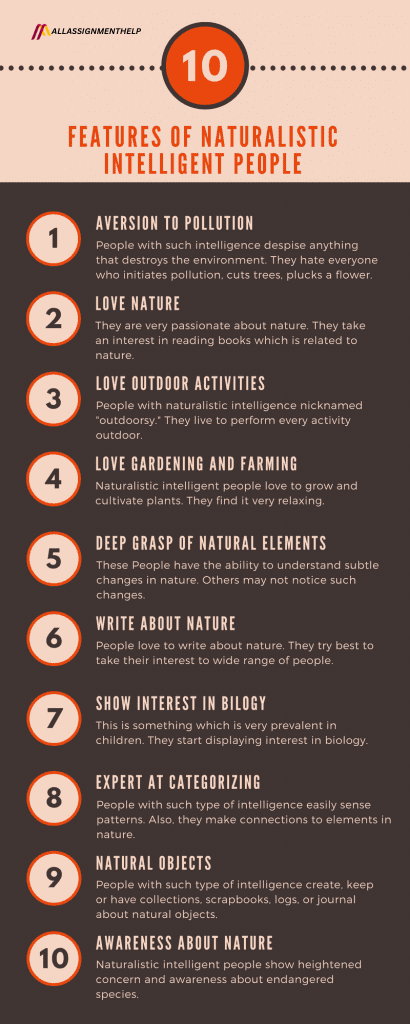
People with developed naturalistic intelligence have a deep understanding of the natural world. They are highly observant and can easily recognize patterns, identify different species, and understand how living organisms interact with their environment. These individuals enjoy exploring nature and often feel more connected to the outdoors than to artificial surroundings.
Below are some of the most common traits of people with strong naturalistic intelligence.
Strong Observation Skills
People with naturalistic intelligence pay close attention to details that others may overlook. They can spot subtle differences in plants, animals, rocks, insects, or weather patterns and use these observations to better understand their surroundings.
Excellent Classification Ability
They naturally organize and categorize objects based on shared characteristics. Whether identifying different bird species, classifying plants, or distinguishing rock formations, they enjoy grouping things accurately.
Love for Nature
They feel happiest when surrounded by nature. Activities such as hiking, camping, gardening, birdwatching, farming, and exploring forests or parks are often among their favorite hobbies.
Curiosity About Living Things
They constantly ask questions about plants, animals, insects, ecosystems, and natural processes. Their curiosity motivates them to learn more about how nature works.
Strong Environmental Awareness
People with developed naturalistic intelligence care deeply about protecting the environment. They often support conservation efforts, practice sustainable living, and encourage others to preserve natural resources.
Pattern Recognition
They can quickly recognize recurring patterns in nature, such as seasonal changes, animal behavior, weather conditions, or plant growth cycles. This ability helps them make connections and predictions based on observation.
Hands-On Learners
Rather than learning only through books, they prefer practical experiences. They enjoy conducting experiments, visiting parks, observing wildlife, growing plants, and participating in outdoor learning activities.
Good Problem-Solving Skills
Their ability to observe details and identify patterns allows them to solve real-world environmental and scientific problems effectively. They often approach challenges logically by analyzing the natural relationships between different elements.
Interest in Science and the Environment
Many people with naturalistic intelligence are naturally drawn to subjects such as biology, ecology, environmental science, agriculture, zoology, geology, and forestry. They enjoy learning about ecosystems and how humans can protect them.
Compassion for Living Organisms
They usually have a strong sense of empathy toward animals, plants, and the environment. Many enjoy caring for pets, maintaining gardens, planting trees, or volunteering for wildlife and environmental conservation programs.
Developing these traits can improve observation, critical thinking, and environmental awareness. They also open doors to rewarding careers in biology, agriculture, wildlife conservation, forestry, environmental science, geology, and other nature-related fields. Students pursuing these subjects often have demanding coursework and practical assignments. When juggling multiple academic responsibilities becomes overwhelming, many search online using phrases like “do online class“ to find academic support that helps them stay on track with their coursework while continuing to focus on learning and other commitments.
What are the Activities Involving Naturalistic Intelligence
There is no nature v/s nurture debate in the theory of multiple intelligences. According to Gardner, intelligence is present in varied degrees at birth, and through time, it may be developed. However, there are many activities that can help children or students learn naturalistic intelligence in a far better way. Some of the activities include:
Observe Nature
The observation comes after experience. Children can see animal behavior, utilize observational instruments like magnifying glasses, microscopes, and telescopes, observe the weather, and discover ecological concepts like how plants change through time using all of their senses.
Explore Nature
Children can delve more deeply into the natural world during exploration. They can achieve this through interacting with and studying the natural world. They can cultivate plants, tend gardens, go on treks, put on plays, read or watch nature-related stories, etc.
Classify Nature
The only thing left to do is categorize once they have encountered, noticed, and examined nature. Your children can categorize objects based on what they have observed. They are able to gather objects to recognize various plants, leaves, berries, and other things. Furthermore, they can emphasize the variations and resemblances among their organic things using these collections.
The exercises that follow will assist in developing and enhancing naturalistic intelligence in young children.
Also Read: Current Biology Research Topics for Students
Famous People with Naturalistic Intelligence
Gardner in his Multiple Intelligence gave examples of renowned persons. Some of those who possessed Naturalistic intelligence are:
Charles Darwin
Charles Robert Darwin was an English Naturalist. He is best known for his theory of evolution. Darwin proposed that all life is derived from the common ancestors. He introduced his scientific theory of evolution through a process, he called natural selection. Darwin’s study on the HMS Beagle. This allowed him to study and collect natural specimens from across the globe.
Inspiration: Darwin showed how far one could reach with naturalistic interests. His naturalistic intelligence helped him to achieve notable success in his field. His theory also proved helpful for the whole of humankind.
Viktor Schauberger
He was an Austrian naturalist. Schauberger was a keen observer of nature and its various dimensions. Through such observation, he developed his theories. Schauberger’s family used to publish an implosion magazine. Darwin expressed various ideas in that magazine. He said in this magazine that aeronautical and marine engineers had incorrectly designed the propeller.
Inspiration: Schauberger is a perfect example of people getting successful in naturalistic fields. He showed the world how to incorporate naturalistic intelligence in engineering. We can draw immense inspiration from his work.
Gerald Durrell
Gerald Malcolm Durrell was an English naturalist, zookeeper, conservationist, and author. He is famous for founding the Durrell Wildlife Conservation Trust and the Jersey Zoo on the Island of Jersey. However, many people remember him for his work on animals. He was an animal collector and enthusiast. Also, he had written many books on the same.
Inspiration: Durrell integrated his naturalistic intelligence with linguistic intelligence. He wrote books like “My Family and other animals.”
Alexander von Humboldt
Humboldt was a 19th-century explorer and naturalist. He was the first person who suggested that humans do have an impact on the natural world and cause climate change. His naturalists’ interest derived him from working on botanical geography. This, at a later stage, laid the foundation of bio-geography.
Inspiration: His work on botanical geography could inspire us. He used his naturalistic intelligence on something constructive.
William Wordsworth
The poet William Wordsworth was a poet and naturalistic. He best summed up his naturalist intelligence in his poem, “The Tables Turned.” In this poem, he encouraged the reader to get up from his studies and go out of the door. He was of the view that We could learn more from nature than from other books.
Inspiration: He integrated his naturalistic intelligence into his poetry. We can also derive inspiration from his work.
Unfortunately, a lot of people believe that this intelligence is more of ability than intelligence. But one must keep in mind that men identify and recognize their surroundings through this intelligence.
How to Teach Various Subjects to Children with Naturalistic Intelligence?
People with this type of intelligence have a keen interest in nature. However, we can also teach them other subjects.
Following are some topics that can be taught in relation to nature.
Mathematics
- Connect all concepts to nature. For example, you can relate the idea of arithmetic progressions to how plants grow. Another way could be to relate sets and Venn diagrams to types of plants and how they share specific features.
- You can give such children books related to Pi, the golden ratio (1.618), etc.
- You can also make them aware of the influence of mathematics in nature. For example, the various geometries in a natural formation.
Science
- You can explain how various concepts in science are related to nature. For example, you may connect the concepts of physics like energy to solar power. You may relate organic chemistry to plastics and their impact on the earth. Another way could be discussing various laws of physics (Newton etc.,) that could explain the planetary system.
- You may help children to make a collection of various natural organisms.
Geography
- You can explain about flora and fauna in various countries.
- As you know naturalist intelligent children are very fond of nature. You may teach them about different climates of the world.
- Teach them about different farming techniques in various climates.
- Highlight how geographical growth has impacted the environment and animal population.
History
- You can discuss how natural events influenced the course of history.
- Learn about how various government policies have impacted nature.
Appropriate Careers for People with Naturalistic Intelligence
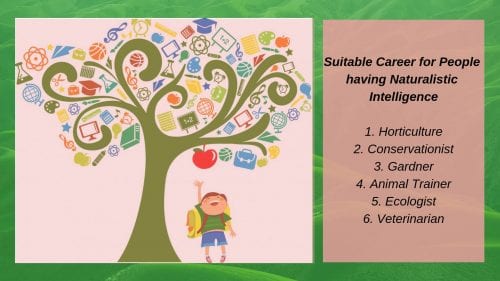
There are various professions that provide you the chance to enhance your naturalist intelligence while allowing you to interact with nature more. Such jobs also provide you the opportunity to spend more time in the outdoors, which fosters the development of your naturalist intelligence. Here are the career options available for individuals interested in naturalistic intelligence:
Horticulturist
These intelligent individuals have a profound connection to the natural world. They enjoy growing decorative plants, fruits, veggies, and flowers. Such individuals like using their naturalistic intelligence in such a profession.
Conservationist
Nature is very dear to these people. They quickly get bothered by pollution and its hazard. A conservationist is an option that is opted for by naturalistic intelligent people.
Animal Trainer
They enjoy training animals since they have a passion for them. Thus, they can use this naturalistic intelligence to instruct animals. Zoos, animal shelters, and organizations that rescue animals all employ animal trainers.
Ecologist
People with naturalistic intelligence are more aware of nature than anything else. They like researching how creatures and their surroundings interact. This is why they are most suited for the position of an ecologist.
Veterinarian
They can do anything to heal and restore any animal back to life. It is due to this reason this career suits them best. Their appreciation and love for animals make them perfect veterinarians.
Biologist
A biologist is a scientist that focuses on the research of living things and how they interact with their surroundings. Biologists collaborate across several disciplines and subfields of biology to acquire an understanding of the complexity, variety, and interconnection of life on Earth.
Also Read: An Essential Guide to the Responsibilities of the Students
Wrapping Up
True representations of naturalistic intelligence show the many elements of human intelligence. This intelligence has evolutionary roots since it was necessary to recognize, distinguish between, use, and stay away from various plant and animal species to survive. Naturalist intelligence still plays a crucial role in understanding, using, and maintaining nature in occupations like farming, gardening, zoology, etc.
Sometimes, many students have naturalistic intelligence. However, they lack intelligence which can help them in their academics. In all such cases, taking assignment writing services online is the only option left with them. If you have any doubts regarding anything, you can directly contact us on our website there are so many expert writers who are ready to help you anytime.
FAQs
Frequently Asked Questions
What is naturalistic intelligence?
Naturalistic intelligence is the ability to recognize, classify, and understand elements of the natural world, including plants, animals, and ecosystems.
What are the key characteristics of naturalistic intelligence?
Strong observation skills, pattern recognition, curiosity about nature, environmental awareness, and the ability to classify natural objects are some of its key characteristics.
What are some examples of naturalistic intelligence?
Gardening, birdwatching, identifying plants and animals, hiking, farming, and studying ecosystems are common examples of naturalistic intelligence.
Which careers are suitable for people with naturalistic intelligence?
Careers in biology, environmental science, agriculture, forestry, zoology, geology, wildlife conservation, and landscape design are well suited to individuals with naturalistic intelligence.
Can naturalistic intelligence be developed?
Yes. Spending time in nature, observing wildlife, gardening, and engaging in outdoor learning activities can help strengthen naturalistic intelligence.
Connect the explanation to the work your course actually requires
Use this guide beside the exact brief, course material and marking criteria for Naturalistic Intelligence.
- Read the complete brief.
- Identify the expected academic output.
- Follow the marking criteria and source rules.
- Check the final structure and referencing.
Rob Rieder
Assignment Writing
Students working on a brief connected to “What Is Naturalistic Intelligence? Know Everything About It!” may compare the requirements with Rob Rieder’s live Assignment Writing profile.
Rob’s established profile presents broad assignment-writing support with exposure to biotechnology, physics and chemistry.
View established tutor profile ↗Relevant subject areas
- Assignment Writing
- Academic Writing
- Biotechnology
- Physics
- Chemistry
Find another explanation across the complete blog
This search uses WordPress itself, so it can reach articles beyond the 20 shown on the dashboard.
Connect Naturalistic Intelligence to the task in front of you
Keep the brief, marking criteria, required evidence and submission format visible while you work.