Table of Contents
The nature of marketing has shifted from visibility to a matter of notoriety and utility. Since technology evolves in a blink, and consumer behaviour changes, companies should overcome simple tricks to attract attention. The era demands a form of strategic innovation that is smarter, faster and more human-centred, from AI-powered personalisation to purpose-led brand making. This blog by All Assignment Help will discuss 10 marketing strategies that are working as of 2025. These insights will arm even startups and established brands to remain on the cutting edge to win the digital war of today.
What is Marketing Strategy?
A marketing strategy is a company’s plan to achieve specific business objectives by understanding customer needs, which creates a sustainable competitive advantage. Moreover, a marketing plan defines how a brand will market its products or services to its ideal customers and convert them into repeat buyers. Market research, market positioning, messaging, and channels, a good marketing strategy comprises all these aspects. It is in line with business requirements and flexible for market dynamics and customer behaviour. Whether it be digital advertising, content creation or influencer outreach, a marketing strategy is going to make sure everything you do stays in line.
Also read: Explore the Best Topics for Marketing Research Papers
Why do We Need Marketing Strategies?
Having a marketing strategy is important because it guides your brand by giving it structure and focus when it comes to reaching its target audience. In this type of competitive market, we cannot play hit and trial. In addition, a focused approach helps to better understand the correct audience selection and media choice, as well as develop appropriate messaging that makes sense.
Here are some achievements that you can achieve with marketing strategies.
- It also creates consistency in branding and scales your investment by using them to their full potential.
- It enables you to track performance, review results and take informed decisions.
- In a market as quickly moving and never predictable, when consumers’ choices change overnight, having a clear strategy is the most important device to keep up with trends, adapt your self to the needs of customers and stay ahead of the competition.
- In the end, a marketing strategy is defined by its ability to translate goals into executable strategies that maximise brand growth and customer loyalty.
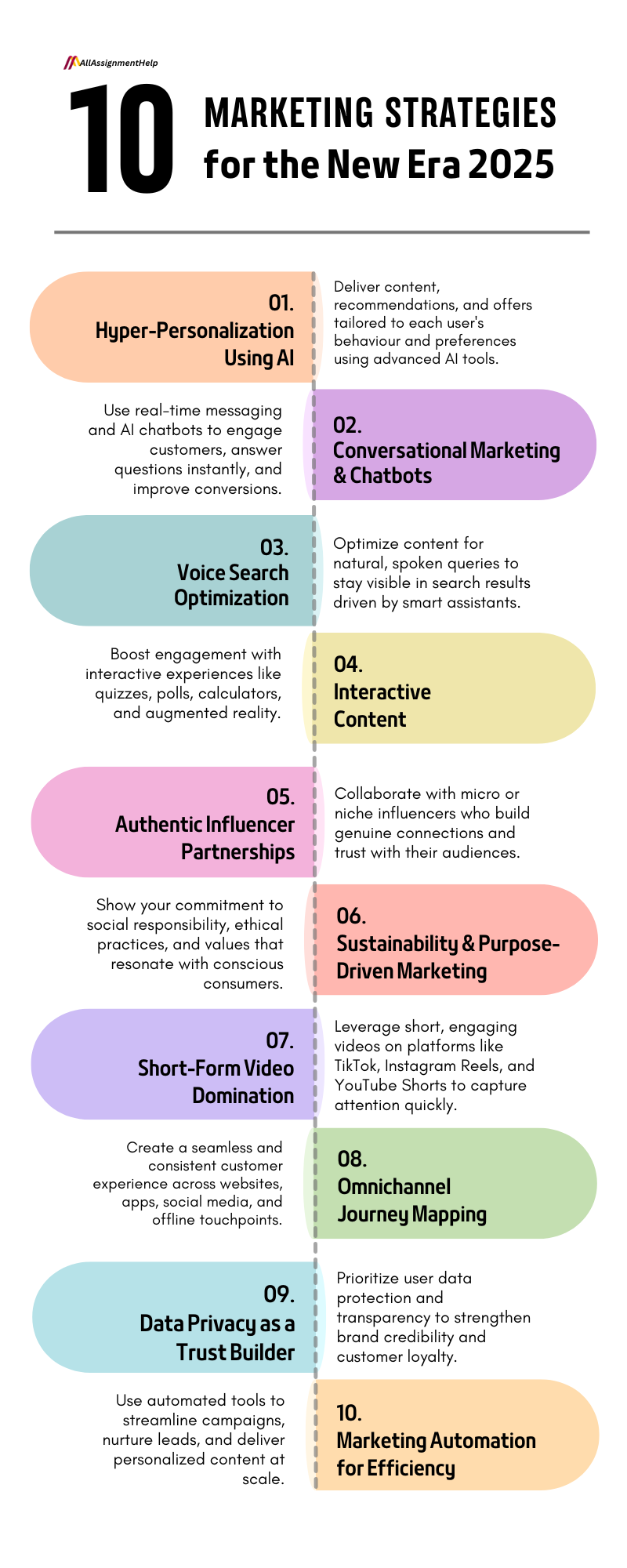
Strategy 1: Hyper-Personalisation Using AI
Hyper-personalisation in digital marketing 2025. The advanced AI and machine learning-powered tools will allow your business to serve the audience with custom content, relevant product recommendations and offers based on the consumer’s insight, preference and browsing history. Not only a first name here and there in our emails, but a recommendation for the appropriate solution when they need it.
For example, students pursuing business management get the opportunity to learn hyper-personalisation using AI. This helps them understand how they can study the consumer’s mindset and create strategies that will benefit their businesses in the future. The role of AI here is to analyse consumer behaviour using data science. When students gain hands-on experience with these technologies and learn how to leverage AI for hyper-personalisation, the implementation of their studies becomes much simpler.
Being a student will be given various assignments and writing tasks based on different marketing strategies. Using hyper-personalisation through AI could be one of those topics. To complete these more efficiently and create compelling, high-quality assignments, you can get assistance from online assignment help services. This can make your learning more effective and help you understand marketing strategies in a much better way.
Strategy 2: Conversational Marketing and Chatbots
This type of marketing is live, two-way between consumers and brands or businesses.
- In 2025, personal interaction is more than live chat, messenger apps, and AI chatbots.
- They give instant answers, manage queries, and give a step-by-step guide to the user in their customer journey, whether they want to explore a product or recommendations.
- Especially chatbots, they have greatly evolved in terms of complexity in handling conversations, mimicking human engagement and being at our convenience 24/7.
- This not only enhances the user experience but also accelerates the process of lead generation.
- Brands build a trust bond with their customers by being where they are: on WhatsApp, on Instagram, or a brand’s website.
Today, consumers want to reach out to you quickly, more humanely and more effortlessly. This is where conversational marketing comes into play. It caters to these demands in a quick time frame, and it also takes an empathy-based approach. This is not necessarily about selling; it is about bonding.
Strategy 3: Voice Search Optimisation
As more households get used to smart speakers like Alexa and Siri, the way people ask questions online is shifting. Voice search is now part of daily life. It is different from a conventional text query, as voice searches are longer. Brands need SEO adaptation that relates primarily to natural language, question-content phrases, and locally focused content, as well as an intricate understanding of natural language search queries.
For example, a student may write, Hey, where can I find a website for online class help on my accounting subject? For a website to appear in these voice results, it needs to contain the actual query that someone might search with their voice in the content of the page. As voice search is more accessible and convenient for users, it becomes a preferred marketing strategies for users on the move.
Strategy 4: Interactive Content
Interactive content is content that requires the user to participate in some manner – quizzes, polls, infographics, calculators, AR features, you name it. It not only saves skillfully engaging the users that not also makes the website time-consuming and warming, but also facilitates learning and boosts brand recall. A beauty brand could offer a virtual tool to try on, or a fitness company could offer an interactive quiz that recommends workout plans. It is an engaging, one-on-one-driven experience through which brands can gather the utmost user data and present purposeful experiences. Social media loves this kind of interactive content too, inciting shares and organic reach. It slices through content stress by turning audiences into participants rather than observers.
Strategy 5: Influencer Partnerships with Authenticity
The year 2025 turned a page on the influencer marketing game. Brands moved away from celebrity endorsements to authentic voices and platforms. The hype is being replaced by honesty, which makes micro and nano influencers more powerful than ever before. Such influencers post real-life experiences and connect with the audience better in niche segments, making their recommendations more credible.
Influencer partnerships in the real world
Are you also thinking about how influencer partnerships make a difference? Let us understand this with an example.
Suppose a student who is also an influencer posts about their frustrations with having to deal with virtual learning and finding a way to ethically find academic help in a non-promotional way. “I had this brand collaboration coming up, and shoot dates were matching my online history exam dates. It was so tough for me to find a way to combat the situation. I was wondering if there is someone who could do my online exam for me, so that I can focus on my shoot. And guess what! I came across this amazing service that helps you handle your exams, quizzes, online classes, assignments, and whatnot. I will let you know about the service so you guys can also use it, but before that, have you subscribed to my channel yet?”
A little real storytelling is the best way to promote trust, the way to encourage your members to create a closer relationship with brands!
Strategy 6: Sustainability and Purpose-Driven Marketing
Today, consumers will only associate themselves with the brand which is having its stand on something, be it sustainability, social equity or simply local support. Which is why purpose-driven marketing is more relevant now than ever; it is imperative.
- It has become less about selling any product and more about proving that your mission resonates with what people care about. Also, it could include packaging it in green, aiding red artisans or propagating the word about mental wellbeing.
- These days, people want more than just promises from brands; they want proof. A sleek ad campaign will not cut it if your practices don’t match. That is why greenwashing is no longer fooling anyone. What works instead? Transparency.
- Consumers notice—like the behind-the-scenes peek at a production process, or in authentically collaborating with mission-focused creators. When the brand makes an appearance without pretence, it hits the human nerve and more than that, it talks.
Many times, word of mouth is far more impactful than anything the brand could say. The global pressure to balance purpose with profit is set to intensify as sustainability moves from the fashionable to the fundamental. It is not easy, but it is becoming obligatory.
Also read: Ten Best Classroom Management Strategies
Strategy 7: Short-Form Video Domination
TikTok, Instagram Reels, and YouTube Shorts are ushering in an era of short-form video that is poised to take digital marketing by storm in 2025. These mean little snippets of the video are perfect for attracting attention, demonstrating product features, or providing a couple of seconds’ worth of value. Under a minute, brands are connecting through storytelling, humour, tutorials, and behind-the-scenes glimpses. Furthermore, short videos can be used to break down complex topics, share quick tips, or for non-promotional advertisements. For example, if you are a student, you might get short promotional ads about services that provide help with assignments.
This mode leads to a high level of engagement, shareability, and quick mind recall of the brand. Also, since video is getting favoured by algorithms, companies that consistently share quality short videos can go viral, exposing them to wider audiences.
Strategy 8: Omnichannel Customer Journey Mapping
Brands engage against a multitude of touchpoints such as their websites, mobile apps, social media, email, and even offline store experience.
- With omnichannel customer journey mapping, each experience is integrated and coherent yet connected for the best possible experience.
- It implies learning the movement of a customer through every phase of their journey and maximising each channel to assist them.
- For example, a potential customer may discover a product via Instagram, receive a follow-up email, and then finally purchase it via an app.
- Hence, those who work to map the entire customer journey get an advantage.
- They can identify pain points, simplify the experience, and customise their messaging at each phase.
Customers take note when it feels like every touchpoint is connected, and they are more likely to stay.
Strategy 9: Data Privacy as a Selling Point
Data privacy is not an issue of compliance anymore; it is rather a competitive advantage. Consumers are becoming increasingly aware of the data being collected and sold, and responding favourably to transparency and meaningful control over their data. If data protection is being made an open secret with the customers also empowered with creating their privacy settings, then companies are moving much faster towards a high trust ratio.
Example of data privacy as a selling point
Academic support platforms that provide assignment writing by experts can ease the minds of users by telling them how student data is protected and confidential. Such transparency breeds credibility. In oversaturated markets, marketing messages around secure practices, encrypted transactions, and responsible handling of data with permissions can enhance a brand and stand the test of time. In an era where trust is pretty much non-existent in the digital world, incorporating data privacy into your value proposition and marketing strategies can become one of the cornerstones to develop and strengthen the customer relationship, and enhance the reputation of your business.
Strategy 10: Marketing Automation for Efficiency
At the core of any good strategy is marketing automation, giving brands the ability to provide highly personalised experiences at a serious scale, without the constant manual efforts. Automation tools add precision and consistency to every touchpoint, from composing and sending email campaigns, scheduling social posts, to automating the lead nurture process, to even audience segmentation. Not only do they give your time back, but they also help you communicate promptly and in a targeted way with both prospects and customers as well. Moreover, automation enables marketers to glean information about how consumers interact with their content. Automation transforms marketing into smart and strategic, sending follow-ups, reengaging the inactive user, content recommendation based on activity, etc.
Conclusion
In conclusion, there are three driving forces of success in 2025: adaptability, authenticity, and innovation. Consumers have always valued connection, and the best brands will foster it with intentional branding, hyper-personalisation, and smart automation. However, the real challenge is to evolve quicker than that, with expectations rising. These marketing strategies are essential to know to survive successfully in the digital-first era.
Frequently Asked Questions
Question: What can small businesses do to compete with big brands in 2025 marketing?
Answer: Focusing on niche audiences, real connections, and customised content enables small businesses to shine even in the absence of giant budgets.
Question: Does influencer marketing still work in 2025?
Answer: Yes, but trust is the name of the game. Bigger celebs are nice to look at, but partnering with micro-influencers whose audience is real can yield better results.
Question: Why is voice search important for my marketing strategy?
Answer: Voice optimisation ensures that your business shows up when someone speaks a query into either a voice assistant or search engine.
Question: Does my business need marketing automation?
Answer: Yes, keeping your marketing automated saves time and ensures that the right message reaches the right person at the right time.