
Table of Contents
All agriculture enthusiasts around the world often ask the question, “What exactly are hybrid seeds?” Nowadays, if you want to have a terrace garden, you can easily find hybrid seeds of flowers, fruits, and vegetables in the market. The fact that they grow faster is what convinces people to use them. Moreover, you can create a hybrid by crossing two same family of different varieties. For example, a male and a female zucchini plant. Furthermore, people use the process of hand pollination to transfer pollen from the male flower to the female flower. Let us understand more about hybrid seeds in detail with the help of this blog by All Assignment Help.
Introduction: What Are Hybrid Seeds?
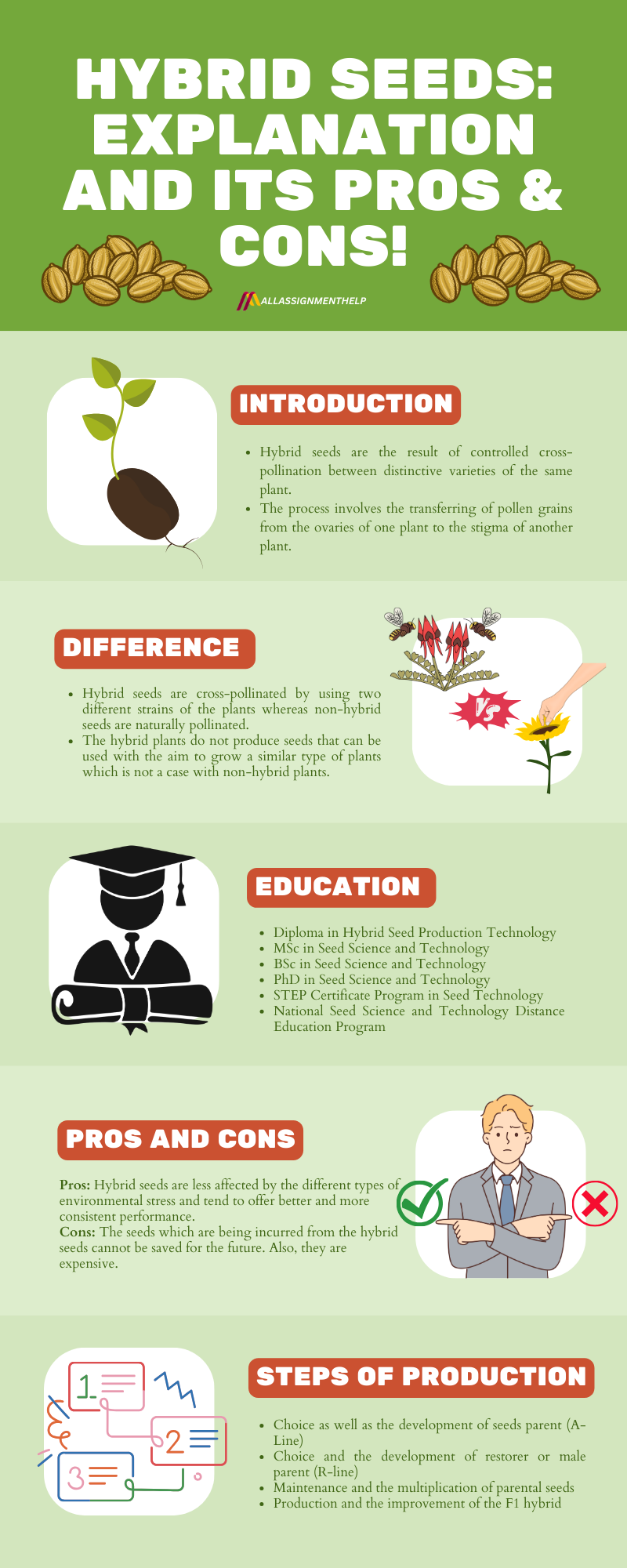
- Technically, hybrid seeds are the result of controlled cross-pollination between distinctive varieties of the same plant.
- The process involves the transfer of pollen grains from the ovaries of one plant to the stigma of another plant. This process is known as cross-pollination.
- This process is in practice for several reasons like, disease resistance, better yield, enhanced characteristics, and greater uniformity.
- One packet of hybrid seeds you will buy from the market has the same parent plants, ensuring uniformity in the resulting plants.
- Additionally, in comparison to heirloom seeds, hybrid seeds grow faster and easier.
- Heirloom seeds are the result of open-pollination caused by natural mechanisms like birds, wind, insects, etc.
Hybrid seeds are indeed a revolution in the field of gardening and agriculture. However, no revolution comes without some consequences.
Hybrid Seeds vs. GMO Seeds
A big confusion among students, farmers, and consumers is the difference between hybrid seeds and GMO (genetically modified organism) seeds. Both are designed to enhance crop performance, but the approaches you take are opposite.
Hybrid seeds are obtained from cross-fertilising between two similar but different parent plants. Also, there is no laboratory-based genetic sculpting in this method. For example, to produce a hardier, more productive crop, two breeds of corn are planted together and cross-pollinate, producing the hybrid seed. The approach has been done for decades and is expected to be safe.
On the contrary, GMO seeds are made in a laboratory, where new pieces of DNA are added to the plant’s genome, typically by splicing them in. It covers traits that would not be able to arise on their own through conventional breeding, including resistance to a herbicide or a crop disease.
The key differences are:
- Hybrids: natural cross-breeding only, no outside genes.
- GMOs: lab science, often more tightly regulated.
This difference is significant because hybrid seeds are accepted by most of the world, while debate remains over GMOs regarding safety, ethics, and the environment.
Hybrid Seeds vs. Non-Hybrid Seeds
Before getting into more details about hybrid seeds, let us educate ourselves a little about hybrid and non-hybrid seeds. In this way, we will effectually understand hybrid seeds. The differences between hybrid and non-hybrid seeds are given in the table:
| Hybrid Seeds | Non-hybrid Seeds |
| These seeds are cross-pollinated by using two different strains of the plants. They are also called by the name of open-pollinated or heirloom seeds. | On the other hand, non-hybrid seeds are naturally pollinated. |
| The hybrid plants do not produce seeds that can be used to grow similar types of plants. Thus, if a person again has to grow a similar type of hybrid vegetable or fruit, then in this situation, they will again have to go through the whole process of hybrid seed manufacture effectively. Further, it is often used to produce vegetables. | Unlike hybrid seeds, in non-hybrid seeds, an individual can get the seeds from the plants. Thus, the seeds can be used to grow a similar type of plant. But it is used for producing fruits and vegetables, etc. |
| Hybrid seeds are expensive. | Non-hybrid seeds are less expensive |
Economic Impact of Hybrid Seeds
The use of hybrid seed has revolutionised economics in modern agriculture. Now, for farmers, the most attractive value has been the yield gain concerning non-GM or open-pollinated varieties. But a great yield generally translates into greater profit, except for all the plants that do not work that way. It could support national food security and lift rural incomes.
Furthermore, hybrid seeds also represent financial pressure. Farmers have to buy new seeds every year because the seeds cannot be used again in the next season. This is a recurring cost and can be a trap, too, depending on the seed companies. Hybrids are also likely to need a greater extent of fertilisers, irrigation, and even more protective measures for crops to reach full potential, thereby cranking up input costs.
Despite these costs, farmers tend to use hybrids, mainly because of the greater marketable surplus that makes up for the outlays. Hybrid maize in India and some African nations has substantially boosted farmer income by delivering as much as two or three times the yield of traditional seeds.
Hybrid seeds offer economic opportunities in the form of higher production and profits, but at the same time, they are problematic in terms of price and sustainability for smallholder farmers.
How Hybrid Seeds Affect the Environment
The hybrid seeds affect our environment both positively and negatively.
Positive effects:
Lots of hybrids are bred to be disease and pest-resistant. Hence, it eliminates the need for chemical pesticides. This, in turn, renders the soil and the water less susceptible to pollution and is also much more sustainable for farming. Hybrids outperform “heirloom” open-pollinated varieties, resulting in increased food production per hectare, which conserves resources.
Negative effects:
They often promote monoculture farming, which takes in millions of hectares of land with just one type of crop. It can lead to declines in biodiversity and can make ecosystems more prone to pests, diseases and fluctuations in the climate. Some hybrids require additional water and fertilisers, putting further strain on the environment.
When used properly, hybrid seeds can be drawn to serve the cause of sustainable agriculture.
Education Line in Hybrid Seeds Production
Undoubtedly, we can see hybrid seeds as an unconventional innovation in the field of agriculture. Moreover, it brings great opportunities for development and growth. If you are interested in exploring this new knowledge or experimenting with advanced farming techniques, you can now learn things online by enrolling on programs that offer seed technology education. However, online classes come with time constraints that require effective time management. The demanding schedule may leave students thinking about, How can I do my online course on hybrid seeds without affecting their day-to-day activities.
While these are extreme possibilities, if you wish to apply this knowledge to your agricultural practices, then there is a solution for you. You can easily pursue a diploma course in hybrid seed production technology from reputable universities worldwide.
Moreover, the course will educate you about seed production, seed testing, seed storage, and seed marketing. Hence, for anyone wanting to gain knowledge in seed technology or pursue a career in agriculture, here is the opportunity for you.
Some well-known courses in seed technology are as follows:
- MSc in Seed Science and Technology
- BSc in Seed Science and Technology
- PhD in Seed Science and Technology
- STEP Certificate Program in Seed Technology
- National Seed Science and Technology Distance Education Program
Advantages of Hybrid Seeds
- It is less affected by the different types of environmental stress, such as insects and plant diseases, etc.
- Hybrid seeds tend to offer better and more consistent performance in comparison to non-hybrid seeds in an effective manner.
- It also helps in the process of providing yield benefits to the individual who grows such types of plants. This happens because hybrid seeds are more drought and pest-tolerant.
- In addition to this, they also have the capability with respect to change themselves as per the climatic conditions. Thus, with the help of hybrid seeds, farmers can avoid different yield-related risks.
- The hybrid seeds produce much stronger and larger plants.
- It helps in the process of obtaining new species of vegetables or flowers, etc.
Disadvantages of Hybrid Seeds
- It takes much time as well as money to prepare. This is due to the process of developing hybrid seeds is not simple. Thus, it can be said that to develop such seeds, sufficient money will be required.
- They are costly in nature in comparison to the other types of seeds.
- Hybrid seeds cannot be obtained with the help of the classical method of production. This is because many hybrid seeds or hybrid plants will have a mechanism that tends to repulse the pollen alien to their species.
- The seeds which are being produced from the hybrid seeds cannot be saved for the future.
- Many people believe that production from hybrid seeds is not tasty.
Now that we have studied the pros and cons of hybrid seeds, let’s move to the steps of production. Also, during your online diploma course in seed technology, if you face any complexity, you can request assistance from professional online coursework services.
How Are Hybrid Seeds Produced? (Step-by-Step Process)
In this section of our blog, we will study the steps that are being performed to yield hybrid seeds. Majorly, this is a four-step process. The details about the same are discussed below.
Step 1: Choice and development of the female parent (A-Line)
Herein, it can be said that for the commercial hybrid, the female parent should possess a male sterline. However, in case if not a suitable male sterline is not available, then in the given situation self-incompatible line is being used. Here, in the process of using the same manual labour will be required. Furthermore, it can also be depicted that in the food grain crops wherein the number of seeds that are produced in each pollination is restricted, the cytoplasmic genetic sterline is being used as the seed parents.
On the other hand, in vegetable seed crops in which single pollination will tend to produce many seeds, fertile pure lines are being used as the seed plants effectively. After identifying the male sterline, an isogenic B-line should be maintained. In this context, the stains can be examined by performing B-line crossing with the A-line. Additionally, it can also be depicted that with the help of repeated crossing, the B-line can be converted into the A-line. This is done until both A and B lines become similar in nature. When both become similar then it is called by the name of isogenic.
Step 2: Choice and the development of the male parent (R-line)
It is being regarded as the second most important component which is required to make a production of hybrid seeds. The given development is being performed by using the pure line selection method. From the heterozygous gene pool, S0 is selected based on different types of attributes such as disease resistance, vigour, productivity, etc. Here, after performing the self-pollination, S1 plants are being obtained and they are being grown in the raw wise. The given function is repeated until S2 is obtained. The whole process will be continued until S5 and S6.
On the other hand, the unwanted inbred line in the process is being discarded from the whole process. In addition to this, the perspective of the R lines is being chosen to make a development of an F1 hybrid. This is being made based on S5 and S6. Thus, it would be correct to say that it is by complying with the given type of activity only the whole activity of choice and the development of the restoration are being completed. After that, the process will move on to the third step.
Step 3: Maintenance and the multiplication of parental seeds
The hybrid programs are based on the 3 lines in the case of cross-pollinated crops. The lines are A (Ms), B (maintainer) and R (Restorer). These all homozygous inbred lines are being maintained by the breeder. In this regard, it is the responsibility of the breeder to it should discard any kind of changes that happen in the population. For effective maintenance, A and B lines are grown in the ideal agronomic conditions. On the other hand, for the effective maintenance of the R-line, the plot should be completely isolated from the others.
As a student of agriculture, you might get to research and write about these intricate steps of the production of hybrid seeds as a part of your academic biology assignment. Hence, it would be a great chance for you to bring the practical aspects of agriculture and the scientific principles of biology together. However, if you find the process too wearying for you, you can get some expert-level help with biology assignments and ace the topic.
Step 4: Production of the F1 hybrid seeds
To make production of the F1 hybrid seeds, both the A and R lines are being grown together. The ratio of them is 4:2 in the production block. The arrangement is the same, but the B line is being substituted by the R lines. Moreover, for the improvement of the F1 hybrid, the parental lines must be improved. Overall, it can be said that it is being regarded as the basic process with the help of which hybrid seeds are being produced.
Also read: Current Biology Research Topics for Students
Main Requisites of Hybrid Seed Production
Breeder’s role and responsibility
- It is being regarded as the main responsibility of the breeder that it should develop the inbred lines. This is because, if a given step is skipped, then in this situation, another process will not be completed.
- Moreover, it is also the responsibility of the breeder to it should get information about the specific parental lines. In this regard, the breeder should make sure that the parental lines which are being assessed by it are correct.
- Furthermore, it is also required by the breeder that it should develop the system to control the pollen.
Key challenges faced by producers
- The maintenance of the parental lines is regarded as the main problem of the breeder.
- Moreover, the separation of the male and female reproductive organs is being regarded as another issue which is being faced by the breeder.
- Also, to perform work like pollination is another issue which is being faced by the breeder.
Also read: Plant Physiology: Its Role and Explanation
Characteristics of Parental Lines
There are some main features in relation to the parental lines examined, and they are given below:
- There are two major types of parents, namely female and male.
- The high seeds will tend to yield good pollen production
- Good seeds also characterise a long shedding period.
- Male sterility leads to the plant’s height.
Hence, it is based on the given features only an individual will get the idea of what the parental lines exactly are.
Popular Hybrid Seeds in Agriculture
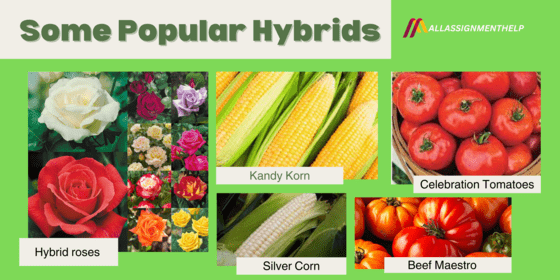
There are some examples drawn to get a better idea about the hybrids. These are all detailed below:
- Roses: It is being regarded as one of the most popular varieties of hybrid seeds. There are huge numbers of hybrid roses being found in the market, and they are also popular.
- Corn: Silver corn, double sweet and Kandy Korn are regarded as some varieties of hybrid corn.
- Tomatoes: There are many varieties of hybrid tomatoes are also available in the market, and these include Celebration and Beef Maestro, etc.
Today, the global hybrid seeds market is reaching great heights. In the year 2021, the market was valued at 25.17 billion USD and was expected to grow by 6.8% in future. Hence, you can imagine how big the hybrid seeds market is and how flourishing a career in the same can be. So, what are you waiting for? Enrol yourself on a degree or diploma in seed technology or biology today.
In case you already have a career and want to study seed technology for your personal experiences and learning, then you can opt for a diploma, as we have discussed above. Also, many resources will support your study regardless of any hurdle. For instance, if you come across situations where it gets tough to juggle between your diploma and your career, then concerns like who will do my online biology class for me or who is going to handle my seed technology class while I am busy with my corporate life might pop up. So, in that case, experts are here to your rescue. Professional experts can take your class on your behalf while keeping all internet safety protocols in mind.
Hybrid Seeds in Major Crops
The application of hybrid seeds has been extended to different crops, providing higher yield, better quality, and stronger resistance compared with traditional breeding varieties. The more common ones are as follows:
- Hybrid rice: Hybrids outyield inbreds by 15–20% over their inbreds. They grow quickly, allowing farmers to bring multiple crops to market each year. But they tend to require more inputs, including fertilisers and water.
- Hybrid maize (corn): Probably the most successful hybrid in the world. Maize’s high yields and adaptability to a wide variety of environments make it the globe’s favourite. Farmers in many countries say the yield is two to four times what they would get with local varieties.
- Hybrid vegetables: You can also get to see the hybrid varieties of tomatoes, brinjal, cabbage, cucumbers, etc. They are bred to be more uniform in size, last longer on the shelf and resist disease. For this, they are an important crop for the farmers and markets.
- Hybrid cotton: It is largely responsible for the increase in fibre yield, especially in a country like India. They offer far more pest resistance and produce more lint, but need careful crop management.
Future of Hybrid Seeds and Technology
Future applications of hybrids are intimately related to advances in agricultural technology.
- Breeding methods are improving, including marker-assisted selection and genomic sequencing. It allows us to develop new hybrids more quickly and accurately.
- These technologies develop seeds to bring nature and artificial management together. It includes high-yield, climate-resistant seeds that can withstand drought, flooding, and temperature differences.
- Digital agriculture is also involved in this. Farmers now have ways to keep closer eyes on the health and growth of their crops through the use of drones, artificial intelligence, or data analytics.
- They can discover which hybrids work well in their area.
- This technology input is realised with both hybrid seeds, optimised with this technology to deliver better benefits and underpins the sustainability of these quality seeds.
In the future, the emphasis will turn to the creation of hybrids that need fewer chemicals, change with the climate and help feed the world. Hybrids will persist as the mainstay of sustainable farming systems as technologies evolve.
Farmer Perspective: Benefits and Challenges
Hybrid seeds, from a farmer’s perspective, are a mixed bag energetically.
Benefits
- The biggest advantage lies in higher productivity and better quality of crop, with a possibility of better economic returns.
- Hybrids also provide farmers with resistance to pests, diseases and erratic weather, helping to reduce crop loss and increase food security.
Challenges
- Hybrid seeds are a check on a farmer’s pocketbook since he has to buy them each year, as they cannot be replanted.
- It may put economic pressure and reliance on seed companies for small and marginal farmers.
- Hybrids are often associated with higher input requirements, such as fertiliser and water and more specific management, which smallholder farmers may lack.
- Though such seeds can prove to be economically profitable, the sustainability relies on costs and the farmers’ investment.
Are Hybrid Seeds Expensive to Produce?
We have discussed earlier that hybrid seeds are being regarded as the type of seeds which are produced with the help of cross-pollination of the plants in an artificial way. Thus, to do the same, the scientist tends to perform thousands of experiments as well as combinations. This is done until the scientist gets the desired results. In this regard, it can be said that to perform the same, the scientist will need to perform much research, and thus, it is due to the presence of a given aspect only it is very expensive in nature.
In addition to this, the companies that also produce hybrid seeds tend to invest lots of money in research and development type of activities. On the other hand, the whole process is very time-consuming in nature. Here, a person cannot stop after inventing one hybrid seed. Thus, an individual will have to make a continuous effort to manufacture the hybrid seeds. Therefore, it is very much correct to say that hybrid seeds are very expensive in production.
Conclusion: Should Farmers Choose Hybrid Seeds?
Hybrid seeds have revolutionised agricultural production because they increase yields and make the produce very uniform in quality and resistant to pests and diseases. To farmers, they promise a dependable route out of poverty and the prospect of satisfying a growing appetite for food. But increasingly, high expense, annual purchase requirements and higher input needs still pose real problems in practice, especially for smallholder farmers. Therefore, the choice to go for hybrid seeds must be based on local ideals, resources, and market factors.
Frequently Asked Questions
Question: Who invented the hybrid seeds?
Answer: Hybrid seeds (double cross) were first invented back in 1917 by Jones. Later, Henry A. Wallace introduced hybrid corn to American farmers.
Question: Who prepared the first hybrid plant?
Answer: The first hybrid plant was prepared by Thomas Fairchild, and the developed plant was known as the Fairchild mule or the Dianthus caryophyllus.
Question: Which seeds have 100% genetic purity?
Answer: Nuclear seeds are 100% genetically pure seeds that are even physically pure. Moreover, original breeders produce it.
Question: What are the 4 classifications of seeds?
Answer: The four classifications of seeds are: the nucleus seed, the breeder seed, the foundation seed, and the registered or certified seed.