How to Write a Comparative Essay: A Step-by-Step Guide
What this article will help you understand
Hello everyone! Are you required to write comparative essays in high school or university? Struggling to figure out where to start or how to structure your essay? You don’t need to worry anymore. This blog post by AllAssignmentHelp.com is designed to clear your doubts and guide you step by step. Here, we’ll cover everything you
What are you trying to do with this topic?
Choose the closest task and the page will point you towards a useful next step.
Start with the central concept and the terminology used in the article.
Open the closest route ↗Connect the explanation to the question, learning outcomes and marking criteria.
Open the closest route ↗Review evidence, structure, referencing and the exact submission requirements.
Open the closest route ↗Do you have enough information to begin?
Select what you already have. Nothing is submitted from this checklist.
When these details are together, the requirement can be reviewed in context.
Assignment Help USA ↗Table of Contents
Hello everyone! Are you required to write comparative essays in high school or university? Struggling to figure out where to start or how to structure your essay? You don’t need to worry anymore.
This blog post by AllAssignmentHelp.com is designed to clear your doubts and guide you step by step. Here, we’ll cover everything you need to write a strong and effective comparative essay for school or college.
Before you begin, it’s important to have a clear understanding of your topic. If you feel unsure about any part, take some time to clarify your ideas first. Once you’re confident, you can start writing with ease. Let’s begin by understanding what a comparative essay is, and then move on to how to write one effectively.
What Is a Comparative Essay?
A comparative essay is a type of academic writing in which you analyze two or more subjects by identifying their similarities and differences. The goal is not just to describe each subject separately, but to compare them in a meaningful way that helps the reader understand them better. Understanding this concept is the first step in learning how to write a comparative essay effectively.
For example, you might compare:
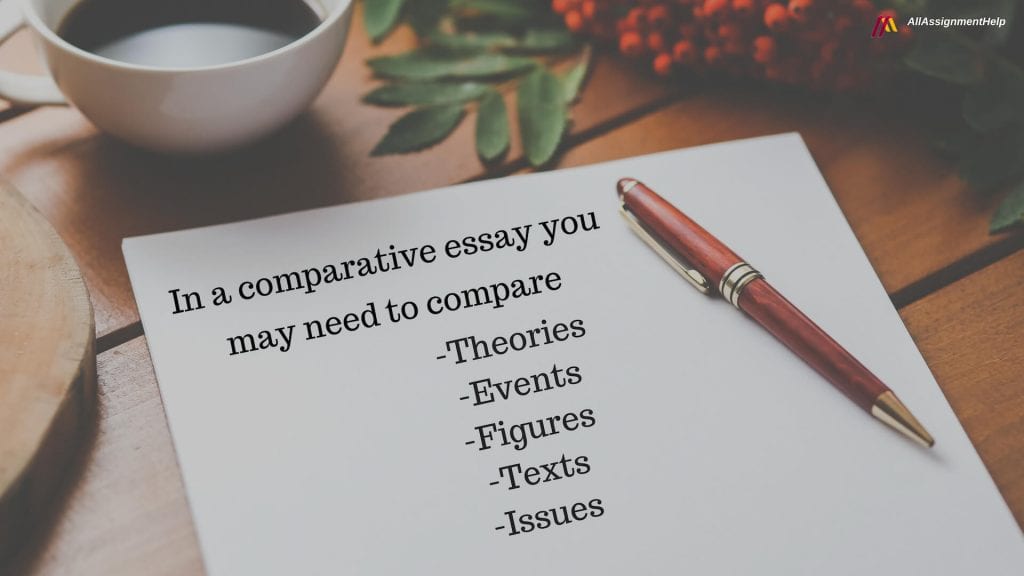
- Two books, theories, or historical events
- Different learning methods or technologies
- Concepts, ideas, or viewpoints
In a comparative essay, you:
- Examine key points of comparison
- Highlight both similarities and differences
- Present a clear argument or insight based on the comparison
Instead of simply listing features, a strong comparative essay explains why these similarities and differences matter and what they reveal about the subjects being compared, this is the core of a comparative essay definition.
Also Read: Top Human Resource Research Topics for Students
How to Write a Comparative Essay?
Before moving on to the steps for how to write a comparative essay, it’s important to understand a few key things first. Proper planning and early preparation can make the writing process much easier and help you complete your essay without stress. Curious to know what these are? Take a look at the points below.
If you find the comparative essay writing process difficult, you can also consider seeking online essay assignment help from professionals. Getting expert support can make things clearer and reduce your academic pressure.
Here is what you need to know:
1. Understand the meaning of a comparative essay
We have already discussed this, so you should have a basic idea by now. Still, here’s a quick recap.
- A comparative essay focuses on two or more subjects.
- Your job is to show how they are similar and how they are different.
- You may also need to raise questions and answer them to make your comparison clear.
- Before moving ahead, make sure you fully understand each subject you are comparing.
2. Have proper knowledge of the topic
This is very important. None of the tips will work if you don’t understand your topic well.
- Before you start writing, do proper research. Gather enough information to support and even question your points.
- Only then can you create a strong and clear comparison. Otherwise, your essay may feel weak or incomplete.
- A good writer is always well-informed about the topic.
This is how you can proceed with an effective and highly impactful comparative essay topic. You can also seek online assignment help to make the topic selection process easier and more efficient, and to gain a better understanding of comparative essays.
What is the Structure of a comparative essay?
A comparative essay follows a clear and organised structure so that readers can easily understand the similarities and differences between subjects.
1. Introduction
The introduction sets the stage for your essay.
- Introduce the subjects you are comparing
- Provide a little background (if needed)
- Present a clear thesis statement (your main idea)
Example: Online learning and traditional classroom learning are widely used today. While both aim to educate students, they differ in flexibility, cost, and interaction.
2. Body Paragraphs
This is the main part of your essay where you compare the subjects in detail. You can use two common structures:
a. Block Method (Subject-by-Subject)
- First, discuss all points about Subject A
- Then, discuss all points about Subject B
Example:
Paragraph 1: Online learning (flexibility, cost, interaction)
Paragraph 2: Traditional learning (flexibility, cost, interaction)
b. Point-by-Point Method
- Compare both subjects side by side for each point
Example:
Paragraph 1: Flexibility (online vs traditional)
Paragraph 2: Cost (online vs traditional)
Paragraph 3: Interaction (online vs traditional)
3. Conclusion
The conclusion wraps up your essay.
- Summarize the key similarities and differences
- Restate your thesis in a new way
- Share the final insight or outcome of your comparison
Example:
Both methods are useful, but online learning offers more flexibility, while traditional learning provides better interaction.
This is the basic structure of writing a comparative essay. However, it requires time, effort, and strong research skills. These tasks can be time-consuming and are often prone to errors if not handled carefully.
It becomes more difficult when students are already managing online courses and other responsibilities. With limited time, many feel stressed trying to balance everything. Some even consider skipping classes to complete assignments.
In such situations, students often look for support and think, “Can I pay someone to do my online class for me?” to manage their workload better and reduce stress. This is where online class help comes into the picture and assists students in handling their academic responsibilities more effectively.
Also Read: Blunders To be Kept at Arms Length While Writing an Essay
How to Choose the Topic for Your Comparative Essay?
Choosing the right topic is the first step to writing a strong comparative essay. A good topic makes your writing easier and more meaningful.
1. Pick Related Subjects
Choose topics that are connected in some way. They should belong to the same category.
Example: media censorship between China and Nepal.
2. Ensure There Are Similarities and Differences
Your topic should allow you to compare both similarities and differences clearly. Avoid topics that are too similar or completely unrelated.
3. Choose a Topic You Understand
Pick something you already have basic knowledge about. This will make research and writing easier.
4. Keep It Specific
Avoid very broad topics. Narrow it down so you can focus better.
Example: Instead of “education systems,” choose “online vs offline learning methods.”
5. Check Availability of Information
Make sure you can find enough reliable information on both subjects. This helps you build strong arguments.
6. Make It Interesting
Choose a topic that interests you. It will keep you engaged and improve your writing quality
A good comparative essay topic should be relevant, balanced, clear, and easy to research. Choosing wisely will make the rest of your essay much smoother. If you ever feel difficulty choosing a topic, getting essay writing services can help you find suitable ideas and guide you in the right direction.
Experts can suggest strong comparison topics, refine your focus, and help you understand what works best. This not only saves time but also improves the overall quality of your essay and boosts your confidence in writing.
Conclusion
Writing a comparative essay may seem challenging at first, but with the right approach, it becomes much easier to manage. Once you understand the purpose, choose a suitable topic, and follow a clear structure, you can present your ideas in a logical and impactful way. The key is to focus on meaningful comparisons rather than just listing differences and similarities.
With proper research, planning, and practice, you can improve your writing skills and create well-structured essays that score better academically. And if you ever feel stuck or short on time, seeking expert support can help you stay on track and complete your work without unnecessary stress
Frequently Asked Questions
| Question 1: Is a comparative essay difficult from other essays? Answer 1: Yes, comparative essays can be a bit difficult to write. Here, you might first have to understand two concepts and then process their differences, which is not an easy thing to do. |
| Question 2: What are the three steps to follow in a comparative essay? Answer 2: A comparative essay is not different from any other essay; here too, you have to follow three steps. The first step is the introduction; the second is the main body; and the last part is the conclusion. |
Connect the explanation to the work your course actually requires
Use this guide beside the exact brief, course material and marking criteria for How to Write a Comparative Essay.
- Identify the exact question or text.
- Use relevant evidence or quotations.
- Explain rather than only describe.
- Connect each paragraph to the central argument.
Sarah Mitchell
English · 4.9/5
English literature tutor whose established profile covers critical analysis, composition, creative writing, grammar and language arts. Master’s degree in English Literature
View established tutor profile ↗What students highlighted
The reviewer described receiving help when English literature homework became difficult and valued the academic and literary treatment.
Profile feedback · September 27, 2023 · 4.7/5The reviewer described a positive first English assignment experience and later returning to the service.
Profile feedback · August 17, 2023 · 4.8/5Find another explanation across the complete blog
This search uses WordPress itself, so it can reach articles beyond the 20 shown on the dashboard.
Connect How to Write a Comparative Essay to the task in front of you
Keep the brief, marking criteria, required evidence and submission format visible while you work.