
Table of Contents
Are you a teacher finding it difficult to keep your students engaged during online classes? Is keeping students focused and motivated in your online classes proving to be a challenge? Wondering how to engage students in online classes? Well, you are not the only one facing such difficulties, especially when you have just started your online teaching.
It can be difficult for online teachers and educators to maintain student engagement in online learning. In comparison with traditional classroom settings, online classrooms often present difficulties such as less engagement, distractions, and late feedback. On the other hand, successful learning and general success in online classes depend heavily on student engagement.
Here’s the exciting part! There are several ways to keep students engaged online, dynamic, and productive. This blog of All Assignment Help is created for online educators and instructors to help them know the 10 different ways and hacks to engage students in online classes.
What is Students’ Engagement in Online Classes?
Student engagement refers to the extent to which students participate in their educational activities and express satisfaction with their educational experience. The interaction might take many different forms. For example, students can actively listen, take notes, ask and answer questions, put effort into group or individual projects, and contact the instructor to request more assignments or resources.
It’s a waste of time for both the educator and students if there is no student engagement. It will make students irritated and tired, which might compel them to inquire online: Is there anyone who can take my online class for me?
Therefore, the primary goal is to increase student engagement in online learning to make online classes enjoyable, increase students’ interest in the subject matter, and provide them with motivation and enthusiasm.
Read Here: How To Maintain Focus During Online Classes?
How to Engage Students in Online Classes?
It is far more difficult to keep students engaged in online classes. They are inclined to often divert themselves and work on multiple assignments at once. This makes sense since it is harder to concentrate when all you see on the screen is an image. Also, it is normal for educators to modify their methods to accommodate the requirements and desires of each student. Considering this, we have compiled a list of multiple ways to keep students engaged online.
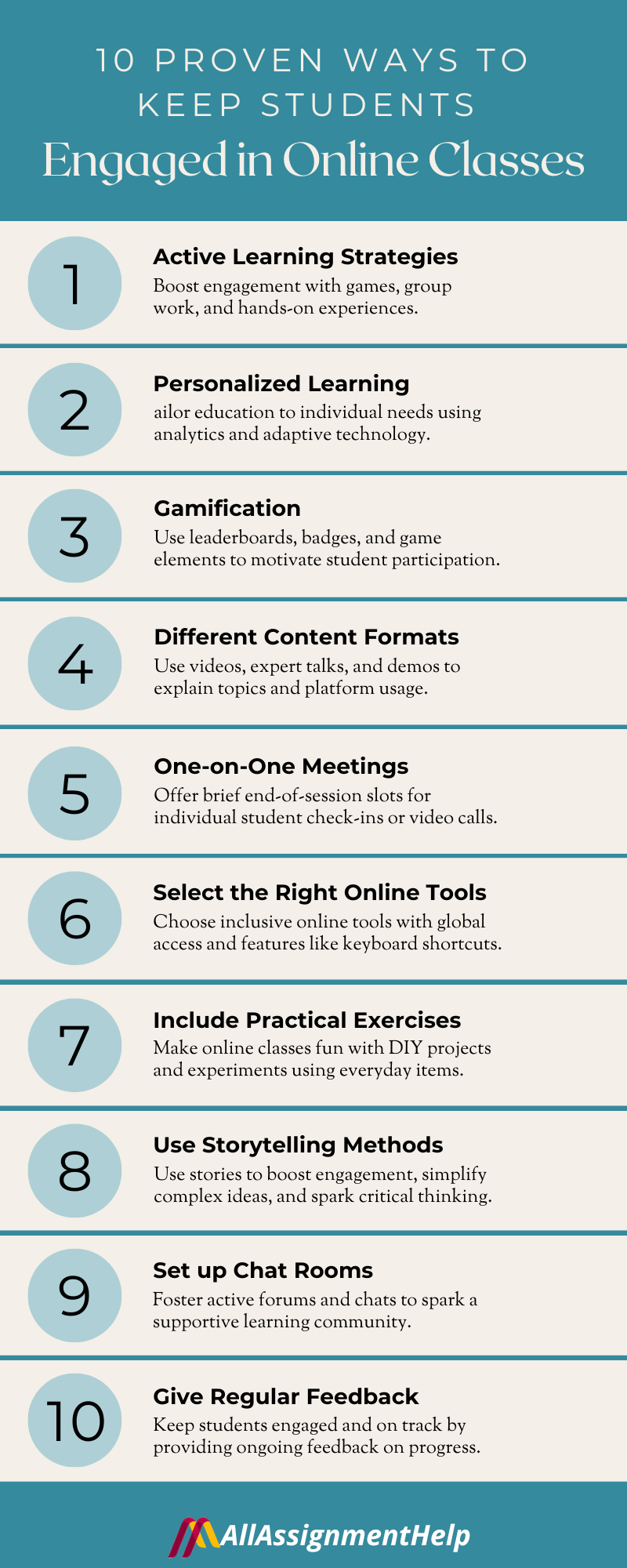
Lead with Active Learning Strategies
It’s important to use teaching strategies that focus on student engagement and encourage creativity. You might use the following active learning strategies in your lessons to maximize online student engagement:
- Active learning: It comprises methods that promote deeper learning and higher-level thinking skills in students, such as game play, discussion groups, problem-solving, case studies, etc.
- Collaborative learning: It is a method that brings multiple individuals together to enhance learning through collaboration. In this way, they can more easily remember information and learn new viewpoints when they work as a group to analyze and understand the concepts provided to them.
- Experiential learning: The method of learning by experience or action is known as experiential learning. Usually, this includes things like practical lab tests, fieldwork, studio performances, etc.
Personalized Learning
Personalized learning involves customizing the educational process to each student’s unique requirements and preferences. This can be achieved by utilizing learning analytics and adaptive learning technology. Online educators can use this to determine each student’s strengths and shortcomings and develop individualized lesson plans to assist students in reaching their learning objectives.
Personalized learning benefits students across all subjects, whether it’s an online accounting, biology, or English class. Also, online class help services support this by aligning with each student’s unique academic needs. Many students struggle to keep up with online lessons, and these services help bridge that gap. Whether you say take my online accounting class for me or help with biology or English, there are reputable platforms available to offer expert support for any subject.
Use Gamification for Student Engagement
Gamification is the process of motivating and engaging students outside of games by applying game design concepts. It is one way to make an online learning environment more dynamic and interesting. This could be accomplished by using leaderboards, badges, and other game features that encourage students to finish tasks and participate in the learning process.
Students who participate in gamified course activities feel more accomplished and make progress as they earn points during the semester. You could also display a leaderboard or chart to show students how they are doing in comparison to their classmates, which would make it more interesting.
Use Different Content Formats
Students will quickly get disinterested if there are only text-based presentations. The average attention span is now 8 seconds instead of 12. As a result, we advise utilizing graphics, movies, or music to maintain students’ interest and engagement. Images can be used for various interactive activities, such as associations, or they can be utilized as infographics. You could give brief explanations, listen to expert lectures on a particular topic, or utilize videos to teach students how to use platforms.
Furthermore, you can share these resources with your students after the classes. It is also good to include blog postings or expert papers. Your course material will become diverse, and students will be inspired to constantly seek out new perspectives and information sources.
Arrange One-on-One Meetings with Students
Student-teacher one-on-one sessions are important, particularly for students who are struggling and making less progress than others. This is another way you engage students in online classes. It will improve their understanding and undoubtedly boost their interest if you give them extra time and specific attention to help them understand the subjects they find difficult. Furthermore, one-on-one sessions are the ideal way to build a relationship with your students, something that is difficult to achieve in a traditional classroom setting.
Too busy for one-on-one sessions? Create short periods at the end of your sessions for students who would like to speak with you one-on-one or via video call. You shouldn’t fear that the rest of the class will suffer if you sometimes take ten minutes out of the lesson for these kinds of sessions.
Select the Right Online Tools
Using the right online tools relevant to the university or institutional department is another way to engage students in online classes. Additionally, it is especially important to make use of the online tools accessible to students in different time zones and global settings. Selecting tools with a range of accessibility options, such as closed captioning, text-to-speech, high contrast themes, bigger cursors, alternate text, and keyboard shortcuts, is the best way to keep students engaged.
Aside from this, interactive online classes are important for increasing students’ energy levels, which in turn promotes teamwork and enhances communication skills, and encourages students to stay involved and participate more in class.
Include Practical Exercises
Online classes can become more engaging and interesting by including practical activities such as do-it-yourself projects, experiments, and projects. These activities also add enjoyment and recollection to the learning process, along with improving theoretical knowledge. Hence, it is important to select activities that can be completed using everyday home objects to guarantee productivity. A few recommendations are as follows:
- The Use of Mathematics in Everyday Life: Start teaching mathematics to students using everyday objects. This will help them learn core concepts in a fun and engaging way. However, if you feel your efforts are falling short despite trying your best, you can suggest some reliable math assignment help services to support their learning
- Science Experiments: Some easy projects include mixing vinegar and baking soda to make a volcano, salt or sugar to create crystals, or oil, water, and food coloring to make a handmade lava lamp. These experiments provide students with a hands-on foundation for learning scientific concepts.
Use Storytelling Methods
Including storytelling in online classes can help students become more engaged and relevant. Students are drawn in by stories. Moreover, it can help them understand challenging concepts. This method encourages critical thinking, creativity, and an emotional bond with the subject matter at every academic level.
Moreover, educators can use video conferencing to conduct online storytelling sessions. In these sessions, they can read stories aloud, share screen presentations, and even invite outside storytellers to provide diversity to the narrative flow. Furthermore, educators can improve the pace and impact of learning at all grade levels by incorporating storytelling into both in-person and virtual classrooms.
Set up Chat Rooms and Communities
It is important to convey the idea that education takes place outside of the online classroom as well. Online educators can set up forums, communities, and chats to increase curiosity and conversation while creating a secure environment for queries. Also, they can include information previously covered and open-ended questions for surveys and conversations to keep the community active.
Besides, online educators can use different types of video systems that let users contribute comments like emojis, applause, thumbs up or down, and more. This response may be immediately displayed by students next to their faces. Also, it allows an educator to assess how well the subject is being understood.
Give Regular Feedback
When studying digitally, it becomes essential for students to understand what they are being taught, how they are approaching multiple instructional modalities, what questions they have, etc. Regular feedback is the only way to make all of this possible. By doing this, educators can guarantee that students will participate in online learning, stay on track, and be sufficiently prepared for the next task.
Apart from this, giving regular feedback helps students in understanding where they are lagging so that they can work on it while exams are closer. Otherwise, they just go on the Internet and type, is there any way I can hire someone to take my online exam for me? However, taking additional assistance from an expert is a good idea, but if they get regular feedback from the educator, they can know where to put more effort and attention while studying.
Also Read: Countering the Never-Ending Challenges with Online Class Help Service
Conclusion
Starting an online class is one thing, but maintaining interest in it is quite another. Online classes present unique challenges for educators. However, with the help of the strategies covered above, they can engage students in an online class. These strategies enable them to guarantee not only full student participation in online classes but also provide multiple chances for improved learning and social interaction.
However, if any student faces difficulties with their online classes, they can turn to us for complete online class help. We provide all-in-one support, including online assignment help, to ensure students complete their assignments on time and stay on track with their online coursework
Frequently Asked Questions
What are the 4Cs of student engagement?
The 4 Cs of student engagement are critical thinking, creativity, communication, and collaboration. They have been and will be essential as educators work to set up students for success in the future.
How to greet students in online classrooms?
Create a friendly, inclusive, and engaging atmosphere to greet students in online classes. Begin by offering a warm welcome, introducing yourself, and summarizing the course’s objectives. Set clear expectations, promote involvement, and let them know you are here to help.
How to make online learning more engaging using the internet?
Use the internet to access interactive resources such as discussion boards, instructional videos, quizzes, and virtual whiteboards to improve the interactive nature of learning via the internet. Incorporate multimedia resources, live polls, and breakout rooms to encourage participation.