Table of Contents
There are many developments occurring in the education sector now than in the past. Nowadays, AI in the Classroom is establishing itself as a game-changer in this dynamic educational environment. It has transformed how students interact with each other and learn from educational resources.
As technology evolves, educators are actively researching how to integrate Artificial intelligence in the classroom to improve instruction and learning, creating personalized, effective, and welcoming learning environments for students. This blog of All Assignment Help will discuss how to introduce AI in education to enhance interactive learning and student engagement.
Understanding AI in the Classroom
AI in the classroom refers to the practice of integrating and using AI technology in the classroom to improve teaching and student learning. This diverse strategy makes use of AI technologies and algorithms to automate administrative tasks, give adaptive feedback, assess and analyze student data, and customize instructional materials.
Examples of AI in education for students include text-to-speech platforms, flashcard software, and grammar checkers. On the other hand, automatic grading systems, lecture transcribing platforms, and plagiarism detection software are a few examples of AI in teaching for professors.
Furthermore, AI is revolutionizing student engagement in online classes by providing real-time feedback, individualized learning experiences, and interactive tools like chatbots and virtual instructors. These AI-powered systems accommodate different learning styles and paces, which helps maintain student engagement and enhance learning outcomes. Additionally, online class help services can further enhance this experience by providing expert guidance, timely assistance, and flexible learning support.
Read Here: Tips To Leverage AI For Scoring Top Grades
Benefits of Using AI in the Classroom
Artificial intelligence is already improving education, so it’s no longer simply a distant goal for the future. By incorporating AI into the classroom, teachers can better help students, streamline administrative duties, and customize learning experiences. The following are a few benefits of incorporating AI in education and in the classroom to improve student engagement:
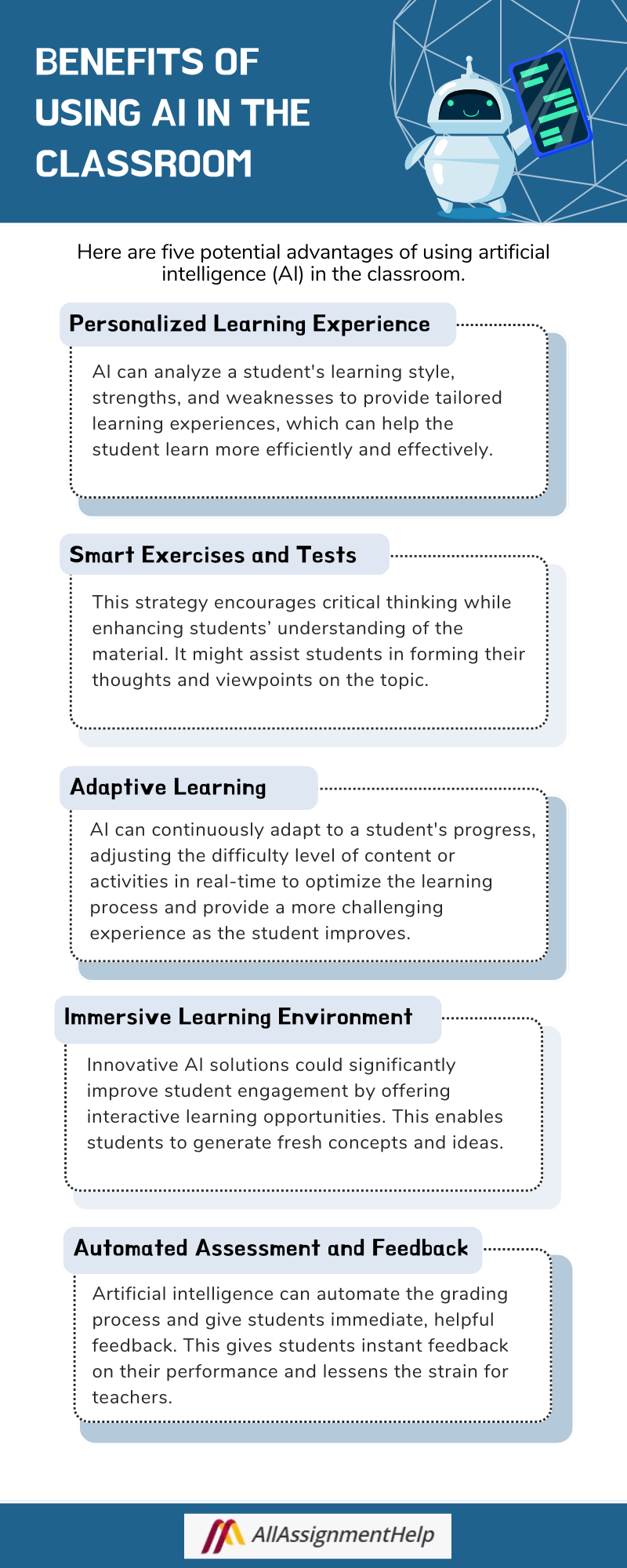
Smart Exercises and Tests
Sometimes, students become disinterested in solving the same problems and questions for weeks and months, which makes them get online assignment help to do the task on their behalf. This is where there are benefits of implementing Artificial intelligence in the classroom, particularly in terms of maintaining student interest.
For example, teachers can design a task in which students read amusing AI-generated course material. They should be instructed to look for mistakes and inconsistencies in the data.
This strategy encourages critical thinking while enhancing students’ understanding of the material. Additionally, it might assist students in forming their thoughts and viewpoints on the topic.
Interactive and Immersive Learning Environment
Innovative AI solutions could significantly improve student engagement by offering interactive learning opportunities. Moreover, AI for student engagement could be improved for better outcomes by introducing additional multimedia components such as virtual reality (VR) and augmented reality (AR) to make learning more engaging.
For example, take a history-minded student who wants to learn about certain historical occurrences. Here, AI and VR can be used to assist students in exploring museums and even virtual representations of these historical locations.
Also, students will be able to generate fresh concepts and ideas during these interactive learning sessions without being restricted by geographical location.
Providing Automated Assessment and Feedback
Artificial intelligence can automate the grading process and give students immediate, helpful feedback. This gives students instant feedback on their performance and lessens the strain for teachers.
For example, if a student is weak in math, the teacher can provide them with instant feedback and share the area where they lack. Also, students can make an extra effort in improving their weak areas by hiring a math assignment help expert online.
Besides, universities are using AI to make grading easier for teachers. These platforms can autonomously grade exams, even handwritten assignments, using machine learning algorithms.
AI-Powered Platforms for Adaptive Learning
Adaptive learning platforms have become popular tools for raising student engagement. The size of the worldwide adaptive learning market is projected to grow from its 2023 valuation of USD 3,083.33 million to an astounding USD 14,114.58 million by 2030. These figures highlight how important adaptive learning systems will be when it comes to how education develops in the future
Moreover, these AI-powered learning systems can flexibly modify the speed and level of difficulty of classes depending on a student’s success.
The system could provide more difficult content to students who are performing well, but it can also give failing students extra practice and guidance. This adaptability keeps students interested by avoiding monotony.
Personalized Learning Experience
Personalized learning experiences are one of the major advantages of using AI in the classroom. AI systems can identify a student’s strengths and weaknesses via assessing their performance, and then develop instructional strategies tailored to meet their requirements.
AI-powered algorithms can suggest relevant and intriguing learning resources based on a student’s performance, learning preferences, and interests. These recommendations can involve articles, videos, games, and other forms of multimedia that encourage better and more joyful learning.
AI is removing roadblocks in education through the use of technologies that accommodate students with unique needs and learning preferences. It has the potential to revolutionize education and open the way for more efficient and individualized learning in the future.
How AI Improves Student Engagement?
Achieving excellent academic performance depends on student engagement. Hence, artificial intelligence (AI) in education provides creative methods to engage students and enrich their learning experiences. Here is how AI improves student engagement:
Smart Tutoring Systems
AI is used by intelligent tutoring systems to provide students with individualized guidance and feedback. These systems provide tailored support and clarifications according to each student’s particular requirements by imitating one-on-one conversations with a teacher. This makes them aware of where they need to put more focus while preparing for the next exam or whether they need to hire an expert whom they can ask, can you take my online exam for me? to improve their overall academic performance.
Gamification and AI
AI could serve as a key component of gamification, a very successful tactic for increasing student engagement. AI could motivate students to actively participate in classroom assignments by incorporating game-like aspects, such as leaderboards, challenges, and prizes, into educational activities. As a result, gamification increases student engagement, creates a sense of competitiveness and accomplishment, and motivates them to do well.
Improved Accessibility
AI-powered assistive technology ensures a more productive learning environment for students with disabilities. AI-powered educational games provide young children individualized learning experiences, while speech recognition software such as Notta converts spoken words into text for students with hearing impairments.
Removing Language Barriers
It might be difficult to develop curricula and course materials that are accessible to students all around the world. Furthermore, the problem gets worse when it comes to teaching students in real time. AI can solve these problems with improved translation and live captioning. The ability to create live captions while on the phone has already been added to regular tools. This can help educational institutions reach a larger audience during a live online lesson and enhance learning standards in different locations.
Challenges and Ethical Considerations Before Using AI in the Classroom
Even though AI has the potential to revolutionize education and create student engagement, there are several challenges and ethical considerations that need to be tackled:
- Data privacy: A lot of data is needed for AI to work efficiently. When artificial intelligence is used in education, the data contains personal information about the students, including their academic histories, learning preferences, and styles. Hence, assuring the ethical collection and use of data is important.
- Algorithm biases in AI: AI algorithms can reinforce biases depending on the facts they receive instruction on. It will influence student learning suggestions and be reflected in the algorithm’s decision-making process. Hence, teachers need to be conscious of these biases and take preventative measures to reduce them by routinely checking out and keeping an eye on AI systems.
- Problems with accessibility: There might be accessibility problems for students with disabilities if AI-powered devices and platforms are not created with all students in mind. It is important to take accessibility into account from the very beginning of development and make sure AI is utilized inclusively to provide every learner an equal chance.
Nowadays, online assignment help services play an important role in minimizing academic challenges, even though it is related to using AI in education. Students from all academic areas can easily access these services when they are in need of nursing assignment help, accounting assignment help, English assignment help, or any other. These services offer personalized support, quick feedback, and tailored learning resources that align with each student’s academic needs.
The Future of AI in the Classroom
Artificial intelligence in education is here to stay. Its use in classrooms and schools is only going to increase. Therefore, it is best to embrace it as soon as possible.
Although we are unable to anticipate with precision how artificial intelligence will advance in education, we can draw some conclusions from its current use. As AI technology advances, its current applications will be improved and made more precise.
We already have the technology that allows AI-powered apps to remotely control devices like lights, alarms, and temperature. The implementation of this technology in educational institutions can make facilities safer for students and easier for the administration to maintain.
Also Read: How AI Can Boost Your Career Prospects
Conclusion
AI in the classroom is a game-changing technology that could completely transform the way students learn and be educated. Teachers can enhance student academic performance by using AI to build individualized, interesting, and productive learning environments. Moreover, AI has a great deal of promise to improve student engagement, despite certain challenges. However, as Artificial intelligence in the classroom advances, educators must collaborate to utilize AI ethically and responsibly.
FAQs
Is AI helpful or harmful to education?
AI can significantly enhance education by streamlining administrative tasks and customizing instruction. But it also brings up concerns regarding equality and data privacy. AI can be used to its full potential while tackling these problems if it is used thoughtfully and ethically.
How can AI identify student engagement to change classrooms?
AI analyzes performance, keeps track of enthusiasm, and generates ideal challenges. Engaging technologies include individualized gamification, emotion recognition, and instant feedback. Implementing ethics requires preserving human instructor direction, preventing bias, and providing strong privacy protection.
How can AI facilitate students’ brainstorming power?
AI can assist students in coming up with more ideas if they are having trouble brainstorming. AI can serve as a thinking companion by offering feedback to a fellow student who excels at brainstorming but needs assistance polishing their work.