Table of Contents
Nowadays, students are more tech-savvy than ever before because they are using technology in every aspect of their lives. They have similar expectations for their educational pursuits, which is understandable. Although traditional classroom models remain important, there are other ways to learn. This change can be seen by the increase in self-paced online courses that allow students to study at their own pace and on their schedules after COVID-19. But how can we make sure these educational opportunities continue to be effective, tailored, and engaging? Artificial Intelligence in the classroom is the solution.
Education is being revolutionised by artificial intelligence (AI), which offers opportunities for more customised instruction, improved administrative efficiency, and better results. From intelligent teaching systems to AI-powered classroom management, AI has a wide range of applications. This blog by AllAssignmentHelp explores the benefits of AI in the classroom. Stay till the end to learn more.
What is Artificial Intelligence?
Before we understand how AI is important in the classroom, it’s better to know what Artificial Intelligence is and how it has developed.
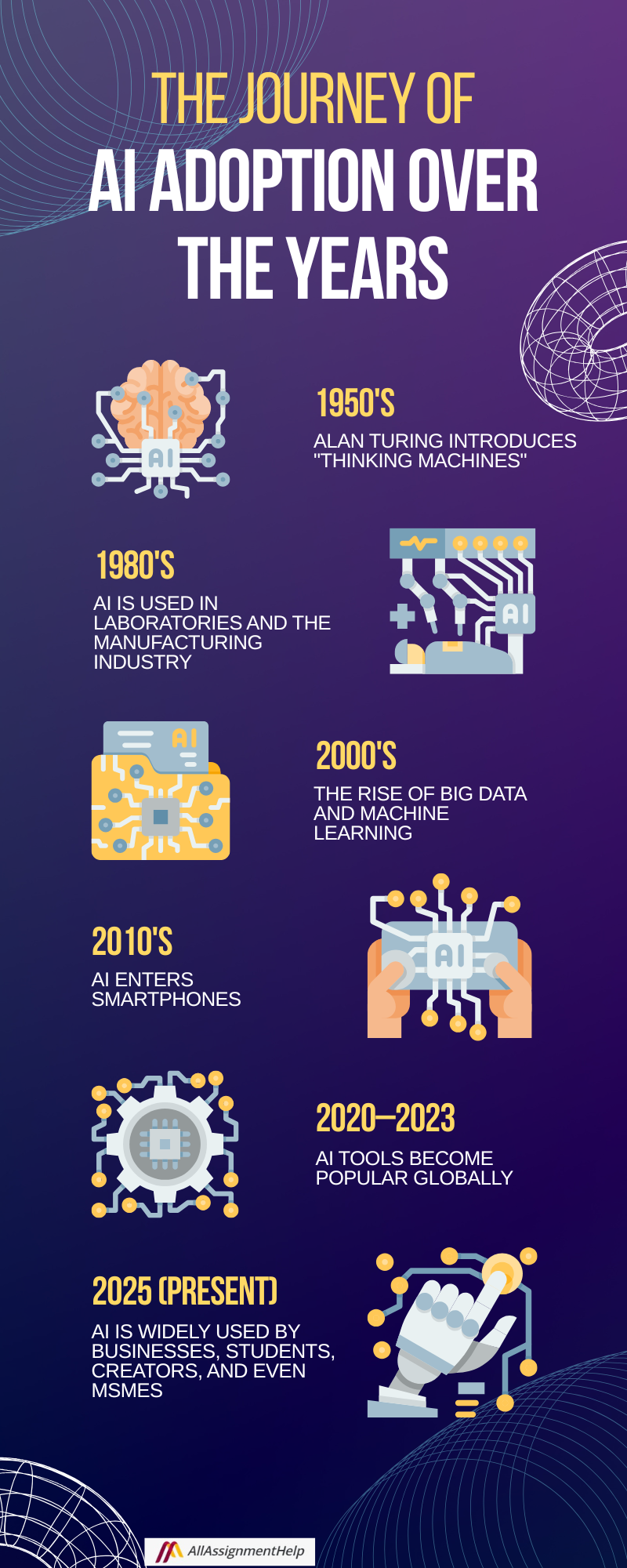
Artificial intelligence (AI) means making computers or robots smart enough to do things that people usually do. This includes learning, understanding, thinking, and making decisions. AI helps machines see what’s around them, understand what’s happening, and do tasks on their own to reach a goal.
However, students are advised not to overly rely on AI, especially for assignment writing, as it can hinder their creative thinking. Moreover, teachers often do not accept AI-generated assignments. Instead, using online assignment help services is a better option, as they provide only human-written content.
Read More: Commemorative Speech Topics-2025
How AI In The Classroom Can Improve Student Engagement?
Today, Artificial intelligence is actively improving education; it is no longer merely a futuristic promise. Teachers can extend student support, control administrative duties, and customise learning experiences by introducing AI in the classroom.
Below are the other advantages of using AI in the classroom:
Learning Opportunities According to Your Needs
Personalised learning experiences are one of the main advantages of AI in education. AI can discover unique learning styles, strengths, and weaknesses by evaluating student data, enabling teachers to modify their lessons to fit the needs of each individual student. Better academic results follow from this individualised approach, which enhances student involvement and comprehension. For instance, AI algorithms are used by adaptive learning platforms to ease assignment difficulty and offer feedback based on each student’s development. This way, students can experience customised education.
You May Get Immediate Feedback
Delays in responses sometimes demotivate students. But in an AI classroom, you won’t have to face the delay in feedback or responses. Chatbots and virtual assistants driven by AI may give students prompt feedback and assistance, which keeps them motivated and involved. These virtual assistants can provide extra resources, respond to enquiries, and help students navigate the course content, resulting in a customised and engaging educational experience. Students’ learning experiences are improved when they receive immediate feedback, which enables them to recognise and quickly fix their errors.
Administrative Procedures That Are Simplified
Additionally, AI plays an important role in helping educational institutions streamline their administrative processes. It automates scheduling and grading and assists with admissions and enrolment management. Consequently, AI frees up educators and administrators to concentrate more on instructing and assisting students. This efficiency frees up vital time and resources, which not only improves the operational aspects of education but also leads to improved learning results.
Adaptive Education Technologies
AI-driven adaptive learning tools examine student performance information to tailor the educational process. These systems make sure that students are properly challenged and receive support when they need it by dynamically modifying the curriculum and tempo of instruction based on each student’s progress. Thus, adaptive learning increases student motivation and agency, which boosts engagement and produces better results.
Read More: The Ethics of Using AI for Homework and Assignments
Working Together to Learn
AI can help students learn collaboratively by matching them with classmates who have similar interests or learning objectives. In the classroom, AI can improve student engagement and build a feeling of community by encouraging cooperation and interaction. Students who use this collaborative approach feel more engaged and inspired to take an active role in their education.
Improving Creativity and Reducing Stress
Since gamification and artificial intelligence (AI) create a more comfortable and interesting learning environment, they help lessen the stress that comes with traditional teaching approaches. With this method, students can freely express themselves, which encourages motivation and creativity.
Apart from that, there are other services that help students reduce their stress. For example, if you’re feeling stressed about online exams because it’s new to you and you’re not very tech-savvy, you can approach experts on online class help sites and say, Please take my online exam for me. These experts not only take the exam on your behalf but also guarantee that you’ll pass with flying colours. Similarly, you can rely on experts for your online classes, or you can ask them to take your online classes for you.
Intelligent Systems for Tutoring
Also, intelligent tutoring systems use AI to give students individualised advice and feedback. By providing individualised support and clarifications according to each student’s particular requirements, these systems mimic one-on-one conversations with an instructor. Intelligent tutoring systems improve learning gaps and increase student engagement by offering prompt assistance and encouraging deeper comprehension.
Improved Classroom Management
Teachers can better control classroom participation and behaviour with the aid of AI tools. Classcraft, for instance, gamifies classroom management with AI by monitoring student behaviour and rewarding good behaviour, hence preserving a motivated and productive learning environment.
Improved Security and Integrity of Assessment
AI improves assessment security and integrity by detecting plagiarism and providing sophisticated proctoring. Exam circumstances are monitored by AI-supported proctoring systems to stop cheating, and tools verify that student responses are original.
Also, you can visit sites from where you can get a free plagiarism report. Some academic writing platforms not only provide custom-written assignments but also include a complimentary plagiarism check report to ensure originality. This helps students submit work that is both authentic and academically sound.
Environments for Interactive Learning
The development of immersive and interactive learning environments that hold students’ interest is another benefit of AI. With the help of artificial intelligence (AI), virtual reality (VR) and augmented reality (AR) technologies give students can gain practical experiences that enhance and enrich their learning. For instance, students can engage with 3D models, perform virtual science experiments, and visit historical locations in an AI-driven learning environment.
AI is transforming classrooms by making education more accessible, interactive, and tailored to individual learning needs. However, for tasks that still require human expertise, like solving complex problems or writing detailed assignments, students can turn to academic support services. Whether you need programming assignment help for a tough coding task or statistics assignment help to understand complicated data sets, professional services are available to guide you and ensure academic success.
What Are The Challenges In an AI-driven classroom?
While there are many ways that AI might enhance student engagement and results, there are drawbacks as well that institutions and educators need to be aware of. Successful AI integration in education requires an understanding of these prospects and difficulties.
Ethics and Data Privacy
However, when incorporating AI into education, ethical and data privacy issues are crucial. Since AI systems depend on gathering and evaluating student data, it is essential to guarantee the privacy and security of this data. Therefore, in order to foster confidence and preserve the integrity of AI applications, educational institutions need to set up strong data protection procedures and follow privacy laws.
Need For Training and Assistance for Teachers
Furthermore, sufficient training and assistance for educators are necessary for the effective integration of AI in education. To effectively use AI tools and incorporate them into their teaching practices, educators need to be prepared with the necessary skills and expertise. Therefore, to enable educators to fully utilise AI, professional development initiatives and continuous assistance are crucial.
Reluctance for Change
Finally, an obstacle to the use of AI in education may be resistance to change. Teachers and administrators may be reluctant to adopt new technology because they are inexperienced with AI systems, worry about their job security, or feel that their pedagogical autonomy will be altered. To overcome reluctance and promote an innovative culture, it can be helpful to communicate, include everyone, and show the advantages of AI.
Read More: Reasons Not To Use AI-Generated Content For Assignment Writing
Conclusion
The use of AI in the classroom increases the chances of completely changing the way that students used to learn. Teachers may improve student performance by using AI to build individualised, interesting, and productive learning environments. AI can improve student engagement, despite certain obstacles like data privacy and ethics. To deploy AI in education responsibly and ethically, it is critical that educators, legislators, and technology companies collaborate. This will help guarantee that every student gains something from it and is ready to succeed in a world that is becoming more and more digital.
FAQs
Q1: How does AI make learning more interactive?
AI incorporates gamification, AR and VR in learning to make it more engaging and interactive.
Q2: Can AI help in monitoring online exams?
Yes, AI-powered proctoring tools monitor exams in real-time and detect suspicious behaviour, helping maintain academic integrity.
Q.3. How can AI improve student involvement?
AI can give quick responses through its chatbots, which highly motivates the students and increases their productivity.
Q.4. Do assignment help services provide plagiarism-free content?
Yes, most reputable services provide human-written content along with a free plagiarism report to ensure originality and academic integrity.