Table of Contents
Excellent writing often reflects intelligence, creativity, and strong communication skills. But how does intelligence affect writing? Intelligence plays a major role in shaping the quality of writing, from building strong arguments to creating engaging and meaningful content.
Different forms of intelligence, such as linguistic, emotional, and logical intelligence, can improve clarity, creativity, and expression in writing. However, intelligence alone is not enough. Practice, experience, and creativity are equally important in becoming a great writer. In this blog by All Assignment Help, we will explore how intelligence affects writing and discuss the key factors that contribute to effective and impactful content.
What is Intelligence?
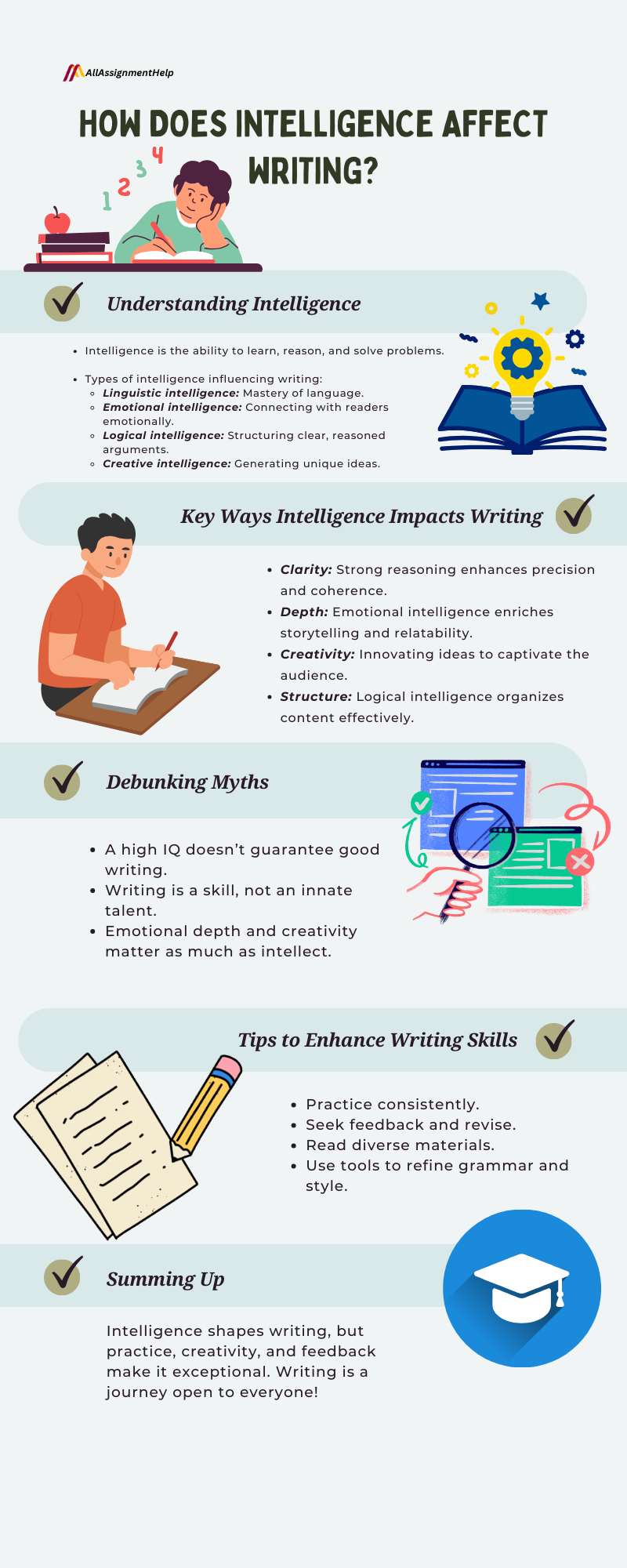
When it comes to intelligence, it is not simply a matter of IQ points or grades. It includes learning, reasoning, problem-solving, and adaptability. Moreover, more than one classification of intelligence exists in psychology. For instance:
- Linguistic intelligence: The ability to use language well, in writing and in speech, for comprehension.
- Logical-mathematical intelligence: The ability to think logically and solve problems.
- Emotional intelligence: Learn how to understand and manage emotions to start connecting with others better than you do now.
- Creative intelligence: Capacity for original ideas and imagination.
These varieties of intelligence play a role in the way a person writes influencing style, structure, tone, and level of depth.
Also read: How Foreign Education Affects the Economy of the USA
What is the Connection Between Intelligence and Writing
The connection between intelligence and writing is stronger than many people think. Writing is not just about grammar or vocabulary. It reflects how a person thinks, organizes ideas, analyzes information, and communicates with others. Strong writing often combines intelligence, creativity, and communication skills.
Intelligence affects writing and helps writers express ideas clearly, create logical arguments, and connect with readers emotionally. People with strong linguistic and logical intelligence can explain complex topics in a simple and engaging way.
How Intelligence Improves Writing
- Better vocabulary and sentence structure
- Clear explanation of ideas
- Strong critical thinking skills
- More creativity and originality
- Better emotional connection with readers
- Smooth and logical content flow
Good writing also depends on practice, reading habits, and experience. Even intelligent writers improve over time through regular learning and writing practice. A balance of intelligence, creativity, and consistency helps create powerful and engaging content.
Does High Intelligence Guarantee Good Writing?
No, high intelligence does not always guarantee good writing. Intelligence can help a person think critically, understand complex ideas, and organize information effectively. However, writing is a skill that also depends on practice, creativity, communication style, and experience.
Many intelligent people struggle to explain their thoughts clearly because effective writing requires simplicity, clarity, and reader engagement. On the other hand, a person with average intelligence but strong writing practice can become an excellent writer over time.
Why Intelligence Alone Is Not Enough
- Writing requires regular practice
- Creativity plays a major role
- Communication skills improve readability
- Reading habits help develop writing style
- Emotional connection is important for engagement
Great writing comes from a balance of intelligence, creativity, and continuous improvement. Students who struggle with academic writing often seek assignment help online to better understand writing structure, research methods, and content organization. With proper guidance and consistent practice, anyone can improve their writing skills over time.
Also read: Effective Ways to Close the Achievement Gap
How Does Intelligence Influence Different Writing Styles?
Different writing styles reflect different types of intelligence and communication abilities. Every form of writing requires a unique combination of creativity, logic, emotional understanding, and language skills. Here is how intelligence influences different writing styles:
Academic Writing
Academic writing mainly depends on logical and linguistic intelligence. Logical thinking helps writers organize arguments, analyze information, and present conclusions clearly. Linguistic intelligence improves grammar, sentence structure, and clarity, which are essential for academic success.
Academic writing also requires originality, critical thinking, and professionalism. Students often seek essay assignment help to better understand research methods, citation styles, and structured academic writing techniques.
Creative Writing
Creative writing is strongly connected with creative and emotional intelligence. It helps writers develop unique ideas, engaging stories, and imaginative characters. Emotional intelligence allows writers to create deep emotional connections with readers through realistic feelings and experiences.
Writers in this field use creativity to build immersive worlds and make readers emotionally invested in the story. Strong storytelling skills help make creative content more engaging and memorable.
Professional Writing
Professional writing combines linguistic and interpersonal intelligence. Business reports, emails, proposals, and official communication require clear, concise, and persuasive language. Writers must understand their audience and adjust their tone based on the purpose of the content.
This type of writing focuses on professionalism, accuracy, and effective communication, making intelligence an important factor in delivering impactful messages.
Technical Writing
Technical writing mainly relies on logical and analytical intelligence. Writers must explain complex information in a simple and organized manner so readers can easily understand instructions, guides, or technical processes.
Precision, clarity, and structure are extremely important in technical writing. The ability to simplify difficult concepts makes this writing style highly valuable in professional industries.
Personal or Reflective Writing
Reflective writing is closely linked with emotional and interpersonal intelligence. This style allows writers to express personal thoughts, experiences, and emotions while connecting them with broader ideas or life lessons.
Students working on self-analysis or experience-based papers often look for reflective essay assignment support to improve clarity, structure, and personal expression in their writing.
Overall, every writing style is influenced by different forms of intelligence. However, great writing is created through a balance of intelligence, creativity, practice, and communication skills.
Tips to Enhance Writing Skills Irrespective of Intelligence
Although having a high IQ may help facilitate the process of writing well, everyone can write beautifully with the right approach and practice. These tips will help you develop your writing apart from your producing skills:
- Practice regularly: Write for practice, to improve fluency, and to fine-tune your style.
- Read more: Read a variety of genres covered by different authors. This will help you expand your vocabulary and learn various writing techniques.
- Get peer review: Show it to peers or mentors and take constructive feedback to further improve.
- Proofread your work: Go through drafts to correct mistakes, increase clarity, and guarantee flow.
- Study examples: Find some good writing and think about why it is so successful and how you can do the same
- Focus on your audience: Be mindful of what your readers want to see and sound and look accordingly.
- Develop emotional intelligence: Cultivating empathy is key to being able to connect with your audience and write engaging stories.
- Try different styles: Test out different forms and genres of writing to discover what works for you and develop range.
- Use writing tools: Use tools such as grammar checkers and style guides to refine your writing.
- Stay persistent: Keep writing, it is a learning process, and you still have a long way to go.
In addition to this, if you urgently need assistance in writing, it is advised to hire expert assignment writers to obtain advanced quality writing without any hassle.
Common Misconceptions About Intelligence and Writing
There is a strange reader-writer gap regarding the link between writing and intelligence with many myths being created in the process. Let us bust these myths.
Myth 1: Writing is only for the genius
It is widely assumed that great writing needs a great brain. The truth is that writing is a skill that anyone can master with enough practice, discipline, and constructive criticism, no matter how high the IQ is.
Myth 2: If you are smart, you are a good writer
Intelligence helps you make sense of ideas and sequence them. However, creativity, emotional awareness, and audience perspective enable you to write well, all of which have no relation to intelligence.
Myth 3: Writing is an easier task for high-IQ writers
Perhaps intelligence is part of the puzzle, but even the most brilliant writers will continue needing to practice their craft and continue developing their craft. Writing is a skill that develops over time and is sharpened with consistent practice.
Myth 4: The logical thinkers cannot be creative writers
Creativity is generally perceived as being at odds with logical intelligence. But a logical thinker can learn to balance logic and creativity to construct creative, compelling stories.
Myth 5: Emotional intelligence does not matter in writing
Some people assume writing is technical and they can skip the emotion. What real content creation really comes down to is emotional intelligence, the ability to connect the reader with content to craft great and meaningful pieces.
If writers take note of these misperceptions, they can concentrate on cultivating the various talents and traits that make a great writer, not just smart.
How Can Students Manage Online Classes Along with Writing Tasks?
Managing online classes and writing assignments together can be stressful for many students. Attending lectures, completing quizzes, and finishing writing tasks at the same time often becomes overwhelming.
Different types of intelligence help students handle this pressure more effectively:
- Logical intelligence helps students organize schedules and manage deadlines.
- Linguistic intelligence supports better essay and assignment writing.
- Emotional intelligence helps students recognize stress and look for practical solutions.
- Time management skills help students balance classes, assignments, and personal responsibilities.
However, even students with strong intelligence and academic skills can struggle when multiple deadlines, personal commitments, and constant online coursework become difficult to manage. In such situations, emotional and practical intelligence also involve recognizing when additional support is needed.
That is why some students search for solutions like, “Who can take my online class for me?” Reliable online class help services can reduce academic pressure, help students manage their workload more effectively, and allow them to focus better on important writing tasks while still meeting deadlines successfully.
Conclusion
While writing, intelligence affects writing, it still has roots in how we think, create, and communicate ideas. Still, that is not the only reason that makes you a good writer. Although language, logic, emotion, and creativity do play a role in different writing styles, so do practice, perseverance, and critique in perfecting the craft. Anyone can become a better writer, not because writing equals intelligence but because writing is a skill. Through welcoming growth, drawing inspiration from our peers and pushing our boundaries, we become better writers and deliver more impactful stories to our readership.
Frequently Asked Questions
How does intelligence help students manage online classes?
Different types of intelligence help students manage schedules, complete assignments, and handle academic stress more effectively.
Can writing skills improve without high intelligence?
Yes, writing improves through practice, reading, feedback, and regular learning, not just intelligence alone.
Why do students seek online class help?
Students often seek help when they struggle to balance online classes, writing tasks, and personal responsibilities together.
Which intelligence is important for academic writing?
Logical and linguistic intelligence are important because they improve clarity, research, grammar, and argument structure.
Does emotional intelligence improve writing?
Yes, emotional intelligence helps writers connect with readers and manage academic stress more effectively.
{ “@context”: “https://schema.org”, “@type”: “FAQPage”, “mainEntity”: [ { “@type”: “Question”, “name”: “How does intelligence help students manage online classes?”, “acceptedAnswer”: { “@type”: “Answer”, “text”: “Different types of intelligence help students manage schedules, complete assignments, and handle academic stress more effectively.” } }, { “@type”: “Question”, “name”: “Can writing skills improve without high intelligence?”, “acceptedAnswer”: { “@type”: “Answer”, “text”: “Yes, writing improves through practice, reading, feedback, and regular learning, not just intelligence alone.” } }, { “@type”: “Question”, “name”: “Why do students seek online class help?”, “acceptedAnswer”: { “@type”: “Answer”, “text”: “Students often seek help when they struggle to balance online classes, writing tasks, and personal responsibilities together.” } }, { “@type”: “Question”, “name”: “Which intelligence is important for academic writing?”, “acceptedAnswer”: { “@type”: “Answer”, “text”: “Logical and linguistic intelligence are important because they improve clarity, research, grammar, and argument structure.” } }, { “@type”: “Question”, “name”: “Does emotional intelligence improve writing?”, “acceptedAnswer”: { “@type”: “Answer”, “text”: “Yes, emotional intelligence helps writers connect with readers and manage academic stress more effectively.” } } ] }