How Applications of Mathematics Work in AI and ML
What this article will help you understand
Mathematics is an important subject in academics. All of us might have studied math at some point in our educational careers. But do you know that mathematics even plays a crucial role in machine learning and artificial intelligence applications? The cutting-edge technologies we all see in our daily lives are the foundation of AI and
What are you trying to do with this topic?
Choose the closest task and the page will point you towards a useful next step.
Start with the central concept and the terminology used in the article.
Open the closest route ↗Connect the explanation to the question, learning outcomes and marking criteria.
Open the closest route ↗Review evidence, structure, referencing and the exact submission requirements.
Open the closest route ↗Do you have enough information to begin?
Select what you already have. Nothing is submitted from this checklist.
When these details are together, the requirement can be reviewed in context.
Math Assignment Help ↗Table of Contents
Mathematics is an important subject in academics. All of us might have studied math at some point in our educational careers. But do you know that mathematics even plays a crucial role in machine learning and artificial intelligence applications? The cutting-edge technologies we all see in our daily lives are the foundation of AI and ML. The application of mathematics plays a silent role in everything that is easily accessible to us. The complex network of mathematical concepts highly impacts our daily lives.
Tech giants use many real-life applications of mathematics to personalize our user experience. From predicting disease outbreaks to self-driving cars, the applications of mathematics in real life are deeply embedded in AI and ML systems. It is not that only students from data science and engineering backgrounds can explore the applications of mathematics in AI and ML. With this blog post from All Assignment Help, anyone can now know the role of mathematics, machine learning, and AI.
Real-Life Applications of Mathematics in Major Industries
Mathematics applies to artificial intelligence in many ways. It helps in solving problems and predicting the future. It won’t be wrong to say that math is the backbone of AI and ML. We can see many examples of the practical applications of mathematics in our daily lives. The applications are literally everywhere in different industries and have had practical impacts on society and business.
Here are some examples of industries that use applications of mathematics in real life.
- Healthcare and Medical Diagnosis
- Finance and Risk Management
- Signal Processing in Radar and Communication
- Drug Discovery with Optimization Models
- Algorithmic Trading
- Self-Driving Cars and Autonomous Systems
- Natural Language Processing (NLP)
- Customer Behavior Modeling
- Robotics and Automation
- Dynamic Pricing Strategies
- Flight trajectory planning
- Marketing and Customer Personalization
- Image and Video Processing
- Smart Grid Management
- Speech Recognition and Synthesis
- Risk Modeling
- Adaptive Learning Systems
- Mathematical Modeling
- Inventory Management and Logistics
Many other industries are deeply embedded with artificial intelligence and machine learning. Education is also one of those industries that is being transformed through AI. Adaptive learning platforms and mathematical models have been improving the lives of students. Now students can easily continue their education online. What is even more surprising is that they can now even hire experts to deal with their challenging online classes. If we go back a few years, who would have thought that we could ask an expert, can you do my online course? At this time, we can actually hire experts, and they could complete our course with top grades. But now everything is possible with the continuous development in technology.
Also Read: Learning the Four Major Branches of Mathematics
Application of Mathematics Concepts in AI and ML
Mathematics has not been limited just to books. Many areas have been constantly evolving with the help of mathematical concepts. The application of mathematics in artificial intelligence and machine learning has seen many real-life examples. Both AL and ML provide a broader concept for development. Linear algebra and calculus are some of the mathematical concepts that have benefited real-world systems.
Here is how the mathematical concepts are optimizing and revolutionizing the way we live and learn.
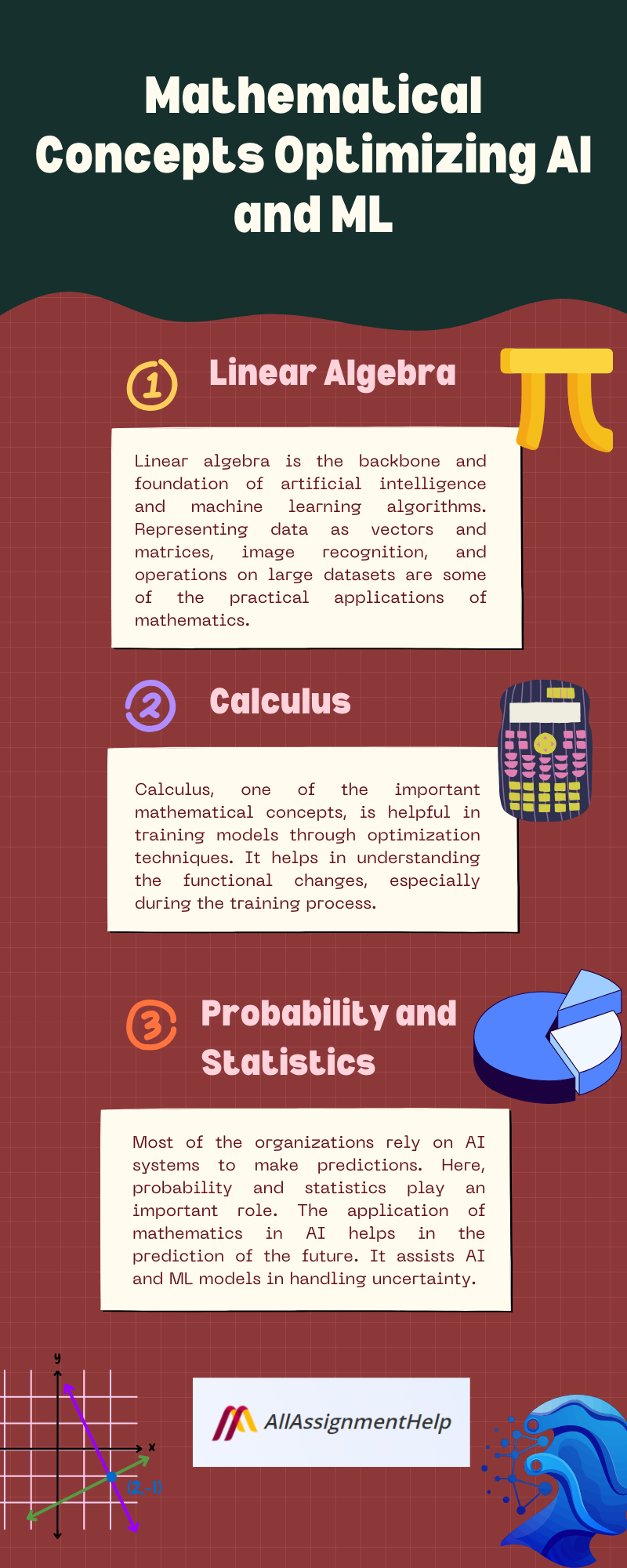
Linear Algebra
Linear algebra is the backbone and foundation of artificial intelligence and machine learning algorithms. Representing data as vectors and matrices, image recognition, and operations on large datasets are some of the practical applications of mathematics.
Linear algebra is essential for advanced techniques in machine learning. Without algebra, it would not be possible to manipulate data and perform transformations. Vector spaces and linear mapping are the two core concepts of linear algebra. This branch of mathematics often represents the role of artificial intelligence for data manipulation and analysis. These are the following core concepts in linear algebra are helpful for optimizing machine learning models.
- Singular Value Decomposition (SVD)
- Eigenvalues and Eigenvectors
- Determinants and Rank
- Identity and Inverse Matrices
- Transpose of a Matrix
- Matrix Multiplication
- Dot Product
- Scalars, Vectors, Matrices, and Tensors
Calculus
Calculus, one of the important mathematical concepts, is helpful in training models through optimization techniques. It helps in understanding the functional changes, especially during the training process. The core concepts, like derivatives and gradients, allow AI models to reduce errors and effectively fulfill parameters.
The core concepts of linear algebra help in the structure and representation of data. On the other hand, calculus helps in probabilistic modeling and understanding continuous outcomes. It is a core algorithm for training models and enables efficient training of AI and ML models. From optimization algorithms to reinforcement learning, we can clearly see the applications of calculus in AI.
The core concepts of calculus that are helpful in AI and ML are
- Function acts as a map input data to the predicted outcomes
- Limits help in understanding continuity
- Derivatives optimize model performance
- Gradient guides the optimization process
- Chain rule propagates errors through layers
We all know that calculus is an important branch of mathematics. Concepts like functions and derivatives are used to find the rate of change of a quantity. For many students, calculus is not an easy subject to learn. They often struggle to complete assignments and end up seeking calculus assignment help. Getting assignment help is a fast-paced solution in this modern world. You can not only save time but also grasp concepts better.
Probability and Statistics
Most of the organizations rely on AI systems to make predictions. Here, probability and statistics play an important role. The application of mathematics in AI helps in the prediction of the future. It assists AI and ML models in handling uncertainty.
The real-world data will become uncertain without the application of probability and statistics. It enables decision-making, handling all uncertainty in the business. Let’s suppose a company predicts that there is a 90% chance of success rate of this product. What do you think is the case? How can anyone predict the future? Here, the mathematical foundation of artificial intelligence and machine learning applies. Probability helps in predicting the outcome. Several factors are considered to understand and make decisions under risk. Without probability and statistics, it would be difficult to calculate expected outcomes and make choices that maximize reward.
Here is a list of the core probability and statistics concepts used in artificial intelligence and machine learning.
- Probability distribution helps in estimating the outcome
- Conditional probability updates predictions
- Bayes’ theorem continuously improves predictions
- Random variables feature model uncertainty
- Statistical inference makes data-driven decisions
- Correlation measures the strength and direction
- Covariance measures variable changes
Statistics is a powerful tool driving our future. Both artificial intelligence and machine learning depend upon statistical concepts. If you are considering a promising career, pursuing a statistics major could be the right decision. Statistics and AI offer a promising and dynamic combination. Statistics is a complex subject to learn. Therefore, if you are starting a journey, make sure you plan everything beforehand. Find ways to boost your understanding and maintain good scores. In overwhelming situations, you may get help with statistics assignment. Expert helpers will tackle tight deadlines while you stay on track and build a strong academic foundation.
Real-Life Applications of Mathematics in AI and ML
Machine learning and artificial intelligence have been benefiting every sector. From education to healthcare to finance, all sectors heavily depend on AI and ML algorithms. But do you know that AI and ML algorithms depend on the application of mathematics? Without mathematical concepts, it would be difficult to perform practical AI and ML applications.
Medical Diagnosis and Health Monitoring
The healthcare system today is faster than ever before. All thanks to mathematical models that drive intelligent medical solutions. Both medical diagnosis and health monitoring have become more efficient. Here is how this process works.
- Statistics and probability theory analyze vast amounts of patient data.
- The AI algorithms help in identifying patterns and making accurate predictions.
- Statistical models can be helpful in detecting early signs of diseases.
- ML models also assist in medical imaging.
Also Read: Top 8 Free Mathematics Software of 2025
Conclusion
Mathematics is way more than an academic subject. It silently plays an important role in the functioning of our day-to-day lives. Not just this, it is a driving force behind the artificial intelligence and machine learning models. We can see the real-life applications of mathematics almost everywhere.
Netflix, YouTube recommendations, and Google translations—all of which we use—depend upon mathematics and AI and ML algorithms. Mathematical concepts like statistics and probability train AI and ML models to make predictions and suggestions. Students looking to master AI must begin by mastering mathematical concepts. You can enroll in an online math degree or course to gain an in-depth understanding of these concepts. With better knowledge, you can perform better. And the best part of pursuing a course online is that you will have greater flexibility. Moreover, if you get stuck with any of the math assignments, you may also seek mathematics assignment help online. The right and timely help from experts will make your learning journey smoother and more effective.
Frequently Asked Questions
Question 1: What are the 5 applications of mathematics?
Engineering, technology, finance, medicine, and physics are the five key areas of application of mathematics.
Question 2: What are the applications of mathematics in daily life?
Budgeting, cooking, shopping, sports, and finance—everything we do in our everyday life—depends on mathematical concepts.
Question 3: What are the key mathematical concepts in AI and ML?
Statistics, calculus, linear algebra, and graph theory are some of the key mathematical concepts used in AI and ML.
Question 4: Can I work in AI with a math degree?
Anyone who has math and/or computer science as their major can pursue a career in artificial intelligence. Though AI is fundamental, you will still need to learn programming and use AI tools for a better career scope.
Connect the explanation to the work your course actually requires
Use this guide beside the exact brief, course material and marking criteria for Applications of Mathematics.
- Write the complete problem.
- Use the method taught in the course.
- Show each material step.
- Check the result and units.
Sarah Johnson
Mathematics
Mathematics tutor with eight years of experience across core college and school mathematics topics. Master’s degree in Mathematics
View established tutor profile ↗Relevant subject areas
- Algebra
- Calculus
- Geometry
- Statistics
- Trigonometry
Find another explanation across the complete blog
This search uses WordPress itself, so it can reach articles beyond the 20 shown on the dashboard.
Connect Applications of Mathematics to the task in front of you
Keep the brief, marking criteria, required evidence and submission format visible while you work.