Table of Contents
Science is constantly evolving, and in 2026, rapid advancements in technology, artificial intelligence, biotechnology, and environmental research are creating new opportunities for students worldwide. These developments have expanded the scope of science education, allowing students to explore innovative fields and build careers in emerging industries. Studying science in the USA in 2026 gives students access to world-class education, cutting-edge laboratories, and diverse academic programs taught by experienced and globally recognized faculty.
The USA remains one of the top destinations in 2026 for students who want to pursue science after completing their 12th grade. With globally ranked universities, modern research infrastructure, and strong career prospects, the country offers science programs that contribute to major scientific discoveries and future innovations.
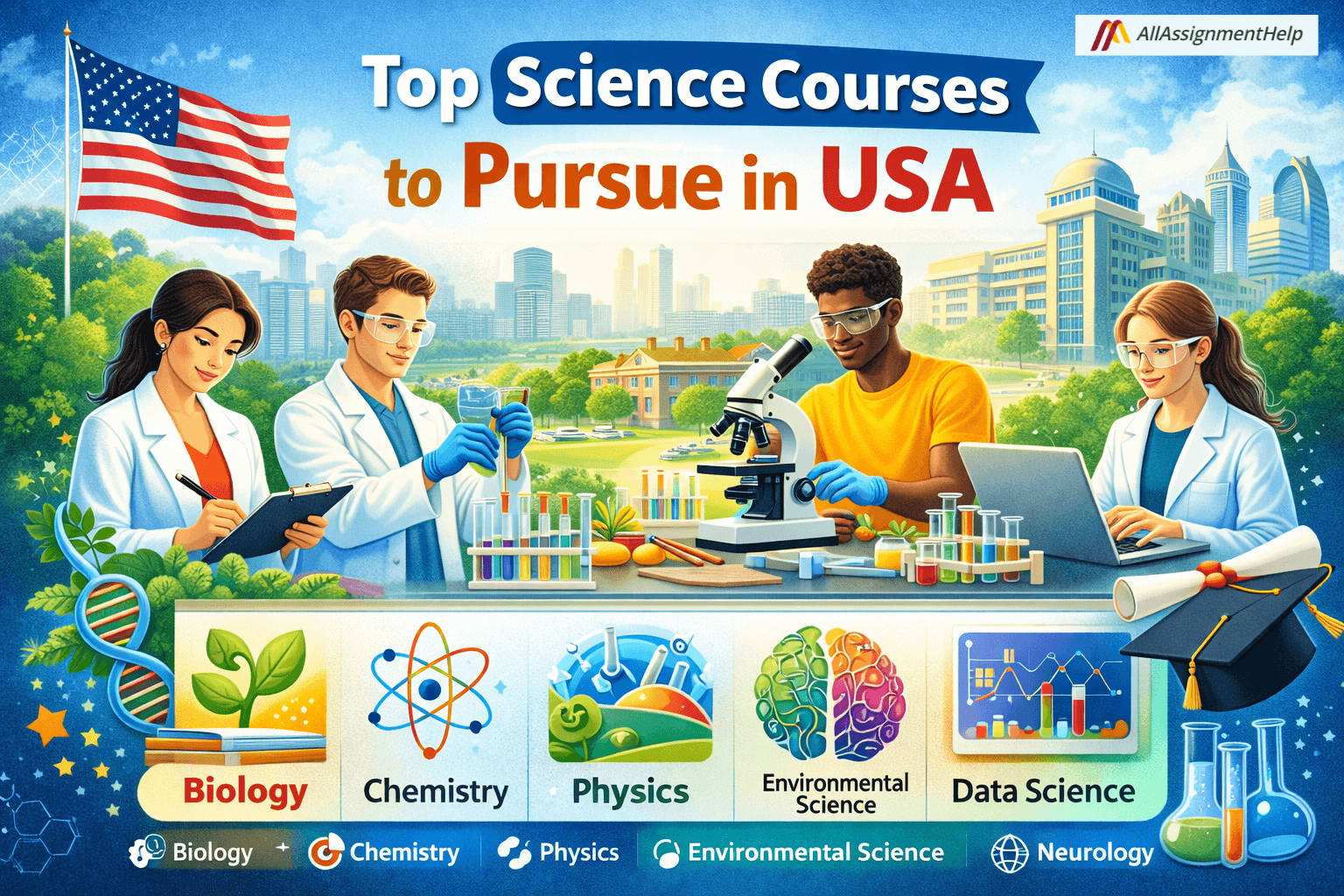
To help you make the right academic decision, we have created this blog highlighting the top science courses in the USA in 2026. This expert guide by All Assignment Help will help you explore the best options and choose a course that matches your interests, strengths, and career goals.
Why Study Science in the USA?

Studying science in the USA has several advantages, such as:
- Course Diversity: Students can access some of the best science majors in USA, ranging from modern subjects like environmental science, neurology, and data science to more traditional ones like biology, chemistry, and physics. Also, USA has some of the best online assignment help providers who can help them excel in these courses.
- Innovative Research Prospects: The United States is home to multiple universities and research centers that are at the forefront of scientific research. It gives students the chance to take part in innovative studies while getting useful experience.
- Career Opportunities: The United States is a global centre for scientific research and development. Students can choose from a wide range of career options after science in USA in fields including technology, biotechnology, healthcare, and energy.
- Cultural Experience: Students can experience a diversified, colorful atmosphere while taking science courses in USA. Moreover, it will enable them to interact with and learn from individuals with a range of experiences and viewpoints.
- Multidisciplinary Teaching Method: Many science courses in the USA follow an interdisciplinary approach to provide students with an understanding of how multiple scientific fields interact and how science can be used to solve real-world problems.
Also, you can enrol in some of the best science majors in the USA. Therefore, studying science in the USA will be the best option for you if you are a curious individual who has a desire to study, research, and succeed.
Read Here: How Learning Science Could be Useful for You
List of Best Science Courses in the USA to Pursue in 2026
Studying in the USA guarantees that students will come across an integration between technology and medicine, both of which will be beneficial to their future opportunities. Here are some science courses in demand in USA that you can choose to pursue in 2026:
Biotechnology and Genetic Engineering
Biotechnology is one of the key drivers of innovation in healthcare, agriculture, and environmental science. In 2026, this field is expected to remain in high demand due to advancements in drug development, personalized medicine, genetic engineering, and sustainable food production. Biotechnology programs combine biology, chemistry, and technology to help students understand and develop solutions for real-world problems.
However, biotechnology and genetic engineering are academically challenging fields that require strong analytical skills, consistent effort, and a deep understanding of scientific concepts. Students who are committed and willing to dedicate sufficient time to learning can greatly benefit from pursuing these science courses in the USA. Additionally, when students face academic difficulties, they can seek biotechnology assignment help or genetic engineering assignment support from qualified experts to better understand complex topics and improve their performance.
What the Course Covers
Biotechnology is an interdisciplinary science that makes use of biology, chemistry, and technology to create products and processes that enhance industry, agriculture, and human health. Furthermore, the primary goal of genetic engineering, which is a branch of biotechnology, is to change genes to produce crops resistant to disease or to create gene treatments.
Top Universities Offering the Course
- Massachusetts Institute of Technology (MIT): Biological Engineering, Biotechnology
- Harvard University: Molecular and Cellular Biology, Biotechnology, Genetics
- Johns Hopkins University: Biotechnology (M.S.), Genetic Engineering & Molecular Biology
- Cornell University: Biological Engineering, Biotechnology, Genetics & Development
- University of Pennsylvania (UPenn): Biotechnology (M.S.), Genetics, Genomics & Molecular Biology
Environmental Science and Sustainability
Among the most serious problems facing human beings are resource shortages, climate change, and global warming. On a global scale, governments, non-profits, and organizations are making significant investments in sustainable practices, which have pushed up demand for environmental science professionals. The Environmental Science and Sustainability course is a popular multidisciplinary course that is available at the undergraduate and graduate levels. Hence, it can be the best choice for those who are dedicated to environmental conservation and sustainability.
What the Course Covers
Environmental Science and Sustainability studies environmental concerns and sustainable alternatives by integrating scientific, social, and policy perspectives. The course gives students an understanding of data analysis, environmental economics, sustainable development techniques, and the natural sciences (biology, chemistry, geology, and ecology).
Top Universities Offering the Course
- Stanford University: Earth Systems Program
- University of California, Berkeley: Environmental Science, Policy, and Management
- Columbia University: Sustainable Development
- Yale University: School of the Environment
- Arizona State University: Sustainability Studies
Neuroscience
Neuroscience is the study of the structure and function of the nervous system. Universities in the USA offer neuroscience majors (B.S./B.A.), master’s degrees (M.S.), and doctoral degrees. The course prepares students for professions in biotechnology, pharmaceuticals, psychology, research, and medicine. Furthermore, the integration of AI into brain mapping and imaging extends the field of neuroscience even more.
What the Course Covers
The course covers systems neuroscience with a particular focus on circadian Rhythms, motor control, sleep, and sensory systems, including hearing and vision. Additionally, students are also introduced to computational neuroscience, neuroimaging tools (fMRI, EEG, PET), and data processing techniques that are important for modern brain research. Since neuroscience is a very diverse and influential subject of study, students are prepared for jobs in medicine, research, biotechnology, and pharmaceuticals via practical laboratory work, research projects, and internships.
Top Universities Offering the Course
- Harvard University: Department of Neurobiology
- Stanford University: Neurosciences Interdisciplinary Program
- Massachusetts Institute of Technology (MIT): Brain & Cognitive Sciences
- Columbia University: Mortimer B. Zuckerman Mind Brain Behavior Institute
- University of California, San Diego (UCSD): Neurosciences Graduate Program
Chemistry and Materials Science
The Chemistry and Materials Science course in USA combines chemistry, physics, engineering, and nanotechnology in a highly multidisciplinary method to analyze the characteristics, design, and uses of materials. This is one of the best science majors in USA, which prepares students for jobs in biotechnology, electronics, research, energy, nanotechnology, aerospace, and the production of sustainable materials. However, here in this course, students need to study chemistry on a deeper level. Hence, they can take assistance from a chemistry assignment help service online to smooth their academic journey.
What the Course Covers
The coursework starts with a strong basis in general, organic, inorganic, analytical, and physical chemistry to help students understand molecular interactions, chemical bonding, and reaction kinetics. Following that, it goes further into the fundamentals of materials science, covering the study of metals, composites, ceramics, polymers, and nanomaterials. Furthermore, students will explore how the electrical, optical, magnetic, and mechanical characteristics of these materials are influenced by their atomic and molecular structure.
Top Universities Offering the Course
- University of Michigan, Ann Arbor: Materials Science & Engineering
- University of Illinois Urbana-Champaign (UIUC): Materials Science & Engineering
- University of California, Berkeley: Materials Science & Chemistry
- California Institute of Technology (Caltech): Chemistry & Chemical Engineering, Materials Science
- Massachusetts Institute of Technology (MIT): Materials Science and Engineering (DMSE)
Computational Biology and Bioinformatics
Computational biology uses statistics and computer science to solve biological problems. On the other hand, Bioinformatics focuses on the analysis of biological data, including protein structures and DNA sequences. Big data, proteomics, and genomics are all expanding quickly in the healthcare industry, making this one of the fastest-growing fields in modern science. This course prepares students to understand biological systems, analyze genetic data, and provide solutions for problems in biotechnology, medicine, and pharmaceuticals using computational tools and algorithms.
What the Course Covers
The course covers the integration of biology, computer science, and mathematics to analyze and interpret complex biological data. Students study core topics such as molecular biology, genetics, genomics, and systems biology, while learning computational foundations like algorithms, statistical modeling, and machine learning. Practical training involves coding in Python or R, using bioinformatics software, and analyzing big biological datasets. It prepares students for careers in biotechnology, pharmaceuticals, personalized medicine, and biomedical research through research projects and internships.
Top Universities Offering the Course
- Carnegie Mellon University: Computational Biology Department
- Yale University: Computational Biology & Bioinformatics Ph.D. program
- University of Pennsylvania (UPenn): Genomics & Computational Biology
- University of Washington, Seattle: Computational Molecular Biology
- University of California, San Diego (UCSD): Bioinformatics and Systems Biology
These are some of the top and most in-demand science courses in USA that you can pursue. The best part is that many of these courses are now available online, so you can easily enroll in your preferred learning course and gain valuable knowledge and skills. However, if you are worried about situations where you may not be able to attend your online classes due to personal commitments and are concerned about falling behind, you do not need to turn to the internet to randomly post queries like, who can I hire to complete my online college class? As you can always hire subject-matter experts through trusted online class help sites and manage your academic hurdles more effectively without compromising your grades and learning.
Cost of Studying Science Courses in the USA
Before choosing a science course in the USA, it is important to understand the overall cost. This helps you plan your budget and make the right financial arrangements. The total expense includes two main parts: tuition fees and living expenses. The cost can vary depending on the university, course type, program duration, and the city you live in.
Here is a simple overview of what you can expect:
- Tuition fees: Most science courses cost between $25,000 and $50,000 per year, depending on the university and program.
- Public vs private universities: Public universities usually have lower tuition fees compared to private universities, making them a more affordable option.
- Living expenses: International students typically spend around $1,000 to $1,500 per month, which equals $12,000 to $18,000 per year. This includes accommodation, food, transport, and daily expenses.
- Lifestyle matters: Your total cost can be lower or higher depending on your lifestyle, housing choice, and spending habits.
- Scholarships: Many universities in the USA offer merit-based and entrance scholarships, which can significantly reduce your overall expenses. Some scholarships are automatically considered when you apply.
By understanding these costs in advance, you can plan better and choose a science course that fits both your academic goals and your budget.
You will be glad to know that if you are taking online science courses in the USA, you can hire an online exam taker at an affordable rate to help you pass your online course with good scores. All you need is to pick a reliable online exam help service and ask them, can you take my online exam for me? That’s All! These services possess a team of subject-matter and professional exam takers to help students make the most of their online coursework.
Also Read: How Practical Science Enhances Classroom Learning
Conclusion
While getting into one of the top universities in the US is a dream come true for students, it is also important to select the right science course in a field of study that interests you. There are numerous opportunities in the United States, which is why more than a million foreign students decide to study science in the country. However, if you are also planning to study science in USA in 2026, you can count on us for science homework assignment help to get complete assistance with your assignments and other science-related writing tasks in one place.
FAQs
What is the eligibility to apply for science courses in the USA?
Students usually need a strong academic background in science subjects (Physics, Chemistry, Biology, or Mathematics) at the high school or undergraduate level. Also, some additional requirements can include standardized test scores (SAT, ACT, GRE), English proficiency tests (IELTS/TOEFL), recommendation letters, and a statement of purpose.
What are the career prospects after pursuing science courses in the USA?
Graduates can build careers in research, healthcare, pharmaceuticals, data science, biotechnology, environmental conservation, artificial intelligence, and academic teaching.
Can international students work while pursuing a science degree in the USA?
Yes, international students can work part-time (up to 20 hours per week) during semesters and full-time during breaks. Additionally, Optional Practical Training (OPT) allows science graduates to work in the USA for up to 3 years after completing their degree.