What Employers Look for in Cybersecurity Freshers: The Hiring Checklist

What this article will help you understand
Everyone has access to the online world, but who will keep it safe? In a world filled with unseen online risks, how can we ensure the security of our digital lives? As the number of cyberattacks increases, both public and private organizations are raising awareness and recruiting qualified experts who can protect sensitive information and
What are you trying to do with this topic?
Choose the closest task and the page will point you towards a useful next step.
Start with the central concept and the terminology used in the article.
Open the closest route ↗Connect the explanation to the question, learning outcomes and marking criteria.
Open the closest route ↗Review evidence, structure, referencing and the exact submission requirements.
Open the closest route ↗Do you have enough information to begin?
Select what you already have. Nothing is submitted from this checklist.
When these details are together, the requirement can be reviewed in context.
Programming Assignment Help ↗Table of Contents
Everyone has access to the online world, but who will keep it safe? In a world filled with unseen online risks, how can we ensure the security of our digital lives? As the number of cyberattacks increases, both public and private organizations are raising awareness and recruiting qualified experts who can protect sensitive information and systems. What’s next? A sharp increase in the need for cybersecurity expertise in almost all fields. However, earning a degree is no longer an entry ticket to success. Employers are looking for individuals who are prepared to take on real-world problems, not just graduates with classroom expertise.
In this blog of All Assignment Help, we will discuss what cybersecurity organizations value in fresher candidates, as well as what skills, qualifications, and characteristics might help you stand out from the crowd and get you the entry-level cybersecurity jobs.
What is Cybersecurity?
Cybersecurity is the process of protecting programs, networks, and systems from digital attacks. Such attacks are often intended to interrupt everyday business operations, extract money from users via ransomware, or access, change, or delete sensitive data.
Moreover, cybersecurity includes learning to spot and stay away from online fraud as well as using advanced techniques to identify and eliminate malicious malware. Adopting sound cybersecurity practices guarantees a secure online experience and helps protect your data.
Read Here: How To Start a Career in CyberSecurity – A Complete Guide
Cybersecurity Hiring Checklist – What Employers Look for in a Fresher
The rivalry for jobs in cybersecurity has intensified as the demand for professionals in this field continues to grow. Now, employers are looking for candidates who have the business savvy and soft skills necessary to protect their companies against changing cyber threats, along with the required technical skills. Below, we have mentioned a cybersecurity hiring checklist in detail so that you can meet the entry-level cybersecurity job requirements:
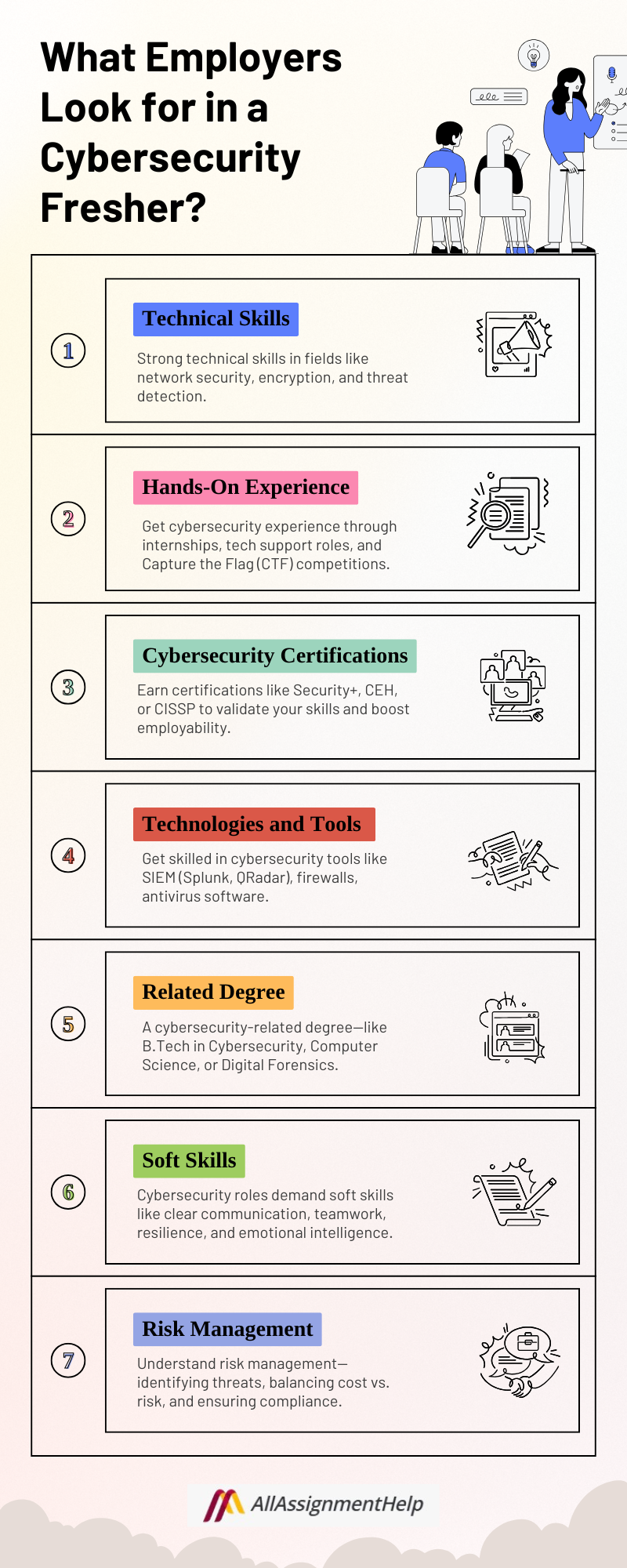
Technical Skills
As per cybersecurity employers, candidates should possess strong technical skills in fields like network security, encryption, and threat detection. They want individuals to possess a specific understanding in fields, along with some general IT skills. Here is what cybersecurity employers look for in technical skills in a fresher:
- Network Security: Familiarity with firewalls, intrusion prevention systems (IPS), and intrusion detection systems (IDS).
- Cryptography: Understanding the techniques used to safeguard data using encryption technology.
- Penetration Testing: The capacity to model cyberattacks to find system vulnerabilities.
- Security Frameworks: Understanding of cybersecurity frameworks such as CIS Controls, ISO 27001, or NIST.
However, those who are in college pursuing a major in cybersecurity must start possessing these technical skills as soon as possible. If you need additional assistance, you can search for online cybersecurity assignment help services and hire a subject expert to clarify the basics of technical skills.
Hands-On Experience
You could be wondering how to acquire hands-on experience without getting a job. However, before you are prepared for a position like a cybersecurity analyst, there are lots of entry-level positions and internship opportunities that will give you some experience in the industry. Here is how you can acquire hands-on experience in cybersecurity:
- Internships: It is an excellent approach for freshers to meet cybersecurity job requirements. While you don’t get paid, you can work in a place where you can pick up new skills and put what you have learned in class into practice.
- Technical Desk: Although working at a technical support help desk might not seem appealing, it will teach you about common user problems, how bugs penetrate systems, and some of the multiple phishing techniques hackers can use to deceive workers of your firm into disclosing private information.
- Capture the Flag (CTF): Consider CTFs to be the best playground for prospective newbies in cybersecurity. These are virtual competitions in which you must solve practical security problems, such as cracking codes, identifying secret data, or hacking into fictional systems.
Exams and textbooks are only good for so long. You need to prove to potential employers that you have used your expertise in practical situations.
Cybersecurity Certifications
Certifications are highly valued by employers. Certifications validate the skills you highlight on your resume and during interviews and give your name more legitimacy. Having advanced, relevant, and necessary credentials can help you stand out from the competition. The following are some of the most valuable certifications you must get to acquire entry-level cybersecurity jobs:
- CompTIA’s Security+
- Pentest+
- Cybersecurity Analyst (CySA+)
- Advanced Security Practitioner (CASP+)
- Certified Ethical Hacker (CEH)
- Certified Information Systems Security Professional (CISSP) certs
However, you can earn these certifications online as well. Just choose the one that aligns with your goal and enroll in an online course or program. Also, if you are unable to manage your online coursework, you can hire an expert simply by asking, can you do my online course for me? The expert will take your course on your behalf and provide you with every lesson and learning taught in the coursework.
Cybersecurity Technologies and Tools Understanding
The world of cybersecurity mainly relies on multiple software tools and technologies to track systems, identify vulnerabilities, and stop attacks. Therefore, employers are searching for candidates who know how to use such technologies to improve the security of their organization. These tools and technologies include:
- SIEM (Security Information and Event Management): Splunk, SolarWinds, and IBM QRadar are some of the tools that help in real-time security data analysis.
- Firewalls and Antivirus Software: Familiarity with endpoint protection software and firewalls (such as Palo Alto Networks and Cisco ASA).
- Forensics Tools: Knowledge of cyber forensics tools like EnCase or FTK, which are used to monitor and look into hacking attempts.
A candidate is more appealing to employers if they are familiar with these or more tools. It indicates they are capable of managing many types of security problems, from identifying malware to looking into online crimes.
Cybersecurity or Related Degree
While earning an undergraduate degree in cybersecurity or information systems might look like the most obvious need, employers don’t value it as much as they should. However, this is mandatory for most companies you apply to. With this degree, you will have a thorough grasp of the profession and how it works. Here is a list of degrees for freshers who want to start their career in cybersecurity:
- Bachelor’s in Cybersecurity
- B.Tech / B.E. in Cybersecurity
- Bachelor’s in Computer Science (with Cybersecurity electives)
- Bachelor’s in Information Technology / Information Security
- Bachelor’s in Digital Forensics / Information Assurance
Getting a degree in cybersecurity comes with multiple challenges. One of them is writing assignments and projects. Hence, we suggest that you get online assignment help from a reliable service that can assist you in completing your assignments on time and lead you towards getting good academic scores as well.
Soft Skills
Although technical skills are important, employers also place a high priority on soft skills in cybersecurity candidates. Cybersecurity professionals need to collaborate closely with teams, including management and non-technical employees, to solve security problems. The soft skills want an employer wants in a candidate are:
- Clear Communication: Being able to clearly and concisely communicate complicated security concepts to non-technical stakeholders.
- Collaboration & Teamwork: Cybersecurity often depends on teamwork. Hence, it is especially important to have the ability to work well with other departments.
- Resilience: Cyberattacks are stressful events. Employers like candidates who are balanced and competent.
Additionally, candidates who possess emotional intelligence under stress are highly desirable. Working in the high-stress sector of safety and security requires the capacity to properly manage stress and function during a stressful situation.
Understanding of Risk Management and Business Needs
Employers look for candidates who are aware of the larger cybersecurity business environment. This involves understanding how security controls fit into a broader risk management plan of a company and being able to match security objectives with corporate goals. Hence, as a fresher, you must know:
- Risk Identification and Assessment: Identifying possible dangers (phishing, malware, insider threats, and data breaches) and assessing the likelihood of a danger and the potential harm it could cause.
- Cost vs. Risk: Companies invest in controls that match the value of the asset they are protecting.
- Compliance & Regulations: Many industries (finance, healthcare) must follow rules like GDPR, HIPAA, and PCI-DSS.
Understanding them not only increases your ability to adapt but also shows your awareness of the risks. However, if you are unaware of the common risks and how to manage them effectively, taking a risk management assignment help from an experienced professional could benefit you. They will guide you from the basics and how you can solve the potential cybersecurity risks during your job.
Cybersecurity Fresher Resume Tips
Here are some practical resume tips for cybersecurity freshers to make their profile stand out in front of employers:
- Keep it Concise: Your resume should be no more than one page, or two if you have done multiple projects or possess qualifications. Recruiters spend only a few seconds scanning.
- Strong Career Objective: Write a concise, 2-3 line objective that shows your curiosity and passion for cybersecurity. Avoid generic statements.
- Highlight Certifications First: As a fresher, certifications like CompTIA Security+, CEH, CCNA CyberOps, and Google Cybersecurity Certificate can cover up the lack of work experience.
- Mention Technical Skills Clearly: Divide into categories (Networking, Tools, Scripting, OS/Cloud Security) to make it easy to scan.
- Include Hands-On Projects: Add academic, self-learned, or lab projects (like penetration testing, vulnerability scanning, phishing simulations).
- Mention Tools You Used: Employers love seeing industry tools: Wireshark, Nessus, Metasploit, Kali Linux, Splunk, Burp Suite, Snort, etc.
- Add Relevant Coursework: List subjects like Network Security, Cryptography, Information Security, and Risk Management if you don’t have much professional experience.
- Add Internships & Trainings: Even short-term internships, online bootcamps, or workshops (Cisco, Palo Alto, AWS, Forage virtual internships) show initiative.
- ATS-Friendly Formatting: Avoid fancy designs, tables, or too many colors. Stick to simple fonts (Arial, Calibri), proper headings, and relevant keywords (cybersecurity, threat analysis, risk management, penetration testing, incident response).
Also Read: Top 7 Highest Paying Jobs in Cybersecurity and Their Benefits
Conclusion
Cybersecurity skills are extremely important and often necessary. Without it, it could be difficult to get even an entry-level job. This is why it is important to grab early possibilities for professional growth, such as internships and certificates. Also, if you are pursuing a major in cybersecurity and need someone to help you with your academic assignments and other writing tasks, you can hire our experts and share the requirements to solve your problems. Besides, we also possess a team of online exam takers who you can ask, will you take my online exam for me, if you have enrolled yourself in an online cybersecurity course and need help with taking online exams.
FAQs
Does cybersecurity benefit fresh graduates?
Yes. Cybersecurity can be a smart career choice for freshers. The profession offers amazing income potential, excellent job security, and high demand even for entry-level jobs. The industry is always changing, providing chances for development and education.
Which country has the highest demand for cybersecurity professionals?
Strong digital infrastructure, growing cyberthreats, and strong government data protection programs have created a high demand for cybersecurity professionals in countries including the US, Switzerland, Luxembourg, the UK, Denmark, and Germany.
Do cybersecurity roles need coding?
No, not every cybersecurity position requires coding, but some technical domains like malware analysis, ethical hacking, and penetration testing can benefit from it.
Connect the explanation to the work your course actually requires
Use this guide beside the exact brief, course material and marking criteria for Cybersecurity Freshers Hiring Checklist.
- Include the complete specification.
- Keep code, inputs and outputs together.
- Explain the algorithm or design choices.
- Test against the stated requirements.
Yonda Morgan
Computer Science
Computer science tutor and coder whose profile covers multiple programming languages.
View established tutor profile ↗Relevant subject areas
- Computer Science
- Programming
- Coding
Find another explanation across the complete blog
This search uses WordPress itself, so it can reach articles beyond the 20 shown on the dashboard.
Connect Cybersecurity Freshers Hiring Checklist to the task in front of you
Keep the brief, marking criteria, required evidence and submission format visible while you work.