Linkedin Profile Tips for College Students
What this article will help you understand
Being a student can be difficult since you have to study for tests, look for a job, and figure out what to do next. While it may seem overwhelming to add another task to your list of things to do, creating a unique LinkedIn profile is not only important to your professional brand and job
What are you trying to do with this topic?
Choose the closest task and the page will point you towards a useful next step.
Start with the central concept and the terminology used in the article.
Open the closest route ↗Connect the explanation to the question, learning outcomes and marking criteria.
Open the closest route ↗Review evidence, structure, referencing and the exact submission requirements.
Open the closest route ↗Do you have enough information to begin?
Select what you already have. Nothing is submitted from this checklist.
When these details are together, the requirement can be reviewed in context.
Assignment Help USA ↗Table of Contents
Being a student can be difficult since you have to study for tests, look for a job, and figure out what to do next. While it may seem overwhelming to add another task to your list of things to do, creating a unique LinkedIn profile is not only important to your professional brand and job search, but it’s also easy and takes only a few minutes.
Developing a digital branding plan while still in college will be essential for success in the modern workplace. Internships, alumni relationships, and future employment prospects are all made possible by having a good online presence. You can make an impression on employers even before you graduate by using sites like LinkedIn.
This blog by allassignmenthlp explores some tips for creating a strong, conversion-oriented digital brand.
What is Meant By Digital Branding?
Your professional identity’s presentation on social networking sites such as LinkedIn is known as digital branding. For college students, attracting the proper opportunities requires building an online portfolio that highlights their volunteer activities, academic accomplishments, and professional aspirations.
However, online assignment help services can be useful for you. They not only offer help with your assignments and homework but also help you build your LinkedIn profile. Since their experts are so qualified and well-versed in the trending things.
Read More: What is Blackboard Learn? Get to Know Everything About It
Why LinkedIn profile Important in the Professional World Nowadays?
Your LinkedIn profile acts as an online portfolio that highlights your qualifications, personality, and ways in which you might benefit prospective employers.
With a wealth of resources to help you develop and advance your career, it is the professional branding platform of choice. LinkedIn gives you the ability to create a captivating story that highlights your professional experience, academic accomplishments, and future goals with features like a skills section, recommendations, a customisable headline, and a full description. Additionally, it offers a doorway to an extensive professional network that links you with graduates, professionals in the field, and possible employment.
Your visibility can be increased, and worthwhile chances can be created by interacting with pertinent content and demonstrating your knowledge. And if you are a busy student juggling multiple responsibilities, getting academic support from online class help by asking experts to take your online class for you can help you free up time to focus on building your LinkedIn presence, networking, and gaining valuable career insights.
What Are The LinkedIn profile Tips For College-Going Students?
Make sure your LinkedIn profile is optimised to highlight your abilities, interests, and potential before you begin networking or applying for internships. Consider it an improved version of your online CV, as LinkedIn allows you to show more than just a page of bullet points.
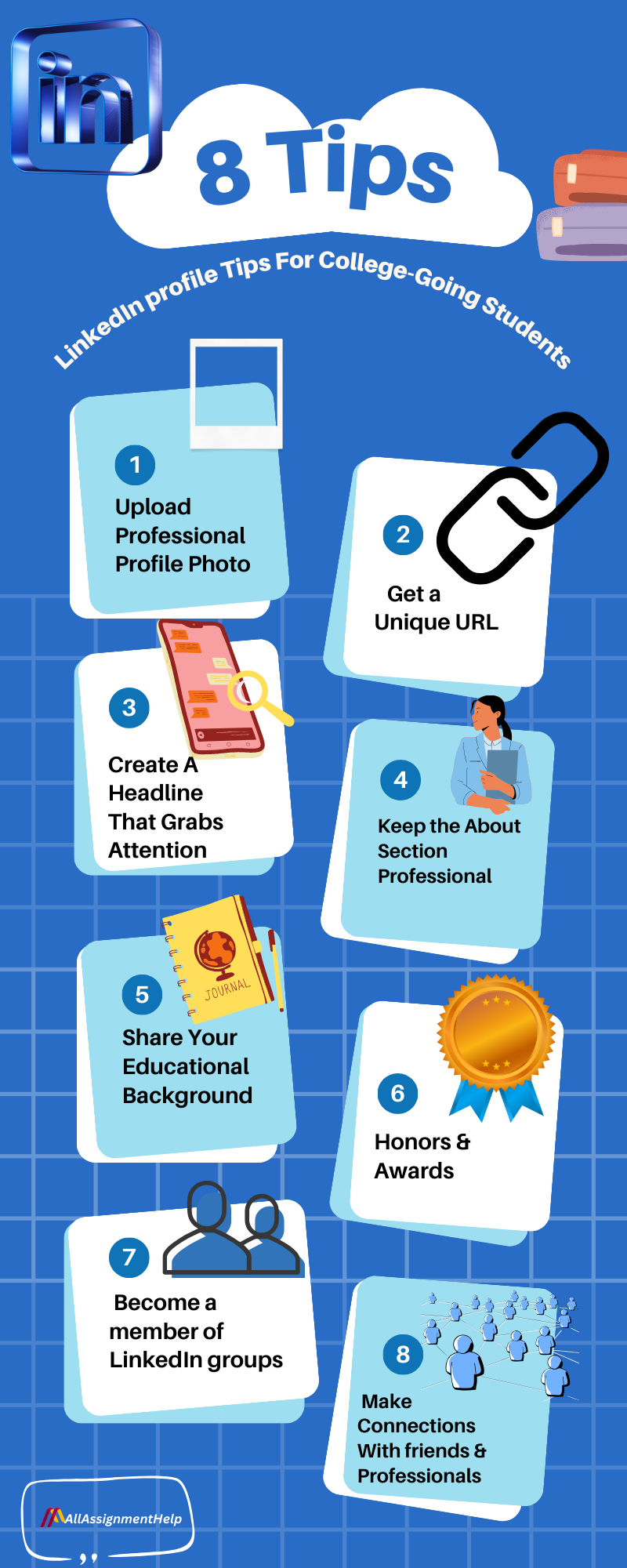
1. Include an official profile picture
One of the first things people will notice about your profile is your photo, and a picture is worth a thousand words. Although expressing your individuality is totally acceptable, keep in mind that LinkedIn is a professional network. Make use of a professional, clear, and high-quality headshot. Keep your eyes on the camera, smile, and dress professionally. Credibility and trust are increased as a result.
2. Get a Unique URL
It just takes a few seconds to customise your LinkedIn URL, and it looks more professional and is simpler to remember and share.
Go to your profile’s “Edit public profile & URL” section and build a URL that contains your name or a version of it to acquire your own unique URL.
3. Create a headline that grabs attention
You can convey your goals and aspirations for the future in the headline. It is a part that LinkedIn uses for search results and additional information that users see before clicking on your profile. Therefore, take the time to create a headline that draws attention to you if you want to increase your visibility among the appropriate individuals (HR & recruiters).
If you leave it blank, LinkedIn will automatically enter your current position, which may not be appealing enough to attract potential employers.
Simple healing phrases like “Student of XYZ subject,” “Student at [college name],” and “Seeking Working Opportunities” might be used by a student.
4. Keep the About Section professional
People look at your About section to find out more about you once they open your LinkedIn profile. As a student, you should introduce yourself and give a summary of your academic and extracurricular accomplishments so far.
Along with describing your strengths, you can also outline your future goals. Basically, this should be a more thorough version of your profile headline that includes answers to the following queries for the individual viewing it:
- What are your career objectives?
- How have you accomplished those objectives?
- Where do you envision yourself following your time in school or college?
- How might your expertise benefit businesses or individuals?
Add industry-relevant keywords to your profile summary if you’re in your last year of college or are ready to enter the workforce. Hiring managers and recruiters will find you more easily in search results if you do this.
5. Share your educational background
Building your network and credibility are the two main goals of this section on LinkedIn. List all of the universities and schools you have attended or plan to attend. You can enter the years you attended the institute if you have graduated, or your anticipated graduation year if you haven’t.
Also, remember to include descriptions of the activities you took part in at the various institutes. You have the chance to demonstrate what you have learnt and achieved at your various institutions. Further, you can include papers, films, and pictures that you are happy to share with the world.
6. Show your abilities
Highlight your skills to other users on the platform by adding them to your profile under the featured skills and recommendation area. On LinkedIn, you may add up to 50 skills. It is advised that you only include the skills you wish to be recognised for in your entries. Keeping your skills list up to date on your profile makes it easier to locate internships and employment.
7. Honours & Awards
List any honours, scholarships, or recognitions you have received, whether academic or professional, in this section. These may consist of industry honours, research funds, or victories in contests.
Give a succinct explanation of each award, mentioning any pertinent selection criteria.
For example:
Award: Best Research Paper, International Conference on Computer Science
Date: March 2024
Description: “Honoured for presenting the most innovative and impactful research in the field of artificial intelligence.”
Also, you can mention any credentials you’ve earned in engineering, design, or any other speciality in the certificates section. Furthermore, include a link so that users may check the legitimacy of your certificates.
8. Point out the courses you have taken
You can add any coursework you have ever taken part in to your profile under the Courses section.
Since LinkedIn professionals are aware of college and school courses, including those that fall outside of this category. Add the classes you completed for training or those that were provided by reputable organisations.
9. Talk about the projects you have worked on
You may have worked on a variety of projects at school and at university, but you may not have any professional experience. You can showcase your abilities and experience by including them in the Project area.
You can also mention any projects you may have worked on during your tenure as an intern. Make sure to include team members and descriptions that are enhanced with keywords for every project.
10. Become a member of LinkedIn groups.
Professionals from related industries and like-minded individuals congregate in LinkedIn groups. Additionally, there may be industry thought leaders, giving you the chance to engage with them and create enduring relationships.
You won’t succeed by merely joining LinkedIn groups. You have to share content and updates about the industry and participate in group conversations. You can establish your presence among the other members in this way.
11. Make connections with both friends and professionals.
The first people you should connect with are your classmates, instructors, and former students. Thereafter, you can find and connect with other industry specialists. Remember to always reply to postings from your connections and to respectfully and professionally ask pertinent questions.
So these are the simple steps to create a profile on LinkedIn. You can create your profile today and explore the opportunities and make connections to people in your field. This can land you a good opportunity.
However, you can connect with the experts online for your academic-related work if you are facing a hurdle while completing your assignment in complex subjects like stats and math. Simply write in the search bar, statistics assignment help or math assignment help, you will get a lot of options. Just choose wisely after reviewing everything.
Developing and Growing Your Network on LinkedIn
It’s time to expand your network after creating your profile. Especially if you don’t yet know many experts in your industry, this can feel awkward. But here’s a secret: if you approach them properly, most professionals are willing to engage with novices.
How to Create a Powerful Network:
- Start with those you know:
Make connections with your university’s instructors, students, and alumni. Many of these individuals are willing to assist new hires in getting started, and they may help you connect with their networks.
- Become a member of LinkedIn groups:
Seek out organisations that are associated with your industry or expertise. You can meet new people and discover internship possibilities that aren’t usually publicly advertised by participating in these communities.
- Make Custom Connection Requests:
Always provide a concise letter outlining your reason for connecting, rather than merely hitting “Connect.”
Conclusion
Building a professional profile on LinkedIn is more important than merely applying for jobs or sending connection requests when looking for an internship. Create a profile that is optimised, grow your network, genuinely interact with others, and highlight your unique qualities. Stay active, have patience, and never forget that if you put in the time and effort, opportunities will present themselves.
Are you prepared to get that internship? Start by doing these things, and you’ll see your career and LinkedIn profile increase.
FAQs
Q1: How can I start networking on LinkedIn?
Start by connecting with classmates, instructors, and alumni before reaching out to industry professionals.
Q2: Why is engaging with connections important?
It helps you build relationships and stay visible in your professional network.
Q3: What should I include in my LinkedIn profile?
Add a professional photo, a clear headline, a detailed summary, your education, work experience, and relevant skills.
Q4: How can I make my LinkedIn profile stand out?
Highlight your achievements, use keywords from your industry, and request recommendations from peers or mentors.
Connect the explanation to the work your course actually requires
Use this guide beside the exact brief, course material and marking criteria for Linkedin Profile Tips.
- Read the complete brief.
- Identify the expected academic output.
- Follow the marking criteria and source rules.
- Check the final structure and referencing.
Earl Anderson
Artificial Intelligence · 5.0/5
For a topic such as “Linkedin Profile Tips for College Students”, a tutor with a published background in Artificial Intelligence offers a useful subject-matching option.
Artificial intelligence tutor whose established profile includes MATLAB and machine learning.
View established tutor profile ↗Relevant subject areas
- Artificial Intelligence
- Machine Learning
- MATLAB
Find another explanation across the complete blog
This search uses WordPress itself, so it can reach articles beyond the 20 shown on the dashboard.
Connect Linkedin Profile Tips to the task in front of you
Keep the brief, marking criteria, required evidence and submission format visible while you work.