How ESL Summer Camps Help Kids Speak English with Confidence?
What this article will help you understand
Summer camps are a perfect opportunity to create lifelong experiences, make friends, and accelerate learning a new language. The primary goal of summer camps is to take kids away from the dull classroom environment and allow them to participate in and enjoy learning through outdoor activities. ESL Summer Camps give kids the chance to learn
What are you trying to do with this topic?
Choose the closest task and the page will point you towards a useful next step.
Start with the central concept and the terminology used in the article.
Open the closest route ↗Connect the explanation to the question, learning outcomes and marking criteria.
Open the closest route ↗Review evidence, structure, referencing and the exact submission requirements.
Open the closest route ↗Do you have enough information to begin?
Select what you already have. Nothing is submitted from this checklist.
When these details are together, the requirement can be reviewed in context.
Assignment Help USA ↗Table of Contents
Summer camps are a perfect opportunity to create lifelong experiences, make friends, and accelerate learning a new language. The primary goal of summer camps is to take kids away from the dull classroom environment and allow them to participate in and enjoy learning through outdoor activities. ESL Summer Camps give kids the chance to learn and practice new words while also building a strong vocabulary in English via different types of activities. These camps often focus on three key areas: learning, creativity, and adventure to promote ESL learning. Read this blog created by All Assignment Help to understand how ESL summer camps can help you improve your communication skills.
What Are ESL Summer Camps?
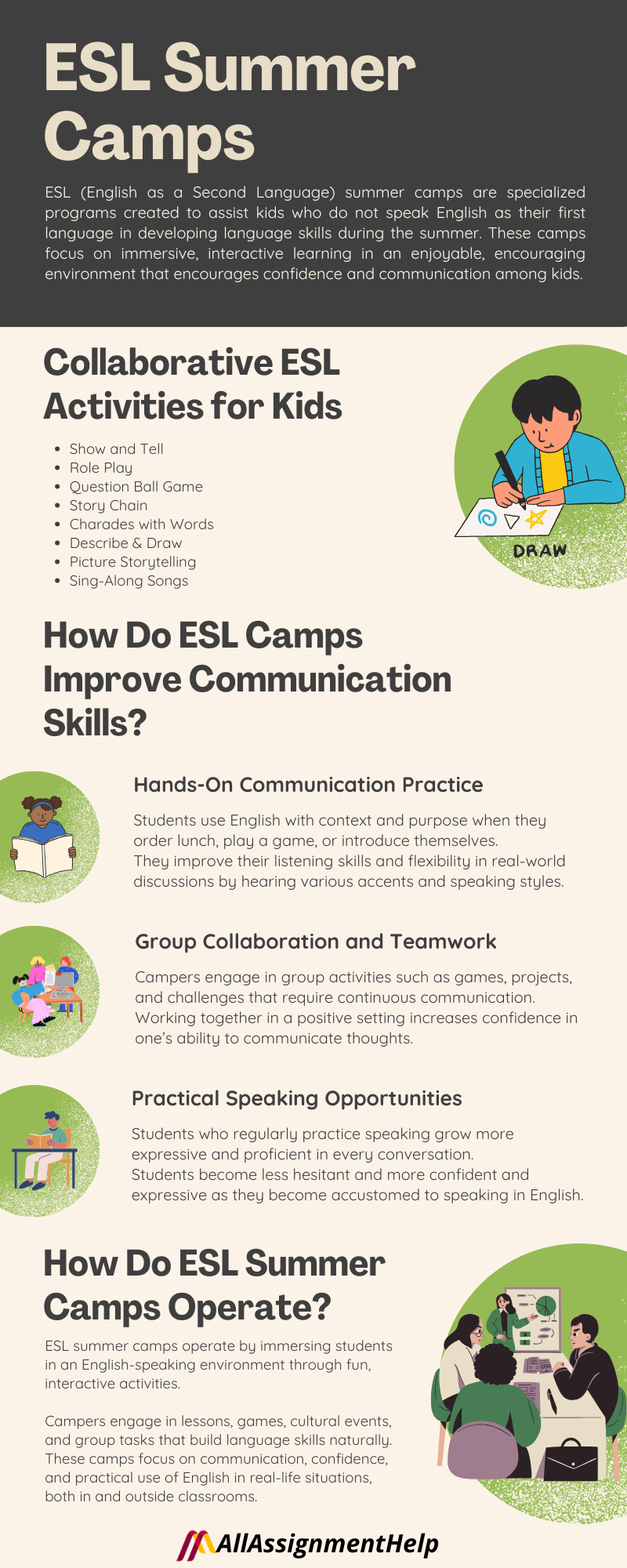
ESL (English as a Second Language) summer camps are specialized programs created to assist kids who do not speak English as their first language in developing language skills during the summer. These camps focus on immersive, interactive learning in an enjoyable, encouraging environment that encourages confidence and communication among kids.
However, ESL camps usually serve children between the ages of 6 and 16, while certain programs might include different age ranges. Campers are often divided into skill-level-based groups so that each kid receives teaching appropriate to their level of proficiency.
- ESL speaking activities for kids include:
- Group discussions
- Language games
- Storytelling sessions
- Arts, crafts, and drama
- Field trips and cultural exchange activities
There are many students who face problems while speaking English. This also affects the way they write homework and assignments. However, English-speaking summer camps are a great way to help them become better at learning English. Online English homework help services are another way to get their homework done without any hassle or mistakes.
Read Here: ESL vs. EFL: Understanding the Difference
Different Formats of ESL Summer Camps
There are no one-size-fits-all ESL summer camps. They are available in multiple forms to suit a range of learning styles, financial constraints, geographical areas, and immersion levels. There is an ESL summer camp model to meet the individual needs of every kid. Let’s have a look at them:
Local ESL Summer Camps
Local ESL camps take place in the kids’ native country. Usually, they are organized in collaboration with language schools or foreign educational institutions.
- These camps are perfect for smaller kids or first-time campers because they provide a warm yet structured atmosphere.
- These camps include group projects, outdoor sports, English classes in the classroom, and language workshops with a theme.
- Furthermore, local camps are inexpensive and provide kids the chance to become more proficient in the language without having to deal with the difficulties of a new culture or being away from home.
International ESL Summer Camps
International ESL camps take place in English-speaking nations, including the United States, United Kingdom, Canada, and Australia. Teenagers or older kids who are prepared for an international experience will love this format.
- These camps provide complete language and cultural immersion, which accelerates English learning.
- Kids participate in real-world activities, communicate with native speakers regularly, and are surrounded by English speakers all the time.
- Moreover, these camps combine language training with cultural exchange activities, city outings, museum visits, and outdoor activities to make learning enjoyable and interesting.
Online ESL Camps
ESL camps conducted online have grown in popularity in recent years. Online ESL camps are a great learning source for students who are taking online classes. Before, they used to inquire online, can someone take my online English class for me, and now they can even participate in online camps to improve their language learning.
- These camps are conducted by professional ESL teachers and take place over video conferencing services like Zoom or Google Meet.
- These online camps are a fantastic choice for families with hectic schedules or those residing in remote locations since they provide accessibility, affordability, and flexibility.
- Also, these camps are quite engaging. Kids can play games, practice speaking, participate in virtual group activities, and work on creative projects like digital presentations or storytelling.
How Do ESL Summer Camps Operate?
The purpose of ESL summer camps is to provide students with a natural opportunity to study and practice the English language in a conversational setting. These camps incorporate interactive activities like games, sports, cultural outings, and group projects with scheduled classroom instruction. Below, we have mentioned detailed information on how ESL summer camps for kids operate:
Small-Size Classes
ESL camps often keep class numbers small to provide individualized attention and active participation. This environment encourages tailored criticism and increases students’ self-assurance when speaking English. Unlike in large-sized school classrooms where students didn’t get individualized attention and seek online assignment help for additional assistance, these camps enroll a limited kids to provide special attention to each kid.
Morning Classes
Qualified ESL teachers lead engaging lessons that focus on speaking, listening, grammar, pronunciation, and vocabulary. Group discussions, role-playing, and games are often incorporated into lessons to promote active engagement.
Afternoon Activities
Students use their language skills in a more casual environment through team-based tasks, science projects, art classes, or outdoor activities. These exercises develop cooperation, creativity, and communication.
Evening Events
Students can express themselves and celebrate their achievements in a cheerful and encouraging environment through cultural exchange events, talent performances, group reflections, or mini-presentations.
Language Immersion
The “English-only” setting facilitates the use of English by students at all times of the day, including during meals, events, and excursions. Furthermore, this immersion accelerates language acquisition naturally.
Assessment and Progress Tracking
At the beginning, students can take placement tests, and at the end, they can earn certificates or progress reports. This provides campers with a sense of success and helps in tracking progress.
With this versatile method, every moment becomes a chance to learn, encouraging the development of social and emotional skills while assisting students in becoming more fluent via authentic interactions.
How Do ESL Camps Improve Communication Skills?
Although the primary goal of any ESL camp is to learn a language, the true change often takes place outside of the classroom. Moreover, these classes are specifically made to assist students in getting the self-assurance they need to not only speak English more fluently but also to enter the world with more self-assurance, independence, and expressiveness. Here’s how ESL camps effectively enhance the communication skills of kids:
Hands-On Communication Practice
It is one thing to speak English in class. However, it is quite another to use it in everyday scenarios. ESL camps provide students the opportunities such as:
- Practical Usage: Students use English with context and purpose when they order lunch, play a game, or introduce themselves.
- Diverse Exposure: They improve their listening skills and flexibility in real-world discussions by hearing various accents and speaking styles.
- Repetition Matters: It’s important to practice using English in different authentic contexts since this makes the language feel more fluid and natural.
The more students engage in conversations in their daily lives, the more fluent and comfortable they become in communicating.
Immersive English Environment
ESL summer camps immerse students in English all day long. Hence, this builds an environment where the language infuses everyday interactions. This involves the following:
- All-Day Exposure: Students interact with English outside of the classroom, from morning activities to evening events.
- Natural Learning: Students who are engaged in the language are more likely to think in English rather than translating from their mother tongue.
- Faster Language Absorption: Regular English-language contact improves sentence structure and vocabulary memorization.
Moreover, this immersion learning environment also includes creative art activities to help kids express creativity in English. They can also take arts assignment help online from experts to explore new creative ways to improve their academic English skills.
Group Collaboration and Teamwork
ESL camps encourage group collaboration, which inevitably improves the social and communication skills of a student. Here is how ESL camps help in improving communication skills via group collaboration and teamwork:
- Interactive Activities: Campers engage in group activities such as games, projects, and challenges that require continuous communication.
- Listening and Responding: Working as a team teaches students how to listen attentively to others and reply politely and clearly.
- Builds Social Confidence: Working together with colleagues in a positive setting increases confidence in one’s ability to communicate thoughts.
Additionally, these collaborative learning opportunities help students get ready for future academic and professional settings where teamwork is necessary.
Practical Speaking Opportunities
ESL summer camps give students regular, worthwhile opportunities to practice speaking in dynamic, real-time situations. Practical speaking opportunities can help them in the following ways:
- Everyday Conversations: Students practice speaking English in informal and practical contexts during meals, games, and leisure time.
- Fluency Through Use: Students who regularly practice speaking grow more expressive and proficient in every conversation.
- Boosts Speaking Confidence: Students become less hesitant and more confident and expressive as they become accustomed to speaking in English.
Furthermore, practical speaking opportunities also involve participating in role-plays, discussions, presentations, and storytelling that require verbal expression.
Vocabulary and Pronunciation Practice
ESL speaking activities for kids use engaging, interactive, and repetitive activities to help students improve their pronunciation and vocabulary. Here is how it will improve their vocabulary and pronunciation skills:
- Contextual Learning: Students engage in discussions using newly learned vocabulary to reinforce meaning and appropriate usage.
- Pronunciation Drills: Guided speaking activities are a common part of camp sessions that help students with their accent and clarity.
- Word-Building Games: Learning new words is made interesting and memorable by using exercises like word puzzles, flashcards, and charades.
Students become more expressive as well as confident communicators as their vocabulary and pronunciation improve.
Also Read: Easiest Ways to Learn a Foreign Language
Conclusion
ESL Summer Camps provide more than simply the opportunity to get better at English. These life experiences give young people a voice, extend their perspective, and give them the confidence they need to face the future.
However, if you face problems while understanding or writing your English assignments, you can reach out to us for help. We have experienced and professional English assignment writers to offer you complete assistance with your academic assignments. Not only this, they can even take your online exam and class on your behalf if you feel less confident or want to score the highest in your English coursework.
FAQs
How can ESL students improve their fluency?
Repeated reading is a well-researched method for improving fluency in which students read the same material aloud several times, usually with the assistance of an adult or someone they know.
Why is speaking difficult for ESL students?
ESL students often have trouble pronouncing words correctly because English and native English sounds differ. This can affect a student’s confidence in speaking the language and make it harder for them to be understood by native English speakers.
What is the biggest challenge for ESL students?
The biggest challenge for the majority of ESL students is the intricacy of English. It’s important to know when and how to use words, not merely to learn them. The intricacies of English, from homophones to idiomatic idioms, can be confusing to even the most focused students.
Connect the explanation to the work your course actually requires
Use this guide beside the exact brief, course material and marking criteria for Esl Summer Camps.
- Read the complete brief.
- Identify the expected academic output.
- Follow the marking criteria and source rules.
- Check the final structure and referencing.
Earl Anderson
Artificial Intelligence · 5.0/5
If your own brief is related to “How ESL Summer Camps Help Kids Speak English with Confidence?”, you can review Earl Anderson’s established Artificial Intelligence profile before requesting a match.
Artificial intelligence tutor whose established profile includes MATLAB and machine learning.
View established tutor profile ↗Relevant subject areas
- Artificial Intelligence
- Machine Learning
- MATLAB
Find another explanation across the complete blog
This search uses WordPress itself, so it can reach articles beyond the 20 shown on the dashboard.
Connect Esl Summer Camps to the task in front of you
Keep the brief, marking criteria, required evidence and submission format visible while you work.