Online Classes vs Traditional Education – An In-depth Comparison
What this article will help you understand
Technology has taken over everything, and education is no exception. The argument over online classes vs traditional education is getting more and more attention, particularly in the wake of the COVID-19 pandemic. All of the learning activities had to take place online due to a worldwide pandemic. You could be wondering, which type of learning
What are you trying to do with this topic?
Choose the closest task and the page will point you towards a useful next step.
Start with the central concept and the terminology used in the article.
Open the closest route ↗Connect the explanation to the question, learning outcomes and marking criteria.
Open the closest route ↗Review evidence, structure, referencing and the exact submission requirements.
Open the closest route ↗Do you have enough information to begin?
Select what you already have. Nothing is submitted from this checklist.
When these details are together, the requirement can be reviewed in context.
Online Class Help ↗Table of Contents
Technology has taken over everything, and education is no exception. The argument over online classes vs traditional education is getting more and more attention, particularly in the wake of the COVID-19 pandemic.
All of the learning activities had to take place online due to a worldwide pandemic. You could be wondering, which type of learning is best for you since everyone who participated in online learning at this time had a distinct experience. This blog, written by an expert at AllAssignmentHelp will help explore the differences, similarities, and more associated with online classes and traditional classes and eventually help students get the right path for education.
Online Classes vs. Traditional Education – What is the Difference?
To know the difference in a crystal-clear manner about the basic differences between these two, we need to have some ideas.
Let’s see these below:
| Feature | Online Learning | Traditional Learning |
| Flexibility & Convenience | Learn anytime, anywhere; perfect for busy schedules or working professionals. | Fixed schedule and location; requires physical presence. |
| Mode of Instruction | Lessons delivered via videos, texts, interactive modules, and forums; self-paced learning. | Instructor-led lectures, in-person discussions, and hands-on activities. |
| Interaction & Networking | Mostly digital interaction (forums, chats, virtual group projects); encourages independence. | Face-to-face interaction with peers and instructors; strong social and teamwork opportunities. |
| Accessibility & Reach | Accessible globally; allows students to enroll in programs not available locally. | Limited to students who can physically attend the institution. |
| Learning Experience & Outcomes | Encourages self-discipline, time management, and tech skills; over 75% of academic leaders consider it as effective or superior to traditional learning. | Provides structured guidance, immediate feedback, and hands-on experiences essential for some subjects. |
| Cost & Affordability | Often more cost-effective; saves on commuting, accommodation, and facility costs. | Usually higher cost due to infrastructure, travel, and other expenses. |
| Ideal For | Working professionals, parents, students seeking flexibility, global learners. | Students who prefer in-person guidance, structured environment, and collaborative learning. |
I hope the table above helped you understand the differences between online and traditional learning. Are you exploring online education too? That’s fantastic! But even with all its flexibility, many students still face challenges keeping up with lectures, projects, and deadlines.
One area that often causes stress is assignments. They can be time-consuming, complex, and sometimes impact your grades if not done carefully. Missing a detail or struggling with the right format can turn hard work into frustration.
This is where professional college assignment help can make a real difference. These experts can handle assignments of any length or difficulty with accuracy and attention to detail. From research to writing and final editing, they ensure your work meets high academic standards. The result? You can focus on learning and improving your skills while submitting top-quality assignments on time.
With the right support, staying on top of your online classes and achieving excellent results becomes much easier.
Read more: How Online Classes Have Proven Its Worth Over Conventional Classes?
Pros of Online Classes vs. Traditional Classes
Your learning style and timetable need to be considered when comparing the benefits and drawbacks of online versus traditional classes.
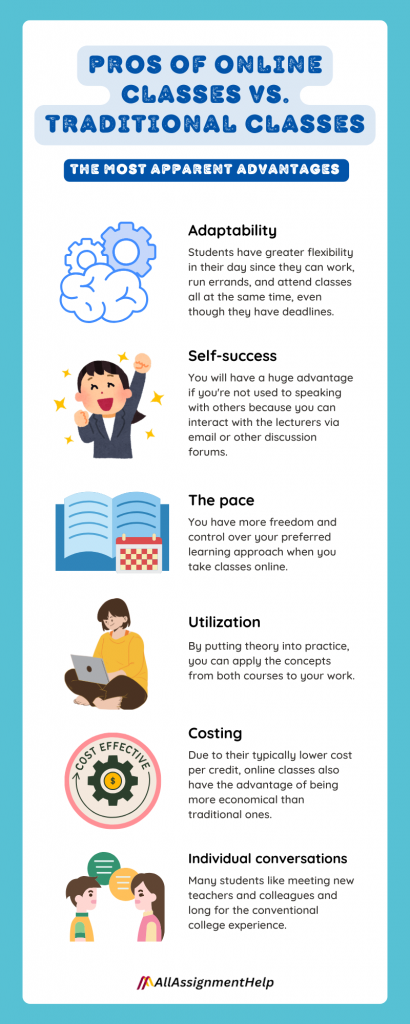
Following are some of the most apparent advantages of these two approaches are listed below:
Adaptability
Flexibility is among the biggest benefits of taking classes online. Students have greater flexibility in their day since they can work, run errands, and attend classes all at the same time, even though they have deadlines. Additionally, they have the freedom to decide when they want to study, complete homework, attend lectures, etc. This also enables students to finish the assignments at their own pace and log into the course whenever they choose.
Since students must physically attend classes, traditional learning environments are less flexible. While this results in a more rigid schedule, there are some accommodating choices available, such as enrolling in a college or institution that lets you design your own schedule.
Self-Success
Both strategies offer benefits in terms of learning styles. Students can work independently without interacting with peers or teachers when they learn online. For kids who struggle with social anxiety or who learn best on their own, this is perfect.
You are in an advantageous position if you’re not used to speaking with others because you can interact with the lecturers via email or other discussion forums.
The ability for professors to allocate students to work in groups, in pairs, or alone makes traditional learning advantageous as well. You may always learn from and alongside other students. But since you’ll be in school all day, you’ll undoubtedly meet new professors and students and pick up social and independent skills.
The pace
You have more freedom and control over your preferred learning approach when you take classes online. Adjust your pace to suit your demands if you work long hours and are busy. Students are free to read and work on the tasks at their leisure throughout that period, without any interruptions. They can also take two classes at once or one class at a time.
Because you have to be consistent and attend classes according to the prescribed timetable, traditional classes are less flexible than online schools. If, however, you find it difficult to keep up in an online course, traditional learning may be a better option. You might be able to take your classes at night, depending on the kind of instructor and classroom you are in.
In case you are unwell and not sure whether will be able to attend your online class, you might be thinking I want to pay someone to take my online class for me. You certainly can do that! Online class takers are available round the clock to take you out of such a stern situation and help you save important marks associated with the class. Be it any class, just write on the internet and get a professional to do it for you at a highly pocket-friendly cost.
Utilization
It’s not always easy to put what you study in traditional or online education into practice. Because of their abilities and expertise, many students are able to secure employment before completing their degree. Nonetheless, by putting theory into practice, you can apply the concepts from both courses to your work.
Costing
Due to their typically lower cost per credit, online classes also have the advantage of being more economical than traditional ones. The teacher doesn’t have to work a full-time job in order to teach the class, which results in a lower cost. Simultaneously, an increasing number of online courses are available at the same price as a typical school or college education.
While traditional education has its value, it is also costly. Because they don’t require extra expenses for things like training facilities, printed materials, or employing an instructor, online classes are more economical. Therefore, when we see online vs traditional education costs, online classes or online ways of study are way more cost-effective and thus, preferred by many students.
Individual Conversations
Many students like meeting new teachers and colleagues and long for the conventional college experience. As a social learner, you will benefit from one-on-one interactions in a traditional classroom setting.
The main misconception regarding online learning is that it doesn’t require any form of communication. In actuality, you can still communicate with your lecturers and fellow students because they are physically present in front of you. Online courses make use of additional tools like Blackboard and video tools to improve student discussion, brainstorming, and communication.
There are several pros related to online studying and once you opt for it, you can surely get much help from various internet resources.
Read more: Role of Online Classes in Career Advancement and Upskilling
Cons of Online Classes vs. Traditional Classes
It may take some getting used to taking classes online if you’ve never done so before or if you’ve just started.
Some typical drawbacks are to be expected, which are detailed below:
Reduced Coordination
Social connection in online classes is lacking, at least from a conventional standpoint. Even though you are unable to attend office hours or have conversations with your peers in the corridor, you are still able to communicate digitally.
You can still communicate with your professors and students in most online classrooms since they use group projects, livestreaming, video chat (Zoom or Google Meet), and other methods.
In many cases, it has been observed that due to limited coordination, students are hesitant to talk to their professors about an issue that they have with a particular subject or topic. This issue can become very serious when they have an online exam in it and they feel highly scared. It is always preferred to sort issues out instantly. However, if you have an exam in a day and are not able to sort out a specific issue with your instructor, instead of getting perplexed, write Take my online exam for me to online class help sites to find top-notch online exam experts to get instant help and relief. They can take your exam on behalf of you and help you save important grades in it when needed.
Engagement
Two advantages of traditional classes are growing your professional network and gaining practical experience. Sadly, there are fewer networking chances when you attend online courses, which puts you at a disadvantage.
If so, you will have to invest a significant amount of time and energy in searching for online universities that offer mentorship programs, let you connect with groups for professionals, and have a robust employer network.
Optimism
Given that every learner is unique, motivation is one of the most contentious drawbacks of these two methods of instruction. While some people appreciate online deadlines, others find that in-person meetings are more motivating for them. Many students find that they are more driven to finish jobs or assignments when they are in the company of classmates and teachers.
Setting personal deadlines might help you stay more motivated and prevent you from putting things off until the last minute. Another way to establish a private online learning environment is to eliminate any unnecessary distractions.
Being focused
In a classroom full of students and your teacher, it’s simple to maintain concentration, but what about online learning? If you are preoccupied with anything else or have other priorities, you are more likely to become side-tracked when studying remotely. Once more, we advise designating a specific area to get rid of any distractions, so take down your phone, TV, and anything else that could divert your attention from your studies.
The cons discussed are quite practical in nature and can give students a tough thought. It is a must for students to think which way they want to pursue their higher education. Once they are clear with this answer, it will be way easier for them to select between the online and traditional courses.
Conclusion
You should be aware that a variety of factors can affect the setting for learning in both traditional and online programs. Usually, it comes down to your priorities and degree of classroom flexibility. When considering Online classes vs traditional education, traditional classrooms offer structured interaction and face-to-face guidance, while online programs provide convenience, flexibility, and access to resources such as online assignment help, which can help you manage coursework effectively.
The final decision is yours and will rely on your preferences; however, it’s important to remember that every learning method has its pros and cons. By carefully weighing these factors and making use of services like online assignment help, you can optimize your learning experience. Ultimately, there is no single “right” answer in the Online classes vs traditional education debate—the best choice is the one that fits your goals, learning style, and lifestyle.
Read more: Which One is The Best Master’s Degree – MBA or M.Tech?
Frequently Asked Questions
| Question 1: What are the key differences between online learning and traditional learning? Answer: Online education can be more flexible, accessible, and individualized than in-person instruction, but it also calls for a high level of self-discipline and may not provide face-to-face connection. On the other hand, an organized learning environment and active engagement are promoted by traditional learning. |
| Question 2: Is online study good or bad? Answer: You can complete the coursework at your own pace, as you see fit, and in a method that best fits your learning style with online classes. One of the main advantages of taking lessons online is that you can learn at your own pace, giving you complete control over the process. |
| Question 3: What is the conclusion of online education? Answer: The emergence of online learning has revolutionized the field of education, presenting both new opportunities and difficulties for conventional educational establishments. Access to education has been democratized by online learning, which has increased affordability, flexibility, and accessibility. |
Connect the explanation to the work your course actually requires
Use this guide beside the exact brief, course material and marking criteria for Online Classes Vs Traditional Education an in Depth Comparison.
- Name the course and current module.
- Include the platform instructions.
- Follow the instructor's method.
- Use the exact local deadline and time zone.
Earl Anderson
Artificial Intelligence · 5.0/5
Students working on a brief connected to “Online Classes vs Traditional Education - An In-depth Comparison” may compare the requirements with Earl Anderson’s live Artificial Intelligence profile.
Artificial intelligence tutor whose established profile includes MATLAB and machine learning.
View established tutor profile ↗Relevant subject areas
- Artificial Intelligence
- Machine Learning
- MATLAB
Find another explanation across the complete blog
This search uses WordPress itself, so it can reach articles beyond the 20 shown on the dashboard.
Connect Online Classes Vs Traditional Education an in Depth Comparison to the task in front of you
Keep the brief, marking criteria, required evidence and submission format visible while you work.