Time Management-Let’s Learn This Amazing Art
What this article will help you understand
With the world moving so quickly, time has become one of our most precious and important assets. Whether you are a professional trying to meet deadlines, a student juggling numerous tasks, or someone seeking a better work-life balance, understanding the art of time management is essential. Thus, learning time management skills is essential, as it
What are you trying to do with this topic?
Choose the closest task and the page will point you towards a useful next step.
Start with the central concept and the terminology used in the article.
Open the closest route ↗Connect the explanation to the question, learning outcomes and marking criteria.
Open the closest route ↗Review evidence, structure, referencing and the exact submission requirements.
Open the closest route ↗Do you have enough information to begin?
Select what you already have. Nothing is submitted from this checklist.
When these details are together, the requirement can be reviewed in context.
Assignment Help USA ↗Table of Contents
With the world moving so quickly, time has become one of our most precious and important assets. Whether you are a professional trying to meet deadlines, a student juggling numerous tasks, or someone seeking a better work-life balance, understanding the art of time management is essential. Thus, learning time management skills is essential, as it enables you to better organise your life.
Finding a healthy work-life balance, meeting deadlines, and exploring new ideas are all made possible by honing your time management skills. Learning a few time management techniques will help you plan how to achieve your goals and lessen stress if you feel overburdened and overworked.
In this blog post by All Assignment Help, you will explore the art of time management, its meaning, importance, and practical insights. You might be wondering, art? How can time management be considered an art? Well, it truly is. Those who have learnt this art often find greater happiness and success in life. To illustrate this, let’s look at some inspiring time management quotes from successful and renowned personalities:
“A man who dares to waste one hour of life has not discovered the value of life”- Charles Darwin.
“Defer no time, delays have dangerous ends”- William Shakespeare.
“Never leave til tomorrow, which you can do today”- Benjamin Franklin.
“Make use of time, let not advantage slip”- William Shakespeare
What Is Time Management?
The ability to manage one’s available time effectively and efficiently to complete activities and reach objectives is known as time management, and it is an essential skill. Planning, organising, setting priorities, and managing your time are all part of it to increase output and reduce wasted time.
Good time management not only enables people to finish tasks and adhere to deadlines, but it also lowers stress, improves attention, and improves work-life balance.
Basically, time management is the process of consciously choosing how to divide your time according to the significance and urgency of your responsibilities. It entails establishing defined time blocks for each work or activity after dividing them into more manageable, smaller parts.
Being a student, it can be a very difficult task to manage time while managing everything. Since students are required to finish many assignments, homework and projects in their academic days, they find it very hard to manage and submit them on time. Thus, they turn to online assignment help services to finish their task promptly.
Read Here: Time Management Strategies: Organise Tomorrow Today
Has The Time Management Definition Expanded?
Yes, today, the time management definition has expanded to encircle our personal and working lives. Good time management leads to improvement of your work and personal life balance, and thus it leads to happiness.
In general terms, time management refers to the growth of processes and tools that increase productivity and efficiency. If you are a business person then, you should know time management definition. You should be able to judge how your time is spent and then you just have to prioritize tasks to increase personal efficiency in your workplace.
Your time management should not only be just dividing your time amongst the tasks, but the results should also be effective. There should be an effective time management. To learn this, let us first see what time management is.
What Are The Skills Required For Good Time management?
Effective time management enables you to make the most of your time and accomplish your goals. These might assist you in effectively allocating your time and completing tasks. The following are some of the most crucial abilities for effective time management:
- Organisation
- Prioritsation
- Goal setting
- Communication
- Planning
- Delegation
- Stress management
- Flexibility
Developing strong management skills allows students to stay productive and reduce stress. However, with multiple assignments and tight deadlines, it’s not always easy to manage everything alone. This is where expert help online becomes a reliable solution. For example, if you are facing a problem while doing your essay or you don’t have much time to write your essay, then you can get essay help online and ease your academic burden.
How Can You Improve Your Time Management Skills?
It can be challenging when you have limited free time and numerous work and personal responsibilities. Whether you’re an executive or looking for a career, having superior time management skills can make you a stronger employee and a competitive applicant for new positions. The following are some strategies to help you become a better time manager:
- Prioritise your assignments
- Prepare a schedule and follow it strictly
- Set some boundaries for yourself
- Fix deadlines
- Set long- and short-term goals
- Manage your calendar effectively
Why Is Time Management Important?
The process of deliberately planning and regulating the amount of time spent on particular tasks in order to improve efficiency is known as time management. You may be used to creating to-do lists, giving yourself small rewards for completing specific tasks, and setting deadlines.
One of the most important aspects of time management is self-motivation. It requires some work to develop positive habits that will help you work and live more effectively.
Knowing the finest practices and solutions available will help you develop positive routines and habits. To determine what works for you, you can try them out in your own life.
Promotes high levels of productivity
Since you are not allowed to waste time in high school or college, you must be extremely productive. It is possible that you have multiple assignments, and you can only finish them if you are productive.
Being productive and doing all of your work on time might be very challenging if you have a lot on your plate and require assistance with time management. Ignoring the assignments will cause them to pile up, forcing you to deal with them in a frantic manner, which is not good for your health. You will have enough time to complete all of your tasks without missing anything if you practise time management.
Encourages Efficient Decision-Making
You are more likely to make a poor choice when you are not rushing and require more time to fully consider your options. For this reason, it’s critical to have good time management skills to make timely and educated judgments.
To avoid regretting your choices later, plan your time so that you have enough time to deliberate and consider them.
Improved Work-Life Balance
To help you consider both sides of an issue, work-life balance, also known as school-life balance, is essential. When you work efficiently, you can finish your assignments ahead of schedule and go on to other things.
You will be able to take care of your personal and professional lives since you will have all the spare time you require. Maintaining a balance and avoiding procrastination can be achieved by increasing your productivity and managing your tasks within the allotted time.
Boosts Self-Control
Having self-discipline is important for your work ethic. Everyone procrastinates, but those with the proper self-control know when to stop.
You have to force yourself to focus on what you are doing and prevent yourself from becoming sidetracked when managing your time.
Reduces Stress
You probably experience stress when you’re behind on your work since you’re worried about how you’re going to finish everything. You must effectively manage your time so that you can concentrate on your work without worrying about whether you will finish it by the deadline. Make use of the right time management resources to drastically reduce your stress levels.
More energy for leisure time
Good time management techniques help you avoid wasting energy wondering about whether you can complete all of your work for the day by letting you know when a task will be finished. You can schedule time for a break from your daily schedule instead.It preserves energy for your leisure time by using time management to schedule when you will finish your work before beginning it. You may ensure that you’re conserving time for yourself and enhance your work-life balance by having more spare time.
Achieve everyday goals
You may streamline your day and spend less time determining what to do or how to do it by using time management to arrange your daily tasks. For instance, it could be beneficial to determine what has to be done for each stage before starting a difficult project with an outline that calls for several, yet unclear, processes. The project then reduces to a straightforward set of tasks that give guidance. You may avoid wasting time figuring out your goals on the fly by planning them beforehand. This can result in more time spent working on your goals rather than pondering them.
Better concentration
Developing good management skills can help you concentrate better at work. Since each task has a designated time slot, allocating a certain amount of time to a project or task helps you avoid juggling too many obligations at once. Additionally, time management enables you to plan out your daily responsibilities in a way that maximises productivity and maintains focus. For instance, you might work on intensely concentrated projects in a low-traffic area of the workplace or respond to emails in a quiet room at home.
So, it’s all about organising and managing things, giving each thing a specific amount of time so that you don’t have to ask someone to do my online class for me or help me with completing my assignment at the very last moment. To make it effective, you need to know which is more important.
How to Eliminate Non-Priorities in Life?
Time management definition also includes, how to eliminate tasks that are non-valuable to you. Lists are not the only key with which you can gain productivity, as most people spend more time making a list, rather than following what’s on it. It is important for you to know that just making lists won’t work. You have to take action on it.
Changes are very hard to make. But, if you need effective results, then you need to follow the changes and walk on the path of productivity. Certain factors affect the management of time. This includes:
- Lack of clarity or lack of uncertainty, guilt, avoiding current tasks.
- Doing tasks with high expectations than their worth.
- It also includes tasks that need support and time etc.
Try to look into these factors and find out which part you need to change and thus, it will surely help you.
Ways for Effective Time Management
Now that we have talked a lot about the importance of time management, here are different ways in which you can apply the art of time management and get effective benefits from it.
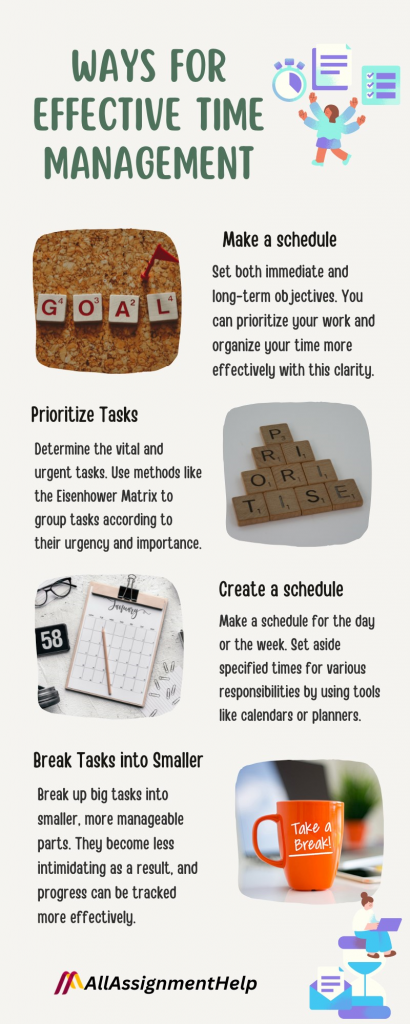
- Set Clear Goals: Set both immediate and long-term objectives. You can prioritize your work and organize your time more effectively with this clarity.
- Prioritize Tasks: Determine the vital and urgent tasks. Use methods like the Eisenhower Matrix to group tasks according to their urgency and importance.
- Create a Schedule: Make a schedule for the day or the week. Set aside specified times for various responsibilities by using tools like calendars or planners.
- Break Tasks into Smaller: Break up big tasks into smaller, more manageable parts. They become less intimidating as a result, and progress can be tracked more effectively.
- Minimize Distractions: Determine your sources of distraction and reduce or eliminate them. This includes disabling notifications, locating a quiet area to work in, or utilizing productivity software that blocks particular websites or applications.
- Practice Time Blocking: Set aside particular time periods for various tasks or activities. As a result, concentration is maintained and activities don’t overlap or take longer than they should.
Effective management of time is a skill that requires practice and adaptability. Experiment with different techniques to find what works best for you and be open to adjusting your approach as needed.
Also Read: 8 Best and Unique Ways for Time Management
Concluison
Being able to manage their time well gives people the ability to take charge of both their personal and professional lives. People can successfully cope with the complexities of the modern workplace and attain long-term success by establishing clear goals, simplifying duties, prioritising tasks, utilising technology, and upholding a healthy work-life balance. According to the old saying, “Time is what we want most, but what we use worst.” The secret to realising its full potential and optimising the path to both career and personal fulfilment is becoming proficient in time management.
FAQs
Q: What impact does multitasking have on time management?
A: Multitasking might make it harder to manage your time. While it may appear to be a productive technique to complete several activities at once, it often results in diminished attention, lower productivity, and higher mistakes.
Q: Why is managing time important for students?
A: It helps students stay organised, reduce stress, and complete assignments on time.
Q: How can technology help in managing time?
A: Time management may be considerably helped by a range of tools and offerings provided by technology. Planning, creating reminders, and organising work may be made easier with the use of calendar applications, task management software, and productivity apps.
Q: How can I improve my time management?
A: Set clear goals, make schedules, minimise distractions, and use time-blocking techniques.
Connect the explanation to the work your course actually requires
Use this guide beside the exact brief, course material and marking criteria for Time Management Definition.
- Select the relevant framework.
- Apply it to the case or organisation.
- Use evidence for analysis.
- Make realistic, supported recommendations.
Anita Sahay
Management
Management tutor with a finance management background and professional financial advisory experience. Master’s in Finance Management, University of Manchester (2017)
View established tutor profile ↗Relevant subject areas
- Finance Management
- Management
- Financial Advisory
Find another explanation across the complete blog
This search uses WordPress itself, so it can reach articles beyond the 20 shown on the dashboard.
Connect Time Management Definition to the task in front of you
Keep the brief, marking criteria, required evidence and submission format visible while you work.