
Table of Contents
The college years are usually associated with lecture halls, exams, and countless essays. However, for some students, campus life is the perfect time to give entrepreneurship a try. On campuses, young pioneers are launching businesses to fund their studies and potentially become successful entrepreneurs. Why? College offers resources, networks, and freedom to experiment with less risk than you will find later in life.
It can be overwhelming to think of starting a business while attending a class, but it can be equally fulfilling. It teaches you how to solve problems, use time, and think creatively. In this blog by All Assignment Help, we will explore the practical and actionable steps on how to start a business in college.
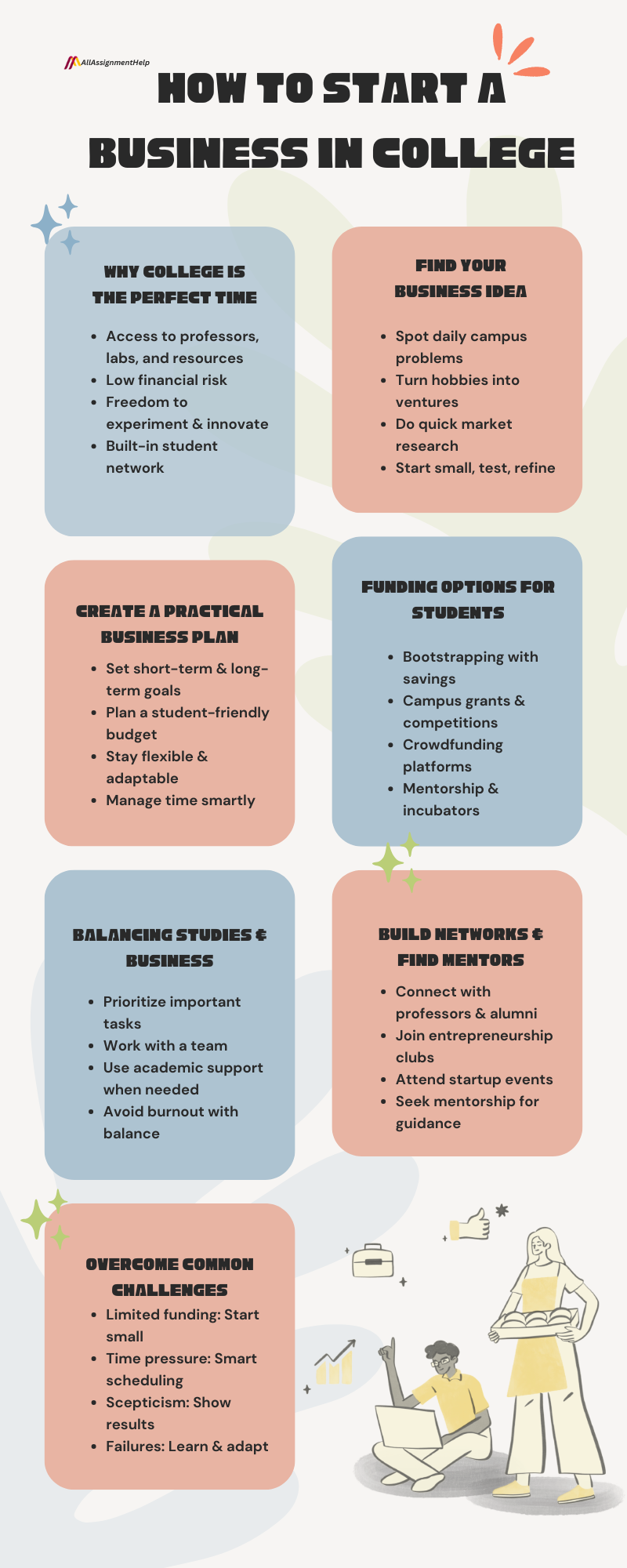
Why College is the Perfect Time to Start a Business
Most people think that you should put your entrepreneur hat on after graduation, but college is one of the best times to leap.
- As a student, you have resources that most professionals would want later in their lives.
- From libraries and research labs to entrepreneurship cells and innovation clubs, campuses are full of opportunities for testing ideas and gathering feedback.
- Additionally, professors, alumni and peers serve as a readily available network that can advise and encourage your business.
- It also has the benefit of low risk. Most students are not saddled with heavy financial responsibilities, so they have the flexibility to experiment.
- Regardless of whether the business idea is a flop, the failure is a valuable lesson in itself.
However, managing studies and business can be a tough thing to do, but for sure, there are some solutions. For instance, to get some more time, you can always take help from student support services like online assignment help. Nowadays, many student entrepreneurs are seeking support from these services. Hiring academic help as needed leaves you with more energy for growing your startup and keeps grades in check.
Also read: Top 70 Entrepreneurship Research Paper Topics for Students in 2025
Identifying Your Business Idea
The first step in the process of thinking about how to start a business in college is to identify a business idea. Every great start-up starts with a great idea, and college is a great place to spot one. Begin by thinking about your campus. What are the issues that students deal with daily? Many of today’s most successful companies were born from solving small but widespread problems.
Apart from this, you could always go with what you are interested in your own life, or what your hobbies are. For example, if you love photography, you could do cheap photo sessions for students and events. Also, if you have a passion for technology, then app development is a good option. So the key is to choose something you like because real passion will carry you through when things are hard.
Market research is equally important. Discuss with classmates, conduct rapid surveys or build a small prototype to test if your idea is viable. In addition to this, do not overlook support systems. Many students juggle overwhelming schedules and have to work extra hours to concentrate on their start-ups. In such a case, they require online class help to handle their studies more efficiently and have more time to dedicate towards getting their business off the ground.
Creating a Practical Business Plan
Once you have your idea, the next step is to map it out with a simple but workable business plan. Your plan does not have to be a hundred pages. As a student entrepreneur, you should focus on being very clear and taking action. So, if you think about how to start a business in college, begin by establishing your short-term goals that you can accomplish in the next three to six months. Next, describe the long-term vision of where you want the business to be in two or three years.
Furthermore, budgeting is a critical part when starting a business. Students generally work with tight budgets. Therefore, you must think lean. You can lean on free tools, take advantage of borrowed campus resources and reinvest early profits. Moreover, your plan also needs to be flexible.
Another important aspect is time management. It can be hard to stay focused between classes, assignments and exams. Especially during exam seasons, student entrepreneurs tend to be underprepared and have thoughts like, Can I hire someone to do my online exam? Hiring professional help services assists them in organising their schedules better. One right guidance when things are stressful can free up some time to work on your startup without having to slum it on grades. Hence, we can say that a strategic business plan helps you move beyond the plan and deliver your products or services.
Funding Options for Student Entrepreneurs
For student entrepreneurs, one of the biggest obstacles is figuring out how to get their hands on the cash to launch. The good news is that there are numerous funding pathways designed specifically for young innovators in the current college environment.
- The first and most obvious way is bootstrapping. It means using savings or diverting any minimal profits back into the business. Although this may be a discipline, it means you are in control of your enterprise.
- Colleges themselves are also rich sources of help. Most schools operate entrepreneurship cells, innovation labs or pitch competitions that award grants or seed funding to student startups. You get the funds, plus some recognition and credibility.
- Off-campus services, such as crowdfunding, are a way to pitch your idea to a much larger crowd while getting funds who believe in your idea.
- Likewise, incubators and angel investors are always searching to find academia-originated student innovation to mentor and sponsor.
Now, let us be real here, it is hard to juggle business and still catch up with work in school. As a result, some students turn to services like business management assignment help to ensure they are up to date when it comes to assignments. Juggling both worlds is a bit easier with the right support systems in place. Also, a proper funding mix can help you turn business dreams into reality. So, if you are wondering how to start a business in college, this is your time.
Also read: Highest Paying Business Degrees to Attain Long-Term Success
Balancing Studies and Entrepreneurship
It is an exciting but challenging experience to launch a business as a full-time student. Time is a challenge for most student entrepreneurs. It is overwhelming to go to class, take exams and run a business, and you can feel like you are losing your head. That’s why learning to prioritise is important. Focus on what is most important, both related to your classes and your startup.
Teamwork can also delegate the load. Since you work alongside classmates or your friends, you can divide tasks and rely on other members for their strengths. Doing this saves time, and it reflects the way business works in the outside world.
Furthermore, another wise thing to do is seek out academic help when you begin to feel overwhelmed with your work. For instance, if your class resources contain financial analysis or budgeting, you can acquire those skills for your entrepreneurial venture with the support of financial management assignment help.
Building Networks and Finding Mentors
No business can grow without networking. College itself is an incredibly valuable network hub. You have professors, alumni, peers, and guest speakers of all types who are churning out great knowledge. Moreover, you can create connections by becoming a card-carrying member of an entrepreneurial club on campus, going to university-hosted workshops, and getting involved in start-up competitions.
But the hand of a mentor can, to some extent, be worth more than a book. The mentor navigates you through tough times, helps to clarify your thinking on things, and can steer you from mistakes others have already made. Finding the right balance between academics and connections in school can be difficult. Accordingly, the majority of students need entrepreneurship assignment help so that they can socialise without hurting their education. The relationships you develop in college, whether with colleagues or professors or friends, may lead to funding and long-term career development.
Common Challenges and How to Overcome Them
The thought of starting a business while you are in college may be an exciting one, but there are some challenges.
- If you wonder how to start a business in college, one of the greatest obstacles is a lack of money. With poor access to large amounts of capital, scaling can be more challenging. So, the answer is simple: gradually reinvest profits and consider college grant or competition funds as a kick start.
- Another barrier to launching a business during college is the time pressure. We know being an entrepreneur and taking classes can sometimes be overwhelming. The remedy to this situation is prioritising, utilising time wisely, and delegating some of the tasks to do the college homework whenever it is necessary.
- Friends and family members’ scepticism can also bring down the enthusiasm of young entrepreneurs. But persistence matters, and it moves you closer toward creating credibility and trust.
- Disappointments and failures are simply a reality of conducting business. Instead of seeing them as obstacles, see them as something you can learn from. And every time you fail, you have fundamentally learned something that defines your thoughts and makes you a more ruthless entrepreneur.
The inevitable lows require student entrepreneurs to plan and strategise ahead. Moreover, you should be resilient and focus on the bigger picture.
Success Stories of Student Entrepreneurs
Oftentimes, there is nothing more motivating than to see what other students have been able to accomplish. The founder of big companies worldwide began as a mere college project.
The prospects of Facebook changed over the decade when Mark Zuckerberg founded it from his Harvard dorm room and transformed it from a niche tool for networking on college campuses into one of the largest social media platforms. Similarly, Drew Houston started Dropbox out of MIT as a solution to file storage and sharing that he experienced daily.
However, not all success stories are tiny billion-dollar giants. Throughout universities, innumerable students have launched smaller, though still impactful, enterprises. These are tales that show you do not necessarily need hundreds or thousands of dollars in funding or years of experience to get started. Hence, what you need is an idea and the will to make it happen.
Conclusion
Launching a college business can feel intimidating. But it is one of the most beneficial things you can do for your future. It is how you learn to solve problems and lead and persevere, whether your business is a success or a failure. Just know this, you do not need to wait for the “perfect time,” the ideal moment or limitless resources. Plus, you do not have to wait until after college to be an entrepreneur; you can start now. There is power in starting with confidence, but once you take that first step forward, no matter how small your idea, it has the potential to turn into something great.
Frequently Asked Questions
Question: Why is it a good idea to start a business in college?
Answer: College provides resources to you, such as mentors, labs and student networks. It is also a relatively low-risk environment where students can take risks, experiment, fail, and learn without being stressed about finances.
Question: How to handle college and entrepreneurship together?
Answer: Juggling both demands good time management, priorities and even academic aid at times. Tools and services such as assignment help relieve busy schedules regarding business and keep the grades consistent.
Question: What are some low-investment business ideas for college students?
Answer: Some popular student business ideas are tutoring, freelance writing, app development, event planning, marketing and digital marketing services. The best ideas often derive from addressing the day-to-day problems on a campus.
Question: How much money do student entrepreneurs need to launch?
Answer: The vast majority of student businesses start small, with little or no investment. You can start through bootstrapping or with money you are awarded through campus grants and competitions. Crowdfunding and mentor programs are also low-cost fundraising options.