Table of Contents
The demand for online classes is growing as students look for more flexible, less-expensive alternatives of traditional education. But even the cost of online education can pose a barrier. This is where financial aid comes to the rescue to keep higher education within reach for more students. The Free Application for Federal Student Aid (FAFSA) is one of the biggest resources that students have. FAFSA opens the door to grants, loans and work-study programs that can help offset the cost. In this blog by All Assignment Help, we will learn how FAFSA functions and how to make the most of it to earn a degree online at a lower cost.
What is FAFSA, and How Does it Help Online College Students
The Free Application for Federal Student Aid (FAFSA) is the federally mandated form completed annually to determine financial aid eligibility. This assistance may be available in the form of federal grant aid, work study aid and low-interest student loans. FAFSA is also for more than just on-campus students, which means that accredited online college students can apply for FAFSA and receive help.
Key benefits of FAFSA for online students
To receive FAFSA, students provide details about their income, family size and financial status. The information is then used to calculate the Expected Family Contribution (EFC), which schools use to decide how much aid a student can get. Even students from middle-income families often qualify for some form of aid.
- Online students benefit from FAFSA as it allows them to focus on their studies instead of being overwhelmed with the cost of tuition.
- Many online students work, have families, and are doing coursework. For this reason, a sense of financial support can help make the education seem manageable.
- FAFSA information is also used by many states and schools to award scholarships and grant aid that open doors to potential financial help.
In today’s digital learning landscape, combining financial aid with tools such as online assignment help offers additional relief from the burden of academic pressure. FAFSA reduces financial burden, and assignment writing services help students to complete their coursework on time. Collectively, these resources ensure that students can pay for their online programs and graduate with a sense of pride and confidence.
Also read: How to Save Money with Affordable Study Abroad Programs
How to Apply for FAFSA for Online Colleges: Step-by-Step Process
FAFSA can be daunting to apply for, but if you take it step by step, then it becomes much less daunting. By following a process, students can defeat stress and enjoy learning.
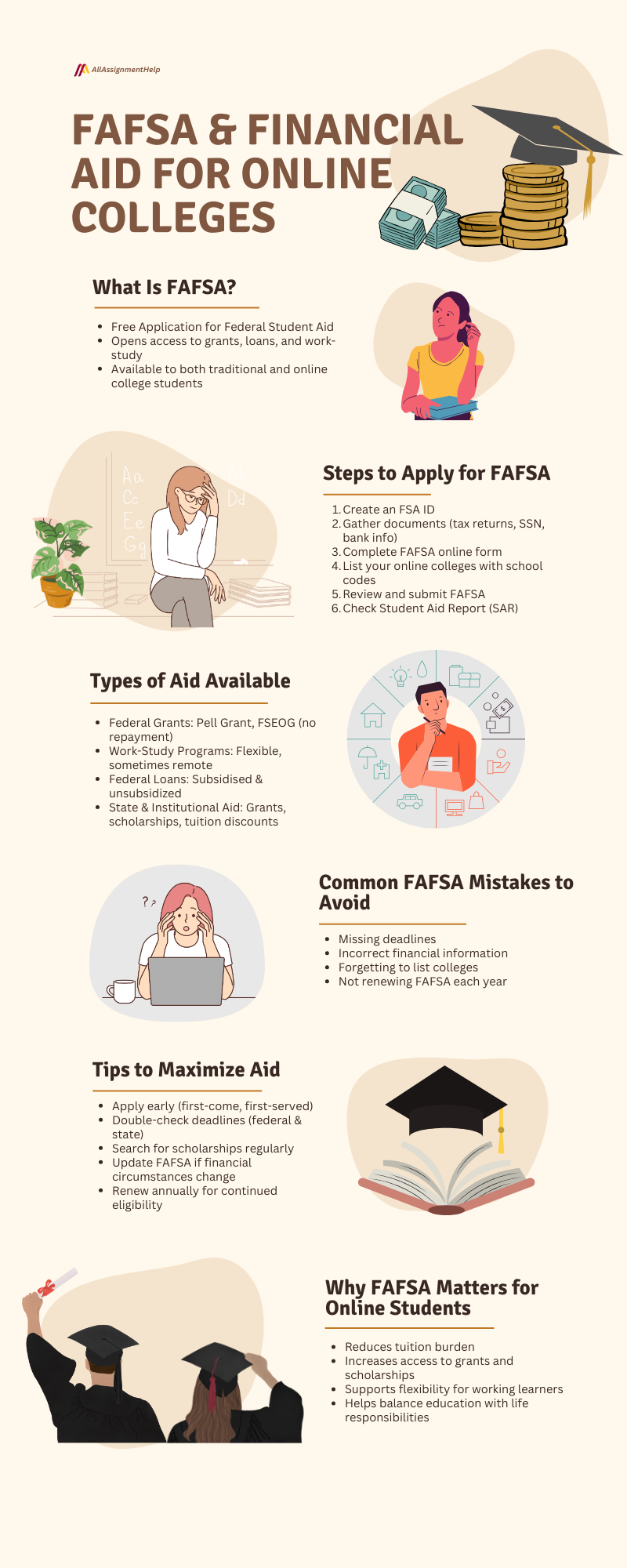
Step 1: Create an FSA ID
To enter the FAFSA funnel, students must get a Federal Student Aid (FSA) ID. This is a digital signature and provides access to the FAFSA on the Web application. The student and at least one parent should have their own FSA ID.
Step 2: Collect the necessary documents
Collect all of the paperwork you will need, including tax returns, a social security number, bank statements and documentation of untaxed income.
Step 3: Fill out the FAFSA form
Head to the government-run FAFSA website and fill out the form as accurately as possible. Provide personal information, details of your financial profile and note the online colleges at which you intend to use the voucher. Precision is of utmost importance, as errors might postpone approval of assistance.
Step 4: List your online colleges correctly
Make certain you add the federal school codes for every online school on your FAFSA application. Colleges, after that, can see your information to determine whether you are eligible for federal and institutional grants and loans.
Step 5: Check and submit your FAFSA
After filling out the form, recheck all information and send it before the last date. You will get a Student Aid Report (SAR) that reviews your application details. Look over it and make any needed corrections.
Ultimately, combining FAFSA and services such as online class help can be very beneficial to students who take on more than one online course, but face difficulty in meeting deadlines.
Also read: How To Fill Out FAFSA: A Guide for Students
Types of Financial Aid Online Students Can Get Through FAFSA
Given below is a list of financial aid that you can get through FAFSA.
Federal grants
Federal grant is among the best financial aid available, and this is because it is a gift to the student which doesn’t require to be repaid. The Pell Grant is a big handout for eligible undergrads, and the Federal Supplemental Educational Opportunity Grant (FSEOG) is for undergrads with the greatest financial need. Such grants can be quite powerful in suppressing the cost of tuition for online students.
Federal work-study programs
Work-study programs allow students to earn money and get some hands-on experience as well. A number of them are flexible and allow for remote work. An ideal companion for busy online students juggling work, family, and other obligations alongside their college coursework. The assistance not only reduces financial pressures but also develops professional expertise.
Federal student loans
Federal loans, both subsidised and unsubsidized, can bridge the gap between tuition and other financial aid. Although loans are not usually forgiven, they generally have lower interest rates and are more flexible than private loans.
State and institutional aid
A lot of states have grants or scholarships for students who attend school online. Plus, some schools offer their own institutional financial aid or merit-based awards. Students can also maximise available funds by investigating state and college-specific programs.
Academic support alongside financial aid
Solving financial issues is not the only thing students are looking for. Online coursework can be difficult to handle, and hence, it requires a solution for that too. For students who are perpetually running out of time to make deadlines or to keep afloat on exams, they often think, Should I ask an expert to do my online exam? Academic services assist students in finishing their exams and assignments quickly, in good format, and to perform well.
Other Financial Aid Options for Online College Students
Although FAFSA includes a variety of federal- and state-based programs, online learners may consider alternative types of funding that can help lower the cost of their education.
Scholarships
These are merit-based or need-based funds that do not have to be repaid. It is tailored to students who want to learn online, or for students who are working, or considering specific fields of study. Those who continue to seek out available scholarships can help fund their education.
Employer tuition assistance
Some businesses provide their employees with online degree tuition reimbursement or education assistance programs. These courses may be fully or partly subsidised for students, so it’s easier to manage work and study.
Private student loans
If necessary, private loans from banks or financial institutions can help fill any gaps left by federal aid. Though these loans may have a higher interest rate than federal loans, they help bring the cost of tuition within reach when other forms of funding are insufficient.
Institutional aid from online colleges
Many online schools offer their own grants, scholarships or academic reductions as a way of promoting registration. Such programs frequently take into account academic grades, choice of program, or financial need.
In addition to this, challenging courses can also be a matter of concern for online students. Moreover, it can add to the financial struggles. For example, if you are studying finance and find the subject complex, then you would require academic assistance. Hence, you must always look for cost-effective finance assignment help to manage studies within the budget.
FAFSA Challenges and Mistakes Online Students Should Avoid
Completing FAFSA can be quite tough when online learners encounter special roadblocks that could impact their federal aid qualifications.
- Missing deadlines, both federal and state and losing funding are among the most common errors.
- Another common problem is that people provide wrong information or not enough information, which can slow down processing.
- Online students also often mistakenly believe that if they are enrolled in an online program, they will be ineligible for some kind of aid, but that’s not the case for accredited schools.
- Also, missing the deadline to renew FAFSA every year can lead to funding gaps, particularly when a program of study spans multiple years.
By steering clear of these mistakes, online students can optimise their FAFSA results and spend less effort following the degree program.
In addition to this, if you are someone who is facing academic troubles in subjects like business economics, human resources, and software development, you can check out assistance through business economics assignment help, human resources homework assistance, etc. Financial trouble is already enough; you should not suffer with the academics as well.
Tips to Maximise Financial Aid for Online Learning
You need to plan to maximise financial aid for online study.
- First, you need to do it early. A lot of federal and state aid is first-come, first-served, so the sooner you file your FAFSA, the better your chances of getting as much aid as possible.
- Second, stay organised with deadlines. Monitor federal, state and institutional due dates, since even missing one can directly impact the aid you receive.
- Third, look out for scholarships. Some scholarships are open to online students and can help offset FAFSA funding, whether merit-based or need-based. Consistently appearing at scholarship gateways and school notices may present you with additional money tools.
- Fourth, insist on reviewing the details of your financing. Reviewing entries and applying income and family changes allows you to make the correct computation of your EFC.
- Finally, renew FAFSA annually. With changes in financial circumstances, families face, by reapplying every year, you will be able to maintain your eligibility for grants, loans, and work-study programs.
Conclusion
FAFSA is a lifeline for online education, for all-comers from all across the country. In addition, families can also qualify for significant tuition and other savings by enrolling their children in work-study and student loan programs. Online students who qualify for FAFSA aid and access to state aid, scholarships and other institutional resources can focus on their academics instead of their bank accounts.
Frequently Asked Questions
Question: Am I eligible for FAFSA as an online student?
Answer: Yes, students enrolled in online accredited colleges are eligible to apply for FAFSA and are treated no differently than traditional students for federal grants, loans and work-study money.
Question: What sort of financial help does FAFSA provide?
Answer: FAFSA opens the door to federal grants, work-study programs, and subsidised and unsubsidized loans, and sometimes state-based online student aid.
Question: How can I get the most financial aid for online college?
Answer: Be proactive with your submission, meet their given deadlines, provide only your concrete financial information, and also seek scholarships available. Moreover, always make an application for FAFSA every year so that eligibility will be maintained.
Question: Do I have to fill out FAFSA every year?
Answer: FAFSA needs to be refiled every year to stay eligible for federal, state, and school aid programs for online studies.