Data Communication Explained: Elements, Types, and Why It Matters
What this article will help you understand
Language has always been the foundation of human communication. Today, with rapid technological advancements, the way we connect has transformed dramatically. Communicating with people across long distances is no longer a challenge; it is instant, seamless, and more dynamic than ever before. Modern tools such as mobile phones, messaging platforms, and digital networks have made
What are you trying to do with this topic?
Choose the closest task and the page will point you towards a useful next step.
Start with the central concept and the terminology used in the article.
Open the closest route ↗Connect the explanation to the question, learning outcomes and marking criteria.
Open the closest route ↗Review evidence, structure, referencing and the exact submission requirements.
Open the closest route ↗Do you have enough information to begin?
Select what you already have. Nothing is submitted from this checklist.
When these details are together, the requirement can be reviewed in context.
Assignment Help USA ↗Table of Contents
Language has always been the foundation of human communication. Today, with rapid technological advancements, the way we connect has transformed dramatically. Communicating with people across long distances is no longer a challenge; it is instant, seamless, and more dynamic than ever before.
Modern tools such as mobile phones, messaging platforms, and digital networks have made it incredibly easy to stay connected with anyone, anywhere in the world. Distance no longer limits interaction. Beyond words, people now share videos, images, and voice messages to express emotions and ideas more clearly and effectively.
Communication has evolved far beyond simple conversations. With the rise of advanced technologies, both wired and wireless systems have expanded the possibilities of how we exchange information, making communication faster, smarter, and more accessible.
If you are interested in exploring the concept of data communication and planning to study this subject in depth, this blog by AllAssignmentHelp will guide you through the essentials.
So let’s get started…
What is Data Communication?
Data communication means sending and receiving information from one device to another. It helps devices like computers, mobile phones, and tablets share data with each other. The data can be anything such as text messages, images, videos, or files.
For example, when you send a message on WhatsApp or watch a video online, data communication is happening in the background. Your device sends data through the internet, and another device receives it.
Main Parts of Data Communication
- Sender: The device that sends the data
- Receiver: The device that receives the data
- Message: The information being shared
- Medium: The path used to send data (Wi-Fi, cables, mobile network)
- Protocols: Rules that ensure smooth and secure communication
Common Examples
- Sending messages or photos on mobile apps
- Watching videos on YouTube
- Attending online classes
- Sending emails
Why It Is Important
- Helps people communicate instantly
- Supports online learning and work
- Makes business operations faster
- Connects the whole world through the internet
In simple words, data communication makes it easy for devices to connect and share information quickly and efficiently. Students pursuing their academic degree, either online or offline, in computer networking get the opportunity to work with data communication devices in a detailed and practical manner.
However, sometimes the demanding nature of online computer networking courses leaves students with little time for other activities and makes them feel overwhelmed, leading them to think, “how can I pay someone to do my online class for me?” This is a sign of poor time management and academic pressure, which should be handled with better planning, proper guidance, and effective study strategies rather than giving up on the online course.
Read More: Everything You Should Know About the Types of Communication
What are the Various Elements Involved in Data Communication?
Data communication works only when a few key elements come together properly. These elements ensure that information is sent, received, and understood without errors. Here are the main components involved:
1. Sender (Source)
The sender is the device or person that creates and sends the data.
It could be a computer, smartphone, or any device capable of transmitting information.
2. Message (Data)
This is the actual information that needs to be communicated.
It can be text, numbers, images, audio, or video.
3. Transmission Medium (Channel)
The transmission medium is the path through which data travels from sender to receiver.
It can be:
- Wired (like cables, fiber optics)
- Wireless (like Wi-Fi, radio waves)
4. Receiver (Destination)
The receiver is the device or person that gets the message.
It interprets and processes the data sent by the sender.
5. Protocol
Protocols are the rules that govern data communication.
They define how data is transmitted, formatted, and received.
Examples include HTTP, TCP/IP, etc.
These are some essential elements involved in data communication. If you need more clarity on these topics, you can refer to assignment help services to improve your understanding.
Various Communication Methods
Channels are useful for establishing a connection between the parties involved in the communication.
The channels that are supported for communication are listed below.
- Transmission channels that are guided.
- Transmission channels that are not guided.
1. Guided media for transmission
Between the two ends, the source and the destination, there are physical connection exits.
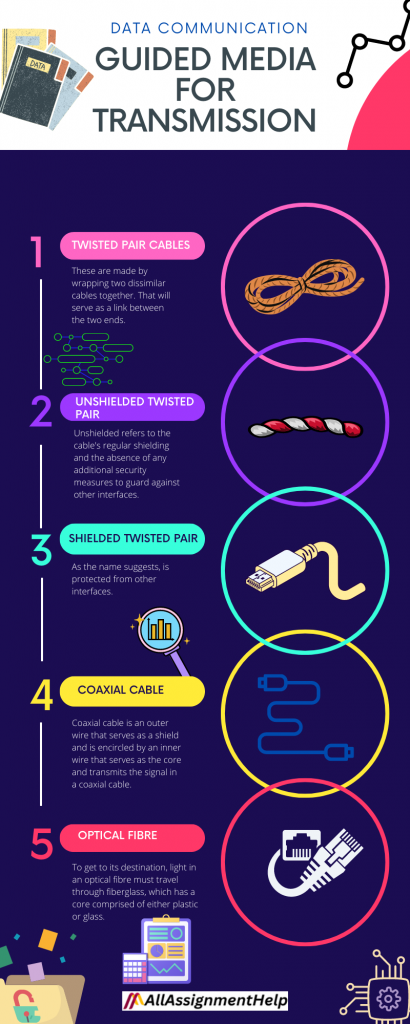
The list of different sorts is below:
- Twisted Pair Cables: These are made by wrapping two dissimilar cables together. That will serve as a link between the two ends.
- Unshielded Twisted Pair: Unshielded refers to the cable’s regular shielding and the absence of any additional security measures to guard against other interfaces.
- Shielded Twisted Pair: As the name suggests, is protected from other interfaces.
- Coaxial Cable: Coaxial cable is an outer wire that serves as a shield and is encircled by an inner wire that serves as the core and transmits the signal in a coaxial cable.
- Optical Fibre: To reach its destination, light in an optical fibre must travel through fiberglass, which has a core comprised of either plastic or glass.
2. Unguided media for transmission
Since it is an unguided medium, wireless communication between the source and the destination is possible. The medium could be something like water or air.
Below is a list of some of the categories that fall under this:
- Microwave: Antennas mounted on towers are utilized with microwave technology to transmit beams over large distances. It has a receiver and a transmitter.
- Radio Wave: It transmits radio frequencies as a radio wave. Some transmitters and receivers use antennas to transport signals.
- Infrared: It uses rays as signals and can only go a short distance.
Now, you probably understand the major differences in data communication. If you still need clarity, seeking data structure assignment help can assist you by offering expert guidance and better understanding of the concepts.
How Important is Data Communication?
Data communication is extremely important in today’s digital world. It allows devices and people to share information quickly and efficiently, no matter the distance.
Here’s why it matters:
- Enables Connectivity: It connects computers, smartphones, and networks, making global communication possible.
- Supports Business Operations: Companies rely on it for emails, video calls, data sharing, and online transactions.
- Faster Information Sharing: Data transmit in seconds, improving productivity and decision-making.
- Foundation of the Internet: Without data communication, the internet, cloud services, and online platforms would not exist.
- Improves Collaboration: Teams can work together in real time, even from different locations.
Data communication is the backbone of modern technology. It keeps the world connected and helps everything, from education to business, run smoothly.
Conclusion
Data communication is not just a technical concept, it is the foundation of how the modern world stays connected and functions efficiently. From sending simple messages to managing complex business operations, it plays a crucial role in every aspect of daily life.
Understanding its core elements, communication channels, and real-world applications helps build a strong base in computer networking and data communication. As technology continues to evolve, the importance of fast, secure, and reliable data transmission will only grow.
Whether you are a student, a professional, or simply someone curious about how digital systems work, gaining knowledge in this field can open up numerous opportunities.
Read More: Data Engineering: A Perfect Career Option
Frequently Asked Questions
1. What is data communication in simple terms?
It is the process of sending and receiving information between two or more devices. This information can include text, images, videos, or files shared through networks like the internet.
2. What are the main elements of data communication?
The main elements are sender, receiver, message, transmission medium, and protocol. These components work together to ensure smooth and accurate data transfer.
3. Why is Communication between data is important?
Data communication is important because it enables instant connectivity, supports online learning and business operations, and forms the foundation of the internet and modern digital systems.
4. What are the types of data communication channels?
Data communication channels are mainly of two types: guided (wired) and unguided (wireless). Guided media include cables like twisted pair and fiber optics, while unguided media include radio waves, microwaves, and infrared.
{ “@context”: “https://schema.org”, “@type”: “FAQPage”, “mainEntity”: [ { “@type”: “Question”, “name”: “What is data communication in simple terms?”, “acceptedAnswer”: { “@type”: “Answer”, “text”: “Data communication is the process of sending and receiving information between two or more devices. This information can include text, images, videos, or files shared through networks like the internet.” } }, { “@type”: “Question”, “name”: “What are the main elements of data communication?”, “acceptedAnswer”: { “@type”: “Answer”, “text”: “The main elements of data communication are sender, receiver, message, transmission medium, and protocol. These components work together to ensure smooth and accurate data transfer.” } }, { “@type”: “Question”, “name”: “Why is data communication important?”, “acceptedAnswer”: { “@type”: “Answer”, “text”: “Data communication is important because it enables instant connectivity, supports online learning and business operations, and forms the foundation of the internet and modern digital systems.” } }, { “@type”: “Question”, “name”: “What are the types of data communication channels?”, “acceptedAnswer”: { “@type”: “Answer”, “text”: “Data communication channels are mainly of two types: guided (wired) and unguided (wireless). Guided media include cables like twisted pair and fiber optics, while unguided media include radio waves, microwaves, and infrared.” } }, { “@type”: “Question”, “name”: “Where is data communication used in real life?”, “acceptedAnswer”: { “@type”: “Answer”, “text”: “Data communication is used in many everyday activities such as sending emails, using social media, attending online classes, streaming videos, and making video calls.” } } ] }Connect the explanation to the work your course actually requires
Use this guide beside the exact brief, course material and marking criteria for Data Communication a Connectivity Method Between Two Entities.
- Select the relevant framework.
- Apply it to the case or organisation.
- Use evidence for analysis.
- Make realistic, supported recommendations.
Anita Sahay
Management
Management tutor with a finance management background and professional financial advisory experience. Master’s in Finance Management, University of Manchester (2017)
View established tutor profile ↗Relevant subject areas
- Finance Management
- Management
- Financial Advisory
Find another explanation across the complete blog
This search uses WordPress itself, so it can reach articles beyond the 20 shown on the dashboard.
Connect Data Communication a Connectivity Method Between Two Entities to the task in front of you
Keep the brief, marking criteria, required evidence and submission format visible while you work.