
Table of Contents
Choosing the right educational institution for your higher education is a big and important choice. For example, is it better to enroll in a four-year university or a two-year community college? Ultimately, the choice between a community college vs. university comes down to your personal educational objectives and preferences.
Community colleges and universities both offer degrees, although they differ in size, cost, and academic focus. Colleges generally focus on undergraduate education with lower class enrollments, whereas universities tend to provide more options of programs, including graduate degrees. However, differences don’t end there. Read this blog curated by All Assignment Help to know the difference between community college and university.
What Is a Community College?
Community colleges are sometimes referred to as junior colleges since they usually offer two-year programs that lead to professional certification or an associate’s degree. Moreover, community colleges are usually the more affordable and practical choice.
After completing a few years of coursework, students can start a professional career or start their academic career, with the possibility of transferring to a four-year university to finish their bachelor’s degree. Community colleges often have open admissions, flexible scheduling, and smaller class sizes.
While community colleges offer a flexible and affordable study option, students are often required to complete multiple assignments during their degree. These assignments demand research, strong writing skills, and subject knowledge. If you lack any of these, you can seek online college assignment help from subject experts who will take complete responsibility for your college work and deliver it before the deadline.
Read Here: How to Choose a College: A Complete Guide to Making the Right Decision
What Is University?
A university provides a more extensive educational curriculum with more undergraduate options for obtaining a four-year bachelor’s degree and graduate programs (i.e., master’s and doctorate degrees). Universities sometimes provide more choices of academic programs (among many others), as well as better career support, better scholarships, and better possibilities for students to live on campus.
Universities are the best option for students who are prepared to commit to certain academic programs to get advanced qualifications (such as a master’s degree) in a highly competitive subject.
However, the university curriculum is more detailed and requires students to study with complete attention. Also, university assignment writing tasks come with a set of rules and regulations that many students fail to meet. In such a case, they can search for a university assignment help service online where they can get the required assistance for their preferred university.
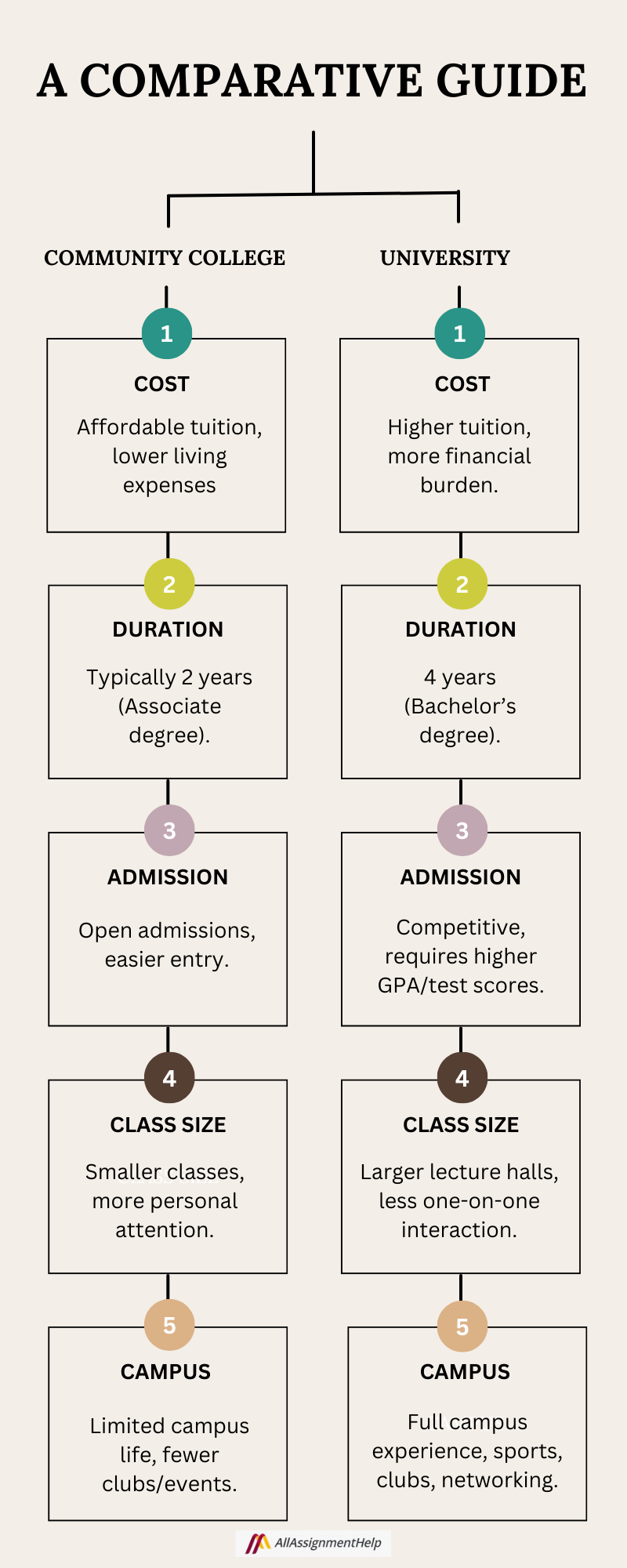
Community College vs. University: Benefits
Let’s weigh the benefits of both the educational institutions in the battle of community college vs university:
Community College Benefits
Affordable
Affordability is a key consideration for students when deciding between community college vs. university costs. Students often enroll in community colleges to save money. Statistics indicate that public community colleges usually charge an annual tuition of about $3,900. In contrast, private non-profit two-year schools charged an average annual tuition of $18,000, while private for-profit universities charged $15,800.
Lower Class Sizes
Community colleges often have lower class sizes, which results in individualized attention and a low student-teacher ratio. However, keep in mind that many community college professors and educators work part-time and might not be as available to students. This way, students can get personalized education. However, if they still get stuck while writing assignments or during any academic tasks, they can opt for online assignment help services for extra assistance.
Convenient Admissions Process
Many community colleges have “open-door” academic policies, which enable students to gain admission regardless of their academic backgrounds. While test results and report cards are requested by certain community colleges, they usually don’t determine a student’s eligibility for admission. Generally speaking, you can enroll in a community college after high school if you have a high school diploma or something like a GED.
Transferable Credits
Many community colleges form articulation agreements with nearby universities to guarantee credits will transfer to the university’s bachelor’s degree programs. These agreements enable students to attend four-year universities after benefitting from the cheaper tuition at community colleges.
Career-Oriented Learning
The necessity of a bachelor’s degree may vary depending on your desired professional path. A two-year degree is all that is needed for many lucrative positions, such as paralegals, automobile mechanics, and radiation therapists. Additionally, the number of jobs requiring two-year degrees might rise, improving your chances of landing a job in industries like engineering, healthcare, technology, and legal assistance.
Benefits of a University
Financial Aid and Scholarship Opportunities
Universities sometimes offer better financial aid and scholarships than community colleges, while having higher tuition costs. These include scholarships based on sports or music performance, program-specific scholarships, and grade point average (GPA) awards. In general, the likelihood that a university will provide multiple types of financial help increases with its student body.
Scope of Study
Universities provide graduate and doctoral-level degree programs along with bachelor’s degree programs. The following are some examples of degree programs that students can choose from:
- Bachelor of Science (B.S.)
- Bachelor of Arts (B.A.)
- Bachelor of Fine Arts (BFA)
- Master of Arts (M.A.)
- Master of Fine Arts (MFA)
- Doctor of Philosophy (Ph.D.)
Students can begin working as financial managers, mental health counselors, software engineers, and many other professions with these various degree levels and specializations.
Research Opportunities
The availability of research opportunities is another comparable factor between a community college vs. university. The research possibilities provided by a standard university challenge students’ resolve and stubbornness, develop their creativity, problem-solving skills, and intellectual independence, and help them explore prospects for publication and sharing their work. Additionally, they could also decide to carry out research for businesses and organizations or pursue their research career at their university.
Academic Excellence
Most university professors work full-time as professionals, which frees them up to concentrate on teaching. Therefore, they focus attention on a wide range of information, experiences, and details. They raise the bar for academic quality to support students’ academic and personal development. They try their best to leave no room for confusion and provide the best educational experience to students.
Enroll in Online Classes
Nowadays, many students have started providing online classes as well. Students who don’t want to travel to university can enroll in these classes of their choice. They design classes in accordance with the students’ needs and requirements so that everyone can get high-quality education in their comfort zone. However, if you are unable to keep up with your online classes and need assistance, you can browse the Internet and search for online class help services where you can ask, will you take my online class for me? This is the ultimate solution to maintain attendance without missing any important lectures in your online class.
Factors to Consider Before Choosing Between Community College Vs University
Think about the following while deciding between a community college and a university:
- Career Objectives: While community colleges provide faster entry into specific fields, universities offer more options for professional advancement.
- Budget: Tuition and living expenses are often cheaper at colleges as compared to universities, making them more accessible.
- Preferred Learning Environment: While universities offer a broad academic experience, community colleges offer individualized attention and small communities.
- Program Type: Colleges concentrate on skill-based learning, whereas universities provide specialized, research-oriented programs.
- Cultural Fit: Community colleges provide warmer, smaller communities, but universities offer a more global experience.
Your educational preferences, economic circumstances, and professional objectives all play a role in selecting the best institution. Being aware of the differences between colleges and universities will assist you in making a wise decision.
Community College vs. University: Key Differences
Both community college and university could be excellent choices, depending on your financial situation and desired professional path. However, the key difference between community college and university is as follows:
| Aspect | Community College | University |
| Program Duration | 2 years (Associate degree, diplomas, or certificates) | 3–4 years (Bachelor’s degree) and beyond (Master’s, Ph.D.) |
| Cost of Education | More affordable, lower tuition fees | Higher tuition fees and additional costs (hostel, labs, etc.) |
| Admission Requirements | Flexible entry requirements, often open admission | More competitive, require higher grades, entrance exams, or standardized tests |
| Class Size | Smaller classes with personalized attention | Larger class sizes, especially in the first year |
| Curriculum | Focused on practical, career-oriented training and transfer programs | Broader academic and research-focused curriculum |
| Transfer Options | Students can transfer credits to a 4-year university | The final step for higher-level education |
| Career Path | Quick entry into the workforce with associate degrees/certifications | Wider career prospects with advanced degrees |
| Examples of Degrees | Associate of Arts (AA), Associate of Science (AS), and technical diplomas | Bachelor’s, Master’s, Ph.D., professional degrees (MBA, MD, JD, etc.) |
Now, both community colleges and universities offer online courses in various areas of study. You can enroll in your desired course and get a degree while learning from home. However, getting a degree online is not as easy as it sounds. You need to take online exams to pass the coursework and earn a degree. However, if you want to improve your chances of getting a degree with high scores, you can hire a professional online class taker by requesting, please take my online exam for me. This way, your chances of earning a degree with great scores become high.
Also Read: Most Useful University Degree for the Walk of Your Life
Community College Vs University: Which One Should You Choose?
Selecting between a college and a university is a major step in your educational process. Both have special advantages, whether it’s the extensive research opportunities at universities or the practical skills that community colleges provide. Considering the differences enables you to choose the institution that best suits your objectives, financial situation, and preferred method of learning. Take your time, consider all of your options, and make the right choice for yourself.
FAQs
How do universities manage class sizes in comparison to community colleges?
Universities sometimes feature more spacious lecture rooms, which might make it harder to connect directly with teachers. However, community colleges often have lower class sizes, which facilitate more individualized attention, close teacher connections, and dynamic learning settings.
Are community college admissions easier than university admissions?
College admissions are simpler, with flexible requirements and open enrollment policies. On the other hand, universities often ask for better extracurricular profiles, higher academic scores, and standardized test results, especially for graduate and professional programs.
Is community college better than a university?
The goal of both community colleges and universities is to educate their students. Hence, attending a community college isn’t always simpler than attending a university. The classes you take at a community college will prepare you for further study at an accredited four-year university if you choose to transfer later.