Table of Contents
Whenever you read, watch, or listen to something and feel the need to express your thoughts or opinions about it, you can do so through a reaction paper. In academics, it is also known as a response paper. Students are often asked to write a reaction paper to present their personal views, interpretations, and conclusions on a particular topic. It also helps demonstrate their understanding of the subject while showcasing their analytical and critical thinking skills.
In this blog by All Assignment Help, you will learn what a reaction paper is, how to write one effectively, and useful tips to create a strong and well-structured response paper.
What is a Reaction Paper?
A reaction paper is a type of academic writing in which a student shares their thoughts, opinions, and analysis about a particular piece of content. This content can be a book, article, movie, speech, research paper, lecture, or any other material. The purpose of a reaction paper is not only to summarize the content but also to explain your personal response, understanding, and interpretation of it.
In a reaction paper, students are expected to critically analyze the topic and support their opinions with logical explanations and examples. It helps teachers understand how well a student has understood the subject and how effectively they can connect ideas, evaluate information, and express their viewpoints clearly.
A well-written reaction paper usually includes:
- A brief introduction to the topic or material
- A summary of the main ideas
- Personal opinions and reactions
- Critical analysis and evaluation
- A conclusion that wraps up the response clearly
Reaction papers are commonly assigned in schools and colleges because they improve critical thinking, reading comprehension, and writing skills. However, many students struggle to organize their thoughts and present clear arguments within deadlines. In such situations, seeking online assignment help can provide useful guidance in understanding the structure, improving analysis, and creating a well-written reaction paper effectively.
How to Write a Top-Notch Reaction Paper
Writing a reaction paper may seem difficult at first, but with the right approach, you can create a clear and impressive paper. A good reaction paper should not only summarize the content but also explain your personal opinions, understanding, and analysis. Here are some simple steps to help you write a top-notch reaction paper:
Read or Analyze the Material Carefully
Before you start writing, carefully read, watch, or listen to the assigned material. Try to understand the main idea, key arguments, and important points. Take notes while reviewing the content so you can easily remember significant details later.
Create a Strong Introduction
Start your reaction paper with an engaging introduction. Mention the title of the material, the author’s name, and a brief overview of the topic. Also, include your main reaction or opinion to give readers an idea of what your paper will discuss.
Summarize the Main Points
Provide a short summary of the content without going into too much detail. Focus only on the important ideas and arguments. This helps readers understand the context before reading your reaction and analysis.
Share Your Personal Reaction
This is the most important section of your reaction paper. Explain your thoughts, feelings, and opinions about the topic. Mention whether you agree or disagree with the ideas and clearly explain why. Use examples and logical reasoning to support your viewpoint.
Add Critical Analysis
A top-notch reaction paper should include analysis along with personal opinions. Discuss the strengths and weaknesses of the material. Evaluate how effective the arguments, ideas, or messages are. This shows your critical thinking skills and understanding of the topic.
Maintain a Clear Structure
Organize your paper properly with an introduction, body paragraphs, and conclusion. Use simple language and smooth transitions between paragraphs to improve readability.
Write a Strong Conclusion
End your reaction paper by summarizing your overall opinion and the key points discussed. Avoid introducing new ideas in the conclusion. Instead, provide a final thought that leaves a strong impression on the reader.
Proofread and Edit Carefully
Always review your paper before submission. Check for grammar mistakes, spelling errors, and sentence clarity. Editing helps improve the quality and professionalism of your writing.
Many students face difficulty balancing research, analysis, and academic deadlines while writing reaction papers. In such cases, online assignment help services can guide students in understanding proper structure, improving writing quality, and developing stronger analytical responses.
Similarly, students working on personal opinion-based academic tasks often seek reflective essay assignment help to better organize their experiences, thoughts, and critical reflections in a clear and meaningful manner.
Key to an Excellent Reaction Paper
A great reaction paper is not just about sharing your opinions. It is about presenting thoughtful responses backed by logic, facts, and clear analysis. While writing your response paper, make sure your content stays connected to the original work and follows a proper essay structure. Instead of simply reacting to the topic, focus on giving evidence-based opinions and meaningful conclusions.
One of the most important parts of a reaction paper is creating a concise summary of the original content. Usually, two or three paragraphs are enough to explain the main ideas clearly. After summarizing, move toward critical analysis. This does not mean only pointing out flaws or criticizing negatively. A strong reaction paper examines both the strengths and weaknesses of the work in a balanced way.
Ask yourself important questions while analyzing the content:
- Did the writer present the ideas fairly?
- Were the arguments convincing and logical?
- Could additional information improve the quality of the work?
- Was the topic explained clearly and effectively?
Answering these questions helps you build a deeper and more meaningful analysis. Remember, constructive criticism always leaves a stronger impact than blunt or unsupported opinions.
An excellent reaction paper should also contain well-developed paragraphs that clearly explain your thoughts. Avoid giving vague statements or weak arguments without proper reasoning. Every opinion should be supported with examples, facts, or logical explanations to make your paper more convincing and professional.
Many students understand the theory behind reaction papers, but still struggle to write them effectively. Improving analytical writing skills often requires practice and proper guidance, which students can gain through online English classes. However, managing extra classes along with assignments, exams, and deadlines can become overwhelming. This is why many students start browsing, Can someone take my online class for me? to better manage their academic workload.
Reliable academic assistance can help students stay on track with their classes while giving them enough time to focus on developing stronger writing and critical thinking skills. With the right support and practice, writing a well-structured and impressive reaction paper becomes much easier.
What Should You Focus on While Analyzing a reaction paper?
When analyzing a reaction paper, you should focus on several important points to make your response clear, thoughtful, and well-structured. Here are the key areas to concentrate on:
1. Understand the Main Idea
- Identify the central theme or message of the text, movie, article, or work.
- Understand what the author is trying to communicate.
2. Analyze the Author’s Purpose
- Think about why the author created the work.
- Determine whether the purpose is to inform, persuade, entertain, criticize, or explain something.
3. Examine Supporting Evidence
- Look at the examples, arguments, facts, or scenes used to support the main idea.
- Check whether the evidence is strong, convincing, and relevant.
4. Evaluate the Writing Style or Presentation
- Observe the tone, language, structure, and techniques used by the creator.
- Consider how these elements affect the audience.
5. Share Your Personal Reaction
- Explain your thoughts and feelings about the work.
- Mention whether you agree or disagree with the ideas presented and why.
6. Connect with Real-Life Situations
- Relate the content to personal experiences, current events, or social issues.
- This makes your reaction paper more meaningful and engaging.
7. Discuss Strengths and Weaknesses
- Highlight what was effective in the work.
- Mention any areas that were unclear, weak, or less convincing.
8. Use Specific Examples
- Support your opinions with examples or references from the original work.
- Avoid giving only general statements.
9. Maintain Logical Organization
- Present ideas in a clear order:
- Introduction
- Summary of the work
- Analysis and reaction
- Conclusion
10. Write Clearly and Objectively
- Even though a reaction paper includes personal opinions, your arguments should still be logical and balanced.
- Avoid emotional or unsupported statements.
A strong reaction paper does not only summarize the content. It critically examines the work and explains your personal understanding and evaluation of it.
Also read: Narrative Conventions and Why Are They Important
How to Format a Reaction Paper?
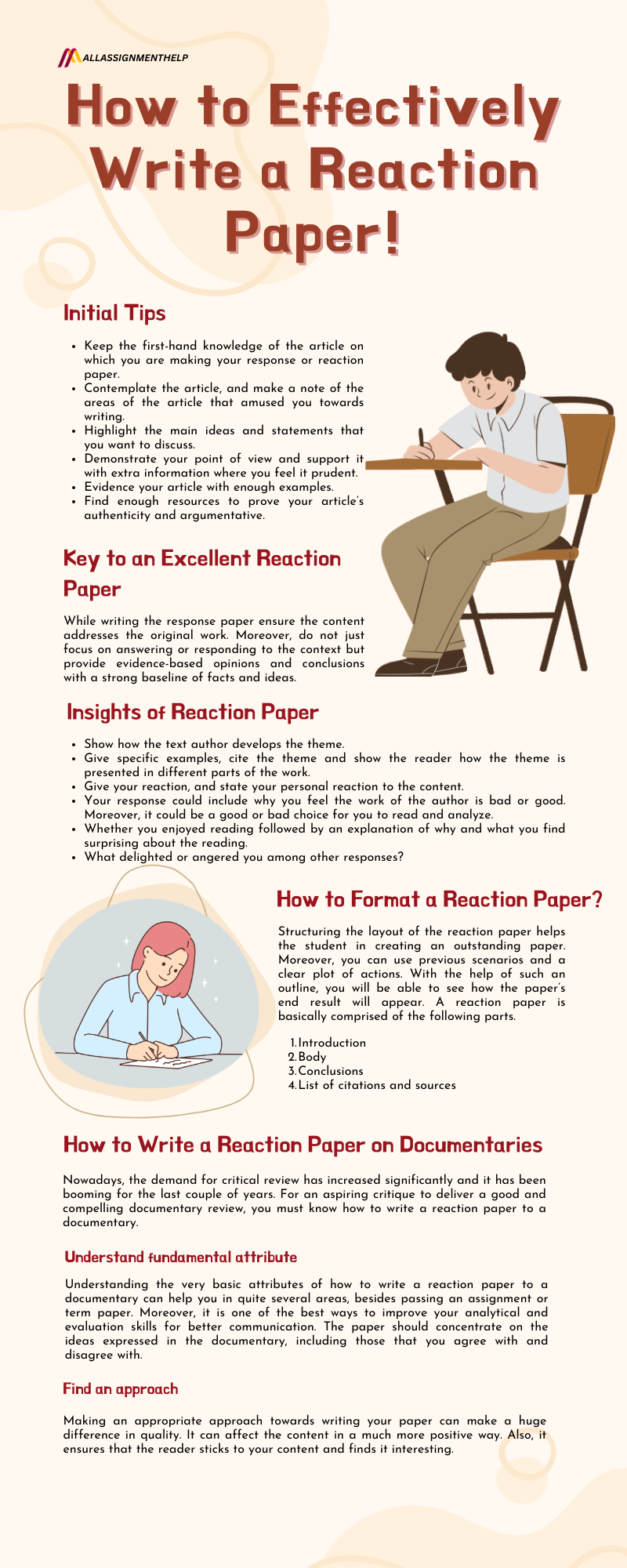
Formatting a reaction paper properly is important because it makes your content organized, easy to read, and more professional. A well-formatted reaction paper also helps readers understand your ideas and analysis clearly. Although formatting requirements may vary depending on your institution or professor, most reaction papers follow a simple academic structure.
Title Page
Start with a proper title page if required. Include:
- Your name
- Course name
- Instructor’s name
- Submission date
- Title of the reaction paper
Make sure the title is clear, relevant, and engaging.
Introduction
The introduction should briefly introduce the original work you are reacting to. Mention:
- The title of the work
- Author’s name
- Main topic or theme
- Your overall reaction or thesis statement
This section gives readers an idea of what your paper will discuss.
Summary of the Content
After the introduction, provide a short summary of the original material. Focus on the main points, arguments, or ideas without adding too many details. Keep this section concise and objective.
Body Paragraphs
This is the most important part of the reaction paper. Here, you should:
- Share your opinions and reactions
- Analyze the content critically
- Discuss strengths and weaknesses
- Support your views with examples and evidence
Each paragraph should focus on one main idea to maintain clarity and structure.
Conclusion
End your reaction paper with a strong conclusion. Summarize your key opinions and overall analysis. Avoid introducing new ideas in this section. Instead, leave readers with a final thought about the topic or content.
Use Proper Formatting Style
Many colleges require students to follow formatting styles such as:
- APA
- MLA
- Chicago Style
These styles include rules for headings, citations, spacing, margins, and references. Always check your assignment guidelines before formatting your paper.
Proofread Before Submission
Before submitting your reaction paper, carefully proofread it for grammar mistakes, spelling errors, formatting issues, and sentence clarity. A clean and polished paper creates a better academic impression.
Many students struggle with formatting rules, citations, and organizing their ideas effectively while writing analytical and reflective assignments. In such situations, proofreading and editing services, along with professional reaction paper help, can assist students in understanding proper academic formatting, strengthening their arguments, and improving the overall quality of their reaction papers.
Also read: Modern Period in English Literature
How to Write a Reaction Paper on Documentaries
Nowadays, the demand for critical reviews has increased significantly and it has been booming for the last couple of years. For an aspiring critic to deliver a good and compelling documentary review, you must know how to write a reaction paper to a documentary. Moreover, writing reaction or response papers about documentaries requires students to properly understand the given material. Regardless of the genre you must present it well and produce arguments showing how it fits into the coursework. Furthermore, documentaries can be both informative and entertaining.
In addition to this, the writer must consider the reader’s line of interest. Hence, what catches the reader’s interest more depends on the writer’s ability to present the paper. It is just a quick perception of understanding the reader’s mind.
Understand fundamental attribute
Understanding the very basic attributes of how to write a reaction paper to a documentary can help you in several areas, besides passing an assignment or term paper. Moreover, it is one of the best ways to improve your analytical and evaluation skills for better communication. The paper should concentrate on the ideas expressed in the documentary, including those that you agree with and disagree with.
Find an approach
Making an appropriate approach towards writing your paper can make a huge difference in quality. It can affect the content in a much more positive way. Also, it ensures that the reader sticks to your content and finds it interesting. According to numerous well-known online coursework service experts, several approaches can be chosen when writing a response paper to a documentary.
- You can either decide to support the arguments or ideas in the film or you can simply focus on passing a critique to them. But what’s more important is that your paper must have enough credits. It should compel the reader to find it curious or intuitive to think about. Besides, your response paper can also make a general opinion. You can address the major aspects of the entire documentary without choosing certain facts.
The fundamentals of a reaction paper are to present your opinion or thoughts about the documentary. However, these should be supported either by examples or evidence from the film. Moreover, as a student, your academic paper requires that you identify a particular angle of approach to pursue in writing.
- First, you should identify the key points properly and acquire evidence from the documentary to prove it. Moreover, all the elements that you pick should relate to the focus of the paper more often. Furthermore, effectively evaluate your response and purpose of writing.
- It is also recommended to do some research to find out more about the facts and statements. You can discuss this in order to present a logical and compelling review.
- The key is precision. You should be precise in choosing the elements to discuss for clarity for every point. It is also advisable to identify about two or three examples to support it.
Hence, you can finally expect to write an outstanding reaction paper for a documentary by adhering to these factors.
Conclusion
Writing a reaction paper is more than simply sharing your opinions about a book, article, documentary, or any other content. It is a process of critically analyzing ideas, understanding the author’s message, and presenting your thoughts in a logical and meaningful way. A strong reaction paper combines summary, analysis, and personal interpretation while supporting opinions with relevant examples and evidence.
By following the correct structure, maintaining clarity, and using critical thinking skills, students can create impactful and well-organized reaction papers. Proper formatting, careful proofreading, and balanced arguments also play an important role in improving the quality of the paper.
However, many students find it difficult to manage analysis, research, formatting, and deadlines at the same time. In such situations, seeking academic guidance or professional reaction paper help can make the writing process easier and more effective. With regular practice and the right support, students can confidently develop strong analytical writing skills and produce high-quality reaction papers for their academic success
Frequently Asked Questions
What is the main purpose of a reaction paper?
The main purpose of a reaction paper is to analyze a piece of content and express your personal opinions, understanding, and evaluation of it. It helps students improve critical thinking, analytical, and writing skills.
How is a reaction paper different from a summary?
A summary only explains the main points of the original content, while a reaction paper goes beyond summarizing by including personal opinions, analysis, and critical evaluation of the topic.
Can I use personal opinions in a reaction paper?
Yes, personal opinions are an important part of a reaction paper. However, your opinions should be supported with logical explanations, examples, and evidence from the original work.
What are the common mistakes to avoid in a reaction paper?
Some common mistakes include giving only a summary, using unsupported opinions, ignoring proper structure, adding irrelevant information, and failing to proofread grammar and formatting errors.
How can students improve their reaction paper writing skills?
Students can improve their reaction paper writing skills through regular reading, critical analysis, proper research, and consistent writing practice. Many students also seek online assignment help to better understand formatting, analysis, and academic writing techniques.