Why Robotics is Becoming a Popular Subject in U.S. Schools
What this article will help you understand
Step into an American classroom today, and you might see a small robot whirring around the room, and students programming it to move or respond to commands. Not very long ago, the idea of robotics as an academic discipline might have appeared to be right out of a sci-fi novel. However, the truth is that
What are you trying to do with this topic?
Choose the closest task and the page will point you towards a useful next step.
Start with the central concept and the terminology used in the article.
Open the closest route ↗Connect the explanation to the question, learning outcomes and marking criteria.
Open the closest route ↗Review evidence, structure, referencing and the exact submission requirements.
Open the closest route ↗Do you have enough information to begin?
Select what you already have. Nothing is submitted from this checklist.
When these details are together, the requirement can be reviewed in context.
Assignment Help USA ↗Table of Contents
Step into an American classroom today, and you might see a small robot whirring around the room, and students programming it to move or respond to commands. Not very long ago, the idea of robotics as an academic discipline might have appeared to be right out of a sci-fi novel. However, the truth is that robotics is entering schools at hypersonic speed. But clearly, the aspiration isn’t merely to construct cool machines. It’s meant to inspire curiosity, creativity and critical thinking in students. Robotics makes STEM learning alive by seeing how math and science relate through application, and develops the practical skills needed to carry students throughout from classroom to career. This is why it is not surprising that robotics has become so popular in American education.
Let us read this blog by All Assignment Help and try to understand why robotics education is becoming a popular subject in the US schools.
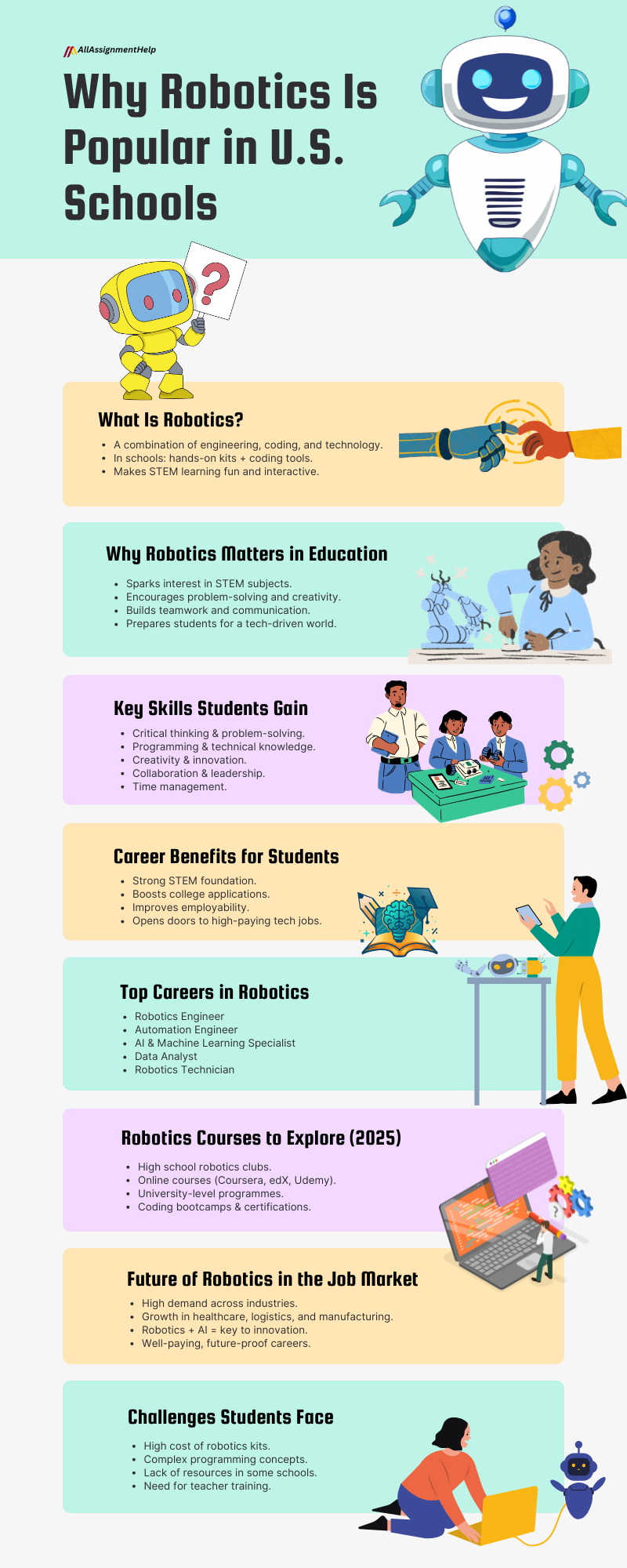
What is Robotics?
Robotics is all about designing and building machines that can complete tasks; everything from programming and designing to the application of the robots in the real world. We can say that it is a combination of engineering, code and technology. When we talk about robotics, many people think of machines, but robotics in schools teaches about programming robots to follow a line or respond to voice commands. The appeal of robotics is that it amplifies abstract sci-fi and math concepts out of the written books into a reality that you can see and feel.
In addition to this, robotics is more than circuits or wires; it is a sense of curiosity. It is one of the reasons why elementary schools and middle schools in the United States have begun teaching children about basic coding and robotics kits in their classrooms. Learning robotics is fun, but it is also difficult. A lot of students trip over trying to stay on top of robotics practice when they have a lot of other homework. However, academic support services like online assignment help can assist students in time management and support their busy academic schedule. Also, these services will compose well-structured and error-free work for you.
Why Robotics Matters in American Education?
Robotics is more than the latest educational craze. It is a powerful tool in facilitating a wide array of opportunities for students to learn in new ways. In many U.S. schools, robotics has been incorporated as a means of making STEM learning subjects fun and applicable. Numbed by paperwork exercises alone, students have a chance to deploy math, science and coding skills to real-world challenges.
Another reason that makes robotics important is that it prepares students for the future. Technology and automation are built into almost every sector today, so having some training in whatever capacity provides an edge to students. It also encourages practical teamwork, critical thinking and creativity skills outside of the classroom.
Additionally, learning robotics can take a lot of time, and you might not have sufficient headspace to learn all other subjects. This is the reason why many students depend on professional experts, such as online class help services, to manage their work and keep themselves up to date on their robotics studies.
Also read: How STEM Clubs Are Shaping the Next Generation of Scientists
Key Skills Students Gain from Learning Robotics
Teaching students about robotics provides them with a lot more than simply coding or engineering skills.
- Problem-solving is a primary skill among the many skills learned while studying robotics. When a robot does not do what it is intended to, students discover how to troubleshoot, experiment and think critically to come up with a solution. It’s also a skill that can be easily translated into nearly any subject or circumstance.
- It is used to develop technical competencies like programming, electronics, and comprehension of automation systems.
- Learning robotics also promotes creativity: students come up with their own robot designs and novel strategies to perform tasks with them.
- Robotic projects tend to operate in teams, which necessitates cooperation, communication and sound leadership skills, to foster a healthy pragmatism in the students’ social skills.
- Additionally, robotics teaches time management and accountability, because constructing and programming robots can be complicated and need to be appropriately scheduled.
We realise that managing online coursework and dealing with several deadlines can be challenging for students. They may find it difficult to invest time in robotics projects. That means they need extra academic support to help them confront their doubts, questions like, Can I really do my online exams and assessment while learning robotics and completing hands-on lab work?
How Beneficial is Robotics for Students in Their Career Growth?
Robotics can have a major impact on a student’s future profession.
- Students who learn robotics early keep a strong grasp of the STEM subjects, which is highly desirable in almost every field of work.
- The skills students develop, i.e. from critical thinking to programming and problem solving, increase their flexibility and competitiveness when they go to college or the workforce.
- For the engineer-inclined, robotics is a laboratory exercise that the students can immediately apply to real-world concepts.
- It can also inspire students to want to learn more about everything from A.I. and automation to mechanical systems. However, students who are working on such robotics projects require support, like mechanical assignment help or additional support to further their understanding of more intricate concepts.
Hence, we can say that robotics builds the mind and trains students for an exciting future, potential future college scholarships and career opportunities.
Top Career Opportunities in Robotics
The top robotics programs can offer a solid foundation in robotics as well as hands-on experience and the confidence to enter the rapidly advancing field of robotics.
Robotics engineer
They design, develop, and program robots that businesses and other organisations use to carry out tasks in a variety of fields, such as manufacturing, healthcare and space exploration. They are also putting together coding, mechanical design and problem-solving to build machines that are simpler to carry out tasks.
Automation engineer
Automation engineers concentrate on creating systems that minimise manual influence and maximise productivity. They are indispensable in factories, logistics and companies embracing smart technologies.
AI and machine learning specialist
Some of the most significant developments in robotics today are being done up by specialists in AI and machine learning, who are applying decades of research to robots. They are experimenting with smarter robots that can learn, improvise and make decisions. Currently, AI and machine learning are two of the fastest-growing areas in robotics research.
Data analyst
Data analysts make sense of the insights collected through robotic systems to improve productivity, maintainability, and effectiveness so that robots are running at their peak.
Robotics technician
Technicians carry out the hands-on work of putting together, maintaining and troubleshooting robots. They verify robots work in a real-world environment.
Though these are interesting fields, students may struggle with some of the ideas in math, engineering, or science. Some topics, such as mechanics and motion, can be tricky. Therefore, the students look for physics assignment help to come up with a good understanding while working on robotics projects.
Also read: Top Online Programming Courses to Consider in 2025
Top Robotics Courses to Consider in 2025
As an ever-expanding industry, the right courses in robotics can make a huge difference in gaining the skills that will get you job opportunities down the road. So if you are an absolute newbie, or if you really want to ramp up your existing knowledge as we head into 2025, there are certainly enough programs and resources in the market.
High school robotics programs
There are now robotics clubs and STEM-based curricula in many U.S. high schools. The curriculum offers students the opportunity for hands-on experience with building and programming robots, so in practice, it is a useful skill set for students to gain.
Online robotics courses
Platforms like Coursera, edX and Udemy have flexible curricula for both robotics beginners, coding hobbyists and automation junkie among us. These online courses are ideal for student who want to learn independently and fit schoolwork into their schedules.
University-level programs
There are also specialised robotics courses offered in higher education colleges or university settings, which often incorporate aspects of theory and practical work. Students may focus on specific areas of specialisation, which include: artificial intelligence integration, mechatronics, and advanced automation systems.
Coding and programming courses
Because both robotics and programming are closely related fields, it’s a must to learn programming languages like Python, Java, and C++. For students of robotics who face difficulties with coding exercises, programming language assignment help may be just the right thing to keep them on the right track.
Certification and bootcamps
Specialised certifications and bootcamps highlight AI, automation and robotics design. Such short-term programs can quickly build skills and make graduates more marketable in fields that are extremely competitive.
Future of Robotics in the U.S. Job Market
The future of robotics for America’s workers seems quite golden. With the rapid rise of automation, smart technology and AI in fields of commerce and industry, there is a huge need for people who can design, build and maintain robots. Even sectors like health care, logistics, manufacturing, and agriculture are being increasingly dependent on robotics for performance enhancement and minimising manual labour.
Students now learning robotics are investing in the future. Robotics can also help children develop the sorts of practical skills some companies look for in their employees, such as problem-solving, creative thinking and teamwork. But learning about robotics can be daunting as it is a field that involves electronics, circuits and sensors. Many students use electronics homework help to understand these concepts so that they can manage their robotics projects with confidence when the right opportunity comes.
As the technology keeps getting better and better, the U.S. job market will continue to have exciting and high-earning careers in robotics. With such an industry pace, students who possess hands-on experience with a solid theoretical background will gain the upper hand.
Challenges Students Face While Learning Robotics
Robotics-based learning is tough and frustrating for students.
- One of the biggest obstacles is the high price of equipment, robotics kits, sensors and other tools that limit access for some schools and students.
- A further barrier is the abstraction of programming and engineering approaches. Learning robotics can be more complex than it seems on paper.
- Besides, teachers are either untrained or not properly equipped to teach children in many places.
Despite the obstacles, there are rewards in learning robotics, things like problem solving, creativity, and teamwork, which a motivated learner can find a way to navigate these barriers.
Conclusion
Robotics is the fastest-growing high school program in the United States. It not only equips students to build robots, but also nurtures skills that include problem-solving, creativity and collaborative teamwork. Not only that, through applied knowledge and ‘inspiration-inducing’ classes, it has made the subject of engineering and computer programming a lot easier to understand and has brought STEM subjects to life.
Frequently Asked Questions
Question: Why has robotics become so popular?
Answer: The usage of robotics mitigates the impact of labour shortages in industry. Human workers can focus on more fascinating and valuable jobs by automating unclean, dull, risky, or delicate ones. Robots conduct tiresome activities like visual quality inspection, dangerous painting, and heavy lifting.
Question: What are the benefits of robotics in school?
Answer: A Robotics curriculum in all schools helps students to enhance critical thinking skills, experiential learning, creativity, and innovation. Additionally, it improves STEM skills, encourages teamwork, collaboration, and enhances computational thinking.
Question: Which country is number one in robotics?
Answer: In terms of both the quantity of robots in use and the expansion of its own domestic robot production industry, China leads the world in robotics. South Korea, Japan, Germany, and the United States are among the top-tier nations with sizable robot populations and sophisticated robotics industries.
Question: Which country is best for robotics education?
Answer: The United States, Japan, South Korea, Singapore, and Germany are the top robotics research destinations because of their cutting-edge technology, intense research emphasis, and integration with top companies.
Connect the explanation to the work your course actually requires
Use this guide beside the exact brief, course material and marking criteria for Robotics As Subject.
- Read the complete brief.
- Identify the expected academic output.
- Follow the marking criteria and source rules.
- Check the final structure and referencing.
Arsha McKinson
Psychology
This guide concerns “Why Robotics is Becoming a Popular Subject in U.S. Schools”. Arsha McKinson is one of the available tutors whose live profile lists experience in Psychology.
Arsha’s live profile describes psychology teaching and writing experience across humanistic, industrial and psychoanalytic topics. PhD in Psychology, Ulster University
View established tutor profile ↗Relevant subject areas
- Humanistic Psychology
- Industrial Psychology
- Psychoanalysis
- Psychosis
- Academic Referencing
Find another explanation across the complete blog
This search uses WordPress itself, so it can reach articles beyond the 20 shown on the dashboard.
Connect Robotics As Subject to the task in front of you
Keep the brief, marking criteria, required evidence and submission format visible while you work.