How is Digital Reading Changing Literature Appreciation in 2026?

What this article will help you understand
The days of buying books at the bookshop or borrowing them from the library are long gone; today, only a small number of die-hard bookworms are still interested in traditional books. The decline of conventional books is largely attributed to digital transformation, but experts believe we're headed in the right direction. What's the point of
What are you trying to do with this topic?
Choose the closest task and the page will point you towards a useful next step.
Start with the central concept and the terminology used in the article.
Open the closest route ↗Connect the explanation to the question, learning outcomes and marking criteria.
Open the closest route ↗Review evidence, structure, referencing and the exact submission requirements.
Open the closest route ↗Do you have enough information to begin?
Select what you already have. Nothing is submitted from this checklist.
When these details are together, the requirement can be reviewed in context.
Assignment Help USA ↗Table of Contents
The days of buying books at the bookshop or borrowing them from the library are long gone; today, only a small number of die-hard bookworms are still interested in traditional books. The decline of conventional books is largely attributed to digital transformation, but experts believe we’re headed in the right direction. What’s the point of reading when all the technologies around us have advanced?
If you have an electronic device or an eBook reader, you can read eBooks anywhere and at any time. They require less storage space and are safe. Furthermore, there’s nothing better than reading from the comfort of your own home. That is what e-books, which are groundbreaking in the field of education, can offer.
This blog by allassignmenthelp is all about digital reading and its impacts on literature. Read the blog till the end to explore some interesting facts about digital reading.
🚀 Struggling With a Tough Online Exam?
Deadlines, complex questions, and exam pressure can be overwhelming. Let academic experts handle the stress while you focus on what matters most.
Get Expert Help for Your Online Exam →✔ 24/7 Academic Assistance ✔ On-Time Completion ✔ Confidential Support
What Is Digital Reading?
Digital reading refers to reading books, articles, or study material on electronic devices such as smartphones, tablets, laptops, or eBook readers. Instead of printed pages, readers access content in formats like PDF, ePUB, or HTML.
In today’s internet-driven world, digital reading has become very common. People can read anytime and anywhere using their portable devices. Whether it is a homemaker listening to a self-help book while cooking, a professional reading fiction during a metro ride, or a student preparing for exams, digital platforms have become a major part of modern reading habits.
One popular example of digital reading is Amazon Kindle Direct Publishing (KDP). It allows readers to purchase and read books in digital format. These books are usually cheaper than printed versions and can be accessed instantly on smartphones, tablets, or Kindle devices.
Read More: How Important are Micro-Credentials in Higher Education?
Is the Rise of Audiobooks Replacing Digital Reading?
The popularity of audiobooks has increased dramatically in recent years. Many people now prefer listening to books while driving, exercising, or doing daily tasks. However, this does not mean that audiobooks are replacing digital reading completely. Instead, they are becoming another way to consume books alongside ebooks and printed books.
- Amazon Kindle Unlimited: It is among the largest e-book subscription services.
- Scribd: over 1 million active subscribers,
People increasingly “read” while driving, exercising, or unwinding. Although human voiceovers continue to dominate premium material, many audiobooks are now AI-narrated, enabling faster production and lower pricing.
The emergence of e-books has given users access to the world of literature. You may access thousands of books immediately with just a device and an internet connection, whether you’re travelling across the world, commuting to work, or just relaxing at home. Literary masterpieces, best-sellers, and specialised publications are now equally accessible to people worldwide because of this unparalleled accessibility, which has democratised reading.
However, this digital shift is even more valuable for students. While e-books make it easier to study and prepare for exams, managing coursework, assignments, and daily routines can still be an overwhelming and daunting task to do. That’s where many students turn to the internet, posting queries such as Can someone take my online class for me, to balance their busy schedules while continuing their digital reading journey.
What Are The Advantages of Digital Reading?
Below are the major advantages of digital reading:
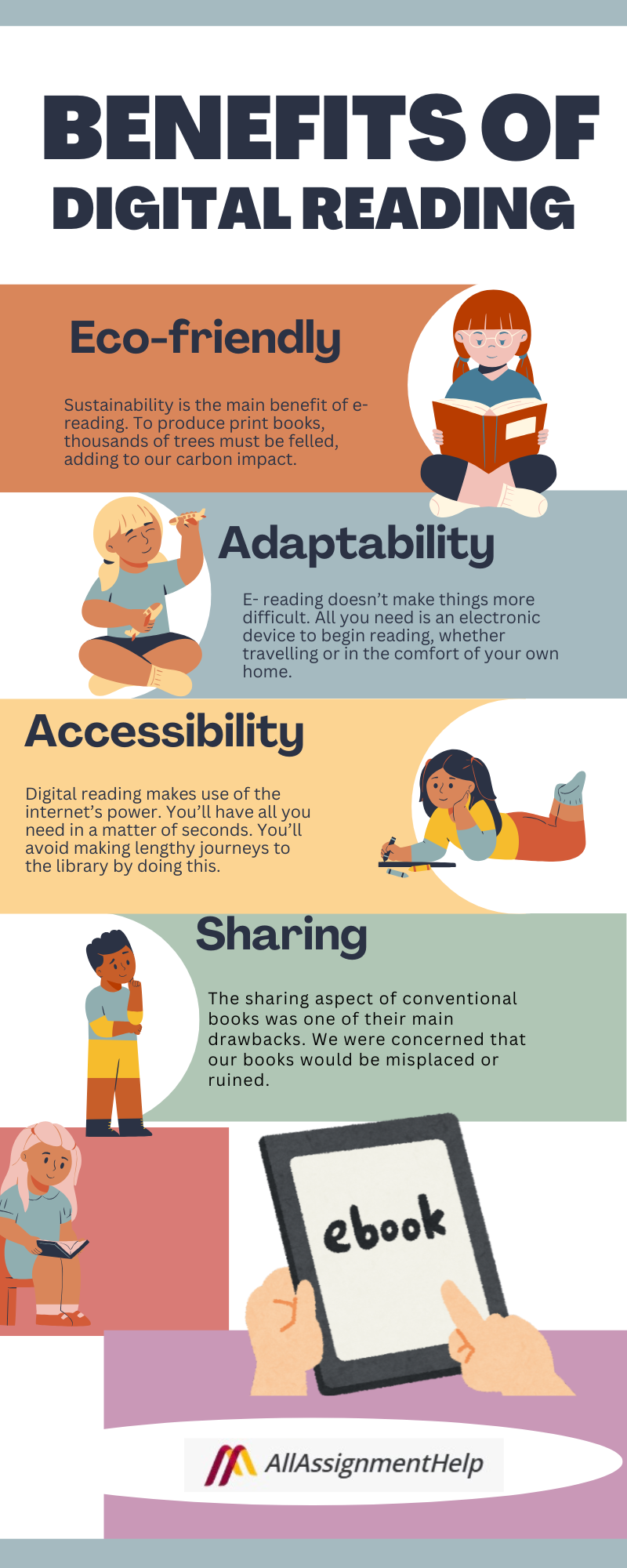
Eco-friendly
Sustainability is the main benefit of e-reading. To produce print books, thousands of trees must be felled, adding to our carbon impact. Traditional books simply worsen the environment when they are not recycled properly.
Considering how little energy it takes to create eBooks, eReading can eliminate this. These days, eBook publishers use clean, renewable energy to create books, which reduces our carbon footprint and is sustainable over time.
Adaptability
E- reading doesn’t make things more difficult. All you need is an electronic device to begin reading, whether travelling or in the comfort of your own home.
How many printed books would you be lugging around and shuffling if you’re one of those readers who enjoy reading several novels at once? With eReading, you may save multiple books on a single device and access them at any time and from any location.
Students can readily make excellent use of eReaders and educate themselves without the need for hundreds of physical copies because they can store hundreds of books at once.
Accessibility
Digital reading makes use of the internet’s power. You’ll have all you need in a matter of seconds. You’ll avoid making lengthy journeys to the library by doing this.
All you have to do is buy or download the eBook and begin reading on your mobile devices; there is no need for rental or paperwork. Paper books may frequently run out of stock, making it difficult to find the same book again.
With eReading, you can escape all of these frustrations; eBooks will never run out of stock and will always be readily available on your device.
Sharing
The sharing aspect of conventional books was one of their main drawbacks. We were concerned that our books would be misplaced or ruined, so we didn’t want them to be given to anybody else.
With eReading, however, such is not the case. eBooks may be downloaded on the internet and quickly shared with others. You can even use your electronic device to read them together at the same time.
Some students may require assistance in order to purchase books. To guarantee that every student receives an equitable education in those situations, teachers can download an eBook and distribute it to the entire class. Thus, one of the main benefits of eReading is its ease of sharing.
While there are many advantages to reading printed books, their sustainability and availability issues have made them a liability in the current digital era. Because of this, eBooks have become the ideal substitute for books that are printed on paper. You can save money and energy by reading electronically, which is the new standard. Thus, digital reading has made your journey much easier; you can avail of assignment help to make your academic journey more comfortable and stress-free.
Read More: How Positive Thinking Can Strengthen Academic Performance
What is the Role of Literature in the Digital Age?
The digital era has transformed how people read, write, and share stories. Today, readers can easily discover new authors and genres through online platforms. Literature is no longer limited to printed books. It now reaches a global audience through digital formats.
The Rise of Online Publishing
Self-publishing platforms allow writers to share their work without relying on traditional publishers. Platforms like Wattpad, Medium, and Amazon Kindle Direct Publishing help authors publish directly and build their own readership.
Key benefits of digital publishing include:
- Easy access for new and independent writers
- A wider variety of voices and stories
- Global reach without traditional publishing barriers
- Faster publishing and reader engagement
Social Media and Reading Communities
Social media has created strong online reading communities. Readers can connect, share book recommendations, and interact with authors.
These communities help readers:
- Discover trending books and writers
- Discuss stories and exchange opinions
- Join genre-specific reading groups
New Forms of Storytelling
Digital platforms have also introduced modern storytelling formats such as web novels, eBooks, interactive fiction, and audiobooks.
Popular digital reading formats include:
- eBooks: portable and easy to access
- Audiobooks: ideal for multitasking
- Interactive fiction: readers can influence the story
Overall, the digital age has made literature more accessible, interactive, and engaging than ever before. However, students pursuing careers in subjects such as history or other theoretical fields can refer to digital reading platforms for note-taking activities when they feel overwhelmed with multiple assignments.
At the same time, getting history assignment help can be useful, and for literature-related tasks, students can also seek English assignment help. Keeping such alternative ways to deal with the current academic workload is always fruitful for students.
What are the Challenges of Digital Reading
Digital reading has made information easier to access than ever before. With just a phone or a laptop, you can read thousands of books, articles, and research papers. However, despite its convenience, digital reading also comes with a few challenges that many readers experience.
Let’s explore some of the common issues associated with digital reading.
Eye Strain and Fatigue
Spending long hours reading on screens can be uncomfortable for the eyes. Bright screens and continuous scrolling often lead to tired eyes, headaches, or blurred vision. For people with weak eyesight, reading digitally for extended periods can become difficult. In comparison, printed books are usually more relaxing for the eyes.
• Screens expose eyes to continuous light.
• Long reading sessions may cause headaches or dryness.
• Printed books are generally easier on the eyes.
Constant Distractions
Digital devices are full of distractions. When you read on a smartphone or laptop, notifications from apps, emails, and social media can easily interrupt your focus. Even a single notification can break your reading flow and reduce concentration.
• Social media alerts interrupt reading time.
• Messages and emails shift your attention.
• Multitasking on devices reduces focus.
Information Overload
The internet provides unlimited information. While this is useful, it can also feel overwhelming. Readers often come across countless articles, links, and resources. Too many choices sometimes make it harder to focus on one topic.
• Endless articles and resources online.
• Difficulty choosing what to read.
• Too much information can create confusion.
Lack of Physical Reading Experience
Many readers enjoy the simple pleasure of holding a physical book. Turning pages, carrying a book while travelling, or reading in a quiet corner gives a comforting experience. Digital reading cannot fully replace that emotional and sensory connection.
• No physical feel of pages.
• Less emotional connection for some readers.
• Traditional reading habits are harder to replicate.
Copyright and Access Restrictions
Digital content often comes with copyright limitations. Some materials cannot be downloaded, shared, or reused freely. These restrictions may sometimes limit how readers access or use digital content.
• Some digital books have usage restrictions.
• Sharing or copying content may not be allowed.
• Access may depend on subscriptions or licenses.
What is the Future of Digital Reading?
The future of digital reading looks strong as more people are using smartphones, tablets, and e-readers to consume content. While many readers enjoy digital formats, traditional books will still remain popular. Instead of replacing each other, both formats will likely continue to coexist.
- Hybrid Approach: Many people enjoy digital reading, but others still prefer physical books. In the future, readers will likely follow a hybrid approach, using both digital platforms and printed books based on their preferences.
- Advanced Technologies: Technologies like Augmented Reality (AR) and Virtual Reality (VR) may enhance digital reading by creating immersive experiences where readers feel like they are part of the story.
- Personalised Learning: Digital learning allows users to study at their own pace, focus on specific topics, and use tools that make learning easier. This helps individuals follow a learning style that suits them best.
- Improved Accessibility Features: E-books and e-readers now include features like text-to-speech, screen readers, and adjustable font sizes, making reading easier for people with visual impairments or reading difficulties.
So, finally, we can conclude that digital learning will rise more and more; there is no sign of decline for sure. You just need to use it carefully while taking care of the things which can cause you harm. For example, if you are having an eyesight issue, you can use spectacles while reading. Digital reading is booming for sure.
Conclusion
The literary world has seen a dramatic change since the arrival of the digital age. As technology develops, we should expect to see more creative platforms and formats that will completely change how we write and read. This paves the way for a more inclusive and diverse literary world by creating new opportunities for both writers and readers.
We may anticipate many more fascinating advancements in the literary field as time goes on. Readers may be able to immerse themselves in stories like never before thanks to virtual reality and augmented reality technologies. Without a doubt, these developments will change how we think about literature and open up new possibilities for expression and creativity.
FAQs
Why are eBooks better than printed books?
e-Books are more affordable, eco-friendly, and easily accessible anytime, anywhere.
What is the trend in literature in 2026?
The Top 5 Fiction Genres Agents Want in 2026
- Young Adult (YA) The most in-demand fiction genre for 2026 is Young Adult (YA), with 56 mentions across literary agent and editor profiles. …
- LGBTQ+ Fiction
- Horror
- Commercial Fiction
- Women’s Fiction
How will digital books develop in the future?
The eBook market is expected to generate $32.19 billion in sales, according to a recent study. This shows clearly that the popularity of eBooks has created prospects for developing a distinctive and captivating reading experience for consumers.
Which is the best digital reading device?
Our Top Tested Picks:
- Best Kindle Overall. Amazon Kindle Paperwhite (2024) …
- Best Ereader for Kids. Amazon Kindle Paperwhite Kids (2024) …
- Best Multipurpose Device. Apple iPad (11th Gen, 2026) …
- Best Color Ereader. Onyx Boox Go Color 7. …
- Best Kindle for Taking Notes.
Connect the explanation to the work your course actually requires
Use this guide beside the exact brief, course material and marking criteria for Digital Reading.
- Read the complete brief.
- Identify the expected academic output.
- Follow the marking criteria and source rules.
- Check the final structure and referencing.
Salina White
English
The subject signals in this article point toward English. Salina White is shown as one available profile in that area.
English literature tutor with experience teaching at primary and university level.
View established tutor profile ↗Relevant subject areas
- English Literature
- Literature Coursework
- Academic Writing
Find another explanation across the complete blog
This search uses WordPress itself, so it can reach articles beyond the 20 shown on the dashboard.
Connect Digital Reading to the task in front of you
Keep the brief, marking criteria, required evidence and submission format visible while you work.