In-Demand Nursing Specialties for 2025

What this article will help you understand
Did you know that nursing is one of those professions that helps in creating a stronger healthcare system? Nurses play an important role in the healthcare sector. However, as per the recent U.S. Bureau of Labor Statistics (BLS), there has been a shortage of nurses. There are many reasons behind the shortage of nursing professionals.
What are you trying to do with this topic?
Choose the closest task and the page will point you towards a useful next step.
Start with the central concept and the terminology used in the article.
Open the closest route ↗Connect the explanation to the question, learning outcomes and marking criteria.
Open the closest route ↗Review evidence, structure, referencing and the exact submission requirements.
Open the closest route ↗Do you have enough information to begin?
Select what you already have. Nothing is submitted from this checklist.
When these details are together, the requirement can be reviewed in context.
Nursing Assignment Help ↗Table of Contents
Did you know that nursing is one of those professions that helps in creating a stronger healthcare system? Nurses play an important role in the healthcare sector. However, as per the recent U.S. Bureau of Labor Statistics (BLS), there has been a shortage of nurses. There are many reasons behind the shortage of nursing professionals. Some included an aging workforce, increased demand for care, burnout, etc. There has been an increased demand for nursing specialties across the USA. California, Texas, and New Jersey are some popular states with nursing shortages.
In a nutshell, it is a great time to enter this industry. With the increased demand in the United States and other countries, it won’t be difficult to sustain for long. While pursuing an advanced role, you can shape healthcare policy. Refer to this blog from the experts of All Assignment Help to learn about the different nursing specialties. With the right knowledge, you can determine which field of nursing to become part of the fastest-growing industry.
What Are Nursing Specialties?
Nursing is the most important part of the healthcare profession. It is not wrong to say that the healthcare industry is incomplete without the contribution of nurses. More or less, we are all aware of the different types of nurses. But do you know what nursing specialties are? Are you aware of the different nursing specialties? It refers to the area of nursing practice that focuses on nurses by population or their disease. Well, talking about the types of nursing specialties, there are so many to name. Each of them has its own specialty and requires advanced knowledge, skills, and certification.
If you are someone who wants to enter the field of nursing, it is essential to be familiar with the various nursing specialty types. It will help you make the right decision, focusing on areas you’re passionate about. You will know which one to choose and how to start your career. From education to career outcome, you must know everything to prepare yourself for leadership roles and career advancement.
Among all the other things, one thing you must know before enrolling in nursing programs is that the curriculum can be intense and demanding. You must keep up with clinical rotations and research work without compromising on your nursing assignments. In these difficult situations, assistance from a nursing assignment help service can be a thoughtful way. You can ensure that you stay on track academically while keeping up with clinical practice.
Best Nursing Specialties
Nursing is one of the fields in the healthcare sector that provides targeted and expert-level care. Different nursing specialties aim at patient care and clinical coordination. For beginners, it can be difficult to decide which specialty to choose and why. Well, several factors will help you make the right decision. Career outcome, salary, and expected job growth are some to consider.
Below, we have briefly explored the highest-paid nursing specialties. We have provided a detailed nursing specialties list for one to get familiar with different nursing roles and specialties.
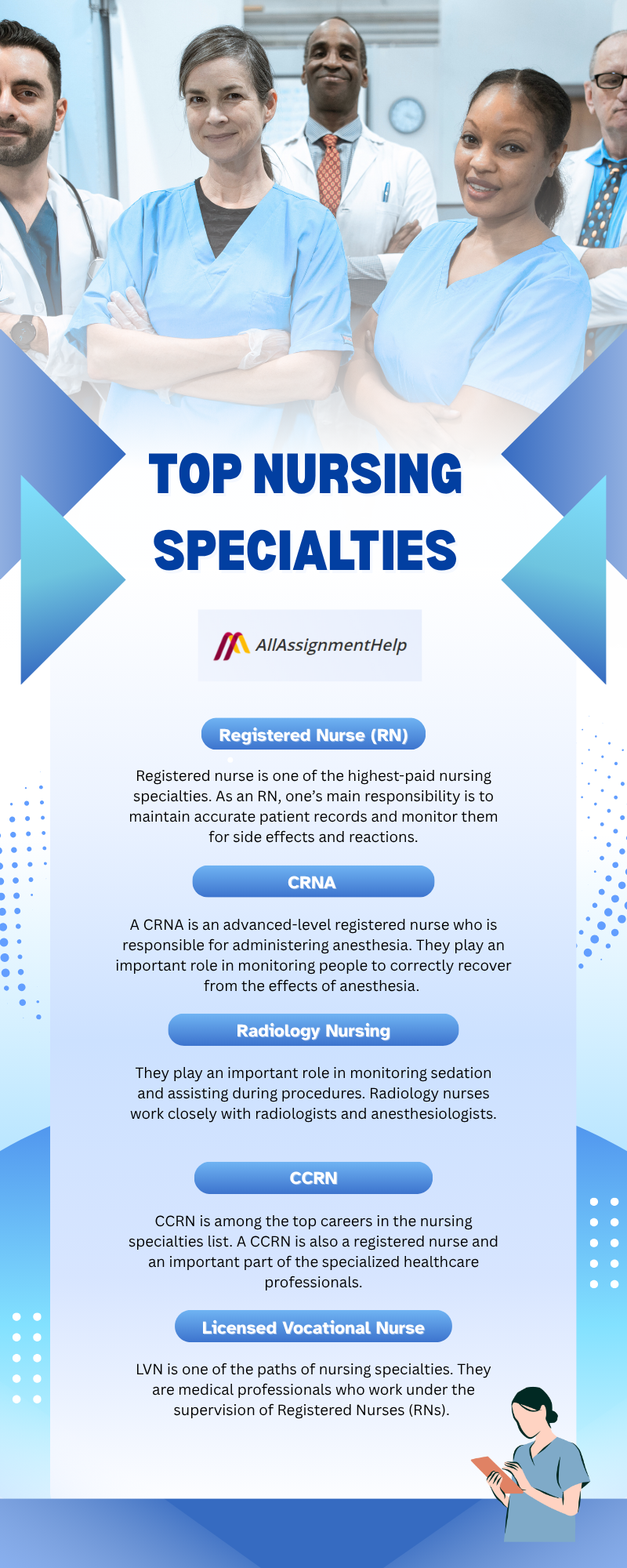
Registered Nurse (RN)
- Job description: Registered nurse is one of the highest-paid nursing specialties. As an RN, one’s main responsibility is to maintain accurate patient records and monitor them for side effects and reactions. There are other responsibilities as well, such as prescribing assistive medical devices and evaluating patient nursing care plans.
- Education requirements: The primary requirement is to obtain a bachelor’s degree or master’s degree in nursing. Nurses are also required to pass the NCLEX-RN and obtain state licensure as a registered nurse.
- Professional skills required: Basic computer skills with a friendly attitude are necessary to work as an RN.
- Career outcome: The demand for registered nurses is almost everywhere. Some of the best places where one can work are hospitals, schools, government agencies, and community health centers.
- Salary for RN: The average salary for RN is $74,697.
Certified Registered Nurse Anesthetist (CRNA)
- Job description: Anesthesia is an important part of medical treatment. Or we can put it that all the major healthcare treatments are incomplete without anesthesia. A CRNA is an advanced-level registered nurse who is responsible for administering anesthesia. They play an important role in monitoring people to correctly recover from the effects of anesthesia. They have knowledge about the different types of anesthesia and how to use them for medical work.
- Education requirement: CRNA is one of the types of nursing specialties and part of the advanced practice registered nurses (APRNs). To work as a CRNA, one needs to complete a Doctor of Nursing Practice (DNP).
- How to become one: First, complete your master’s degree with one year of working as a registered nurse in the ICU. Passing the National Certification Examination for Nurse Anesthetists is also a part of the process. Conferences, research, and classes are all part of the working process. To become a nurse anesthetist, you should never compromise on your academic and training process. Both theory and practical knowledge are necessary. Many top online assignment help services can help you improve your academic process. You can hire an assignment helper to help complete your nursing assignments on time. With the timely submission of assignments, you can fully focus on providing anesthesia care to people undergoing medical procedures.
- Career outcome: Like other nursing specialties, CRNAs can also work in different medical settings. Top places include hospital operating rooms (ORs), postanesthesia recovery rooms (PACUs), and labor and delivery units.
- Salary of a CRNA: $167 per hour or $190,500 each year.
Also Read: Nursing Decision-Making In Associate Professional Nursing Practice
Radiology Nursing
Radiology is a wide professional field with different specializations. Diagnostic radiology, interventional radiology, and radiation therapy in oncology are a few of it.
- Job description: In recent years, there has been a slight increase in radiology nurses. The prime responsibilities include patient preparation and helping patients after the procedure. They play an important role in monitoring sedation and assisting during procedures. Radiology nurses work closely with radiologists and anesthesiologists.
- Educational requirement: It is essential to complete a Bachelor of Science in Nursing (BSN).
- What are radiology nurse qualifications? Education, training, certification, and skills are essential requirements to meet.
- How to become one: One must earn an RN license and gain experience in acute or clinical care. Moreover, obtaining ACLS/BLS certification is essential to pursue specialized courses.
- Career outcome: One can work in diagnostic imaging departments and ambulatory surgery centers.
- Salary: The average salary may range between $73,000 and $100,000.
Also Read: Best Nursing Course to Pursue a Lucrative Nursing Career
Cardiac Nurse
Cardiac nursing is also one of the top nursing specialties. Here is what you need to know to pursue a career in this field.
- Educational requirement: Students with an associate’s degree or a bachelor’s of science degree are eligible to apply for it.
- Career outcome: Cardiac nurses can work in the ICU and CCU. They can find employment in hospitals and rehabilitation centers.
- Cardiac nurse salary: They can make upto $93887 per year in the United States.
Pursuing a field in cardiac nursing might not be easy. Strong medical knowledge might be required to understand the core areas of this field. Moreover, you must be able to regularly work on complex nursing assignment topics. If things get difficult or unmanageable, you may get help. Getting help from a cardiac nursing assignment help service is not a weakness. Highly experienced writers will not only help you in timely submissions but will also support your grades.
Critical Care Registered Nurse (CCRN)
- Job description: CCRN is among the top careers in the nursing specialties list. A CCRN is also a registered nurse and an important part of the specialized healthcare professionals. Providing critical care to adult and neonatal patients is the prime responsibility of this nursing professional.
- Educational requirements: The first step is to complete a degree in nursing. You can either complete an Associate Degree in Nursing (ADN) or a Bachelor of Science in Nursing (BSN).
- How to become one: Like any other nursing specialty, specialized training and clinical experience are all part of it. The candidate should pass a nursing program followed by the NCLEX-RN exam. Gaining clinical experience is also a part of the work. A minimum of 1,750 hours of direct care of treating critically ill patients is necessary. There are three specializations in CCRN. You can pursue one specialization and provide care to a group of people.
- Career outcome: Professionals can work in cardiac care or trauma units.
- Salary: The average salary of a CCRN may vary as on the professional skills. Average salary may range from $90,000 to $115,000/year.
Also Read: Is Nursing an Ideal Profession for You? Should You Choose Nursing, Find Out
Licensed Vocational Nurse (LVN)
- Job description: LVN is one of the paths of nursing specialties. They are medical professionals who work under the supervision of Registered Nurses (RNs). The main responsibility is to provide basic patient care. The other responsibilities include monitoring vital signs and wound care. They play an important role in providing emotional support to patients and families.
- Education requirement: The first step is to complete a state-approved practical nursing program. You can enroll in a community college or vocational school to complete this program. Completing does not just mean passing; it is essential to score top grades. However, if you find yourself struggling to keep up with the curriculum, you can pay someone to do your online class. A professional expert will make sure you get top scores while you focus on supervised clinical practice. Following this program, passing the NCLEX-PN (National Council Licensure Examination) is also necessary.
- Where they can work: They can work in nursing homes, clinics, and rehabilitation centers.
- Career outcome: They are an important part of the healthcare force and can work in hospitals and rehabilitation centers.
- Salary: Monthly pay of $6,166 or yearly pay of $74,000
Each nursing specialty has its benefits. Students exploring a career in nursing need to know about different nursing specialties. The right knowledge will help in making informed decisions with long-term growth in healthcare. From educational requirements to career outcomes to salary, you must know everything in detail. Once you know about the curriculum and clinical duties, you can plan everything thoughtfully. Most students don’t have prior knowledge and struggle to keep up with their assignments and exams, along with their clinical experiences. Many of them, in overwhelming situations, end up searching, can someone take my exam for me? Well, undoubtedly, seeking professional help is the smartest choice. Online helpers will help you manage workloads while still mastering the core concepts. You can stay on track with your courses and maintain top grades.
Final Words!
Nursing is an important part of the healthcare profession. Different nursing specialties help in providing the best care for everyone. These specialties are categorized into different groups to fulfill the healthcare demands. Various specialized nurses are needed to meet the needs of an individual or group of people. From hospice nurse to oncology nurse, each one plays a vital role in patient outcomes and overall healthcare delivery.
Anyone who wants to consider a career in nursing must be aware of the nursing specialties. The right education will only prepare you for rewarding and secure high-paying roles.
Frequently Asked Questions
Question 1: What are nursing specialties?
It is a process that helps nurses develop advanced knowledge and skills to move forward in their careers. Nursing specialties are grouped into different categories, providing additional training to nurses.
Question 2: What are the different nursing specialties?
Clinical-based, non-clinical-based, setting-based, and Advanced Practice Registered Nurses (APRN) are the different categories in nursing specialties.
Question 3: How many nursing specialties are there?
There are 30+ nursing specialties focusing on environments, age groups, leadership, and education.
Question 4: How to change nursing specialties?
The first step is to research other specialties. Next, you need to evaluate gaps and build necessary skills. Followed by this gain in exposure, go for training and network to grab better opportunities.
Connect the explanation to the work your course actually requires
Use this guide beside the exact brief, course material and marking criteria for Nursing Specialties.
- Use the named clinical or academic framework.
- Distinguish evidence from personal observation.
- Follow the required care, case or research format.
- Check current sources and referencing.
Finley Davies
Medical · 4.9/5
For a topic such as “In-Demand Nursing Specialties for 2025”, a tutor with a published background in Medical offers a useful subject-matching option.
Finley’s profile presents clinical experience alongside tutoring across pre-clinical, para-clinical and clinical study.
View established tutor profile ↗Relevant subject areas
- Nursing
- Radiology
- Pathology
- Dermatology
- Health and Social Care
- Clinical Studies
Find another explanation across the complete blog
This search uses WordPress itself, so it can reach articles beyond the 20 shown on the dashboard.
Connect Nursing Specialties to the task in front of you
Keep the brief, marking criteria, required evidence and submission format visible while you work.