How to Choose the Best Health Care Management Degree
What this article will help you understand
The healthcare industry is one of the fastest-growing sectors in this fast-paced world. Among all the other degrees, a healthcare management degree is the one that can bridge the gap between clinical expertise and administrative efficiency. This degree is specially designed for individuals who want to develop their skill set. Advanced knowledge and skills of
What are you trying to do with this topic?
Choose the closest task and the page will point you towards a useful next step.
Start with the central concept and the terminology used in the article.
Open the closest route ↗Connect the explanation to the question, learning outcomes and marking criteria.
Open the closest route ↗Review evidence, structure, referencing and the exact submission requirements.
Open the closest route ↗Do you have enough information to begin?
Select what you already have. Nothing is submitted from this checklist.
When these details are together, the requirement can be reviewed in context.
Nursing Assignment Help ↗Table of Contents
The healthcare industry is one of the fastest-growing sectors in this fast-paced world. Among all the other degrees, a healthcare management degree is the one that can bridge the gap between clinical expertise and administrative efficiency. This degree is specially designed for individuals who want to develop their skill set. Advanced knowledge and skills of the healthcare industry will prepare you for top-level leadership roles.
It is one of the best academic programs designed to prepare students for the unique requirements of the healthcare sector. Healthcare workers are responsible for ensuring everything runs smoothly behind the scenes. To know more about the healthcare management degree and how you can pursue this degree, refer to this blog post from All Assignment Help. We have provided comprehensive information to help you select the right course and advance in your career.
What is a Healthcare Management Degree?
Healthcare management is a crucial aspect of the healthcare industry. It serves as a specialized program to organize and streamline healthcare systems and organizations. The main purpose of this degree is to equip students with the knowledge and skills they need. They prepare individuals for leadership roles where they can meet the specialized demands of healthcare.
Some of the main roles of healthcare managers include overseeing daily operations and managing staff and resources. Moreover, there are also other crucial responsibilities, such as applying healthcare regulations, making strategic decisions.
Who can apply for this degree? Anyone passionate about the healthcare industry is suitable for this degree. This is the most rewarding career with long-term growth. However, general skills like leadership, computer proficiency, and a problem-solving mindset are important.
Healthcare management covers complex topics like strategic planning and healthcare marketing. You need to learn everything to effectively meet the demand of hospitals and take on leadership roles. However, not to worry, you can always seek assignment help and ensure the timely submission of assignments. Well-written assignments will increase your knowledge and prepare you for a career in health care management.
Best Healthcare Management Degree Options
Healthcare management is one of the sectors that has seen significant growth in recent years. Moreover, in upcoming years, it is likely to increase even more, and healthcare managers can expect higher salaries. Therefore, if you are looking to pursue a degree in this, then you have made the right decision. With this degree, you will be skilled enough to manage the business side of the healthcare industry.
However, with different healthcare management degrees available, choosing the right one can be confusing. We have got you covered. Here are the top healthcare management degree options available. Ensure that you choose a degree that equips you with the knowledge and skills that will make you successful.
- Bachelor’s of Science (BS) in Health Care Management
- BS in Health Care Administration
- BS in Health Information Management
- BS in Nursing (BSN)
- BS/BA in Social Work (BSW)
- BS/BA in Public Health
- Master of Arts or Master of Science in Public Health
- Master of Arts or Master of Science in Healthcare Management
- Master of Arts or Master of Science in Healthcare Administration
- Master of Science in Nursing Informatics
- Master of Science in Nursing Administration
- Master of Science in Health Systems, Nursing Leadership and Effectiveness
- Master of Science in Health Informatics
- Master of Public Health
- Master of Public Administration
- Master of Management
- Master of Healthcare Management
- Master of Healthcare Delivery Science
- Master of Health Services Administration
- Master of Health Information Management
- Master of Health Administration
- Master of Arts or Master of Science in Epidemiology
- MBA/MSN
- MBA – Pharmaceutical Industry Specific
- Healthcare MBA
- Executive Master of Business Administration
- Doctor of Public Health or Doctor of Philosophy in Public Health
- Doctor of Philosophy in Health Policy
- Doctor of Philosophy in Epidemiology
- Doctor of Philosophy in Biostatistics
- Doctor of Philosophy in Biomedical Informatics
- Doctor of Nursing Practice
- Doctor of Management
- Doctor of Healthcare Management
- Doctor of Healthcare Administration
- Doctor of Health Informatics
Core Curriculum of Health Care Management Degree
One of the common questions raised by students before enrolling in any degree is, What will I study? One needs to know about the subjects they will study. By this, you can prepare yourself mentally and physically to learn both the easy and challenging subjects. In case of difficulty, you can always inquire with experts, can you do my online class? You can receive professional help for your entire class or any subject at any time. But still, it is essential to know about your core curriculum to effectively plan other things.
Undergraduate Degree Syllabus
In the bachelor’s health care management degree, you will study the following course concepts.
- Health Gadgets and Digital Health Initiatives
- HIS & Basics of Disruptive Technologies
- Food, Nutrition, and Hygiene
- Physical Education and Yoga
- Basics of Human Anatomy
- Medical Terminology
- Elementary Statistics
- Fundamentals of Financial Management
- Healthcare Service Relations
- Organisational Behaviour in Hospitals
- Introduction to Health Systems and Hospitals
- Basics of Health Economics
- Fundamentals of Administration
- Communication Skills – I
- Foreign Business Language
- Communication Skills – II
- Biomedical Waste Management
- Hospital Pharmacy
- Occupational Health Hazards and Disaster Management
- Medical Ethics
- Audit in Hospitals
- Patient Safety in Hospitals
- Change and Innovation Management
Graduate Degree Syllabus
In the master’s health care management degree, the following subjects are covered in detail. Here you can study and gain practical experience as well.
- Management Processes & Organisational Behaviour
- Corporate Finance
- Marketing Management
- Managerial Communication I
- Managerial Communication II
- Production and Operations Management/ Management of Clinical Services
- Business Research Methods
- Legal Aspects of Business/ Legal Aspects of Healthcare
- Information Technology for Managers
- Governance, Ethics & Sustainability
- Introduction To Hospital Healthcare Management
- RBL-1 (Compulsory Audit Course)
- RBL-2 (Compulsory Audit Course)
- Strategic Management
Managing theoretical exposure across semesters, along with practicals, might not be easy. There should not be any compromise in the submission of assignments. You must make sure to submit high-quality and plagiarism-free assignments on time. The smart move in this situation is to seek online help with assignments. For example, if you are not good at corporate finance, seek finance assignment help. They will help you deal with complex finance assignments without compromising on your grades.
Tips to Choose the Right Healthcare Management Degree
The demand for a healthcare management degree is increasing. There is a constant need for qualified professionals who can lead teams and manage patient outcomes. It is one of the best degrees for someone who is aiming for professional development. With different degrees available under this specialization, it might be difficult to choose one. Some of the factors to consider when choosing the right healthcare management degree for your career are:
Choose the Right Health Care Management Degree
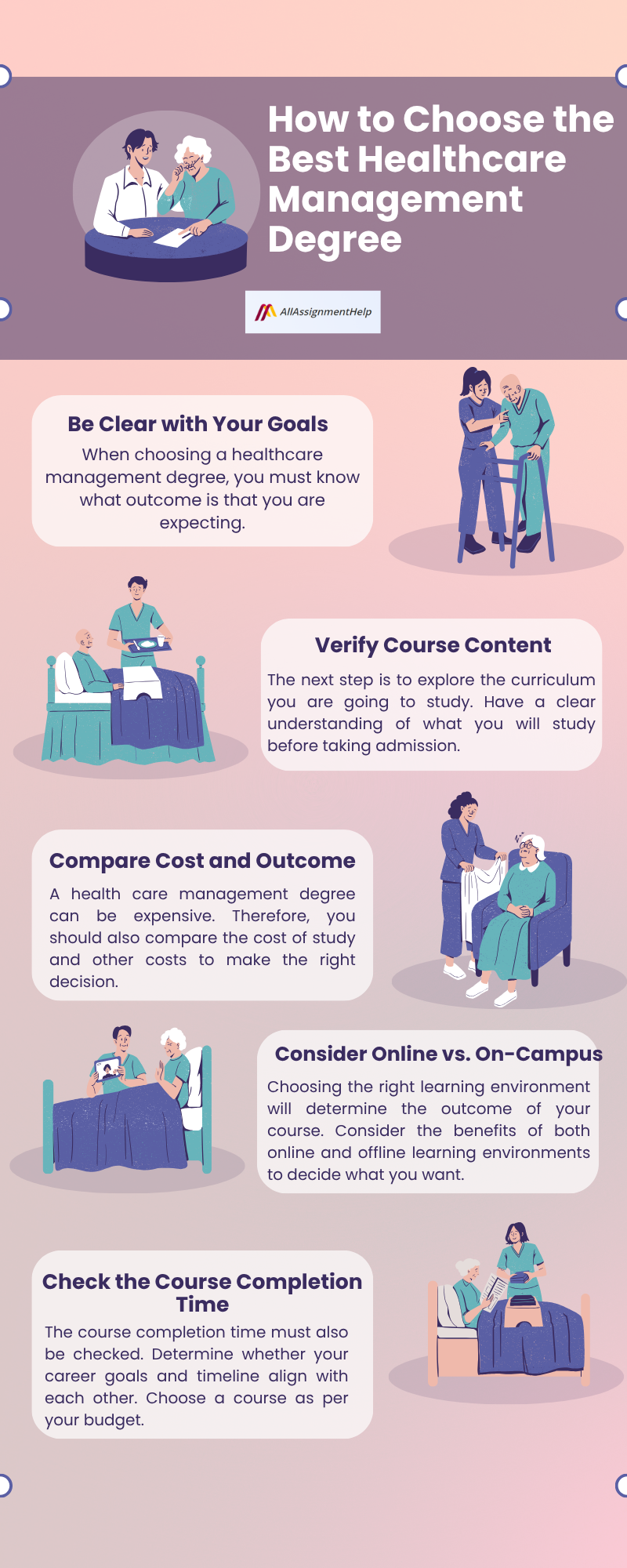
Healthcare management is a wide area with different specializations. When choosing a healthcare management degree, you must know what outcome is that you are expecting. Each degree has its own benefits and opens doors to different career fields. Therefore, know what you are expecting. Whether you want to become a hospital administrator, clinical manager, or healthcare consultant. This way, you can decide the right degree level for yourself.
Verify Course Content
The next step is to explore the curriculum you are going to study. What if you enroll in a degree that you can’t proceed to complete? Difficult courses will make your study time even more difficult. The healthcare management curriculum is especially difficult. Marketing, statistics, and pharmacy are some of the parts of this curriculum. In addition to this, there are many other subjects that you will cover in each semester. Have a clear understanding of what you will study before taking admission. However, if you still encounter any problems, get help with assignments. Students who are not good at marketing can get marketing assignment help. Likewise, you can always get help with other assignments that you are not good at.
Compare Cost and Outcome
A health care management degree can be expensive. Therefore, you should also compare the cost of study and other costs to make the right decision. Compare which one is cost-effective for you. Whether it is a traditional learning method or an online mode. Online degrees are mostly affordable, and you can save a lot of money. However, this reason should not be enough to make your decision.
Make sure you evaluate the cost and return on investment. Check whether your chosen program justifies the career opportunities or not. In this step, there are a few things you need to consider before jumping into any program. Consider tuition fees, financial aid, scholarship opportunities, placement rate, and salary.
Consider Online vs. On-Campus
With the recent developments in technology, now students have the benefit of choosing whether they want to continue in an online or offline mode. Choosing the right learning environment will determine the outcome of your course. Hence, make the right decision.
Consider the benefits of both online and offline learning environments to decide what you want.
- Online learning modes are flexible and affordable. This is ideal for working adults and career changers. Traditional classrooms might not be the best for everyone. However, online is suitable for all, especially those who are dealing with work and study. Moreover, you can also get help with your exams and assignments to improve your academic grades. Just search. Can someone take my online exam for me? and get timely help with your exams. The same goes for assignments. You can get help with assignments and better academic performance anytime.
- Traditional learning modes are also beneficial. Here you will have the opportunity to directly interact with your instructors and clear your doubts one-on-one. You can make friends and enjoy your university life. Structured learning environment provides in-person networking and faculty access.
Check the Course Completion Time
The course completion time must also be checked. Bachelor’s degrees are usually three to four years long. While the master’s degree is one or two years long, if completed full-time. Not all students find it easy to complete a course on a full-time basis. There are quite a few students who prefer the part-time mode, which can take up to six years. Therefore, when selecting an academic program, always consider the course completion time.
- Determine whether your career goals and timeline align with each other. Choose a course as per your budget.
- Longer courses can be expensive, while shorter courses can demand intensive study routines.
Frequently Asked Questions
Question 1: Which is the best healthcare management degree?
Master of Healthcare Administration, which will prepare you for top-level positions. You can develop the necessary skills and meet the demands of your profession.
Question 2: What can you do with a health care management degree?
You can work in hospitals, nursing homes, and outpatient health care facilities. With the right clinical experience, you can find employment in a hospital or another type of health care facility.
Question 3: What are the specializations in healthcare management?
Post Graduate Certificate in Healthcare Management (PGCHM) and Health and Human Services Management Post-Diploma Certificate are the important specializations in this degree.
Question 4: What are the top trends in healthcare management?
Value-based care, patient-based care, telemedicine, and artificial intelligence in healthcare are some of the trends.
Connect the explanation to the work your course actually requires
Use this guide beside the exact brief, course material and marking criteria for Health Care Management Degree.
- Use the named clinical or academic framework.
- Distinguish evidence from personal observation.
- Follow the required care, case or research format.
- Check current sources and referencing.
Cindy Anderson
Nursing and Medical · 4.8/5
Tutor selection should follow the exact brief. For “How to Choose the Best Health Care Management Degree”, Cindy Anderson’s published Nursing and Medical background is a relevant place to start.
Cindy’s live profile lists nursing instruction, advanced practice nursing and medical case-management experience. PhD in Nursing, University of Warwick
View established tutor profile ↗Relevant subject areas
- Advanced Practice Nursing
- Ambulatory Care Nursing
- Health Plan Creation
- Medical Case Management
- Healthcare
Find another explanation across the complete blog
This search uses WordPress itself, so it can reach articles beyond the 20 shown on the dashboard.
Connect Health Care Management Degree to the task in front of you
Keep the brief, marking criteria, required evidence and submission format visible while you work.