How to Manage Online Exam Fear Before and During the Test

What this article will help you understand
Online exam fear may be driven by subject knowledge, timing, previous experiences or uncertainty about the platform. The article helps students separate these causes, build confidence through visible preparation, create a test-day routine and recognise when professional wellbeing support is appropriate.
- Separate academic, format, technical and timing concerns before choosing a response.
- Use practice evidence rather than reassurance alone to build confidence.
- Prepare the device and support route before the examination begins.
- Seek qualified help when anxiety is severe, persistent or disrupts daily functioning.
What are you trying to do with this topic?
Choose the closest task and the page will point you towards a useful next step.
Start with the central concept and the terminology used in the article.
Open the closest route ↗Connect the explanation to the question, learning outcomes and marking criteria.
Open the closest route ↗Review evidence, structure, referencing and the exact submission requirements.
Open the closest route ↗Do you have enough information to begin?
Select what you already have. Nothing is submitted from this checklist.
When these details are together, the requirement can be reviewed in context.
Online Class Help ↗Table of Contents
Online exam fear is not always a sign that a student has failed to prepare. Anxiety may come from the subject, the time limit, previous results, or uncertainty about the technology. The practical response is to identify which part of the situation feels threatening and prepare for that part directly. Now, educational institutions are choosing to use online exams in place of paper-based ones. While some students adopt and get familiar with new technology more quickly than others, many students are unfamiliar with this new examination format. This brings online exam fear in them. Although exam fear is common among exam-takers. Still, excessive worry can harm the performance of the students.
Are you one of those who are preparing for online exams and want to know how to overcome exam fear? Then, you should pay close attention to this blog post created by one of the experts at All Assignment Help as it includes some of the most essential exam strategies that will help you overcome the fear and anxiety associated with it.
What online exam fear can look like
Some nervousness before an assessment is common. It may appear as a racing heartbeat, tense muscles, nausea, difficulty sleeping or an urge to avoid revision. It can also affect thinking: a student may repeatedly predict failure, reread the same paragraph without absorbing it or struggle to retrieve information that felt clear the day before.
Persistent or severe symptoms deserve support from a qualified health professional or the institution’s student-wellbeing service. This guide offers study and test-day strategies; it is not a diagnosis or substitute for mental-health care.
Read Here: Best Way to Secure High Grades in Online Exams
Primary Causes of Online Exam Fear
There are various reasons why students experience exam fear. Among these are:
- Having trouble staying focused when studying or having trouble remembering things
- Fear of failing an exam or receiving a low score
- Fear of falling short of expectations set by parents and educators
- Insufficient preparation for specific topics
- Making comparisons with other classmates
- Putting high standards for oneself
- Thinking negatively
Students who suffer from exam anxiety often suffer from low academic achievement. They have a decline in self-esteem as well as an impact on their general physical and mental health. Thus, all these make them ask themselves, is it right to hire someone to take my online exam for me? To get help from an expert who can assist them in getting high scores in their online exams?
What are The Symptoms of Exam Fear ?
Exam fear, also known as test anxiety, is a feeling of stress, worry, or nervousness before or during an exam. It can affect a student’s emotions, physical health, concentration, and academic performance.
Common Symptoms of Exam Fear
| Type of Symptom | Common Signs |
|---|---|
| Physical symptoms | Sweating, a racing heartbeat, headaches, stomach pain, nausea, or trembling hands. |
| Emotional symptoms | Fear of failure, excessive worry, irritability, nervousness, or feeling overwhelmed. |
| Mental symptoms | Difficulty concentrating, negative thoughts, overthinking, and forgetting answers despite studying. |
| Behavioral symptoms | Avoiding revision, procrastinating, skipping exams, or repeatedly checking study materials. |
| Sleep-related symptoms | Trouble falling asleep, restless nights, or feeling tired before an exam. |
These symptoms are common whenever a student has to take an online exam. However, the stress of taking exams online increases when students have exams related to math or statistics. They feel less prepared as these subjects require in-depth preparation. As a result, they were left with no option other than to ask an expert, ” Can you take my online math class for me?” To strengthen their understanding, practise difficult problems, and prepare more confidently for upcoming exams.
How To Overcome Exam Fear? Proven Exam Strategies for Eliminating Fear
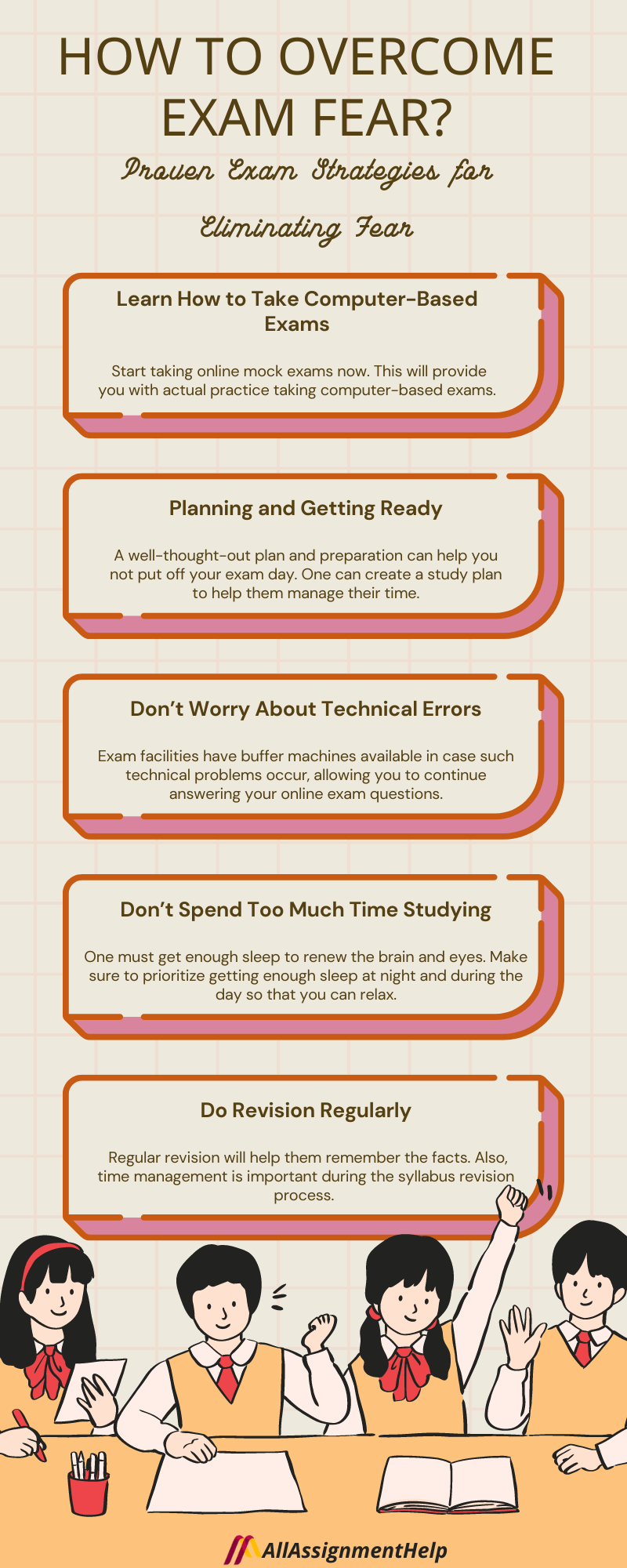
Students often feel exam anxiety when taking exams. Exam anxiety management is crucial for them, and there are lots of effective strategies for doing so. Below we have put up some useful tips for getting over exam anxiety and fear.
Separate academic anxiety from technical anxiety
Ask two questions: “Am I worried that I do not know the material?” and “Am I worried that the platform will fail?” The answers lead to different actions.
- For a knowledge gap, use short retrieval sessions, practice questions and feedback.
- For a format gap, take the official practice assessment and learn the navigation.
- For a technical concern, test the device, network, browser and support route.
- For a timing concern, practise question allocation under realistic limits.
Build confidence with evidence, not reassurance alone
Writing “I will be fine” may not convince an anxious mind. Concrete evidence is stronger. Keep a short record of practice questions completed, topics recalled without notes and technical checks passed. This turns preparation into something visible.
The companion guide to using online mock tests effectively explains how to turn practice results into targeted revision.
Begin with a manageable task: ten minutes of recall, five questions or one difficult concept. Completing a small action reduces avoidance and makes the next action easier.
Use a realistic revision rhythm
Long, exhausted study sessions can create the impression of effort while reducing concentration. Divide the syllabus into specific outcomes and alternate retrieval, explanation and practice. Review errors after each set rather than waiting until the end of the week.
Sleep, food and movement are part of preparation. Staying awake all night may increase the very concentration and memory problems that cause anxiety.
Create a test-day plan before test day
- Confirm the start time and time zone.
- Charge the device and arrange a power connection.
- Open only the permitted applications and materials.
- Keep the official support details available.
- Log in early enough to handle authentication without rushing.
- Read the full instructions before answering.
If online coursework has fallen behind, ask for appropriate help early. Tutoring, concept explanation and study planning are safer than waiting until the exam becomes a crisis. Students can review support for demanding online classes while checking their institution’s academic-integrity boundaries.
Reset attention when anxiety rises during the exam
Pause for a few seconds, place both feet on the floor and slow the exhale. Then identify the next observable action: read the command word, underline the required quantity or write the first step of the calculation. The goal is not to eliminate every anxious feeling. It is to return attention to the task.
If one question causes a block, mark it and continue when the platform permits. Securing available marks can restore momentum.
A five-minute pre-exam reset
Stop studying and check only what can still be acted upon: login details, permitted materials, water, power and the support route. Sit in the planned position and take several slower breaths without trying to force a particular feeling. Read the first instruction carefully when the assessment opens. This short routine prevents last-minute searching from carrying directly into the timed session.
Review the experience without judging yourself
After submission, record what worked and what should change. Distinguish preparation problems from technical events and from ordinary uncertainty. Avoid repeatedly replaying answers that cannot be changed. Use official feedback when it becomes available.
When to seek additional help
Contact a counsellor, doctor or student-support service if anxiety is intense, continues outside the exam period, causes panic symptoms or regularly prevents sleep and daily functioning. If you are in immediate danger or thinking about harming yourself, contact local emergency services or a crisis service immediately.
Adjust the plan for different kinds of online exams
Fear often increases when a student prepares for the wrong assessment experience. A multiple-choice exam requires careful discrimination between similar options and a plan for negative marking, if it applies. A problem-solving exam requires practice showing steps while monitoring time. An essay exam requires rapid planning, a defensible argument and enough time to revise. An oral examination adds speaking practice, camera familiarity and concise explanations.
Use the course instructions to rehearse the decisions that the actual format will demand. For an open-book exam, organise permitted resources and practise finding information without turning every question into a search exercise. For a closed-book test, prioritise retrieval practice. For an adaptive test, accept that questions may change in difficulty and avoid interpreting one hard item as proof that the entire attempt is failing.
Create one short contingency statement for predictable worries: “If the page freezes, I will record the time and use the support route”; “If I cannot answer a question, I will mark it and continue”; or “If my thoughts race, I will return to the command word.” A rehearsed response reduces the number of decisions that must be invented under pressure.
Also Read: How to Prepare for Online Math Exams?
Final Thoughts!
It is challenging for students to overcome the factors that surround their academic life, such as academic pressure, physical and mental health loss, stress, anxiety, and exam fear. However, very few people know how to get over their fears. The reasons behind fear differ from person to person. Thus, particular attention should be given to the solution as well. Every student is different, and so are their problems.
Hope these aforementioned online exam strategies will help you. Students can improve their performance and confidence by putting these strategies into practice. Also, if you need help with your online exams or classes, you can get help from us. We also have online assignment helper available to help you with your academic assignments. Get all-inclusive assistance in one place!
Frequently asked questions
Why do I forget material during an online exam?
Stress, weak retrieval practice, poor sleep and rushing can all interfere with recall. Practising without notes under mild time pressure can make retrieval more dependable.
Should I keep studying until the exam starts?
Brief review may help, but last-minute cramming can increase agitation. Stop heavy study early enough to prepare the environment and arrive mentally settled.
Can technical practice reduce exam fear?
Yes, when uncertainty about the platform is part of the fear. Use the institution’s demonstration or practice test on the same device and connection planned for the assessment.
What this article covers
This guide offers general study, preparation and attention-management strategies for online exam fear. It does not diagnose or treat an anxiety disorder and does not replace care from a qualified mental-health professional.
Terms used in this guide
- Exam anxiety
- Worry or distress connected with preparing for or taking an assessment.
- Retrieval
- Bringing previously learned information back from memory.
- Grounding
- A technique that redirects attention toward the present situation or next action.
- Technical rehearsal
- Testing the required device, platform and connection before an online exam.
Sources consulted for this guide
- Anxiety DisordersCleveland Clinic · July 3, 2024
- Organizing Instruction and Study to Improve Student LearningInstitute of Education Sciences · Accessed October 17, 2026

Vyad
- Next review
- April 6, 2027
What changed: Added a clear health limitation, separated technical fear from knowledge gaps and replaced generic motivation with an actionable test-day plan.
Connect the explanation to the work your course actually requires
Use this guide beside the exact brief, course material and marking criteria for Online Exam Fear How to Stay Focused and Confident.
- Name the course and current module.
- Include the platform instructions.
- Follow the instructor's method.
- Use the exact local deadline and time zone.
Raul Hegidges
Psychology · 4.8/5
Raul’s published profile combines psychology writing experience with cognitive science, quantitative research and clinical reasoning. Master’s in Psychology, University of Queensland
View established tutor profile ↗Relevant subject areas
- Psychology and Cognitive Science
- Numeracy and Quantitative Research
- Clinical Reasoning
- Experiential Learning
Find another explanation across the complete blog
This search uses WordPress itself, so it can reach articles beyond the 20 shown on the dashboard.
Connect Online Exam Fear How to Stay Focused and Confident to the task in front of you
Keep the brief, marking criteria, required evidence and submission format visible while you work.