What Are the Four Major Branches of Mathematics? A Comprehensive Guide
What this article will help you understand
Mathematics is often described as the language of the universe. It is indeed a vast and complex field that serves as the basis for much of our understanding of the world. It is essential in every aspect of our life, from simple calculations to scientific research. Generally, mathematics consists of several branches, each representing a
What are you trying to do with this topic?
Choose the closest task and the page will point you towards a useful next step.
Start with the central concept and the terminology used in the article.
Open the closest route ↗Connect the explanation to the question, learning outcomes and marking criteria.
Open the closest route ↗Review evidence, structure, referencing and the exact submission requirements.
Open the closest route ↗Do you have enough information to begin?
Select what you already have. Nothing is submitted from this checklist.
When these details are together, the requirement can be reviewed in context.
Math Assignment Help ↗Table of Contents
Mathematics is often described as the language of the universe. It is indeed a vast and complex field that serves as the basis for much of our understanding of the world. It is essential in every aspect of our life, from simple calculations to scientific research. Generally, mathematics consists of several branches, each representing a unique group of disciplines. In this blog by All Assignment Help, we will discuss four major branches of mathematics: Arithmetic, Algebra, Geometry, and Calculus. We will provide an overview of each branch, history, and practical application and explore how they relate to each other.
This blog will express the value of branching in understanding the beauty and complexity of mathematics. Moreover, this tour through the realms of mathematics will reveal not only some interesting facts but also its beauty and importance for each student, worker, or person who is just on their way to studying this exact field.
What Are the Four Major Branches of Mathematics?
The four major branches of mathematics are different areas of study that focus on solving specific types of mathematical problems. Together, they provide the building blocks for nearly every mathematical concept taught in schools and universities.
Here’s a quick overview.
| Branch | Primary Focus | Common Uses |
|---|---|---|
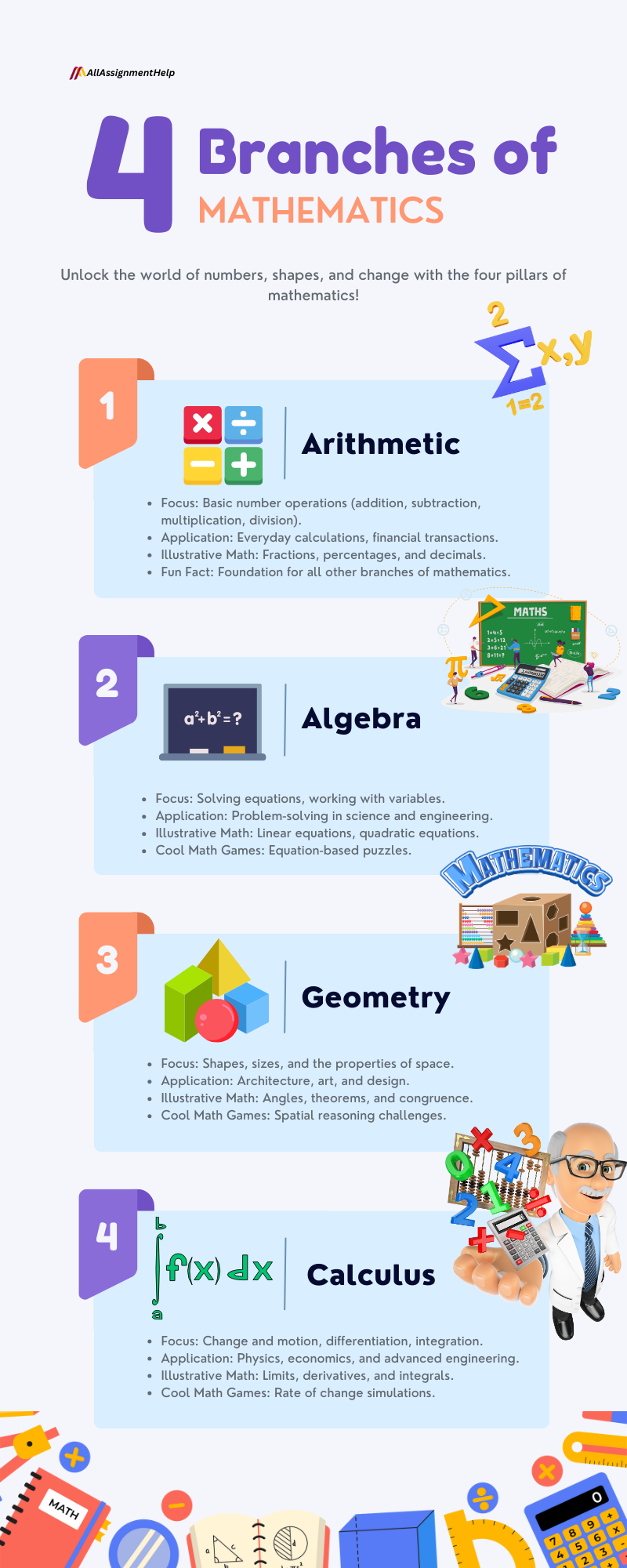
| Arithmetic | Numbers and basic operations | Daily calculations, budgeting, shopping |
| Algebra | Variables and equations | Problem-solving, programming, engineering |
| Geometry | Shapes, sizes, and space | Architecture, construction, design |
| Calculus | Change and motion | Physics, engineering, economics |
Each branch builds upon the knowledge gained from the previous one. Students typically start with arithmetic before progressing to algebra, geometry, and eventually calculus.
Why Is Mathematics Divided into Different Branches?
Mathematics has evolved over thousands of years. As new discoveries were made, mathematicians realized that different types of problems required different methods and approaches.
For example:
- Calculating grocery bills requires arithmetic.
- Finding an unknown value requires algebra.
- Designing a bridge requires geometry.
- Predicting how a rocket moves requires calculus.
Rather than treating all mathematical concepts as one large subject, they were grouped into specialized branches. This makes learning more structured and allows professionals to apply the right mathematical tools to solve specific problems.
Today, these branches work together in fields such as:
- Artificial Intelligence
- Computer Science
- Finance
- Engineering
- Healthcare
- Astronomy
- Architecture
- Data Analytics
Without a solid understanding of these branches, mastering advanced mathematical concepts can become challenging. If you’re struggling with coursework, projects, or complex problem-solving, seeking math assignment help can provide expert guidance, strengthen your understanding, and help you build confidence while improving your academic performance.
Arithmetic: The Backbone of Mathematics
Of course, each person knows what arithmetic is because people use it much more often and with more success than other areas of mathematics. Moreover, arithmetic is the essence of math because it is the basis for other branches of mathematics. It is the simplest type of mathematics, which implies the four basic operations including addition, subtraction, multiplication, and division.
They help to add the numbers and subtract, multiply, or divide one figure by the other one. It is not too complicated and manifests itself in daily living. For example, you use it daily for shopping or cooking. On the other hand, in arithmetic, discrete mathematics is a way to make clear such operations as addition or multiplication via illustrative examples.
Historical significance and practical applications
Arithmetic is one of the oldest branches of mathematics, with a history dating back thousands of years. Long before modern calculators and computers, ancient civilizations used arithmetic to solve practical problems related to trade, construction, agriculture, and astronomy.
Some key milestones in the history of arithmetic include:
- Ancient Egyptians used arithmetic for land measurement, taxation, and constructing monumental structures like the pyramids.
- Babylonians developed one of the earliest number systems and used arithmetic for trade, record-keeping, and astronomical calculations.
- Ancient Indian mathematicians introduced the decimal number system and the concept of zero, which transformed mathematics worldwide.
- Arabic scholars preserved and expanded mathematical knowledge during the Middle Ages, helping spread arithmetic across Europe and beyond.
Over centuries, arithmetic evolved from simple counting techniques into a structured mathematical discipline. Today, it serves as the foundation for advanced branches such as algebra, geometry, calculus, and statistics, making it one of the most important concepts every student learns.
Thus, both mathematics and its branches connect through their usage depending on circumstances and add to the knowledge in mathematics, allowing the construction of models for practical use. Moreover, as a student, arithmetic might bring you tough times with your coursework. In such cases, you can rely on good assignment help. Because the subject matter expert would help you understand the concept better and provide you with error-free work.
Also read: How Online Math Classes Make the Learning More Accessible?
Algebra: The Language of Symbolic Mathematics
Arithmetic teaches us how to work with numbers, but algebra takes mathematics a step further. Instead of using only numbers, algebra introduces letters and symbols to represent unknown values and quantities. This allows mathematicians to solve problems, identify patterns, and create formulas that work in different situations.
Unlike arithmetic, which focuses on specific numerical calculations, algebra deals with relationships between numbers. By using variables such as x, y, or z, it becomes possible to solve equations, predict outcomes, and represent real-world situations mathematically.
What Is Algebra?
Algebra is the branch of mathematics that uses variables, symbols, and equations to represent numbers and their relationships. It helps solve problems involving unknown values and forms the basis of many advanced mathematical concepts.
Some of the key concepts in algebra include:
- Variables: Symbols (such as x or y) that represent unknown values.
- Constants: Fixed numerical values that do not change.
- Expressions: Mathematical statements made up of variables, numbers, and operations.
- Equations: Statements that show two expressions are equal.
- Functions: Relationships where one value depends on another.
Algebra is much more than a classroom subject. It serves as the foundation for advanced fields such as computer science, engineering, economics, artificial intelligence, cryptography, coding theory, and data science. It also supports important areas of higher mathematics, including linear algebra, abstract algebra, and discrete mathematics, where concepts like groups, rings, and fields are studied.
Historical development and key concepts
Algebra has a rich history that dates back thousands of years. Early forms of algebraic thinking appeared in ancient civilizations such as Babylonia, Egypt, Greece, and India, where mathematicians developed methods to solve practical problems involving unknown quantities. However, modern algebra began to take shape in the 9th century through the groundbreaking work of the Persian mathematician Muhammad ibn Musa Al-Khwarizmi, often called the Father of Algebra. His influential book introduced systematic techniques for solving linear and quadratic equations, laying the foundation for the algebra we study today.
Over the centuries, algebra continued to evolve as mathematicians expanded its principles and introduced more advanced concepts. Today, it is one of the most important branches of mathematics and serves as the basis for numerous scientific and technological advancements.
Applications outside mathematics and their significance
Algebra is one of the most practical branches of mathematics, with applications that extend far beyond the classroom. It provides the tools needed to solve equations, identify patterns, analyze data, and create mathematical models for solving real-world problems. As a result, algebra is an essential skill in many academic disciplines and professional careers.
Some of the major fields that rely on algebra include:
- Engineering: Designing structures, electrical circuits, and mechanical systems.
- Computer Science: Developing algorithms, programming software, and creating efficient computational models.
- Economics and Finance: Forecasting market trends, calculating profits, and optimizing investment strategies.
- Physics: Describing motion, forces, energy, and other scientific phenomena using mathematical equations.
- Artificial Intelligence and Data Science: Building predictive models, analyzing large datasets, and developing machine learning algorithms.
- Cryptography: Securing digital communication through encryption techniques based on algebraic principles.
In everyday life, algebra also helps people make informed decisions. It is used to calculate loan repayments, compare investment options, estimate project costs, and solve budgeting problems. Businesses rely on algebra to analyze performance, predict future growth, and optimize resources.
However, concepts like variables, functions, polynomials, and equations can become increasingly challenging as students progress to higher levels. If you’re struggling with coursework or complex problem sets, seeking algebra assignment help from experienced subject matter experts can provide personalized guidance, simplify difficult concepts, and help you complete assignments accurately while strengthening your overall understanding of algebra.
Also read: How to Prepare for Online Math Exams?
Geometry: Exploring Shapes and Spaces
Geometry is the domain of mathematics studying the properties and relationships of points, lines, planes, and solid objects in space. It includes an examination of the size, shape, and relative position of figures in space, and as a result, involves the study of compositions, arrangements, and proportions. Knowledge of geometry allows a person to receive an understanding of the surrounding space while defining dimensions and sizes.
Historical evolution and fundamental concepts
Geometry is one of the oldest subjects that study different spatial forms and bring their relations to a logical sequence. It goes back to ancient civilizations and sees tremendous contributions from many Greek mathematicians, such as Euclid and Pythagoras. Their works and research have shaped the entire understanding of this subject.
A text element that remains one of the most influential in the history of mathematics is Euclid’s “Elements.” Key concepts of geometry are points, lines, angles, shapes, and theorems. They are used to prove specific properties of various spatial forms and solve several spatial problems.
Applications and relevance for modern life
Geometry is relevant in human life and serves as a basis for many branches. The sphere of geometry application in real life is vast and diverse. Architects use geometry to design buildings and ensure their stability. It is also used in art to make the image more harmonious using a well-chosen proportion. In engineering, it is used to solve tasks of stability and durability of structures in contact with the nature’s force.
Moreover, physicists use geometry to track calculations and understand the behaviour of other planets and stars relative to the Earth. When mastering geometry, the skill of solving problems is formed, and a person begins to better perceive the world as a world of space. In addition, graph theory applied to geometric problems is actively used to model geometric problems and solve connectedness tests and planar graph checking.
Calculus: The Mathematics of Change
The mechanisms of change and motion have occupied people’s minds from time immemorial. Thus, calculus, as a branch of mathematics, has emerged to study these phenomena. Through the concepts of derivatives and integrals, calculus helps to identify the tools for change and motion analysis and determine accumulated values.
Thus, calculus is based on such concepts as differentiation and integration, which allow people to understand the mechanics of change and solve different problems related to continuous change. For this reason, calculus can be viewed as the major aspect of modelling as it helps to analyze rates of change, optimize functions, and evaluate systems of change. Moreover, illustrative mathematics in calculus allows people to use visual tools for a better understanding of derivatives and integrals, defining the rates of change and sums of quantities.
Historical development and key concepts
Calculus is a branch of mathematics that originated from the work of the mathematicians Isaac Newton and Gottfried Wilhelm Leibniz, who independently invented calculus in the 17th century. The development of calculus involved the formalization of concepts such as the limit, continuity, derivatives, and integrals. The key concepts of calculus include limits that describe the functions as they approach some point; derivatives that define the rate of space’s change for a function; and integrals that range and quantity accumulation.
The concepts are vital for understanding, applying, and solving calculus problems effectively. You can strengthen your skills through regular practice and interactive cool math games that make learning more engaging. However, if you’re finding it difficult to keep up with assignments, quizzes, and deadlines, it’s common to wonder, “Can someone take my math class for me?“ In such situations, seeking professional mathematics assignment help can reduce academic stress while ensuring you continue learning even when coursework becomes overwhelming.
Applications and Impact on Science and Engineering
One of the most essential fields where calculus plays a crucial role is physics.
- Here, calculus is applied to model and analyze motion by considering the time rate of change of variables related to distance, speed, and acceleration at a point without regarding information about the motion on the interval between two points, which leads to the deriving of equations of motion.
- Other examples are the determination of the hour when the speed of production lies within a specified range and the evaluation of the number of cars moving at a certain speed at a distance from zero to six miles.
- Moreover, the notions of mass transfer and accumulation, as well as physical quantities of solids and liquids are described by differentiation.
- Another field is consideration of Newton’s law of cooling based on concepts of cooling and mixing chemicals.
- Finally, physics includes the use of calculus for the analysis of forces, work, and energy.
- In addition, engineers also apply this branch of mathematics to design and optimize systems.
When it comes to economics, calculus plays a role in analyzing optimization and predicting market behaviours.
Finally, calculus also has numerous applications in computer science: Algorithms, for instance, have been developed for scanning a plane with a radar beam, for random sampling, for finding the largest triangle in a set of points, and for finding a maximum flow in a network.
The knowledge of this field of mathematics allows practitioners to be able to solve the most sophisticated problems and make decisions based on mathematical analysis. Furthermore, discrete mathematics provides numerical methods and algorithms to solve problems related to calculus during computer simulations.
Also read: How Online Math Classes Help Students Simplifying Mathematical Concepts?
Comparative Analysis: Interconnections and Evolution
Mathematics is not a collection of isolated subjects. Instead, arithmetic, algebra, geometry, and calculus are deeply interconnected, with each branch building upon the concepts of the previous one. Together, they create a powerful framework for solving everything from simple calculations to complex scientific problems.
How These Branches Connect
- Arithmetic is the starting point. It introduces numbers and basic operations like addition, subtraction, multiplication, and division, forming the foundation of all higher-level mathematics.
- Algebra builds on arithmetic. Instead of working only with numbers, it uses variables, formulas, and equations to represent unknown values and solve more complex problems.
- Geometry combines logic with algebra. While it focuses on shapes, angles, measurements, and spatial relationships, many geometric proofs and calculations rely on algebraic equations and formulas.
- Calculus takes mathematics a step further. It uses concepts from arithmetic and algebra to analyze change, motion, growth, and continuously changing quantities, making it essential for solving real-world problems.
Evolution of Mathematics
The development of mathematics has been a continuous journey, with each branch evolving from earlier discoveries.
- Arithmetic laid the groundwork for mathematical thinking.
- Algebra introduced abstract reasoning and symbolic representation.
- Geometry expanded mathematical understanding by explaining the physical world through shapes and space.
- Calculus revolutionized mathematics by making it possible to study motion, rates of change, and optimization.
Why Their Connection Matters
Understanding how these branches work together makes learning mathematics easier and more meaningful.
- Improves problem-solving skills by combining different mathematical approaches.
- Strengthens logical and analytical thinking across various topics.
- Helps solve complex real-world problems in science, engineering, finance, and technology.
- Creates a strong foundation for advanced subjects such as linear algebra, statistics, differential equations, and data science.
- Supports modern innovations like artificial intelligence, robotics, computer graphics, architecture, and asteroid surface modelling.
Rather than viewing arithmetic, algebra, geometry, and calculus as separate subjects, think of them as four interconnected pillars of mathematics. Each branch strengthens the others, creating a unified system that helps us understand patterns, solve practical problems, and drive innovations in science and technology. If you’re struggling to grasp these concepts, seeking expert guidance or online assignment help can make learning much more manageable.
Future Trends and Developments
Mathematics continues to evolve, with every branch playing a key role in technological innovation and scientific discoveries.
Key Trends
- Arithmetic: Improves algorithms, digital transactions, and financial systems.
- Algebra: Powers artificial intelligence, machine learning, and data analysis.
- Geometry: Supports 3D modeling, architecture, virtual reality (VR), and augmented reality (AR).
- Calculus: Solves complex problems in engineering, climate science, robotics, and economics.
The Future of Math Learning
Technology has made learning mathematics more flexible through online courses, AI-powered tutoring, and interactive learning tools. However, students may still struggle with difficult concepts, technical issues, or balancing coursework with other responsibilities. In such situations, many students search for reliable do my online class services to stay on track while meeting deadlines and maintaining their academic performance.
Conclusion
In conclusion, arithmetic, algebra, geometry, and calculus are fundamental to mathematics. They generate tools to solve almost all questions in practice and help lay the foundation for studying other subjects. The bulk of innovations across different fields of science can be traced to the subject as well.
Generally, people should not feel more favourably disposed to one branch than the other because they are interconnected. Anyone who can access any of the devices or applications for solving math problems will appreciate having in-depth knowledge of all the branches.
Frequently Asked Questions
| Question: What are the four major branches of mathematics? Answer: The four major branches of mathematics are Algebra, Geometry, Calculus, and Statistics. |
| Question: Which branch of mathematics should I start learning first? Answer: You should start with Algebra. |
| Question: How are we applying all these branches of mathematics in real life? Answer: Algebra might help with financial planning, Geometry with designing and constructing something, Calculus with changes, and Statistic with any kind of data and decision-making. |
Connect the explanation to the work your course actually requires
Use this guide beside the exact brief, course material and marking criteria for Four Major Branches of Mathematics.
- Write the complete problem.
- Use the method taught in the course.
- Show each material step.
- Check the result and units.
Sarah Johnson
Mathematics
Mathematics tutor with eight years of experience across core college and school mathematics topics. Master’s degree in Mathematics
View established tutor profile ↗Relevant subject areas
- Algebra
- Calculus
- Geometry
- Statistics
- Trigonometry
Find another explanation across the complete blog
This search uses WordPress itself, so it can reach articles beyond the 20 shown on the dashboard.
Connect Four Major Branches of Mathematics to the task in front of you
Keep the brief, marking criteria, required evidence and submission format visible while you work.