How to Maintain Focus During Online Classes? Practical Tips That Actually Work
What this article will help you understand
Online classes make learning more flexible than ever. Students can attend lectures from home, access recorded lessons, and study at a pace that suits their schedules. However, learning from home also comes with a challenge that many students experience: staying focused throughout a lesson. A notification appears on the phone, someone in the family starts
What are you trying to do with this topic?
Choose the closest task and the page will point you towards a useful next step.
Start with the central concept and the terminology used in the article.
Open the closest route ↗Connect the explanation to the question, learning outcomes and marking criteria.
Open the closest route ↗Review evidence, structure, referencing and the exact submission requirements.
Open the closest route ↗Do you have enough information to begin?
Select what you already have. Nothing is submitted from this checklist.
When these details are together, the requirement can be reviewed in context.
Online Class Help ↗Table of Contents
Online classes make learning more flexible than ever. Students can attend lectures from home, access recorded lessons, and study at a pace that suits their schedules. However, learning from home also comes with a challenge that many students experience: staying focused throughout a lesson.
A notification appears on the phone, someone in the family starts talking, or a lecture becomes difficult to follow. Before long, a student may realize that they have missed an important explanation or spent several minutes thinking about something unrelated to the lesson.
Learning how to maintain focus during online classes is not simply about avoiding distractions. It also involves creating a comfortable study environment, managing energy levels, participating actively, and developing habits that make learning easier. Students who understand their distractions and work on them gradually can improve their concentration without making their study routine unnecessarily complicated. However, a few practical changes can help you make better use of your study time, understand lessons more effectively, and feel less overwhelmed by academic responsibilities. Read this blog curated by an expert at allassignmenthelp to know the strategies you can use to maintain focus while learning online.
Why Is It Difficult to Maintain Focus During Online Classes?
Online learning requires students to manage their attention more independently than many traditional classroom settings. In a physical classroom, the teacher’s presence, interaction with classmates, and changes in classroom activities can help students remain engaged. At home, those external reminders may be less noticeable.
Several everyday situations can make concentration difficult during virtual lessons.
- Digital distractions: Social media notifications, messages, games, and unrelated browser tabs compete for attention.
- An uncomfortable study environment: Background noise, poor lighting, and an untidy desk can make it harder to concentrate.
- Passive learning: Watching a lecture without taking notes or answering questions can make students feel disconnected from the lesson.
- Mental fatigue: Long sessions without breaks may reduce alertness and make information harder to process.
- Unclear learning goals: Students may struggle to stay attentive when they do not understand what they are expected to learn.
- Personal responsibilities: Household tasks, family conversations, and work commitments can interrupt study time.
Recognizing these challenges is the first step toward solving them. Instead of blaming yourself for losing concentration, identify the specific situations that interrupt your attention and address them one at a time.
Also Read: Enhancing Your Online Class Performance: Tips for Students
Tips to Stay Focused In Your Online Classes
Online learning has become a common part of modern education, but staying focused during virtual classes can be challenging. Distractions, demanding coursework, and difficulty understanding lessons may affect students’ concentration and engagement. As a result, some students search for services using queries such as, “Can I pay someone to take my online class?” Others look for academic guidance, tutoring, or time-management support to improve their focus and make online learning more manageable.
We’ll look at some tried-and-true methods in this section for improving focus and getting the most out of your online education.
Uphold a regular routine
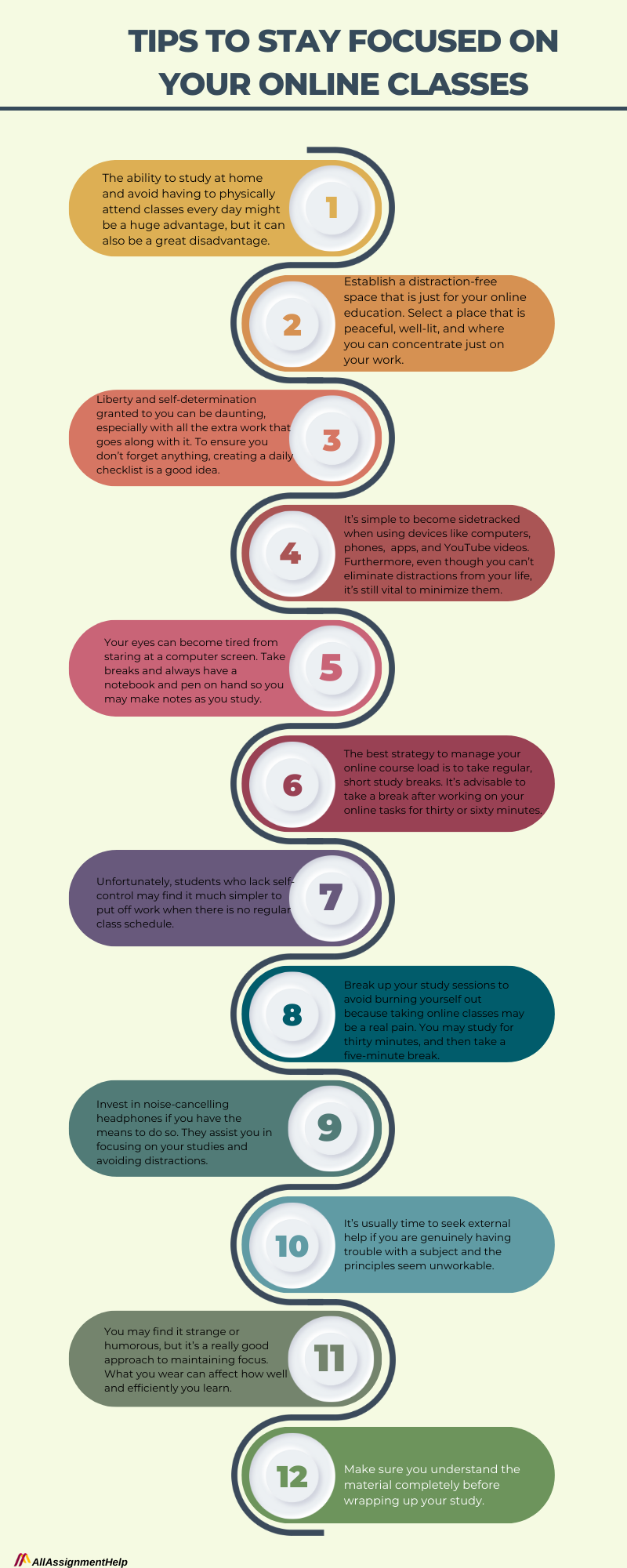
The ability to study at home and avoid having to physically attend classes every day might be a huge advantage, but it can also be a great disadvantage. One of the main advantages of online learning is the desire to feel free.
It is not appropriate to misuse the flexibility to select the study time. To maintain consistency with your study schedule, you must establish a daily routine. You can be more proactive in your studies by creating a daily schedule in advance. You’ll need to follow a rigid timetable once you’ve established your perfect plan. This can help you ground your vision organically.
Make a space just for studying
Establish a distraction-free space that is just for your online education. Select a place that is peaceful, well-lit, and where you can concentrate just on your work. Don’t use your dining room or kitchen table twice for teaching purposes. Establish a peaceful office instead, away from any noise from your home that may distract you. Gaining and maintaining focus for an online course requires a well-established learning environment.
Establish a daily to-do list
Having total liberty and self-determination granted to you can be daunting, especially with all the extra work that goes along with it. To ensure you don’t forget anything, creating a daily checklist is a good idea.
This will be quite helpful, particularly as exams are drawing near. You’ll likely need to do written projects, quizzes, discussion activities, and more, all of which usually have separate deadlines.
Creating a daily checklist helps you stay organized, track upcoming deadlines, and estimate how much time you need to complete your assignments and projects. If you find it difficult to manage multiple academic responsibilities, online assignment help services can provide guidance with challenging tasks and help you better understand your coursework. Some services may also offer support with tracking deadlines and staying informed about online class activities, making it easier to manage your academic workload.
Reduce the number of outside distractions
It’s simple to become sidetracked when using devices like computers, phones, social media, apps, and YouTube videos. Furthermore, even though you can’t eliminate distractions from your life, it’s still vital to minimize them.
Put your phone in Do Not Disturb mode and try to stay away from YouTube as much as you can. These diversions add up, and before you realize it, you can have wasted an hour or four of your precious time engaging in them. Become an active creator of your own success rather than a passive observer of your own failure!
Make handwritten notes
Your eyes can become tired from staring at a computer screen. Take breaks and always have a notebook and pen on hand so you may make notes as you study. Research indicates that writing by hand improves memory and understanding, which is another advantage. Taking notes in class is an excellent habit to get into if you want to learn and remain focused when you study. It will help you retain your lessons better and offer you something to do with your hands. It also provides you with a sense of conventional classroom instruction.
Allocate Specific Time for Studying
Many students find online programs very appealing because of their flexibility, especially those who are doing jobs along with studies. Unfortunately, students who lack self-control may find it much simpler to put off work when there is no regular class schedule. Students who have set out specific periods for study can benefit from maintaining the rigidity that an ordinary classroom schedule has probably given them. When it’s feasible, review your timetable and set aside time each week for study during the same times. You’ll find it easier to avoid delaying when your body adjusts to studying simultaneously over time.
Take a Pause in Between
Break up your study sessions to avoid burning yourself out because taking online classes may be a real pain. You may study for thirty minutes, and then take a five-minute break. Several studies reveal that taking a five-minute walk break during extended study sessions has numerous benefits.
Put on headphones
Invest in noise-cancelling headphones if you have the means to do so. They assist you in focusing on your studies and avoiding distractions. You can concentrate on your online course in this way. You can try to put yourself in the right frame of mind by listening to soothing or classical music while doing your homework or going over your notes.
Look for guidance and tutoring online
It’s usually time to seek external help if you are genuinely having trouble with a subject and the principles seem unworkable. Everyone struggles with certain subjects, so don’t take this as an evaluation of your intelligence or worth. Even the most gifted physicists may require help with their online physics classes, and vice versa. This is crucial to understand because many people choose not to ask for the assistance they require out of self-dignity, which hurts their overall academic performance. Online programs usually involve some sort of tutoring service; but, if not, you can use other genuine options. There are a multitude of online class help providers available.
They tend to be accessible and adaptable, and even if there might be a small upfront cost, the returns will be substantial. Asking for the assistance you require should not be put off until it is too late.
Read More: How to Stand Out in Your Online Programming Classes
How Can Teachers and Students Make Online Classes More Engaging?
Concentration is not solely an individual responsibility. The way a class is designed can also affect how easy it is for students to remain attentive.
Teachers can support engagement by breaking lengthy explanations into smaller sections, using relevant examples, inviting questions, and including short activities. Students can make the most of these opportunities by preparing beforehand and participating when possible.
For students, useful strategies include the following:
- Connect theoretical concepts with real-life situations.
- Write down questions as they arise instead of waiting until the end to remember them.
- Participate in group discussions and classroom activities.
- Review difficult topics after class while the information is still fresh.
- Study with classmates when collaboration helps clarify confusing material.
For teachers, short knowledge checks, interactive presentations, practical demonstrations, and clear learning objectives can make lessons easier to follow.
When students and teachers both contribute to an engaging learning environment, online classes can become more interactive and rewarding.
How Can You Build a Long-Term Habit of Better Concentration?
Improving concentration takes practice. Trying to change every study habit in one day may create unnecessary pressure, so begin with a few manageable adjustments and build from there.
For example, you could silence your phone during class this week, prepare your desk the following week, and start reviewing your notes after each lecture. Gradual changes are often easier to maintain than a complete routine overhaul.
Keep track of what works for you. If you concentrate better in the morning, schedule challenging work accordingly. If background noise is your biggest problem, prioritize finding a quieter study area.
You can also review your progress at the end of each week by asking yourself three simple questions:
- What helped me stay attentive this week?
- Which distractions interrupted my learning most often?
- What one change could make next week’s classes easier?
Your answers can guide small improvements without turning studying into another source of stress.
If concentration difficulties remain persistent across different activities and begin interfering significantly with daily life, consider discussing them with a qualified professional. Sleep difficulties, stress, and other underlying factors can affect attention, and it may be helpful to explore them rather than assuming that the problem is simply a lack of discipline.
Conclusion
Learning how to maintain focus during online classes is about creating conditions that support consistent attention rather than expecting yourself to remain perfectly concentrated every minute.
A comfortable study environment, fewer digital distractions, clear learning goals, active participation, and realistic time management can all help you get more from each lesson. Looking after your sleep, nutrition, hydration, and physical activity can further support your ability to learn.
You do not need to follow every strategy immediately. Start with the challenge that affects you most, whether it is checking your phone, feeling sleepy, or struggling to follow long lectures. Make one change, observe the results, and adjust your routine as needed.
Over time, these small habits can help you become a more attentive and independent learner. The real goal is not merely to sit through an online class without distractions. It is to understand what you are learning, remember important concepts, and use your study time more effectively.
Also Read: The Benefits of Online Classes for Working Professionals
Frequently Asked Questions (FAQs)
1. How can I focus on online classes without getting distracted?
Start by silencing unnecessary notifications, closing unrelated browser tabs, and choosing a quiet study location. Taking notes and setting a clear learning goal can also help you stay mentally involved throughout the lesson.
2. Why do I lose focus during online classes even when I want to learn?
Your attention may be affected by tiredness, background noise, stress, passive listening, or frequent digital interruptions. Identify the situations in which you lose concentration and make small adjustments to address them.
3. How long should I study without taking a break?
There is no single ideal duration for everyone, but 25–40 minutes of focused work followed by a short break is a useful starting point. Adjust the intervals according to the complexity of the lesson, your energy level, and your ability to remain attentive.
4. Is it better to study in silence or listen to music during online classes?
Silence is generally a practical choice during lectures because it allows you to hear the teacher and process explanations clearly. If you prefer background music while completing independent work, choose something unobtrusive and turn it off whenever it interferes with reading or problem-solving.
5. How can I stop checking my phone during online classes?
Keep your phone out of reach, enable Do Not Disturb mode, and allow only essential notifications. If checking your phone has become a habit, begin by keeping it away for one class and gradually extend that practice to the rest of your study schedule.
6. What should I do if I feel sleepy during online lectures?
Check whether you are getting sufficient sleep, drinking enough water, and taking movement breaks between classes. If sleepiness continues despite adequate rest or regularly interferes with your daily activities, consider seeking medical advice to understand the possible cause.
7. How can I concentrate during long online lectures?
Divide the lecture mentally into smaller sections and focus on understanding one concept at a time. Take brief notes, identify key points, and use natural pauses to review what you have learned instead of trying to memorize everything at once.
8. Does taking notes improve concentration during online classes?
Yes, taking notes can encourage active listening because you need to identify and organize the most important information. Write summaries in your own words rather than copying every sentence, and mark confusing points for review after class.
9. How can I improve my concentration when studying at home with family members?
Choose a regular study area, communicate your class timings to family members, and agree on ways to minimize interruptions when possible. If a quiet room is unavailable, try studying during less busy hours or using suitable headphones to reduce background noise.
10. How long does it take to improve focus during online classes?
The time required varies depending on your existing habits, learning environment, and the factors affecting your attention. You may notice improvements after making a few practical changes, but consistent routines and regular evaluation are important for developing lasting concentration habits.
Connect the explanation to the work your course actually requires
Use this guide beside the exact brief, course material and marking criteria for How to Maintain Focus During Online Classes.
- Name the course and current module.
- Include the platform instructions.
- Follow the instructor's method.
- Use the exact local deadline and time zone.
Connor Hamilton
Data Science
For a topic such as “How to Maintain Focus During Online Classes? Practical Tips That Actually Work”, a tutor with a published background in Data Science offers a useful subject-matching option.
Data science tutor with eight years of industry experience across analytics, large-scale data systems and machine learning. MSc in Data Science
View established tutor profile ↗Relevant subject areas
- Data Mining and Warehousing
- Hadoop and Spark
- Data Visualisation and Analytics
- Machine Learning Integration
- Cloud Big Data
- Python, R and Scala
Find another explanation across the complete blog
This search uses WordPress itself, so it can reach articles beyond the 20 shown on the dashboard.
Connect How to Maintain Focus During Online Classes to the task in front of you
Keep the brief, marking criteria, required evidence and submission format visible while you work.