All You Need to Know About Developing Interpersonal Communication Skills
What this article will help you understand
The exchange of information between people is known as interpersonal communication. Thoughts, ideas, feelings, and other types of data are all examples of information. This communication takes place both verbally (with words) and nonverbally (with facial expressions, gestures, body language, and voice tone). These abilities are now required for professional success. Employers value strong interpersonal
What are you trying to do with this topic?
Choose the closest task and the page will point you towards a useful next step.
Start with the central concept and the terminology used in the article.
Open the closest route ↗Connect the explanation to the question, learning outcomes and marking criteria.
Open the closest route ↗Review evidence, structure, referencing and the exact submission requirements.
Open the closest route ↗Do you have enough information to begin?
Select what you already have. Nothing is submitted from this checklist.
When these details are together, the requirement can be reviewed in context.
Online Class Help ↗Table of Contents
The exchange of information between people is known as interpersonal communication. Thoughts, ideas, feelings, and other types of data are all examples of information. This communication takes place both verbally (with words) and nonverbally (with facial expressions, gestures, body language, and voice tone). These abilities are now required for professional success. Employers value strong interpersonal communication skills because they help them communicate effectively with others.
To develop connections and establish relationships, effective interpersonal communication skills are essential. However, many people still lack interpersonal communication skills and struggle to move forward in their careers. Are you also one of them? Do you want to learn interpersonal communication skills? You can learn everything about these skills. We have provided all the information one needs to know in this blog post from the experts at All Assignment Help.
What Are Interpersonal Communication Skills
The interaction and sharing of information between two or more people is known as interpersonal communication. This can take the form of verbal or nonverbal communication. This is also known as people skills.
To develop strong professional relationships with coworkers and team members, interpersonal relationship skills are required. Furthermore, these skills are a mix of personality qualities and your capacity to deal with social situations. It is a skill that can make them confident in their communication skills and is mutually beneficial to both parties. The primary purpose of interpersonal communication skills is they help in expressing emotions clearly. Let’s suppose you are a student who is dealing with test anxiety. In this situation, it is normal to wonder, I wish I could pay someone to take my online exam. However, if you try to clearly express your concern to your teacher, they can guide you most beneficially. They will guide you to deal with exam anxiety and overcome stress.
In simple words, these skills are important both in academic and professional settings. Whether you are a student or an employee, good communication skills will make every conversation meaningful. You will know how to function well in a collaborative environment. Some of the interpersonal communication skills examples are
- Active listening
- Teamwork work
- Leadership
- Conflict resolution
- Emotional intelligence
- Motivation
- Negotiation
- Dependability
- Patience
- Positive attitude
- Adaptability
- Decision-making
- Responsibility
- Empathy
- Conflict resolution
- Constructuve feedback
- Positive attitude
Types of Interpersonal Communication Skills
Confidence, presence, social and emotional intelligence, and being transparent with others and oneself are the foundations of interpersonal communication. It is a tool that goes way beyond just words. You need to understand tone, body language, listening, and empathy.
It is an essential aspect in all parts of life. Different types of interpersonal communication skills help effective communication and foster healthy relationships. Here is what you need to know about the types of interpersonal communication skills.
Verbal
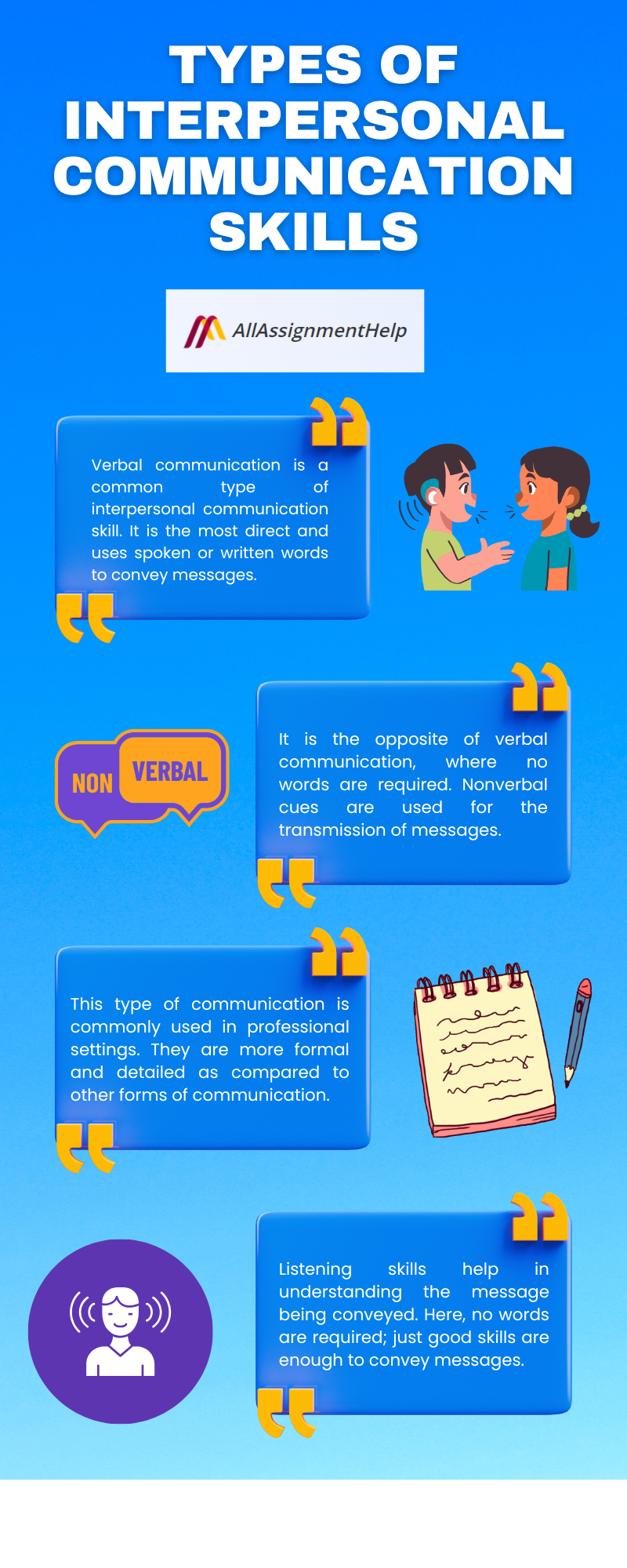
Verbal communication is a common type of interpersonal communication skill. It is the most direct and uses spoken or written words to convey messages. If you want to effectively communicate your message, you must know how to choose the right words. For example, let’s suppose you need help with assignment from your teacher. You need to use the right words to make yourself appealing. Do not sound aggressive as you are asking for assistance.
Moreover, in addition to words, tone of voice and the clarity of our speech also matter. You need to adjust your pitch and keep your motive clear and concise. Pacing and the ability to adapt language are also important.
Non-verbal
Nonverbal communication is the other type of interpersonal communication. It is the opposite of verbal communication, where no words are required. Nonverbal cues are used for the transmission of messages.
Here are the common types of nonverbal communication and examples.
- Body language
- Facial expression
- Posture
- Gestures
- Eye contact
- Personal space
Nonverbal communication is very easy and useful. It can transmit messages even when the physical distance is large. One can easily interpret accurate information without the use of words.
Written
Here, communication is made with the help of words. This type of communication is commonly used in professional settings. They are more formal and detailed as compared to other forms of communication. Here are some examples of it.
- Emails
- Text messages
- Letters
- Reports
Listening
Listening skills help in understanding the message being conveyed. Here, no words are required; just good skills are enough to convey messages. If you pay full attention when hearing, you can easily process information and respond correctly. The three types of active listening are
- Active listening
- Reflective listening
- Empathetic listening
Good hearing skills can be highly beneficial in an academic environment. As a student, you must have the ability to thoroughly process the information. The students who are not attentive in the class often end up searching, can someone take my online class?. To avoid such a situation, make sure you pay attention to understand the speaker’s words.
Importance of Interpersonal Communication Skills
Interpersonal communication skills are important; there is no other way around. It will make every communication meaningful, whether it is personal, social, academic, or professional. It is way more than exchanging information actively; it also helps in conflict resolution.
Here are some of the reasons for the importance of interpersonal communication skills.
- Problem-Solving: People need interpersonal skills because they allow them to discuss difficulties and consider the benefits and drawbacks of many options before deciding on a final solution.
- Reliance: Interpersonal communication skills are critical for establishing workplace trust and communication. All employees, particularly business leaders, should seek to enhance their communication with their staff.
- Change Management: When it comes to change management analysis and implementation within businesses, good interpersonal communication is crucial. Effective internal communication helps employees better grasp the change, align with it, and collaborate to make the change a success.
- Maintain Relationships: Interpersonal skills are critical for establishing and maintaining meaningful personal interaction. People with strong interpersonal communication skills can thus form healthy relationships with their teammates and collaborate more effectively.
- Express Emotions: One of the top reasons for the importance of interpersonal communication skills is that they will help you truly express your emotions. You can interpret emotions and respond to others’ feelings correctly.
- Effective Management and Leadership: For an effective leader, the capacity to create interpersonal relationships, establish trust, and communicate properly is all necessary abilities. Also, whether you create a lesson plan or are communicating with anyone, interpersonal skills are necessary.
- Helps in Clear Exchange of Information: Interpersonal communication skills help in conveying and receiving messages accurately. Without it, it would be difficult to convey casual information. Conveying in a professional setting can be even more confusing. You will know where to use the right words and avoid any kind of miscommunication.
- Resolve Conflicts: Conflicts are natural in professional settings. However, not everyone is capable of solving conflicts. With good interpersonal communication skills, one will know how to stay calm and resolve conflicts amicably.
- Support Teamwork: This can support teamwork. One can effectively communicate with their teams and support each other’s learning. This will automatically result in leading to better outcomes.
- Become Confident: Mastering interpersonal communication skills will make an individual confident. They can interact confidently and make themselves feel confident.
How to Improve Your Interpersonal Communication Skills?
Knowledge of interpersonal communication skills is essential. Whether you are a student or an employee, you need to develop your communication skills. Good knowledge of communication will increase your chances of success.
The best thing is that we all have basic interpersonal communication skills. However, this might not be enough. You need to improve it to meet the requirements of the workplace.
Improve Vocabulary
To effectively communicate, you need to know how to use the right words in the right place. For this, a good knowledge of vocabulary is essential. Improve your vocabulary to make your message clearer and more compelling.
There are many ways to improve your vocabulary. One of the most effective ways is to read books and articles. Moreover, learn to practice structuring to express yourself effectively.
Enroll in Interpersonal Skills Training Courses
One of the best ways to improve your interpersonal communication skills is to enroll in an online course. Now, you can enroll in various online courses provided by renowned universities and online educational platforms to boost your interpersonal communication skills at the workplace or with others. To know more about the best online interpersonal communication skills to improve, refer to the information given below.
Here is the interpersonal communication that one should improve. This will improve the chance of collaboration and help you perform better as a team.
- Active listening
- Effective communication
- Emotional Intelligence
- Successful negotiations
- Handling objections
- How to be a team player
- How to build trust
- Conflict resolution
- Conversation strategies
- How to grow your self-confidence
- Operating with empathy
Best Online Courses to Improve Your Interpersonal Communication
- Developing Interpersonal Communication Skills for Work
- Communication in Project Management
- Hazard Communication (for Healthcare)
- Empowered Pathways: Navigating Gender and Women’s Leadership
- Improving Your Active Listening Skills
- Effective Communication in Customer Service
- Emotional Intelligence: Cultivating Immensely Human Interactions
- Emotional and Social Intelligence
- MichiganX: Successful Negotiation: Essential Strategies and Skills
- Handling Objections with Emotional Intelligence
- Emotional Intelligence at Work (for Manufacturing)
- The Leap From No to Yes – Customer Objections
- Negotiation Fundamentals
- Dealing with Office Politics
- Introduction to Interpersonal Skills
- Embracing Teamwork
- How to Develop Strong Working Relationships.
- Introduction to Uncovering Value
- Building Team Cohesion
- Build Trust and Grow Your Self-Confidence
- Operating with Empathy
Observe Others
Nothing could be easier than this. Yes, one can develop their interpersonal skills by observing others. If you see someone effectively communicate, make sure you observe them.
- See how they start a conversation.
- Pay attention to their tone of voice and choice of words.
- Identify how they structure their thoughts.
Frequently Asked Questions
Question 1: What is interpersonal communication skills?
Answer: The exchange of information between people is known as interpersonal communication. Thoughts, ideas, feelings, and other types of data are all examples of information.
Question 2: What are the types of interpersonal communication?
Answer: Verbal, nonverbal, written, and listening are the four types of it.
Question 3: What are interpersonal communication skills examples?
Answer: Active listening, patience, responsibility, and conflict resolution are some of the interpersonal communication skills examples.
Question 4: What are the most powerful interpersonal connection skills?
Answer: Negotiation, decision-making, problem-solving, and communication are some of the powerful communication skills to develop.
Connect the explanation to the work your course actually requires
Use this guide beside the exact brief, course material and marking criteria for Online Courses to Improve Your Interpersonal Communication Skills.
- Name the course and current module.
- Include the platform instructions.
- Follow the instructor's method.
- Use the exact local deadline and time zone.
David Soler
Psychology
If your own brief is related to “All You Need to Know About Developing Interpersonal Communication Skills”, you can review David Soler’s established Psychology profile before requesting a match.
David’s published background covers university teaching and several clinical, social and experimental branches of psychology. PhD in Psychology
View established tutor profile ↗Relevant subject areas
- Social Psychology
- Clinical Child Psychology
- Clinical Health Psychology
- Experimental Psychology
- Addiction Psychology
Find another explanation across the complete blog
This search uses WordPress itself, so it can reach articles beyond the 20 shown on the dashboard.
Connect Online Courses to Improve Your Interpersonal Communication Skills to the task in front of you
Keep the brief, marking criteria, required evidence and submission format visible while you work.